
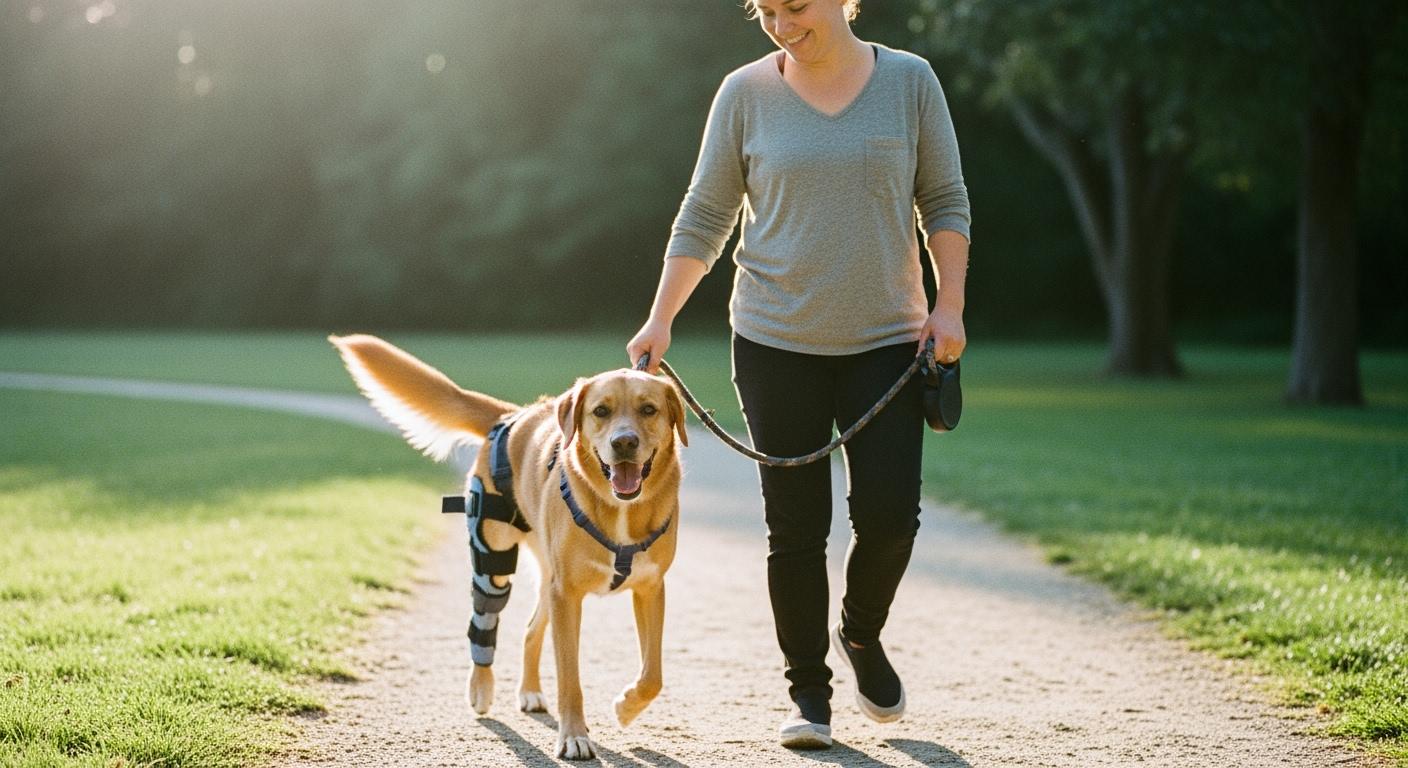
A hip brace goes on snug. The dog takes five steps. The brace has already drifted back an inch.
That is the gap between how a brace looks at rest and how it holds under motion. For arthritic dogs — whose hip joints already ache on every stride — a brace that slides, twists, or pulls into the groin does not just fail to help. It makes the dog less willing to walk than before. And a dog that stops moving loses the one thing arthritis management depends on: regular, low-impact motion through the joint.
What separates a brace that stays put from one that does not is not marketing language. It is strap geometry, anchor point placement, and how load travels from the pelvis through the thigh straps during a stride. The structural decisions that keep a hip brace stable are visible in the first ten minutes of supervised wear — if you know what to look for.
Why Hip Braces Slide Backward and Rub the Groin
Two failures dominate real-world use: backward drift and groin rub. They share a root cause but show up differently.
Backward drift starts with anchoring. A hip brace wraps the pelvis and runs straps around each thigh. When the dog strides forward, the thigh moves through an arc. That arc pulls on the strap. If the strap’s anchor point on the pelvic wrap sits too far forward or the strap path has no mechanical resistance to rearward pull, the entire brace walks itself backward — one stride at a time. No amount of tightening fixes this. The geometry is wrong.
Here is the causal chain: thigh moves forward under the body → strap tension vectors point rearward and slightly inward → the pelvic wrap receives a diagonal rearward force with no counter-anchor → the wrap shifts back → the brace loses coverage over the hip joint → support collapses. A harness anchor that connects the brace to a chest strap adds a forward counter-force that resists this drift at the source. Without it, the brace is just fabric waiting for motion to defeat it.
The observable check is straightforward. Mark the brace position against the dog’s hip bone with a piece of tape before a 10-minute walk. After the walk, measure the gap. More than half an inch of rearward travel means the anchoring geometry cannot hold under stride — regardless of how tight the straps feel at rest.
Groin rub has a different mechanism but the same origin: force concentration. A narrow thigh strap — say, half an inch wide — carries the full stride load across a thin line of contact. That line sits at the groin fold, where skin is thin and leg motion constantly flexes the area. The strap edge rolls inward under tension. Instead of a flat band distributing pressure, the dog gets a rolling cord cutting into soft tissue. Redness appears within one session. After three or four sessions, the dog flinches when the strap is fastened.
Wide straps with soft edge binding flatten this load path. A two-inch strap spreads the same force across four times the surface area. Edge binding prevents the roll that turns a strap into a cord. Evaluating strap width and edge finish before first use catches this failure before skin damage starts.
| Real-use problem | Why it happens | Better structure | When to stop using the brace |
|---|---|---|---|
| Brace slides backward | Strap geometry lacks forward counter-anchor; rearward stride force unopposed | Harness anchoring to chest strap, non-slip inner panels | Brace shifts more than half an inch during a 10-minute walk |
| Thigh straps rub the groin | Narrow straps concentrate load on a thin contact line; edge rolls inward under tension | Wide straps with soft edge binding, placed to avoid the groin fold | Skin becomes red, hot, or the dog flinches during strap fastening |
| Soft wrap bunches at hip | Weak material with insufficient pelvic coverage cannot maintain shape under motion | Wide pelvic wrap with structural stitching that resists deformation | Fabric bunches into ridges or the dog’s gait changes visibly |
| Dog refuses to walk | Combined pressure points, poor fit, or instability trigger avoidance | Stable anchoring, graduated strap tension, breathable padding | Refusal repeats across multiple sessions despite fit adjustments |
| Skin becomes red, hot, or irritated | Trapped moisture under non-breathable padding combined with friction | Open-cell foam or mesh padding, moisture-wicking inner liner | Irritation persists or worsens after brace removal and skin rest |
The Material Difference: Why Neoprene Causes Problems Over Time
Neoprene shows up in many braces because it feels soft, stretches, and costs little to manufacture. Those are short-term virtues. Under daily wear, neoprene traps body heat and moisture against the skin. After 20 minutes of walking, the inner lining is damp. Damp skin under friction breaks down faster than dry skin. For a senior dog with thin, aging skin, that breakdown happens in days — not weeks.
Flip the brace lining after a 20-minute walk and press a dry paper towel against it. Wet spots on the towel mean moisture is not escaping. That trapped moisture is the precursor to every hot spot and skin irritation that follows.
Open-cell foam and mesh liners allow air exchange. They dry faster between sessions and keep the skin barrier intact during wear. Hip brace designs that use breathable padding instead of sealed neoprene reduce the moisture-friction cycle that drives most skin complaints.
When a Hip Brace Is the Wrong Tool
A hip brace supports walking. It does not lift. That distinction matters more than most product pages admit.
Dogs who cannot stand on their own, cannot bear weight through the hind legs, or need help getting up from the floor are outside the design scope of a hip support brace. Using a brace in these conditions creates two problems: the brace slides because there is no active stride to tension the straps into position, and the owner instinctively grabs the brace itself to lift — transferring body weight through a structure built for compression support, not suspension.
Disclaimer: The fit checks and wear observations described here assume a dog that can stand and walk short distances independently. For dogs with neurological conditions affecting hind-leg proprioception — including degenerative myelopathy or advanced IVDD with nerve involvement — a hip brace does not address the underlying control deficit. These dogs typically need a lift harness or mobility cart rather than joint support.
Brace refusal is another boundary. If a dog consistently freezes, chews at the brace, or refuses to take more than a few steps after three separate supervised trials with fit adjustments in between, the brace is not the right tool for that dog at that time. Pushing through refusal tends to create a conditioned avoidance that transfers to other handling — harnesses, leashes, vet exams.
Worsening pain signals the same conclusion from a different direction. If the dog was walking 10-minute routes before the brace and now limps, stiffens, or stops mid-walk after the brace goes on, the brace may be altering gait in a way that loads the joint differently — and worse. Knowing when a lift harness or mobility aid replaces a hip brace prevents the common error of treating a structural support as an all-purpose solution.
Disclaimer: Short-coated breeds make skin redness easy to spot. Double-coated breeds — Huskies, German Shepherds, Golden Retrievers — hide early irritation under fur. For these dogs, hand-check the groin and inner thigh by feel after every session rather than relying on visual inspection alone. What looks fine from above may already be warm and tender to the touch.
Fit Checks That Reveal Whether the Brace Works
Fit is not a size on a chart. It is behavior under load. Three checks separate a brace that will hold up from one that will not.
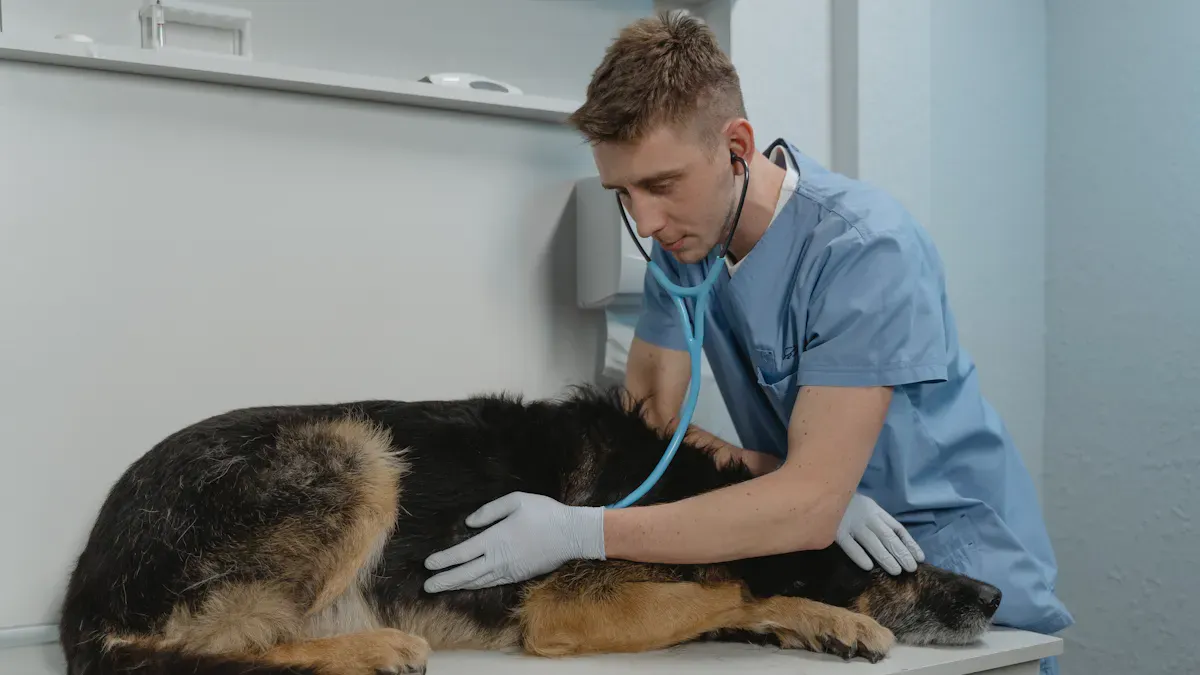
The 15-to-30-minute supervised wear. Put the brace on. Walk the dog on a flat surface — no stairs, no hills, no off-leash. Watch for drift, twist, bunching, or gait changes. A brace that cannot survive 15 minutes of flat walking will not survive a real day. Remove it. Check the skin. If the brace stayed in place, the gait looked normal, and the skin is clear — proceed. If any of the three failed, adjust and retest or stop.
The one-finger strap check. Slide one finger flat under each thigh strap after the walk — not before, because straps settle under motion. The finger should fit without forcing. If the strap is tighter than it was at rest, the strap path is pulling under load. That pull concentrates force somewhere. Find where.
The skin check, every session, twice daily. Redness at pressure points, warmth at the groin fold, or any blister-like raised area means the brace is concentrating force or trapping moisture. A systematic daily fit and wear check routine catches these signals before the dog has to communicate discomfort by refusing to move.
The Short Flat Walk Progression
Start with 5-minute walks, three times a day, on flat ground only. Watch for the brace position after each walk. If it has not shifted after two to three weeks at this duration, increase to 10-15 minutes. The full progression typically spans a month before the dog reaches 20-minute walks, and two months before 30-minute sessions are reasonable — assuming the brace passes every interim skin and position check.
This graduated schedule is not caution for caution’s sake. Each increase in duration adds cumulative friction cycles to the skin and cumulative drift forces to the strap geometry. Jumping from 5 minutes to 20 in the first week hides failures that would have appeared at 12 minutes — and by the time they show, the skin is already damaged.
| Wear Phase | Walk Duration | Frequency | Pass Condition Before Advancing |
|---|---|---|---|
| Initial (week 1-2) | 5 minutes | 3 times daily | Zero brace shift, skin clear after each session |
| Build (week 2-4) | 10-15 minutes | 2-3 times daily | Brace stays within half-inch of start position |
| Established (month 2) | 15-20 minutes | 2 times daily | No adjustment needed between walks |
| Maintenance (month 3+) | Up to 30 minutes | 1-2 times daily | Skin and gait remain normal throughout |
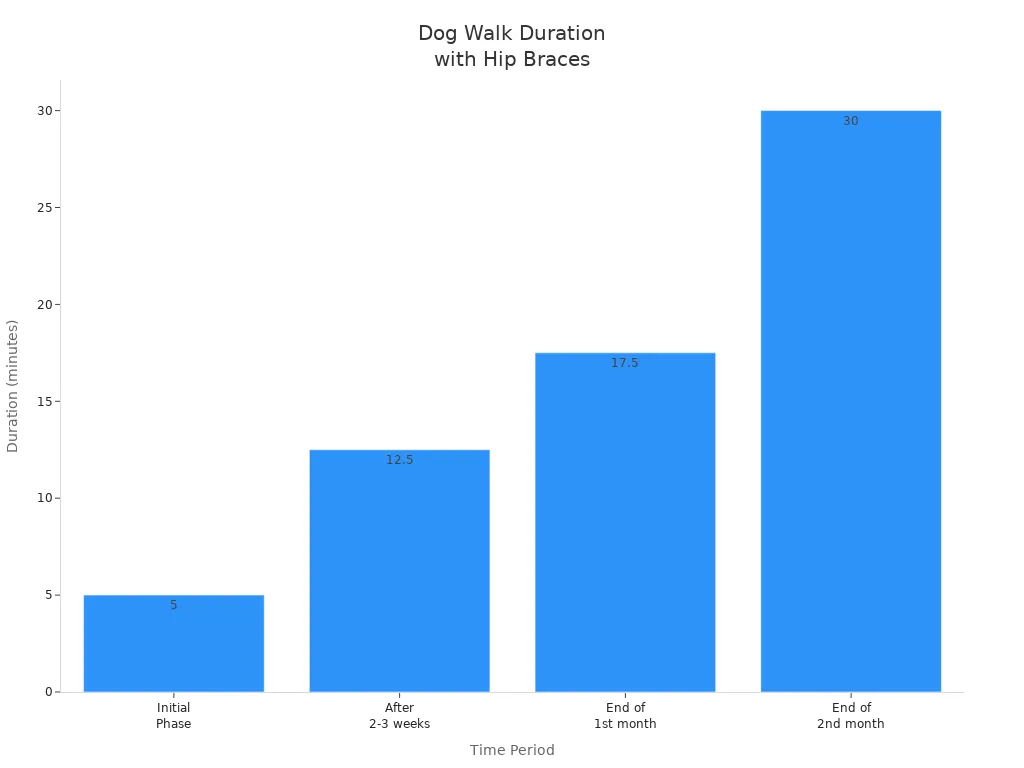
What the progression reveals is whether the brace’s structural choices — strap geometry, anchor placement, padding material, edge binding — hold up as wear time and friction cycles accumulate. The first week wear plan exposes anchoring and skin tolerance issues that a quick try-on in the living room never will.
Häufig gestellte Fragen
Why does the brace slide backward even when straps feel tight at rest?
Tightness at rest has almost no relationship to stability under motion. When the dog strides, the thigh pulls forward and the strap transmits a rearward vector to the pelvic wrap. If the wrap has no harness anchor providing counter-force, it drifts. Tightening the straps further does not change the vector — it only increases pressure on the skin while the brace still slides.
How quickly should skin irritation appear if the brace fits poorly?
With narrow straps or non-breathable padding, redness often appears within the first 15-minute session. Check the groin fold and inner thigh immediately after removing the brace. If the skin is warmer than surrounding areas or shows any pinkness, the fit or material choice needs adjustment before the next session.
Can a hip brace replace a lift harness for a dog that struggles to stand?
No. A hip brace is designed to stabilize during active walking — the dog’s own stride tensions the straps into their working position. A dog that cannot stand or bear weight cannot generate that tension. A lift harness or rear support sling is the appropriate tool for assisted standing, stair climbing, or vehicle transfers.
