
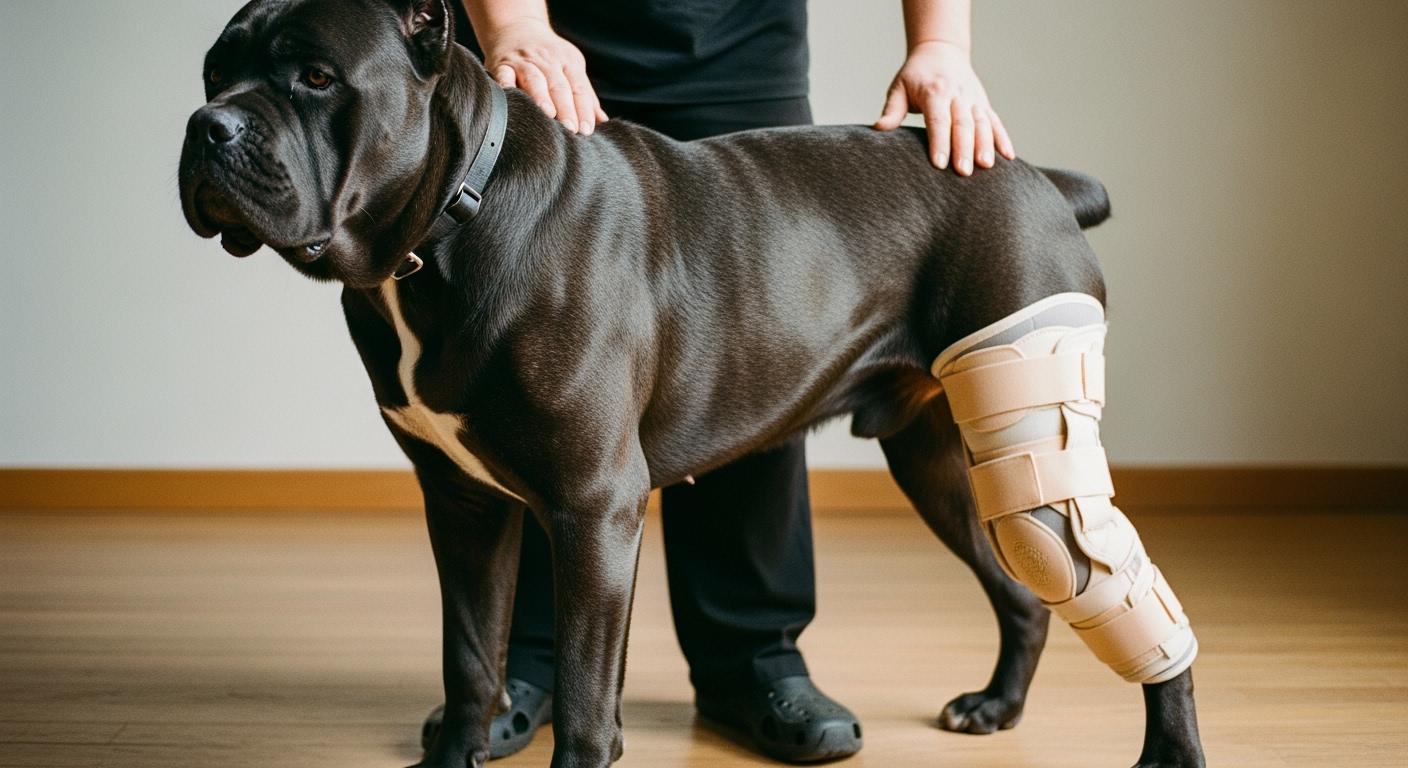
A dog stands square on the exam table. The thigh measurement matches the size chart. The brace goes on. Ten minutes later it has migrated an inch toward the hock. This is not a measuring error. It is a geometry problem that no single circumference number captures.
The upper strap encircles a thick, muscular thigh and holds firm. The lower shell wraps a much narrower section of leg — less surface area for the shell to press against. Each step pushes the brace a fraction of a millimeter downward. Forty strides. The hinge drifts below the knee joint center. Support drops to near zero. The dog compensates with an uneven gait, and soft tissue under the migrated strap begins to break down under concentrated pressure.
This sequence — anchor, migrate, lose support, compensate, break skin — repeats across braces that are otherwise well-built. The failure is not in the stitching or the materials. It is in the mismatch between a straight-cut brace interior and a tapered canine leg. Knee braces that slip and rotate on luxating patella cases often trace back to this same root cause: the size chart says it fits, but the leg cross-section changes too sharply over too short a distance for a single-shell design to track.
Why a Knee Brace Slides Down Even When the Size Chart Says It Fits
The size chart typically asks for one number: thigh circumference at the widest point. A Labrador with a 48 cm thigh can have a lower leg measuring 28 cm just above the hock. Both numbers are valid for different brace sizes. Neither captures the rate of taper between them.
A brace interior is cut to a roughly cylindrical shape. The padding compresses to accommodate some taper, but compression has limits. When the taper is steep — a circumference drop of more than 30 to 40 percent over the length of the brace shell — the lower portion contacts the leg across a band too narrow to resist the downward force of each stride.
Here is the mechanical sequence. As the dog loads the stance phase, ground reaction force travels up through the tibia. The brace shell receives a fraction of that upward impulse. If the lower shell has enough contact area, friction between padding and coat resists the impulse. If the contact area is too small, friction fails. The shell translates downward by a fraction of a millimeter. Over dozens of strides, that fraction accumulates. The hinge center — originally aligned with the knee joint axis — sits below it now. Because the hinge is no longer co-axial with the joint it is meant to stabilize, force that should route through the brace enters the joint at an angle, compressing one side of the capsule more than the other.
You can verify this yourself. After a 15-minute supervised walk, place two fingers on either side of the knee joint. Find the hinge center on the brace. If it has drifted more than a finger’s width below the joint line, the lower anchor is failing — regardless of how secure the straps feel at a standstill.
Structural Details That Make or Break Stability on Tapered Legs
Two braces can use similar materials and measure identically on the chart, yet one stays put through a walk while the other migrates within minutes. The difference comes down to four structural details that interact with leg geometry under dynamic load.
Upper Anchoring: Why a Single Strap Creates a Pivot Point
A single wide strap with one Velcro closure seems simpler. On a tapered thigh, that single strap becomes a fulcrum. When the dog flexes the stifle, the quadriceps changes shape — bulging under part of the strap, flattening under another. A single-closure strap grips unevenly: tightest at the closure edge, looser opposite. The brace rocks around this uneven hold, and each rocking cycle pumps the lower shell farther down the leg.
A double-locking system with two independent closure zones distributes grip tension across a wider arc of the thigh. The strap conforms to the muscle through the gait cycle instead of fighting it. The difference is visible after removal: a single strap tends to leave one pronounced red band at the closure point. A double-locking strap leaves two fainter marks spread across more surface area. The wider the pressure distribution, the less any single patch of skin takes the full load. Hind leg knee pads with contoured inner geometry extend this principle further — padding shaped to match the tibial crest fills the void between a straight shell wall and curved bone, increasing effective contact area without increasing strap tension.
Lower-Leg Control: Contact Area Over Surface Coatings
Silicone strips and textured inner liners appear in product descriptions as anti-slip features. Surface texture alone does not stop migration on a steeply tapered leg. What keeps the lower shell from drifting is total contact area against the leg and how closely the shell contour matches the leg cross-section at that height.
A narrow lower leg provides limited surface for the shell to press against. If the shell is cut too short vertically, there is not enough contact area. If it extends past the hock to gain more surface, it interferes with hock flexion and creates a new failure mode. The shell needs enough vertical reach to spread the downward force without crossing the joint line below. Knee brace types handle this tradeoff differently — some prioritize coverage, others prioritize joint clearance. The right choice depends on how much taper the specific leg has.
Here is an observable check. After 10 minutes of walking, note where the lower edge of the brace shell sits relative to the hock. Walk the dog another 10 minutes. If the lower edge has moved visibly closer to the hock, the shell is migrating. A brace structurally suited to the leg should show no measurable shift in lower-shell position between these two checks.
Strap Configuration: Multi-Point Tension vs. Single-Band Pressure
Three narrow straps spaced along the brace spread anchoring force across three zones of the leg. One wide strap concentrates the same total force into a single band. The difference shows up in skin marks after removal.
Three evenly fading marks at different heights signal distributed load. One deep red band that does not fade within 20 minutes signals concentrated pressure — and that is where breakdown begins. The worst configuration is a single tight upper strap with a loose lower strap: the brace pivots around the tight band, the lower shell lifts away from the leg on each stride, and when it slaps back against the skin it creates a friction cycle that no padding can absorb indefinitely. Fit and slippage failures in luxating patella knee braces often trace back to this top-tight, bottom-loose imbalance — the brace stays on the dog but stops supporting the knee.
Hinge Alignment: Why a Small Offset Destroys Support
A hinge that sits even slightly off the joint center introduces an off-axis force vector. Instead of rotating cleanly with the joint, it pushes the joint sideways through each flexion cycle. The dog feels resistance. The response is a shortened stride or a subtle hip hike on the braced side.
Over hours of wear, that off-axis input irritates the joint capsule. The dog begins to avoid loading the leg fully. Gait worsens. This is why a brace that almost fits can produce a worse walk than no brace at all — the joint fights both its original instability and the brace geometry.
Observe this during use. On a flat surface, watch the dog’s hips from behind during a slow walk. If the hip on the braced side rises noticeably higher with each step compared to the unbraced side, the hinge is out of alignment. The dog is compensating vertically to clear a limb that is not tracking straight.
When a Knee Brace Is the Wrong Tool
A knee brace addresses instability originating at the stifle. It does not correct a gait problem that starts at the hip, the hock, or the paw. If the primary issue is hip dysplasia altering hind-limb mechanics, bracing the knee alone redirects load without addressing the source. The knee becomes a stress concentrator for forces the hip cannot manage. Knee brace solutions for stability and recovery work within a specific mechanical scope. Recognizing when the problem falls outside that scope is as important as selecting the right structure for the right joint.
Leg shapes at the extremes create anchoring challenges that no off-the-shelf brace geometry solves reliably. A leg with virtually no taper — thigh and lower leg nearly equal in circumference — needs an entirely different retention strategy than the taper-grip approach described here. Angular limb deformities that twist the leg axis out of the sagittal plane introduce rotational forces the brace was never designed to counteract. The brace may appear to fit at a standstill and fail the moment the dog moves.
Disclaimer: The fit checks described here assume a short-coated dog where strap position and skin condition are visible at a glance. Double-coated breeds may show subtler rub marks that need hand-checking — run fingers against the grain of the fur along each strap line after removal, feeling for warmth or tenderness rather than relying on visual inspection alone. If the dog’s leg conformation falls outside the breed norms this brace geometry was patterned for — particularly dogs with angular limb deformities or very deep chests — the observable verification methods described here may not catch every pressure point. A single brief wear session is not sufficient to rule out hidden friction under a heavy coat.
A knee brace tends to hold when the leg has enough taper for the upper anchor to gain purchase, enough lower-leg surface for the shell to resist downward migration, and a stifle that can be palpated clearly for hinge alignment checks. It tends to fail when any of these conditions is absent — and no amount of strap tightening fixes a fundamental geometry mismatch. Adjustable knee braces need a structured break-in period to confirm the fit holds under movement. Skipping this step turns a sizing guess into a wear failure.
| Fit Problem | Why It Happens | Product Structure That Helps | Stop-Use Signal |
|---|---|---|---|
| Brace slides toward hock | Tapered leg geometry — lower shell has insufficient contact area | Extended lower shell with contoured inner surface, above-hock termination | Lower edge migrates visibly closer to hock between checks 10 minutes apart |
| Brace twists around the leg | Single-point strap tension allows rotation under side-loading | Multi-point strap configuration, anti-rotation inner surface geometry | Hinge rotates more than 15 degrees off the sagittal plane during walking |
| Strap leaves deep red marks | Pressure concentrated at a narrow band, often at the closure edge | Wider pressure-distributing padding, double-locking closure with independent tension zones | Red marks persist longer than 20 minutes after brace removal |
| Lower strap requires overtightening every session | Narrow lower leg provides too little friction surface for passive retention | Extended lower shell reach, contour-matched inner geometry, secondary retention above hock | Overtightening needed every session to prevent migration |
| Dog walks worse with the brace on | Hinge misalignment introduces off-axis force into the joint | Anatomically contoured hinge placement, multi-point adjustment for alignment fine-tuning | Gait visibly worsens compared to unbraced walking within the same session |
| Skin redness or heat persists | Friction and trapped moisture exceed skin tolerance | Breathable padding with moisture-wicking inner layer, ventilated shell design | Redness, swelling, or heat detectable 30 minutes after removal |
Material Choice: What Changes Under Repeated Load
Fabric and plastic serve different structural roles, and the tradeoffs become visible after repeated wear cycles rather than on first fitting.
| Material | How It Behaves Under Repeated Load | Where It Tends to Fail |
|---|---|---|
| Fabric shell with internal stiffeners | Conforms to leg contour over multiple wear sessions; flex allows some shape adaptation | Stiffener pockets may shift position after repeated washing; fabric absorbs moisture and holds it against skin longer |
| Rigid plastic shell | Maintains consistent geometry session to session; does not absorb moisture; easier to clean and dry | Cannot adapt to leg shape changes over time; pressure points that exist on day one remain unless padding is repositioned |
The structural demand on the material depends on how much the leg shape changes during the gait cycle. A thigh muscle that expands and contracts significantly with each step puts more demand on material flexibility. A leg with less muscle excursion tolerates a rigid shell more easily. The same brace model performs differently on two dogs with identical measurements but different muscle mass distribution.
Edge Finishing and Padding Under Repeated Wear
Strap edges and shell rims that feel smooth to a human finger can still abrade canine skin after an hour of movement. The friction mechanism is different: a static finger test detects roughness, while the dog generates shear forces between brace interior and coat with every stride.
Rolled or beveled strap edges reduce the shear concentration at the transition between padded and unpadded zones. Padding that extends past the rigid shell edge prevents the hard rim from contacting skin when the brace shifts under load. These are not comfort features — they are structural choices that determine whether the brace can be worn long enough to do its job before skin tolerance runs out.
Häufig gestellte Fragen
How do you measure a dog with tapered legs for a knee brace?
Take two measurements with the dog standing and weight-bearing. First, thigh circumference at the widest point. Second, lower leg circumference just above the hock. The ratio matters more than either number alone — a difference larger than roughly 30 to 40 percent between thigh and lower-leg circumference signals a steep taper that demands strong lower-leg anchoring. Use a cloth tape, not a stiff ruler or a piece of string measured against a ruler afterward. String stretches, rulers do not follow leg contour, and both introduce errors that compound on tapered legs where the margin between sizes is already narrow.
Can a dog wear a knee brace all day?
No. The limiting factor is skin tolerance, not structural durability. Even a well-fitted brace traps moisture and heat against the skin. Start with 15 to 30 minutes of supervised wear. Remove the brace, inspect for marks that last longer than 20 minutes, and extend wear time only if skin remains clear. Most dogs top out at a few hours of continuous wear before skin needs a break. The brace structure may survive all-day wear. The skin underneath will not — and once skin breaks down, the dog will refuse the brace regardless of structural fit.
What signs show the brace fit is failing during use?
The brace drifts more than half an inch from its starting position during a single walk session. Red marks do not fade within 20 minutes of removal. The dog’s gait worsens with the brace on compared to off — particularly if a subtle limp becomes pronounced or the dog begins to hop on the unbraced leg. The dog chews at the brace, freezes mid-stride, or refuses to stand. Any one of these is a stop-use signal, not a reason to tighten the straps harder.
How do you clean a knee brace without damaging the straps or hardware?
Hand wash with cool water and mild soap. If the brace has metal hinge components, do not submerge it — spot-clean the padding and wipe down the outer shell. Air dry away from any direct heat source. Heat from a dryer, radiator, or direct sunlight degrades neoprene foam, weakens the adhesive layers bonding padding to shell, and softens the backing adhesive on Velcro hook surfaces. When that backing adhesive fails, the hook panel lifts at the edges and loses grip — and the strap that was structural becomes decorative. Heat exposure is the fastest way to turn a functional brace into fabric with loose straps.
Why does the brace feel secure at a standstill but migrates during walking?
Static fit and dynamic fit are different conditions. At a standstill, strap tension holds the brace against the leg, and friction between padding and coat is sufficient because no external force is trying to shift the brace. The moment the dog walks, ground reaction force travels up through the limb with each stride. That upward impulse acts on the brace shell. If the lower portion has insufficient contact area — common on tapered legs — static friction is overwhelmed by dynamic load, and the brace migrates. This is exactly why a 15-to-30-minute walking check matters: a brace that passes a standing fit test can still fail the first time the dog moves at a normal pace.
