
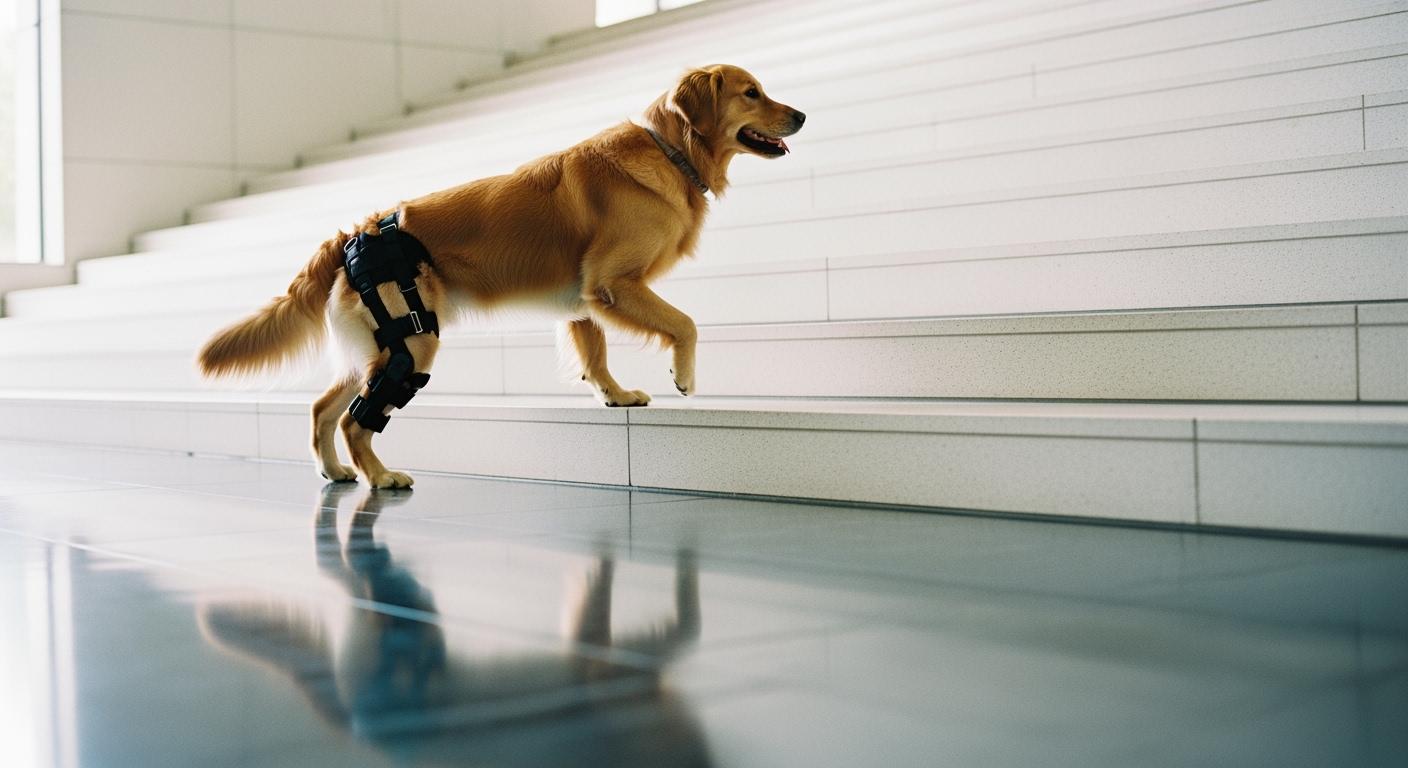
A stifle brace can look nearly perfect in a standing photo. Straps lie flat. The hinge sits centered over the knee. Nothing gaps, nothing pinches. Then the dog sits down. Within two seconds the lower strap has ridden up half an inch, the hinge has drifted forward of the joint line, and the upper anchor is tugging at a patch of fur it was not touching a moment ago. That is the gap between a standing fit and a moving fit. And it is where most stifle braces fail.
A brace that drifts during everyday movement does not just lose support. It redirects force into places the joint was never meant to absorb it. A dog that was loading the leg evenly at the start of a walk may be weight-shifting to the other side within ten minutes, not because the knee hurts more, but because the brace itself has become the source of discomfort. The daily wear schedule that works for one stifle brace design may fail entirely for another if the anchoring system cannot hold position through a full range of motion.
When a Stifle Brace Passes a Standing Check but Fails the First Sit
Standing fit is a snapshot. The thigh is extended, the quadriceps and hamstrings are relaxed, the stifle angle hovers around 130 degrees on most dogs. Everything the brace needs to do — resist tibial translation, limit hyperextension, control rotation — happens at other angles, under load, with muscle bellies changing shape under the straps.
During a sit, the stifle closes to roughly 45 degrees. The distance between the upper anchor point and the lower anchor point shortens. The muscle contour under the thigh strap changes as the quadriceps lengthen and the hamstrings contract. If the strap material cannot distribute this compression evenly across its full width, tension concentrates at one edge. That edge rolls. Once a strap edge rolls, it acts like a wedge — narrow contact area, high local pressure, no resistance to further rotation.
Here is the chain. A strap edge rolls under lateral force. The rolled edge reduces the effective width of the anchor from, say, 1.5 inches down to a fraction of that. The narrowed contact patch cannot resist torque. The brace rotates around the leg. The hinge, now tracking a line that is no longer the joint axis, inputs force off-angle into the femoral condyles. One side of the joint surface takes more load than the other with every step. The soft tissue on the overloaded side breaks down — first redness under the hinge edge, then hair loss, eventually an abrasion that makes the dog hesitate to bend the knee. Hesitation to bend becomes a shortened stride. A shortened stride shifts more weight to the sound leg. Within days, the brace is doing the opposite of what it was put on to do.
In practice: After 10 minutes of walking that includes three full sit-stand cycles, remove the brace and check whether any strap has drifted more than half an inch from its original position. A strap that holds steady means the anchor is distributing tension across its full width rather than concentrating it at one edge.
A knee brace designed to keep the stifle stable during daily movement depends on anchors that do not narrow under load. Width alone is not the answer. A straight-cut strap on a tapered thigh leaves gaps at the top and bottom edges where no contact occurs. The load concentrates in the middle band where fabric actually meets skin. A contoured upper anchor that follows the thigh’s natural taper eliminates those gaps, so tension spreads evenly across the entire strap.
| Movement test | Pass signal | Fail signal | Product detail to check |
|---|---|---|---|
| Sit-to-stand | Brace stays aligned, knee bends smoothly | Brace blocks knee bend, twists, or slides down thigh | Hinge position, strap tension balance |
| Slow turn | Brace follows leg without rotating | Hinge shifts, brace rotates around knee | Hinge alignment, upper anchor stability |
| Short stair or threshold | Normal rear-leg rhythm, even paw placement | Dog skips the leg, drags brace, or bunny-hops | Upper anchor contour, strap layout |
| Slick floor | Brace stays stable when traction is controlled | Foot slips, brace rotates, dog loads opposite leg | Padding grip surface, overall brace stability |
| Skin check after removal | No redness, any strap marks fade within 15–30 minutes | Persistent redness, swelling, or marks that do not fade | Padding material, edge finish, pressure distribution |
Why Thigh Anchoring and Hinge Alignment Decide Whether the Brace Holds
Two structural decisions drive most stifle brace failures. Neither is visible in product photos. Both show up within the first few minutes of real movement.
The Upper Anchor Is the Load Path
When a dog walks, ground reaction force travels up through the tibia and into the stifle joint. The brace resists anterior tibial translation by transferring that force into the thigh. The upper anchor is the entire load path. A narrow anchor concentrates every pound of that force into a band of fabric with negligible surface area. Under lateral force from turning, that narrow band has no anti-rotation surface — it catches, rolls, and the brace shifts.
The strap width a dog needs is not about comfort. It is about whether the anchor has enough contact area to resist torque without rolling. A stifle brace guide focused on daily use typically flags anchor stability as the first thing to check, because no amount of lower-strap tightening can compensate for an upper anchor that walks.
The Hinge-Axis Problem
The stifle is not a simple hinge. As the knee flexes, the instantaneous center of rotation migrates slightly because the femoral condyles have a cam-like profile. A single-pivot hinge approximates this motion well enough for support, but only if it is placed within a narrow tolerance of the true joint axis.
When the hinge sits even a quarter-inch above or below the stifle axis, each flexion cycle forces the brace to fight the joint’s natural path. The dog responds by reducing range of motion — shallower knee bends, shorter steps, a stiffer gait overall. What begins as a mechanical mismatch becomes a movement pattern that can persist even after the brace is removed.
A CCL brace with a hinge matched to the stifle axis controls translation without fighting flexion. The difference is not always visible in a product photo — but it is measurable in how the dog loads the leg after ten minutes of walking.
In practice: Watch the dog walk toward you on a flat surface for 20–30 strides. If the hip on the braced side dips consistently lower than the other side with each step, or the braced leg swings outward slightly instead of tracking straight forward, the hinge may be forcing a path the joint does not want to follow.
A knee brace for a torn ACL where fit matters more than raw rigidity tends to produce better daily results than a heavier brace that fights the joint. The question is never “is this brace strong enough?” It is “does this brace follow the knee or does the knee have to follow the brace?”
| Product feature | Performance difference | Main limitation |
|---|---|---|
| Upper thigh anchor | Contoured anchors maintain tension distribution across sit-stand cycles; straight-cut straps narrow under load | Contouring must match the individual dog’s thigh taper — a contour cut for a Greyhound will gap on a Bulldog |
| Hinge alignment | Hinges placed within a narrow band of the stifle axis allow near-natural flexion; off-axis hinges force compensatory gait changes | Single-pivot hinges approximate but cannot fully replicate the stifle’s migrating center of rotation |
| Strap layout | Multi-point strapping with independent tension per strap prevents differential shift; single-strap systems inevitably drift | More straps mean more adjustment points to check and more edges that can roll if not finished properly |
| Padding and edge finish | Rolled or bonded edges distribute edge pressure; raw-cut edges concentrate it into a narrow line | Thicker padding adds bulk that can interfere with knee flexion in deep-chested or short-legged dogs |
| Breathability | Perforated or moisture-wicking liners reduce dampness under the brace; non-porous liners trap heat and moisture | More breathable materials tend to be less durable under repeated washing and friction from floor contact |
| Bulk around knee | Low-profile designs allow fuller flexion; thick padding or oversized hinges block the knee from closing fully | Minimum bulk trades some impact protection for range of motion — a tradeoff that matters more for active dogs |
When a Stifle Brace Is Not the Right Support
Not every knee that needs support needs a stifle brace. And not every dog that fits a stifle brace can wear one safely.
A stifle brace is designed to control specific movements: anterior tibial translation, hyperextension, and excessive rotation. If the dog’s primary problem is not at the stifle — if the instability originates at the hip or the hock — a stifle brace loads the wrong joint. The brace resists motion at the knee while force continues to transmit unchecked through the actual problem site. The dog compensates by altering gait elsewhere, and a new issue develops at a different joint.
Signs that a stifle brace may not be the right tool include the dog moving worse with the brace than without it, persistent skin breakdown at contact points despite repeated adjustments, refusal to sit or lie down while wearing the brace, and new lameness in the opposite leg or the hip on the same side.
A stifle brace with knee padding designed for hind leg support works within a defined scope. It does not repair a fully ruptured ligament. It does not replace surgical stabilization when that is indicated. It does not substitute for controlled activity restrictions.
Disclaimer: This fit-check approach assumes a short-coated dog where rub marks are visible on the skin surface. Double-coated breeds may hide early pressure points under dense undercoat — hand-checking by running fingers against the grain of the hair along strap lines tends to catch what visual inspection misses. Dogs with angular limb deformities or unusually deep chests may fall outside the conformational norms these braces are patterned for, and standard fit checks can miss pressure points that develop only after extended wear.
Häufig gestellte Fragen
How do you check whether a stifle brace actually fits during movement?
Start with a standing fit check, then walk the dog on a non-slip surface for 10 minutes. Watch one sit-to-stand, one slow turn to each side, and 1–3 slow stair steps if permitted. Remove the brace and inspect strap positions, skin condition, and hinge alignment. A strap that has migrated more than half an inch signals an anchor that is not distributing tension evenly.
What is the difference between a stifle brace and a hock brace?
A stifle brace stabilizes the knee joint — it controls tibial translation, rotation, and hyperextension at the stifle. A hock brace stabilizes the ankle joint lower on the leg. The two joints move in different planes under different loads, and a brace built for one cannot substitute for the other. Using a stifle brace on a hock problem loads the wrong joint and can create new gait compensations.
Can a stifle brace repair a torn cruciate ligament?
No. A stifle brace supports the joint by limiting the specific movements that stress a damaged or healing cruciate ligament — primarily anterior tibial translation. It does not reattach or regenerate torn tissue. The brace buys time and stability for either surgical repair to heal or for the joint to develop compensatory fibrosis in non-surgical management, but the ligament itself does not repair through bracing alone.
