
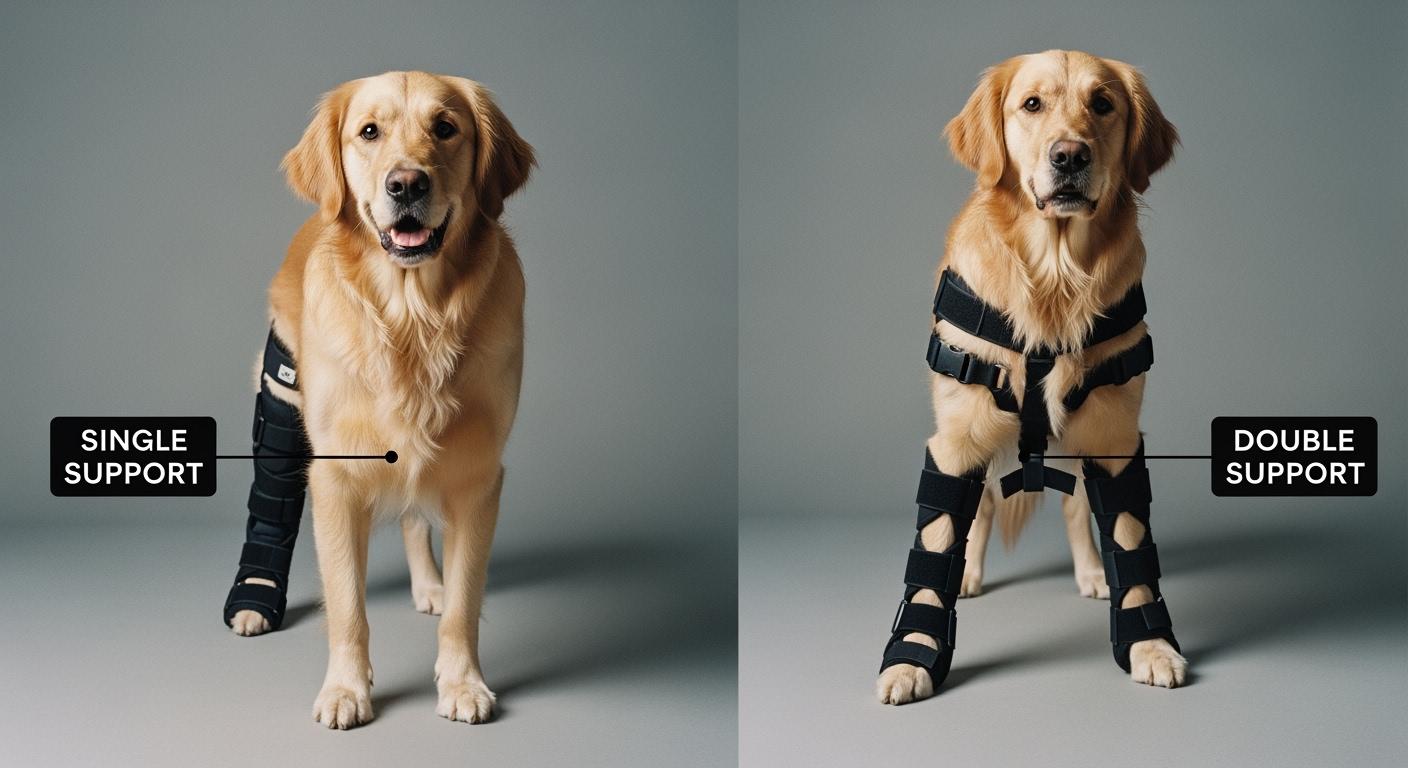
A brace for dog torn ACL single vs double support should be chosen by one practical question: does your dog need targeted support for one injured knee, or more balanced support because both knees are affected or the second leg is at clear risk. Single support and double support do not solve the same problem in the same way. If you want a broader overview of ACL brace fit, support level, and daily-use planning before comparing one-leg and two-leg options, start with this dog knee brace for ACL injury guide.
| Support Type | Usually Best For |
|---|---|
| Single Knee Brace | One injured knee, post-op support for one side, lighter unilateral instability |
| Double Knee Brace | Both knees involved, strong bilateral weakness, or clear overload risk on the opposite leg |
Before deciding, compare support type by injury distribution, balance needs, fit complexity, and daily wear tolerance instead of assuming more support is always better.
Das Wichtigste in Kürze
- Single support is usually better when one knee needs targeted bracing and the opposite leg is still functioning well.
- Double support is usually better when both knees need help or when balance and symmetry are becoming part of the recovery problem.
- The right answer depends on fit, bilateral risk, movement quality, and daily tolerance—not on “more support” alone.
What Does “Brace for Dog Torn ACL Single vs Double Support” Mean?
Buyer Intent and Search Context
When people search brace for dog torn ACL single vs double support, they usually want a practical answer to three questions: is one knee brace enough, when does the second leg need support too, and how does that choice affect balance and daily use. This is a decision page, not just a product page, so the article should help readers judge support level by injury pattern and routine demands.
Tip: Use single vs double support as a treatment-planning question, not just a product-selection question. The better choice depends on the dog’s real movement pattern and veterinary assessment.
Typical Use Cases
You usually choose single support when one knee is injured and the other side is still stable enough for normal compensation. You usually choose double support when both knees are involved, when the dog is shifting too much load to the “healthy” side, or when bilateral rear-end instability is already affecting gait and balance. For broader recovery planning before product comparison, use this dog cruciate ligament brace solution page.
- Single support: one injured knee, post-op support on one side, lighter unilateral instability
- Double support: bilateral knee problems, strong opposite-leg overload risk, greater balance instability
Picking the right support type helps the dog move more safely and makes daily wear more realistic.
Why Dogs Need Knee Braces After ACL Injury
Stability and Recovery Goals
You want your dog to move more safely after an ACL injury, and a knee brace can help by improving stability and supporting controlled movement. The main value of bracing is not to “fix” the ligament, but to reduce unstable motion, improve confidence, and make activity control more practical during recovery.
Evidence Type | Description |
|---|---|
Joint Stability | Braces make the knee more stable by stopping bad movement. This is very important for healing after an ACL injury. |
Pain Reduction | Doctors see that braces lower swelling and help dogs stand better. This means less pain for your dog. |
Preventive Strategy | Braces are used to keep the other knee safe. Many dogs hurt their other CCL later on. |
You should use a brace together with weight control, controlled exercise, and regular reassessment. If you want a stronger fit-and-use reference before choosing between one-leg and two-leg support, compare this article with the dog knee brace for CCL tear fit and traction guide.
“The best outcomes occur when bracing is combined with weight management, controlled exercise, and muscle strengthening.”
Risks Without Support
If you do not use a brace, your dog may have more pain and heal slower. Dogs with a torn ACL often limp and do not want to use the hurt leg. Without a brace, your dog could hurt the other knee too. Many dogs end up with problems in both knees. Your dog might lose muscle and have trouble doing normal things.
Reminder: A brace can support recovery and activity control, but it does not replace diagnosis, surgical decision-making, or a veterinary rehabilitation plan.
You should always talk to a vet to find out what is best for your dog. Braces can help with pain and healing, but they do not take the place of a vet’s care. Clinics and buyers use a brace for dog torn acl single vs double support as part of a bigger rehab plan. You can learn more about ACL injury help on our special solution page.
Single Knee Brace: Features and Uses
How Single Knee Braces Work
A single knee brace is usually the right choice when one rear knee needs targeted support and the opposite leg is still handling normal load reasonably well. It helps by focusing support on the injured side, improving knee stability, and making controlled movement easier during rehab or daily management.
Here is a table that lists the main features of a single knee brace for dogs with torn ACLs:
Key Feature | Description |
|---|---|
Joint Stability | Gives outside support to the joint, acting like the damaged ligament. |
Stress Reduction | Takes pressure off the hurt ligament, helping it heal. |
Support for Rehabilitation | Helps with rehab exercises, so healing is better. |
Increased Movement Confidence | Makes dogs feel safer when they move during recovery. |
Compression for Comfort | Squeezes gently, so the dog feels more comfortable. |
Maintains Activity Level | Lets dogs stay active, keeps muscles strong, and helps them get better. |
If you want a product-level example for one-side rear-leg support, review the Hind Leg Knee Brace after you finish this comparison.
When to Choose a Single Knee Brace
Choose a single knee brace when one knee is clearly the main problem and the other rear leg is still supporting balance without obvious overload. This is often the better option after surgery on one side, in unilateral ACL cases, or when the dog mainly needs targeted support rather than bilateral stabilization.
Single support is usually easier to fit and easier for daily wear because it does not interfere with the opposite leg. That can make it more practical for dogs that still walk reasonably well but need extra support on the injured side.
- Choose single support for:
- one injured knee
- post-op support on one side
- unilateral weakness with acceptable opposite-leg stability
Note: Single support works best when the second leg is still reliable enough that bracing both sides would add bulk without adding real value.
For broader comparison after this section, review the dog knee brace category.
Double Knee Brace: Features and Uses
How Double Knee Braces Work
A double knee brace supports both hind legs at the same time. This layout is usually more useful when both knees need help, when the dog is strongly overloading the opposite side, or when bilateral instability is starting to affect posture and balance. The value of double support is not just “more brace.” It is more symmetrical support.
Here is a table that shows the main features of a double knee brace for dogs with ACL injuries:
Feature | Description |
|---|---|
Bracing on Both Hind Legs | Supports both knees for balanced movement. |
Bilateral Knee Disease | Useful for dogs with injuries in both knees. |
Protecting Healthy Side | Shields the uninjured knee from extra stress. |
High-Risk Dogs | Good for breeds likely to have ACL injuries or dogs with past injuries. |
Targeted Tool | Used when your dog needs support on both sides or for prevention. |
If you want a product-level example of bilateral support, review the Hind Leg Knee Pads after you finish comparing support logic.
When to Choose a Double Knee Brace
You should consider double support when both knees show pain or weakness, when the opposite knee is already under too much strain, or when unilateral bracing no longer keeps movement balanced enough. Double support can also make sense for dogs with bilateral instability or for cases where protecting the second knee is becoming part of the treatment goal.
Choose double support if:
- both knees are affected
- the “healthy” side is already showing overload or weakness
- your dog needs more balance and symmetry than one-side support can provide
For broader ACL planning after this section, continue to the ACL recovery solution page.
Comparing Single vs Double Support Braces
Stability and Movement Control
Single support gives more targeted control to one injured knee, while double support gives more symmetrical control across both hind legs. That means the better choice depends on whether the main problem is one unstable knee or a broader balance problem affecting both sides.
Balance and Symmetry
Balance is where the difference becomes clearer. Single support usually works when the opposite leg is still managing normal compensation. Double support becomes more useful when the dog is leaning too hard into the second leg, walking asymmetrically, or showing bilateral instability.
Fit and Daily Wear
Fit and daily wear are often where single support becomes easier to manage. A one-side brace usually fits more simply and interferes less with the opposite leg. A double brace can offer better symmetry, but it also adds more coverage, more fitting complexity, and more chances for daily comfort issues if the dog does not actually need both sides braced.
| Brace Type | Main Strength | Main Tradeoff |
|---|---|---|
| Single Knee Brace | Targeted support for one injured knee with simpler daily wear | Less useful when bilateral instability is already affecting movement |
| Double Knee Brace | Better symmetry and bilateral support | More complex fit and more daily bulk |
Single knee braces help one hurt leg and do not bother the good leg.
Double knee braces are good if both knees are weak or if the healthy leg is used too much.
Think about injury distribution, opposite-leg overload, daily tolerance, and whether the dog actually benefits from bilateral support before choosing the more complex option. For a broader product view, use the dog knee brace category.
Tip: Always talk to a licensed vet before picking a brace. Only a vet can check your dog’s injury and say what is best.
Decision Factors for Buyers
Injury Assessment and Risk
You need to start with a clear injury assessment. Check which knee is injured, whether the opposite side is compensating normally, and whether both knees are already affecting balance. Dogs with a torn ACL often shift weight off the injured side, but the more important question for this article is whether that shift is becoming a second support problem.
Consider these factors when you assess injury and risk:
Type of Injury: Is the ACL tear in one knee or both?
Bilateral Risk: Does your dog have a history of knee problems or show weakness in both legs?
Dog Size and Breed: Large dogs and certain breeds face higher risks for ACL injuries.
Activity Level: Active dogs may need more support to prevent further injury.
Tip: Keep a daily log of your dog’s walking and standing. Share this with your veterinarian to help guide brace selection.
If you want a broader ACL support framework before deciding between one-side and two-side bracing, compare this section with the dog knee brace for ACL injury guide.
Custom vs Off-the-Shelf Braces
You also need to decide whether standard sizing is enough or whether the dog’s leg shape, bilateral needs, or repeated fit failure make a more individualized fit necessary. Custom options usually help most when standard braces cannot stay aligned or when one-side vs two-side support becomes too hard to manage with generic sizing.
| Brace Type | Fit Quality | Best Use Case |
|---|---|---|
| Custom | More individualized fit | Complex cases, repeated slip issues, longer-term use |
| Off-the-Shelf | Standard fit range | Simpler cases, faster selection, lighter short-term comparison |
For a stronger fit-check process before deciding between standard and more customized options, compare this section with the dog brace sizing guide.
Vet Recommendations
You should always involve a veterinarian when choosing between single and double support because the right answer depends on diagnosis, bilateral risk, activity control, and the dog’s overall recovery plan. A vet can help decide whether the opposite leg needs real support or whether one-side bracing is still the better path.
Note: Braces support recovery, but they do not replace veterinary treatment or rehabilitation planning.
For broader condition-based guidance, continue to the ACL injury solution page.
Common Comparison Mistakes
Overlooking Bilateral Risk
Most comparison mistakes happen because buyers focus only on the injured knee and ignore how the rest of the dog is moving. The biggest errors are assuming one-side support is always enough, assuming double support is always “safer,” and choosing by product complexity instead of real movement needs.
- Do not ignore overload signs in the opposite rear leg.
- Do not choose double support just because it sounds stronger.
- Do not choose single support when bilateral instability is already obvious.
- Do not judge the brace only by appearance instead of daily fit and tolerance.
Use the support level that matches the dog’s real movement problem. For broader planning, compare this article with the Dog Brace Solutions by Condition page.
If you avoid these mistakes, your dog can get the right support and heal better.
When to Seek Further Guidance
Signs More Support Is Needed
You should watch for signs that the current support level is no longer enough. Take action if you notice:
- more limping or less weight use on the injured side
- new overload signs in the opposite rear leg
- worsening balance, rising asymmetry, or repeated difficulty standing
- brace slippage, rubbing, or reduced daily tolerance
- pain when touching the knee or resistance to wearing the brace
If the dog is recovering after surgery, these changes may mean the support plan needs to be adjusted rather than simply worn longer.
Tip: Keep a short daily record of gait, opposite-leg load, and brace tolerance. That makes it much easier to tell when one support strategy has stopped working well enough.
Consulting a Professional
You should contact a veterinarian if warning signs continue or if you are unsure whether the dog needs more support, less bulk, or a different brace strategy altogether. A professional can reassess the injury, opposite-leg risk, and gait pattern before you switch from single to double support or vice versa.
You can also ask about standard vs custom fit if the dog keeps slipping out of the current setup or cannot tolerate it well enough for daily use. For broader next-step guidance, continue to the dog knee brace for CCL tear guide and the ACL injury solution page.
Remember: Early changes in support planning usually work better than waiting until the second leg becomes a bigger problem.
You get better results when you match brace for dog torn ACL single vs double support to the dog’s real injury pattern and movement needs instead of choosing by product complexity alone. Single support is usually the better fit for one clearly injured knee with acceptable opposite-leg stability. Double support is usually the better fit when both knees need help or when balance and symmetry have already become part of the problem.
For next steps, continue to the dog knee brace for ACL injury guide, the ACL injury solution page, the dog knee brace category, the Hind Leg Knee Brace, or the Hind Leg Knee Pads depending on whether you still need education, condition planning, or product comparison. Data authenticity note: This article is for educational purposes only. It is designed to help readers compare single and double ACL brace support for dogs, not to replace veterinary diagnosis or individualized treatment advice.
Häufig gestellte Fragen
What is the main difference between a single and double support brace for dog torn ACL?
A single support brace helps one injured knee, while a double support brace helps both knees at the same time. The difference is really about targeted one-side support versus bilateral balance support.
When should you choose a double support brace?
Choose double support when both knees need help or when the opposite leg is already taking too much extra load. It is most useful when symmetry and balance have become part of the recovery problem.
Can a brace for dog torn ACL single vs double support replace surgery?
No. Braces can support recovery and activity control, but they do not replace surgery decisions, diagnosis, or veterinary treatment planning.
How do you know if your dog needs single or double support?
Watch how your dog walks, stands, and shifts weight. If both knees seem unstable or the opposite leg is starting to overload, double support may help. If one knee is the clear problem and the other side is still coping well, single support is often enough.
Are custom braces better than off-the-shelf options?
Custom braces usually help more when the dog has unusual leg shape, repeated slippage, or more complex support needs. Off-the-shelf braces can work well when the fit is straightforward and the case is simpler.
