You are watching your dog limp after a CCL diagnosis, and someone mentioned a brace. The real question is not simply “do dog CCL braces work?” but whether a brace matches your dog’s specific injury, activity level, and tolerance. This article walks through what a brace can realistically change, which dogs tend to benefit, and the signs that tell you support is helping or failing. More support is not automatically the better path: the right choice depends on condition severity, fit quality, and how your dog responds day to day.
Note: This article covers stifle (knee) bracing for cranial cruciate ligament injuries in dogs. It does not address other joint braces, post-surgical recovery protocols, or non-orthopedic causes of hindlimb lameness.
What “Working” Actually Means for a Dog CCL Brace
Support Is Not the Same as Healing
A CCL brace provides mechanical support: it helps steady the knee joint during walking and can reduce painful movement patterns. Healing the torn ligament is a different process entirely. Braces can stabilize an unstable stifle, but they do not repair the ligament itself. This distinction matters because expecting a brace to “fix” the injury leads to disappointment and, in some cases, worsening damage.
Veterinarians most often consider bracing when surgery is not an option — because of age, health risks, or cost — or as part of post-surgical protection. Older dogs with partial tears frequently use braces as their primary support strategy.
| What to Compare | What Support Does | What Healing Requires |
|---|---|---|
| Joint stability during walking | External brace reduces wobble and shift | Scar tissue stabilization or surgical fixation |
| Pain and discomfort level | Often lowers pain by restricting harmful motion | Pain resolves as inflammation subsides and joint stabilizes |
| Return to normal activity | Enables controlled, low-impact walking | Full return depends on injury grade and rehab |
| Main limitation | Cannot reverse joint damage or reattach ligament | Surgery or long-term conservative management needed |
How a Brace Changes Movement
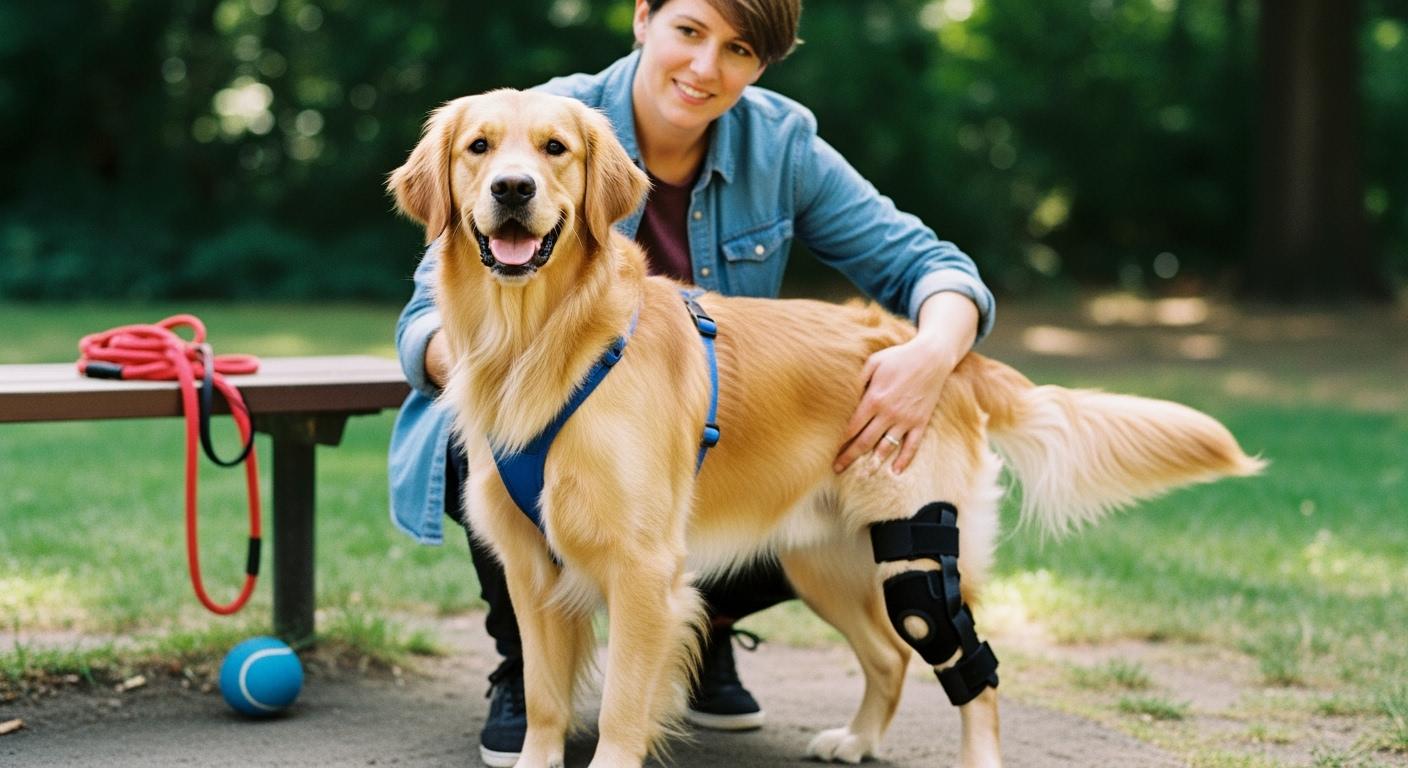
A well-fitted knee brace changes how force travels through the joint. Hinged designs can reduce the forward slide of the tibia and limit painful internal rotation — two mechanical problems that make a CCL-deficient knee unstable. When the brace controls these motions, dogs often load the leg more evenly, limp less, and walk with a smoother stride.
Gait studies show measurable improvement with custom stifle orthoses. In one case series, dogs with unilateral CCL tears showed significantly better limb pressure distribution after using a custom orthosis. Owners consistently report less lameness and more willingness to walk, though improvement varies by injury severity and fit quality.
What Bracing Cannot Do
A brace can steady the joint during controlled walks, but it cannot correct the underlying ligament tear, restore normal joint biomechanics, or prevent arthritis from developing over time. It does not protect the meniscus the way surgery can. If your dog has a complete rupture with significant instability, a brace alone is unlikely to provide enough control. Bracing also cannot rescue a poor fit: if the brace shifts, rubs, or the dog refuses it, support is functionally zero regardless of how the device is designed.
Quick decision rule: A CCL brace can help when the tear is partial, the joint still has some natural stability, and the dog tolerates the device well. It is the wrong tool when the knee is grossly unstable, the dog refuses the brace repeatedly, or skin breakdown develops and does not resolve with fit adjustments. Surgery gets the stronger evidence for full ruptures in otherwise healthy dogs.
What the Evidence Shows About Dog CCL Braces
Why a Veterinary Diagnosis Comes First
CCL disease is the most common cause of hindlimb lameness in dogs, and it is usually a progressive degenerative condition rather than a single traumatic tear. A veterinarian can assess the injury grade, check for meniscal involvement, and evaluate muscle loss — all of which determine whether bracing is appropriate. Skipping this step risks using a brace on a knee that needs surgery or missing a meniscal tear that causes persistent pain.
What the Research Tells Us
The evidence on canine stifle bracing comes from a mix of biomechanical models, prospective case series, and large owner surveys. It is not a deep clinical-trial literature, but several studies point in a consistent direction.
A biomechanical computer model of a CrCL-deficient stifle showed that an orthosis can reduce cranial tibial translation and internal rotation while lowering collateral ligament load — confirming a mechanical rationale for bracing.
On the outcomes side, a prospective study of 43 dogs using orthoses and prostheses found that all 11 stifle-orthosis dogs (100%) improved on objective gait analysis. However, 58% developed skin issues in the first three months, 14% never accepted the device, and 7% needed repairs — a reminder that fit and daily monitoring determine whether the mechanical benefit translates to real-world success.
A large owner-satisfaction survey comparing stifle orthoses (819 dogs) to TPLO surgery (203 dogs) found that at least 85% of owners in both groups would choose the same option again. Surgery, however, led to significantly better lameness resolution — 11% of orthosis users eventually converted to surgery, and 46% reported skin lesions.
| Reference | Key Finding | Evidence Type and Limitation |
|---|---|---|
| Bertocci et al. (2017) | Orthosis reduced tibial translation and rotation in a computer model | Biomechanical model of a single dog; real-world results vary by fit and anatomy |
| Rosen et al. (2022) | 100% of stifle-orthosis dogs improved on gait analysis; 58% had skin issues | Prospective cohort of 43 dogs; small stifle subgroup limits precision |
| Hart et al. (2016) | Owners of both orthosis and surgery groups showed high satisfaction; surgery resolved lameness more completely | Owner survey with 1,022 dogs; self-reported, not randomized |
| Carr et al. (2016) | Custom stifle orthotics significantly improved limb pressure distribution | Small case series of 10 dogs; limited generalizability |
Brace vs Surgery: When the Evidence Points One Way
Surgery (TPLO or TTA) directly stabilizes the joint and has the strongest evidence for reducing lameness long-term in dogs with complete CCL ruptures. Bracing fills a different role: it can improve comfort and mobility when surgery is not feasible, and it may serve as a bridge during pre-surgical conditioning or post-surgical protection. Use this as a starting point for talking with your vet:
| Decision Factor | CCL Brace | Surgery (TPLO / TTA) | What to Watch |
|---|---|---|---|
| Partial tear, mild instability | Often a reasonable first option with rehab | Usually not needed unless tear progresses | Monitor for worsening limp or instability |
| Complete rupture, gross instability | Unlikely to provide enough control alone | Strongest evidence, best long-term function | Delay raises arthritis and meniscal damage risk |
| Older dog, anesthesia risk | Commonly chosen to avoid surgical risk | Risk may outweigh benefit at advanced age | Quality-of-life focus; set realistic activity goals |
| Meniscal click or sharp pain | Not appropriate — needs imaging and likely surgery | Addresses meniscal damage directly | Do not brace through a meniscal tear |
| Cost and access | Lower upfront cost; no hospitalization | Higher cost ($3,000–$6,000 typical range) | Brace plus rehab still requires commitment and follow-up |
Which Dogs Get the Most from CCL Bracing
Stronger Candidates for Bracing
Owner surveys show that dogs selected for orthosis management tend to be older (median age around 9 years), often overweight, and commonly from larger breeds — reflecting the population for whom owners want to avoid anesthesia and surgical recovery. Smaller dogs under about 30 pounds also frequently do well with conservative management that includes bracing. The strongest predictor of success is not breed or age alone, but having a partial tear with some remaining joint stability, combined with an owner who checks the brace daily and follows a structured rehab routine.
When Bracing Is Likely to Fall Short
A brace rarely succeeds when the CCL is fully ruptured and the knee shows obvious drawer motion. Young, active dogs with complete tears almost always need surgery to return to normal function. Bracing also fails when the dog will not tolerate the device: about 14% of dogs never accept a stifle orthosis. Meniscal injury with an audible click or sharp pain is a hard stop — the dog needs imaging and likely surgery, not a brace. Hoping a brace will restore pre-injury running, jumping, or off-leash activity usually leads to disappointment and re-injury.
Fit and Tolerance Make or Break the Outcome
A custom-fitted brace matches the dog’s knee shape and joint angle far better than a generic off-the-shelf option. Even a well-made custom brace needs daily attention: check for rubbing, shifting, or skin changes every time you remove it. Small fit adjustments early prevent the skin breakdown that is the most common reason owners stop bracing. Dogs that wear the brace comfortably and show steady gait improvement over the first two to three weeks are on the right track. Dogs that chew, twist out of, or consistently refuse the brace are telling you something about fit or discomfort.
| Situation | Likelihood of Brace Success | Main Failure Risk | Safer Path |
|---|---|---|---|
| Partial tear, mild instability | Moderate to high when fit and monitoring are consistent | Poor fit, owner skips daily skin checks | Custom brace, structured break-in, vet follow-ups |
| Older dog, not a surgical candidate | Moderate, realistic goal is comfort and controlled mobility | Skin rubbing, slow adaptation, unrealistic expectations | Vet-guided bracing with quality-of-life focus |
| Controlled rehab with short leash walks | High when combined with gradual wear-time increase | Brace slips, tolerance drops after first week | Gradual break-in, daily fit and gait checks |
| Complete rupture, gross instability | Low — brace cannot control severe instability | Joint remains unstable, arthritis risk climbs | Surgery or advanced veterinary care |
| Meniscal signs (clicking, sharp pain) | Very low — meniscal tear needs direct treatment | Missed diagnosis, worsening pain, joint damage | Imaging, orthopedic re-check |
| Repeated brace refusal or chewing | Very low — no support if dog rejects the device | Zero effective support, continued instability | Stop bracing, reassess with vet |
| Rubbing, sores, skin breakdown | Very low while skin is compromised | Infection, pain, brace abandonment | Remove brace, treat skin, reassess fit before restarting |
Tip: The best results come when the brace matches the injury grade, the dog tolerates it willingly, and the owner checks fit and skin every single day. No brace works well without that daily attention.
Daily Checks That Catch Problems Early
Movement and Fit
Start with short indoor sessions — maybe 15 to 30 minutes — and increase wear time gradually over one to two weeks. Move from quiet standing to short flat walks before attempting stairs or inclines. After each session, check that the brace still sits in its original position without twisting or sliding down the leg. A brace that migrates out of place loses its mechanical benefit and creates new pressure points.
- Watch for steady, even steps — not a skip-step or head bob.
- Confirm the brace hinges align with the knee joint at the end of every walk.
- Look for any hesitation to stand, start walking, or turn.
- Note if the dog licks, chews, or paws at the brace during or after wear.
Skin and Comfort
Skin problems are the most common complication of stifle bracing, affecting 58% of dogs in the first three months. A properly fitted leg brace paired with daily skin checks gives your dog the best chance at staying comfortable. Remove the brace and inspect the skin every time. Mild pinkness that fades within 10 to 15 minutes is common during break-in. Redness that persists, any broken skin, hair loss, or heat under the brace means stop and address fit before continuing. Your dog should move without flinching and accept the brace without avoidance behavior.
When to Continue, Adjust, or Stop
Use this signal guide to decide each day whether to keep going, tweak the fit, or pull the brace and call your vet.
| Signal Level | What You See | Was ist zu tun? |
|---|---|---|
| Green — continue | Steady gait, brace stays aligned, skin normal after removal, dog walks willingly | Continue use, keep daily checks, gradually increase walk duration |
| Yellow — adjust | Mild redness that fades, slight brace shift during walks, brief hesitation at start | Shorten wear time, check strap tension and alignment, monitor skin closely |
| Red — stop | Swelling, open sores, worsening limp, pain signs, meniscal click, refusal to bear weight | Remove brace, contact your veterinarian, do not restart without a reassessment |
What to Track Each Day
A simple daily note habit catches problems before they become reasons to quit. Record just a few words each evening.
| What to Record | Warum das wichtig ist |
|---|---|
| Gait quality (steady, slightly off, clearly limping) | Shows whether support is improving or stalling over time |
| Brace position at end of walk (aligned, shifted, twisted) | Migration reduces support and creates new pressure points |
| Skin under brace (normal, pink, red, broken) | Skin breakdown is the top reason bracing fails |
| Willingness to walk (eager, hesitant, refuses) | Behavioral signs often appear before visible lameness worsens |
| Any unusual event (fall, extra-long walk, missed session) | Context helps the vet interpret changes at follow-up visits |
Escalation rule: If gait worsens, skin breaks down, or the dog refuses the brace for two or more days in a row, remove the device and contact your veterinarian before continuing. Do not wait until a follow-up appointment if pain or lameness is increasing.
Das Wichtigste in Kürze
- A CCL brace can steady the knee and reduce pain during controlled activity, but it does not heal the ligament or replace surgery for full ruptures.
- Success depends on three things: the right injury match (partial tears do best), daily fit and skin checks, and a structured break-in and rehab routine.
- Stop and call your vet if you see worsening gait, skin breakdown, pain signs, or repeated brace refusal — these are signals that bracing is not the right path.
Häufig gestellte Fragen
How long should my dog wear a CCL brace each day?
Start with short sessions of 15 to 30 minutes and increase gradually over one to two weeks as your dog adapts. Your veterinarian can recommend a specific schedule based on the injury and your dog’s tolerance. Never leave a brace on unattended or overnight.
Can a CCL brace replace surgery for a torn ligament?
For partial tears in older or higher-risk dogs, a brace with structured rehab can be a reasonable alternative to surgery. For complete ruptures in otherwise healthy dogs, surgery has the stronger evidence for long-term function and lower arthritis progression. The decision should come from a veterinary assessment of the injury grade, not from cost or convenience alone.
What are the signs a dog brace is not working?
Worsening limp, increased pain, skin breakdown that does not resolve with fit adjustments, brace refusal lasting more than a day or two, and any clicking sound from the knee all mean stop and contact your vet. A brace that constantly shifts or twists out of position is also failing to provide meaningful support.
Is a custom brace worth it over a generic one?
A custom brace built from a cast or 3D scan of your dog’s leg matches the joint angles and contours far more precisely than a generic option, which reduces shifting, rubbing, and pressure points. Most of the research on stifle bracing involves custom devices, so the evidence for off-the-shelf options is thinner.
How do I know if the brace fits correctly?
The brace should stay aligned with the knee joint throughout a walk without twisting or sliding down. After removal, the skin should look normal or show only mild, temporary pinkness. Your dog should walk without flinching or avoiding the brace, and the straps should be snug without digging in — you should be able to slide one finger under each strap.
Data authenticity note: The studies cited in this article are real, peer-reviewed publications. The data points (percentages, sample sizes, and findings) are drawn directly from those publications as listed in the References section. No data has been fabricated, averaged across studies, or extrapolated beyond what each study reported.