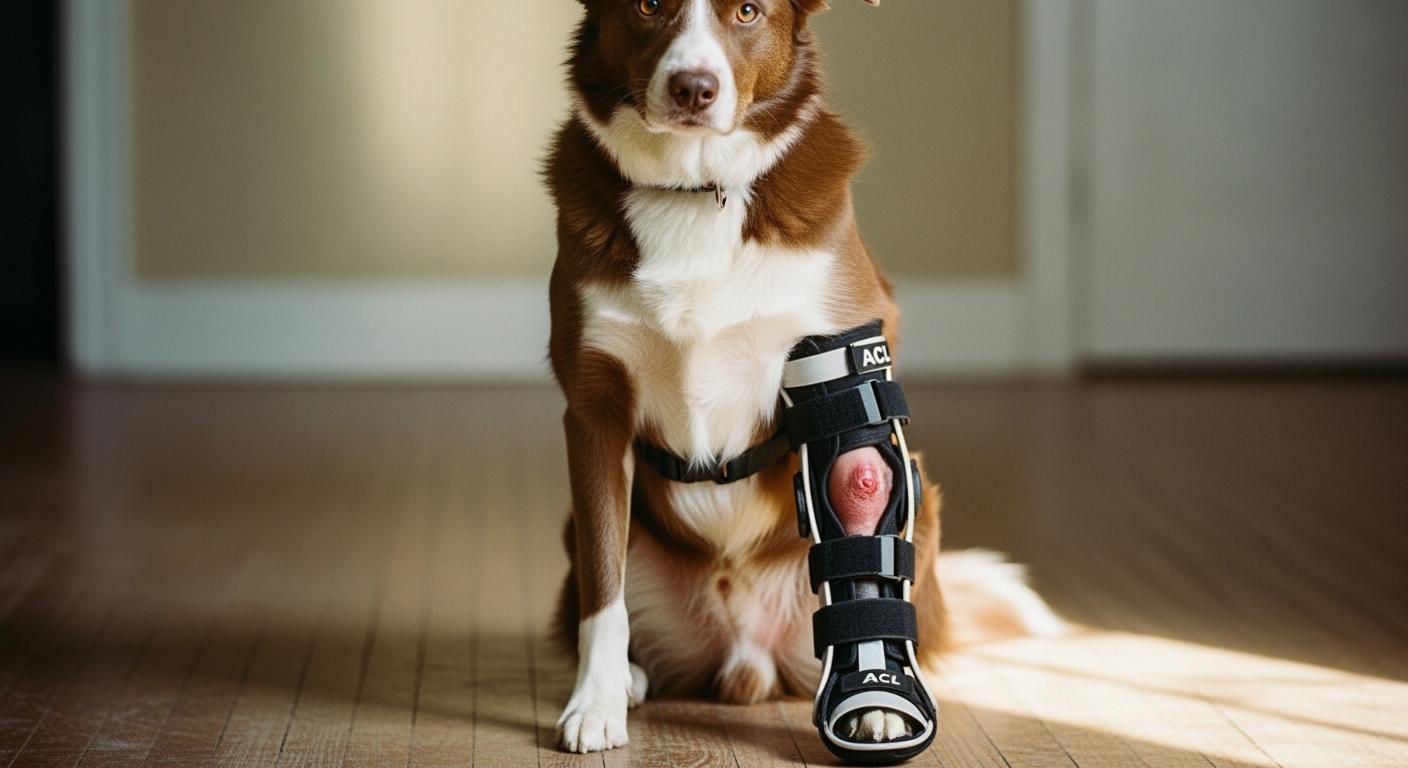
A dog ACL leg brace can look snug and centered when your dog stands still. You check the straps. The shell sits where it should. Everything passes. Then the dog sits, and the top edge drives into the groin fold. The dog hesitates, shifts weight, or starts mouthing at the brace. That is not a strapping mistake. It is a structure mismatch between brace geometry and how the leg actually moves during stifle flexion.
(In veterinary practice this ligament is the CCL — cranial cruciate ligament. The mechanics discussed here apply to either term.)
Groin pressure that only shows up during movement exposes the gap between a standing fit check and what the brace does under load. A shell height that clears the groin when the femur is vertical may not clear it when the stifle flexes and the thigh angle changes. The top edge rotates forward into soft tissue. No amount of strap adjustment fixes this — the shell is simply too tall for that dog’s dynamic leg geometry. This failure mode matters because it converts a support device into a source of skin breakdown, and the dog’s reluctance to sit or walk normally undermines the stability the brace is supposed to provide.
Where a Knee Brace Fails First — and Why It Is Never Just a Comfort Problem
Three failure points surface once the dog moves. Each traces back to a specific structural decision made during brace design, not to how carefully the straps were adjusted.
The top edge collides with the groin fold
The soft tissue in the groin fold cannot dissipate concentrated pressure from a hard, straight shell edge. When the brace is too tall, the edge acts like a fulcrum every time the dog sits — the stifle flexes, the femur rotates, and the upper rim levers forward into tissue that has almost no padding. The result is not just redness. Sustained pressure occludes capillary blood flow in the skin directly under the edge. Remove the brace after a 10-minute wear session and press the back of your hand against the groin area. If the skin feels warmer than the surrounding thigh and the heat persists beyond 10 minutes, the edge is transmitting enough pressure to compromise circulation — not just causing friction warmth.
A curved or rolled upper edge changes the contact geometry from a line to a surface, distributing force across a wider area. A shorter upper shell reduces how far the edge can travel forward during flexion. These two dimensions — height and edge profile — determine whether the brace clears the groin dynamically, not just statically.
| Failure Type | Structural Cause | Design That Reduces It |
|---|---|---|
| Groin rubbing and sores | Shell too tall, straight hard edge | Shorter upper shell, curved or rolled border |
| Blocked sitting or knee flexion | Shell blocks posterior stifle movement | Posterior cutout, flexible edge near the fold |
| Brace slides down after walking | Thigh anchor too weak, single-strap dependency | Independent upper and lower strap tension, wider contact patch |
| One strap edge digs in | Narrow strap with unfinished edge | Wider strap, finished or padded edge |
| Heat buildup under the liner | Non-breathable liner material | Breathable liner, graduated wear-in schedule |
| Dog chews at the brace | Discomfort from any of the above | Softer edge, proper shell height, wider pressure distribution |
One strap edge carries the load — and the brace rotates
Here is the chain. A narrow strap concentrates tension along its edge rather than across its full width. When the dog walks, lateral forces act on the brace. A narrow contact patch has no resistance to rotation — the strap edge becomes a pivot point. The brace twists. The hinge axis shifts away from the stifle joint center. Now every step loads the joint off-axis, and the very structure meant to stabilize the knee begins steering it into uneven loading.
You can verify this yourself. Mark the brace position against your dog’s thigh with a small piece of tape before a short walk. After five minutes of leash walking on a flat surface, check whether the mark has drifted more than half an inch from its starting point. Rotation that small is enough to pull the hinge off the stifle axis. The brace is no longer stabilizing — it is redirecting force through the joint at an angle the anatomy is not built to handle. When red flags like persistent skin warmth and visible rotation appear together, the support is insufficient regardless of how tightly the straps were pulled.
Wider straps with finished edges resist this pivot effect because the broader contact patch creates a longer lever arm against rotation. Independent tension control above and below the stifle means you are not trading thigh grip for calf grip — each strap does its own job. That distinction — independent versus linked tension — often determines whether the brace stays centered or drifts during a walk.
Shell Height, Edge Shape, and Strap Width — the Structure That Determines Daily Performance
When a brace fails during movement, the fix is rarely more tension. It is a different set of structural choices. Three decisions control most outcomes.
Shorter upper shell with a curved edge
A shell that stops lower on the thigh reduces the forward travel of the top edge during sitting. Combine that with a curved or rolled border instead of a straight cut, and the contact surface during flexion spreads across a radius rather than concentrating on a sharp corner. The gap between the top edge and the groin fold should be wide enough to fit one or two fingers even when the dog is seated — not just when standing. If that gap closes during sitting, the shell is too tall for that leg, period. Tightening straps will not create clearance that the shell geometry denies.
Independent strap tension above and below the stifle
A single continuous strap or a system where tightening one side pulls the other creates a trade-off: thigh security at the cost of calf pressure, or vice versa. Fit that follows the leg’s contour contributes more to joint stability than raw clamping force. Independent upper and lower strap control lets each anchor do its job without compromising the other. The upper strap maintains thigh position. The lower strap prevents rotation around the calf. Neither needs to be overtightened to compensate for the other’s slack — a signal of structural mismatch when it happens.
Wider liner surface and breathable materials
Liner width is not about cushioning. It is about force per unit area. The same strap tension spread across a wider liner reduces peak pressure under any single point. A knee brace built for CCL support needs the liner to extend across the full inner shell surface — any gap between the liner edge and the shell edge creates a hard transition point where pressure spikes. Breathable liner material matters because trapped heat softens skin and makes it more vulnerable to friction damage. Short, graduated wear-in sessions give the skin time to adapt, and a liner that dries quickly between sessions reduces the maceration risk that turns minor rubbing into open sores.
| Structural Decision | What It Changes in Daily Use | Main Limitation |
|---|---|---|
| Shorter, curved upper shell | Clears groin during sitting; reduces forward edge travel | Less proximal coverage — not for dogs needing upper-thigh stabilization |
| Softer rolled border | Spreads contact force; reduces edge pressure on skin | Adds bulk near flexion point; must not interfere with stifle movement |
| Independent strap tension | Each anchor adjusts separately; no trade-off between thigh and calf grip | Requires more adjustment steps during initial fitting |
| Wider liner with breathable surface | Lowers peak pressure; reduces heat and moisture buildup | Adds overall brace volume; may not suit very short-coated or thin-skinned breeds without monitoring |
These structural differences show up most clearly during daily wear decisions. An orthopedic knee brace used for daily support exposes liner performance, edge durability, and strap retention in ways a brief fitting session cannot. The brace either holds its position through a full walk, or it does not. The skin either stays cool and dry under the liner, or it does not. These are binary outcomes, and they are determined by structure — not by instructions.
When a Knee Brace Is Not the Right Support for This Leg
A knee brace stabilizes the stifle joint. It does not support the hip, the hock, or the lower spine. Problems start when a stifle issue is assumed but the dog’s real stability loss originates elsewhere — or when leg conformation makes a standard knee brace geometry a poor match.
Three conditions where a knee brace tends to underperform:
- Hip-driven instability. If the dog shifts weight off the hind leg because of hip discomfort, a knee brace cannot correct the gait. The brace stays on the stifle, but the dog loads the leg differently, and the brace’s support axis no longer aligns with how force travels through the limb.
- Angular limb deformity or atypical leg conformation. A shell patterned for a standard femoral-tibial angle will not sit flush on a leg with significant deviation. The gap between shell and skin creates a pivot zone — the brace rocks instead of stabilizing.
- Concurrent hock instability. When the hock collapses during weight-bearing, the entire hind leg geometry shifts from underneath the knee brace. The stifle brace may appear to be sliding down when in reality the leg beneath it is changing shape.
Disclaimer: The fit checks described here assume a short-coated to medium-coated dog where skin changes are visible on inspection. Double-coated breeds may show subtler rub marks beneath the fur that require hand-checking for warmth and tenderness rather than visual inspection alone. If the dog’s leg conformation falls outside typical breed norms — particularly dogs with angular limb deformities or very deep chests that alter hind-limb stance — the clearance and alignment checks described here may not catch every pressure point.
The decision framework is straightforward. If the brace stays centered through a full walk, the skin shows no lasting warmth or marks, and the dog moves naturally — the structure matches. If the brace shifts, the top edge presses into the groin during sitting no matter how the straps are set, or the dog refuses to sit at all — the structure does not match, and adjusting straps will not close that gap.
| Status | What You Observe | Action |
|---|---|---|
| Green | Brace stays centered, dog sits and walks naturally, skin normal after removal | Continue use with routine checks |
| Yellow | Mild slipping, short-lived pink marks, hesitation sitting | Adjust strap tension, recheck after next session |
| Red | Swelling, persistent heat, broken skin, visible rotation, refusal to bear weight | Stop use, consult your veterinarian |
This decision table matters because it separates fit issues you can address from structural mismatches you cannot. Mild slipping that resolves with a strap adjustment is a fit issue. A brace that blocks sitting regardless of adjustment is a shell geometry problem — the brace is too tall or the posterior edge is too rigid for that dog’s leg. Recognizing the difference prevents weeks of troubleshooting something that cannot be fixed with tension. For a step-by-step fit decision process matched to real dog movement, the pattern is always the same: observe during motion, not just at rest, and decide based on what the brace does when the dog moves naturally.
The brace that works is the one whose shell height, edge profile, strap configuration, and liner surface match the dog’s leg through its full range of daily movement. Not the one that looks best standing still.
Häufig gestellte Fragen
Why does my dog refuse to sit with the brace on?
Refusal to sit almost always signals that the brace shell is blocking stifle or hip flexion. The upper edge presses into the groin fold or the posterior shell prevents the knee from bending fully. The dog learns within one or two attempts that sitting causes discomfort and stops trying. This is not stubbornness — it is a clear signal the shell height or posterior shape does not match that leg.
How quickly can groin rubbing turn into a skin injury?
Pressure that occludes capillary blood flow can produce visible skin changes within 15 to 30 minutes of continuous contact. What starts as pinkness becomes erythema, then superficial skin loss if the same edge contacts the same spot across multiple sessions. A curved or rolled upper edge and a one-to-two-finger clearance gap prevent this progression.
Can a wider strap fix a brace that keeps sliding down the leg?
A wider strap helps resist the rotation that often precedes sliding, but sliding that persists despite a wide upper strap suggests the primary problem is shell geometry — either the brace is too tall, forcing it downward during sitting, or the thigh contour does not provide enough natural anchor above the stifle. Fix the shell fit first; use strap width as a secondary improvement.