
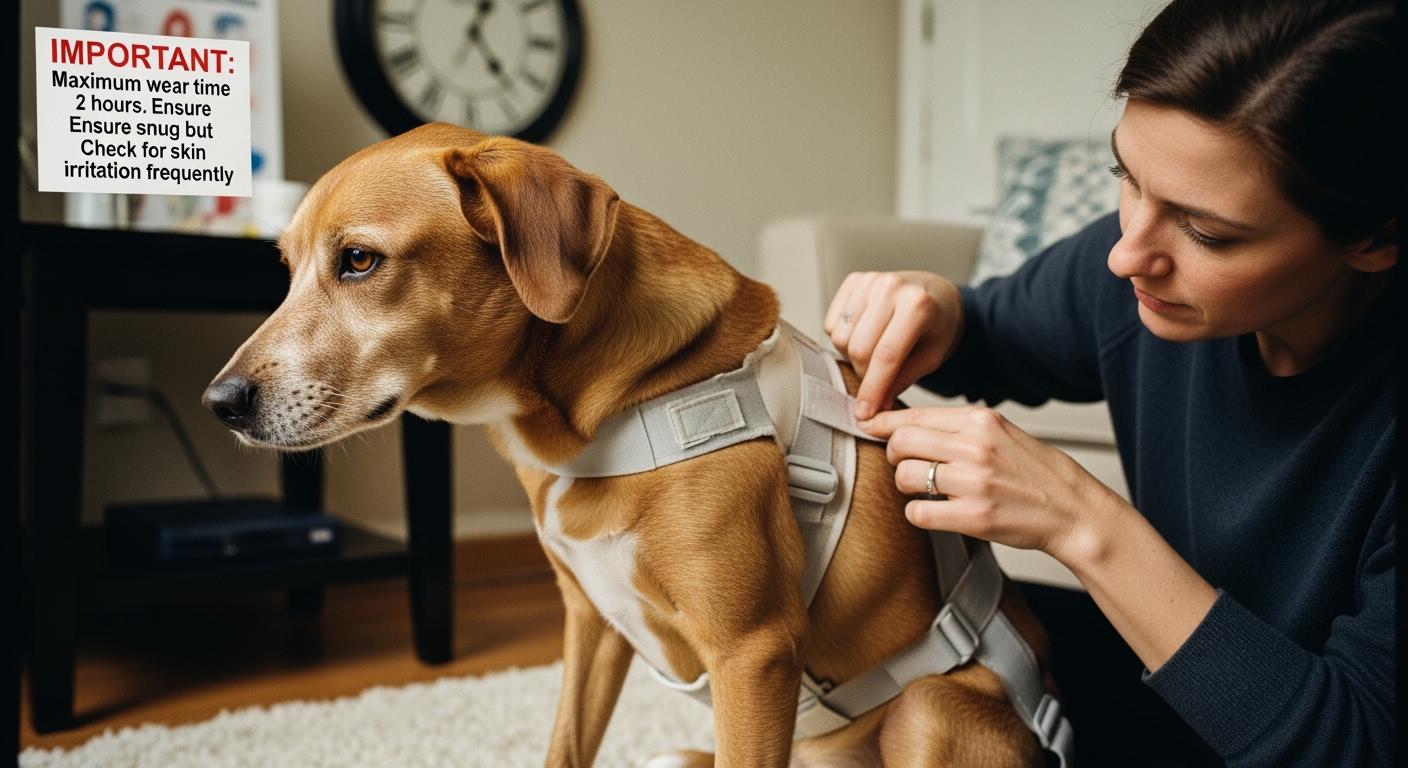
Your dog has an IVDD diagnosis and you are trying to do the right thing. A back brace can provide meaningful spinal support, but only when three things line up: the right stage of the condition, a secure and comfortable fit, and strictly limited wear time. Get any of these wrong and the brace can do more harm than good. This article walks through what safe brace use looks like for each dimension and when the right decision is to stop and call your veterinarian.
Note: This article covers back bracing for dogs with intervertebral disc disease under veterinary guidance. It is not a substitute for diagnosis, crate rest protocols, or emergency care. If your dog cannot walk or has lost bladder control, skip the brace and go to a veterinary hospital.
What a Back Brace Can and Cannot Do for IVDD
The Support a Brace Actually Provides
A well-fitted back brace helps stabilize the spine during short, supervised activity. For a dog with mild IVDD signs — pain that responds to rest, no loss of motor function — the brace can limit twisting and bending movements that risk worsening the disc. Owners most often see benefit during brief leash walks to a bathroom spot or between the crate and a feeding area. The brace encourages straighter posture and discourages the sudden twists that can turn a contained disc problem into an emergency.
Braces work best for dogs at the milder end of the spectrum: those who can still walk, have pain under control, and are following a veterinarian-supervised conservative management plan that includes enforced rest.
What a Brace Cannot Replace
A back brace does not cure IVDD, does not shrink or reposition a herniated disc, and does not shorten the healing timeline. It cannot substitute for crate rest, prescribed medication, or surgery when those are indicated. Over-relying on a brace can create a false sense of security: your dog may look steadier while wearing it, but the underlying disc injury is unchanged. If you let activity levels creep up because the brace “makes things look fine,” you risk a setback that may be worse than the original episode.
Using a brace without veterinary guidance also carries specific risks. A brace that is too restrictive can contribute to muscle loss over time. One that fits poorly can press on the abdomen, interfere with breathing or elimination, or create pressure sores that go unnoticed under the device.
Stage Matters: When a Brace Helps and When It Harms
IVDD is not one condition with one answer. The severity spans from mild pain with normal walking to complete paralysis with no deep pain sensation. The brace decision flows entirely from where your dog falls on that spectrum. The table below maps the standard IVDD grading system to what it means for brace use:
| IVDD Grade | Observable Signs | Brace Decision | Main Risk if Bracing Is Misapplied |
|---|---|---|---|
| Grade I | Pain only, walks normally, may avoid jumping or stairs | May help during short supervised activity under vet guidance | Overconfidence — owner permits too much movement too soon |
| Grade II | Weak or wobbly but still able to walk independently | May help with careful supervision and strict activity limits | Fit problems can worsen wobbliness if brace shifts during use |
| Grade III | Cannot stand or walk, but can still move legs | Do not brace without explicit veterinary approval | Delay in imaging or surgical consult while relying on a brace |
| Grade IV | Paralyzed, deep pain sensation still present | Do not brace — urgent surgical referral needed | Permanent loss of function from delayed surgery |
| Grade V | Paralyzed, no deep pain sensation | Do not brace — emergency surgical intervention | Window for surgical recovery closes within hours |
Escalation rule: If your dog loses the ability to walk, cannot control bladder or bowels, or shows sudden severe pain, remove the brace and go directly to a veterinary hospital. Do not wait to see if it improves.
Post-Surgery: A Different Set of Rules
After spinal surgery, your veterinarian may clear the brace for specific supervised moments. In this context, the brace’s job is to limit risky spinal movement during the early healing window while your dog is on a short leash for a bathroom break or a brief flat-surface walk. The brace should support without forcing an unnatural posture. It is never a replacement for crate rest or post-surgical restrictions — it is a temporary tool used within them. Check skin and comfort after every session, and report any change in gait, breathing, or elimination to your veterinarian immediately.
Fit Problems That Undo the Benefit
A brace that does not fit is worse than no brace at all. It can create new pressure points, destabilize the spine, or compress the abdomen in ways that interfere with breathing and elimination. Long-bodied breeds like Dachshunds are especially vulnerable to fit problems because a brace that rides up or twists can concentrate force on the wrong part of the back.
Slipping, Twisting, and Pressure Points
When a back brace shifts during movement, it loses its ability to stabilize the targeted spinal segment. Instead of restricting harmful motion, a shifted brace can pull the spine into an uneven position. Look for secure closures that hold position during walking, padding that distributes pressure without bunching, and a shape that follows your dog’s body contour without forcing an unnatural arch or curve. If the brace slides, rolls, or rotates noticeably during a short walk, it is not doing its job.
Abdomen and Breathing
A back brace should never squeeze the belly. If your dog shows shallow breathing, reluctance to move, or straining during urination or defecation while wearing the brace, the fit is compressing the abdomen. Remove the brace and contact your veterinarian before the next use. The dog must be able to breathe comfortably and eliminate normally with the brace on.
Skin and Posture Signs
Check the skin under the brace after every removal. Redness that fades within a few minutes is common during break-in. Redness that persists, any broken skin, strap marks that do not fade, or heat buildup under the brace all mean stop and address fit. Watch for postural changes too: a hunched back, tucked tail, or refusal to walk while wearing the brace signals discomfort that may be from poor fit rather than the underlying IVDD.
| What You See | Warum das wichtig ist | Was ist zu tun? |
|---|---|---|
| Brace slips, twists, or rides up during a short walk | Unstable support can worsen spinal stress | Stop use, adjust or refit, consult your vet before restarting |
| Rolling edges, persistent strap marks, or broken skin | Pressure injury that can become infected | Remove brace, treat skin, do not reuse until fit is corrected |
| Hunched back, arched posture, tucked tail while braced | Brace is forcing an unnatural spinal position | Stop use, review fit and brace design with your veterinarian |
| Shallow breathing or visible effort to breathe | Abdomen is compressed — unsafe | Remove brace immediately, contact your vet |
| Straining to urinate or defecate while braced | Brace pressure is interfering with elimination | Remove brace, check abdomen, call your vet |
| Dog refuses to stand or walk while wearing the brace | Pain, fear, or discomfort from the device | Remove brace, check for injury, consult your vet before retrying |
Wear Time: How Long Is Too Long
A back brace is for supervised activity, not for all-day support. The safest rule: brace on during short, watched movement; brace off during rest, sleep, and any time you are not directly present.
Active Use Only
The brace should be worn for the specific, limited windows when your dog is up and moving: a brief bathroom walk, a short flat-surface stroll, moving between a crate and a water bowl. Start with about 15 to 30 minutes for the first few sessions and increase gradually only if your dog tolerates the brace well and skin checks are clean. The brace comes off when your dog returns to the crate or resting spot. Leaving a brace on during unsupervised rest increases the risk of pressure sores, skin irritation, and overheating without adding any meaningful spinal support.
Never-Safe Activities
Some movements can override whatever protection a brace provides. These are never safe for a dog recovering from an IVDD episode, braced or not:
- Running, jumping, or climbing stairs
- Jumping on or off furniture, beds, or into a vehicle
- Rough play, chasing, or wrestling with other dogs or children
- Ball games, fetch, or sudden direction changes
- Moving fast on slick floors like tile, hardwood, or laminate
- Being outside off-leash without direct supervision
The Stop-Use Signals
Recognizing when things are going wrong matters more than following a fixed schedule. Remove the brace and call your veterinarian if you see any of these:
- Sudden loss of balance, crossing of back legs, or staggering
- Sharp pain, yelping, or refusal to move
- New or worsening paralysis in the hind limbs
- Loss of bladder or bowel control
- Back pain, arching, or crying out when touched along the spine
- Shallow or rapid breathing while wearing the brace
- Skin that stays red, looks broken, or feels hot after brace removal
| Signal Level | What You See | Was ist zu tun? |
|---|---|---|
| Green — continue | Steady walking, brace stays aligned, skin normal after removal, dog tolerates the brace without signs of distress | Continue supervised use, keep daily skin and fit checks, stick to activity limits |
| Yellow — adjust | Mild brace shifting, temporary skin pinkness, dog hesitant but still walking | Shorten wear time, check strap fit and padding, inspect skin after every session, call vet if not improving within a day |
| Red — stop | Worsening gait, pain signs, skin breakdown, breathing difficulty, loss of bladder or bowel control, new paralysis | Remove brace, contact your veterinarian or go to an emergency hospital, do not restart without a veterinary reassessment |
Tip: The brace is one tool in a recovery plan that starts with crate rest, medication, and veterinary guidance. It supports the spine during short, controlled movement — it does not replace rest or make unsafe activity safe.
Das Wichtigste in Kürze
- A back brace can stabilize the spine during short supervised activity for dogs with mild IVDD, but it cannot cure the disc injury or replace crate rest, medication, or surgery.
- The three failure points are wrong stage (bracing when the dog needs emergency care), wrong fit (shifting, pressure, or abdomen compression), and wrong wear time (leaving the brace on during unsupervised rest).
- If your dog loses the ability to walk, loses bladder or bowel control, or shows sudden severe pain, remove the brace and get to a veterinary hospital immediately — waiting can close the window for successful treatment.
Häufig gestellte Fragen
Can I use a back brace for my dog’s IVDD without seeing a vet first?
No. IVDD severity ranges from mild pain to surgical emergency, and only a veterinarian can determine the grade through examination and imaging. Using a brace without a diagnosis risks delaying treatment for a condition where hours can matter.
How long should my dog wear a back brace each day?
Only during short, supervised activity like bathroom walks or brief flat-surface strolls — usually 15 to 30 minutes per session, a few times a day. The brace should come off during crate rest, sleep, and anytime you are not directly watching your dog.
What signs mean I should stop using the brace immediately?
Stop and call your vet if you see: new weakness or paralysis, loss of bladder or bowel control, sudden severe pain, shallow breathing while the brace is on, or skin that stays red or breaks down after removal.
Can a back brace replace crate rest or surgery for IVDD?
No. A brace is a temporary support tool for supervised movement, not a substitute for enforced crate rest, prescribed medication, physical rehabilitation, or surgery when those are indicated. Using a brace in place of rest can make the disc injury worse.
How do I know if the brace fits my dog correctly?
The brace should stay in place during a short walk without sliding, twisting, or riding up. Your dog should breathe comfortably and show no signs of strain during elimination. After removal, the skin under the brace should look normal or show only mild, temporary pinkness. If the brace shifts noticeably or leaves lasting marks, the fit needs adjustment.
This article is informational only and does not replace diagnosis, treatment, or advice from your own veterinarian. GaitGuard designs and sells canine mobility and bracing products, which creates a commercial interest in this topic. Always consult your veterinarian before using a brace, and seek emergency care immediately if your dog shows any signs of paralysis, loss of bladder control, or severe pain.
