
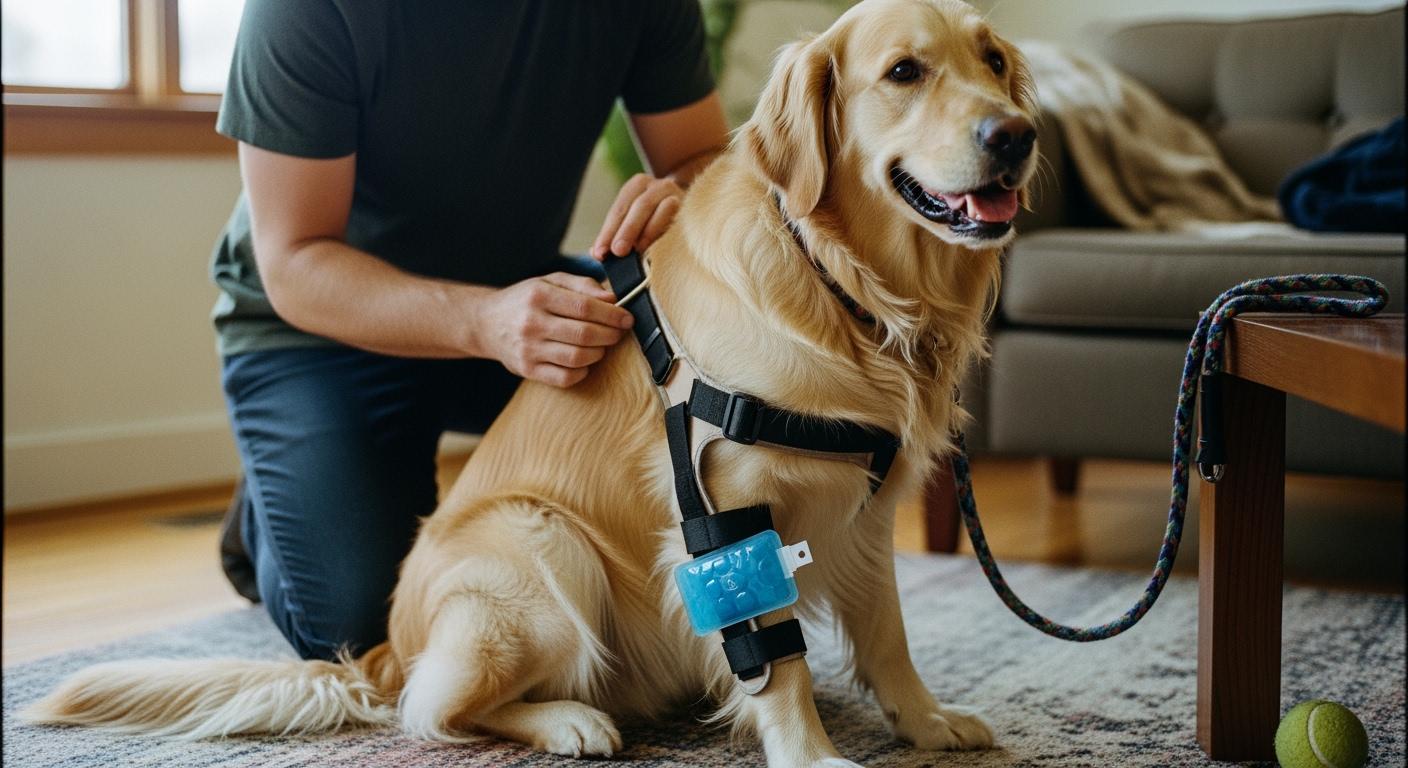
A dog cruciate ligament brace with hot cold gel pack should be chosen by one practical question: does your dog need both knee support and a more structured way to manage swelling, soreness, or stiffness during rehab. The brace helps stabilize the knee during daily movement, while the gel pack adds a therapy option that can be used at the right stage of recovery. For a broader fit-and-safety foundation before adding heat or cold therapy, compare this article with canine rehabilitation brace fit, comfort, and safety.
Das Wichtigste in Kürze
- A brace with a hot cold gel pack is most useful when your dog needs both mechanical support and better control of swelling, soreness, or stiffness during rehab.
- Cold therapy is usually more relevant earlier or after activity when swelling is the priority, while heat therapy is usually more relevant later when stiffness and tissue comfort become the focus.
- Fit, therapy timing, and skin safety matter as much as the brace itself.
What Is a Dog Cruciate Ligament Brace with Hot Cold Gel Pack?
Targeted Knee Support for Dogs
You want your dog to move more safely after a cruciate ligament injury, and this type of brace is designed to do more than simple wrapping. A dog cruciate ligament brace with hot cold gel pack combines joint support with a built-in therapy option, so the product decision is really about whether your dog needs both stability and guided rehab support in the same workflow. For product-level comparison after this section, review the knee brace with hot cold gel pack.
Here is a more useful way to explain what makes this type of brace different:
| Feature | Warum das wichtig ist |
|---|---|
| Cruciate-focused knee support | Helps control movement around the stifle during walking and rehab. |
| Gel pack compatibility | Adds a more structured way to use heat or cold during recovery. |
| Adjustable fit | Helps the brace stay aligned and more comfortable during repeated use. |
| Daily-use construction | Makes it more realistic to combine support and therapy in one routine. |
The real value is not just that the brace supports the knee. It is that the brace can make therapy timing easier to repeat as part of a rehab plan.
Added Value of Hot & Cold Therapy
A brace with a gel pack adds value when therapy needs to be part of the daily routine, not just an occasional add-on. The gel pack can make it easier to use cold therapy after activity when swelling control matters, or heat therapy later when stiffness and tissue comfort become more important.
Tip: The gel pack should be treated as a therapy tool with timing rules, not as something to use interchangeably at any moment.
- Cold therapy is usually more useful when swelling, acute soreness, or post-activity irritation is the main concern.
- Heat therapy is usually more useful later in recovery when the main goal is easing stiffness before controlled movement.
- The brace helps keep therapy more targeted to the knee instead of turning it into a separate, inconsistent step.
This is where the gel-pack version becomes different from a standard support brace: it helps combine knee support with a more repeatable therapy routine.
When to Choose a Brace with Hot & Cold Gel Pack
Rehab and Recovery Needs
You want your dog to heal well after a cruciate injury or during conservative recovery, and this kind of brace can help when support and therapy need to work together at home. The brace provides stability during movement, while the gel pack helps you build a more consistent swelling-or-stiffness management routine around that support.
Here is a more practical way to frame rehab use:
| Recovery Situation | Brace Role | Gel Pack Role |
|---|---|---|
| Early recovery or post-activity irritation | Stabilize the knee during controlled movement | Cold therapy may help with swelling and soreness management |
| Mid-stage rehab | Support walking and guided activity | Cold or heat may be used depending on swelling versus stiffness pattern |
| Later-stage daily comfort support | Help maintain steady function during controlled use | Heat may be more useful when stiffness is the main issue before activity |
The main decision is not just whether the brace supports the knee. It is whether your dog will benefit from having support and therapy integrated into the same daily workflow.
Walking, Standing, and Daily Comfort
Your dog needs support for walking and standing every day, but daily comfort depends on more than the brace alone. A gel-pack brace is most useful when walking, rest, and therapy timing are being managed together. Cold therapy may fit better after controlled walks when the joint feels irritated, while heat therapy may fit better before a short rehab session when stiffness is limiting movement.
Tip: Watch your dog’s comfort during therapy and after movement. If tolerance drops, check therapy timing first and brace fit second.
For a stronger activity-side framework, compare this article with dog knee brace for CCL tear: fit, traction, and safe use. For broader recovery planning, use the dog cruciate ligament brace solution page.
Key Features to Look For in a Dog Knee Brace
Picking the right dog knee brace helps your dog move better. It also helps your dog heal faster. You should look for features that fit your dog’s needs. Think about your dog’s daily life. Focus on how the brace fits, what it is made of, and if you can adjust it. These things give your dog the best support.
Fit and Sizing for Canine Comfort
The way the brace fits matters even more when a gel pack is part of the system. A poor fit can make support unstable, but it can also make therapy less safe because pressure, slipping, or bunching become more likely once the pack is added.
- Measure the leg carefully at the upper support point, knee area, and lower support point required by the brace.
- Compare the numbers to the sizing chart instead of estimating by breed or weight.
- Check the fit first without long therapy use.
- Watch the dog walk and stand to confirm the brace stays aligned.
Tip: The brace should fit securely before you treat the gel pack as part of the routine. Therapy cannot fix a poor brace fit.
For a more detailed measurement workflow, compare this section with dog brace sizing: measure, record, and fit check before ordering.
Materials and Durability
What the brace is made of matters because this product has to do two jobs at once: support the knee and tolerate repeated therapy use. Materials should help the brace stay stable, feel comfortable against the skin, and remain practical to clean and re-use in a rehab routine.
| Material Factor | Warum das wichtig ist |
|---|---|
| Stable support material | Helps the brace hold alignment during walking and rehab. |
| Soft contact areas | Reduce rubbing during repeated use. |
| Cleanable construction | Makes it easier to maintain a safe therapy routine. |
| Low-bulk comfort | Improves wear tolerance during daily support. |
Adjustability and Ease of Use
Adjustability matters because the brace has to stay useful across walking, therapy, and rest routines. Good adjustment makes it easier to correct minor fit drift and keep the gel-pack routine practical instead of frustrating.
- Look for straps that allow small fit corrections instead of only tight-versus-loose choices.
- Look for a design that is easy to put on consistently.
- Look for enough structure to support the knee without making the routine too complicated to repeat.
Note: Ease of use matters because a brace that is hard to fit or hard to reapply is less likely to be used correctly every day.
A dog knee brace that fits well, uses good materials, and can be adjusted gives your dog the support needed for walking, standing, and healing. You help your dog stay active and comfy every day.
How to Measure and Fit Dog Leg Braces
Step-by-Step Measuring Guide
You need accurate measurements to choose the right dog leg brace. Start by making sure your dog stands naturally. This helps you avoid errors caused by bending or lying down. Use a soft measuring tape and allow one finger under the tape for a snug fit.
Follow these steps to measure your dog:
Measure the thigh circumference. Wrap the tape around the upper thigh, about one inch below where the leg meets the body.
Measure the knee circumference. Find the center of the knee joint and wrap the tape around this midpoint.
Measure the hock to knee length. Start at the knee and measure down to the hock joint. This shows the brace height.
Measure the lower leg circumference. Place the tape halfway between the hock and the paw.
Record your dog’s weight and breed. Some braces work best for certain breeds.
Tip: Repeat each measurement twice to check for accuracy. Record photos or videos for reference if needed.
You should never measure your dog while it is lying down. This can distort the results. If you need help, contact the brace provider for virtual fitting support.
Measurement Area | How to Measure | Warum das wichtig ist |
|---|---|---|
Thigh Circumference | Upper thigh, just below the hip | Ensures proper brace fit |
Knee Circumference | Center of knee joint | Targets support for the stifle |
Hock to Knee Length | From knee to hock joint | Determines brace height |
Lower Leg Circumference | Halfway between hock and paw | Helps with strap placement |
Weight and Breed | Use scale and note breed | Some braces are breed-specific |
Ensuring Proper Fit and Placement
A well-fitted dog leg brace gives your dog stability and reduces harmful motion. This is important for healing during rehabilitation. When you fit the brace, check for gaps or tight spots. The brace should stay in place when your dog walks or stands.
Proper fit allows your dog to move normally during recovery. This helps preserve muscle mass and supports better long-term outcomes. You need to follow the wearing and activity plan from your veterinarian. Poor fit can lead to inadequate stabilization and slow healing.
Note: Always monitor your dog’s comfort. Adjust the brace if you see rubbing or slipping.
You help your dog recover faster when you measure your dog carefully and fit the brace correctly. Dog leg braces work best when you check fit often and follow your rehab plan.
Using Hot & Cold Gel Packs Safely
When to Use Cold vs. Heat
You want to help your dog heal and feel better, but hot and cold therapy only works well when timing matches the recovery stage. The simplest rule is that cold is usually for swelling-focused moments, while heat is usually for stiffness-focused moments later in recovery.
| Therapy Type | Usually Best For | Main Caution |
|---|---|---|
| Cold therapy | Swelling, post-activity soreness, earlier recovery irritation | Do not overextend the session or apply directly without skin protection |
| Heat therapy | Later-stage stiffness before controlled activity | Do not use too early when swelling is still the main issue |
- Keep sessions short and controlled instead of trying to maximize therapy time.
- Use a protective barrier between the pack and the skin.
- Check the skin during and after the session.
- Stop if your dog shows discomfort, restlessness, or skin change.
The brace can help integrate therapy into rehab, but it does not remove the need for timing judgment and skin safety.
Monitoring for Comfort and Safety
You must watch your dog during every therapy session because dogs cannot explain whether a pack feels too cold, too warm, or too irritating. Use this as a simple safety check:
| What to Watch | What It Usually Means |
|---|---|
| Redness, pale spots, or skin change | Stop and reassess skin protection or timing |
| Restlessness, pulling away, or whining | The therapy session may be too intense or poorly tolerated |
| Wet, broken, or irritated skin | Do not continue therapy on that area until it is reviewed |
| More swelling after therapy | The therapy choice or timing may not be appropriate |
Shorter, well-monitored sessions usually work better than longer aggressive sessions. Safety matters more than intensity.
Integrating a Canine Rehabilitation Brace into Daily Life
Introducing the Brace to Your Dog
You want your dog to accept the brace as part of a daily routine, so start slowly. Let the dog inspect the brace, confirm the fit during short sessions, and keep activity controlled while the dog adapts.
- Check the fit before every early session.
- Keep movement calm and structured during the adjustment period.
- Use praise, treats, and short exposure windows instead of long forced wear.
- Watch closely for pain signs, skin issues, or reduced willingness to move.
Tip: During the first stage, the goal is tolerance and fit confirmation, not long wear time.
Building a Routine for Canine Mobility
You can build a daily routine around three things: controlled movement, therapy timing, and recovery checks. Low-impact activity such as short leash walks often works better than irregular bursts of exercise. The key is repeatability.
| Routine Element | Main Value |
|---|---|
| Short leash walks | Support controlled movement and confidence |
| Therapy timing before or after activity | Helps match heat or cold use to the dog’s needs |
| Weight and activity control | Reduce repeated stress on the knee |
| Simple rehab exercises | Support better function when approved by your veterinarian |
You help your dog most when the routine is simple enough to repeat consistently and easy enough to adjust when tolerance changes.
Common Mistakes and How to Avoid Them
Fit and Sizing Errors
One of the most common mistakes is assuming the gel-pack feature makes fit less important. In reality, this type of product needs even more careful fit because both support and therapy depend on stable placement.
- A poor fit can cause chafing, pressure, and skin irritation.
- A slipping brace loses both support value and therapy precision.
- Incorrect sizing can make the dog move worse instead of better.
Tip: Watch your dog walk and stand with the brace before treating the gel-pack feature as part of a stable daily plan.
Misuse of Hot or Cold Therapy
Hot and cold therapy can help, but it is easy to misuse when owners focus on the pack instead of the timing. The most common mistakes are using sessions that are too long, choosing heat too early, or treating gel-pack therapy as automatically safe just because it fits into the brace.
| Common Mistake | How to Avoid It |
|---|---|
| Using cold too long | Keep sessions short and monitor the skin closely. |
| Using heat while swelling is still the main issue | Wait until heat is appropriate for the recovery stage. |
| Skipping a skin barrier or safety check | Protect the skin and inspect the area during therapy. |
Note: Safe therapy is measured by tolerance and tissue response, not by how long the pack stays on.
When to Consult Your Veterinarian
Knowing When to Ask for Help
You should involve your veterinarian before starting a brace with heat or cold therapy, because the decision is not just about support. It is also about whether the dog’s swelling pattern, pain level, and recovery stage make the gel-pack feature appropriate.
Note: Ask your veterinarian before starting a new brace or changing therapy timing. The wrong timing can reduce the value of the brace routine instead of improving it.
You should contact your veterinarian promptly if you see any of these signs:
- more limping or visible changes in gait
- swelling that does not improve or gets worse
- pain when touching the joint or during walking
- skin irritation, redness, or pressure injury under the brace
- less willingness to stand, walk, or bear weight
For broader ACL/CCL recovery planning after this section, continue to the dog cruciate ligament brace solution page.
Learn More About Dog Knee Brace Options
Internal Links to CCL/ACL Support Resources
You can learn more about this topic by moving through your site in a more useful order: fit first, condition logic second, then product comparison.
- Dog Knee Brace for CCL Tear: Fit, Traction, and Safe Use for brace-fit logic.
- Canine Rehabilitation Brace Fit, Comfort, and Safety for tolerance and comfort checks.
- Knee Brace with Hot Cold Gel Pack for product-level comparison.
- ACL/CCL Solution Page for condition-first planning.
- Dog Knee Brace Category for broader brace options.
Where to Find Product and Condition Guides
You make better choices when you separate three questions clearly: does the dog need support, does the dog need therapy timing help, and can the dog tolerate both in one routine. That is where product and condition guides are most useful.
| Guide Type | What It Helps You Decide |
|---|---|
| Fit and safety guides | Whether the brace can be worn comfortably and correctly |
| Condition guides | Whether the dog’s knee problem fits brace-based support |
| Product guides | Whether a gel-pack brace adds useful therapy value for the case |
Note: This topic works best as part of a support cluster, not as a stand-alone product decision.
That structure makes it easier to decide whether a brace with hot cold gel pack is truly more useful than a standard support brace.
Choosing a dog cruciate ligament brace with hot cold gel pack makes the most sense when your dog needs both knee support and a more structured therapy routine. The brace should fit securely, the therapy timing should match the recovery stage, and the dog should still tolerate the full routine without skin or gait problems.
- Confirm that the brace fits correctly before adding regular therapy use.
- Use cold or heat based on recovery stage, not just convenience.
- Build the brace, therapy, and walking routine into one repeatable rehab plan.
For next steps, continue to the dog knee brace for CCL tear: fit, traction, and safe use, the canine rehabilitation brace fit and safety guide, the ACL/CCL solution page, the knee brace with hot cold gel pack product page, or the dog knee brace category depending on whether you still need fit guidance, therapy logic, condition planning, or product comparison. Data authenticity note: This article is for educational purposes only. It is designed to help readers evaluate a cruciate ligament brace with hot cold gel pack for dogs, not to replace veterinary diagnosis or individualized treatment advice.
Häufig gestellte Fragen
How does a dog cruciate ligament brace with hot and cold gel pack help my dog with a ccl injury?
The brace supports the stifle joint during daily movement, while the gel pack gives you a more structured way to manage swelling, soreness, or stiffness as part of rehab.
Can I use the brace for daily activities if my dog has a ccl tear?
Yes, but the value is highest when the brace is part of a controlled routine for walking, standing, and rehab use. The gel pack should be added with a clear timing purpose, not used randomly.
How do I know if the brace fits my dog’s leg after a ccl injury?
The brace should match your dog’s size and shape closely enough that it stays aligned during walking and standing. Measure carefully, then watch for slipping, twisting, or rubbing once the dog starts moving.
Is hot and cold therapy safe for my dog’s ccl rehab?
Yes, when used correctly. Cold is usually more appropriate when swelling is the main issue, while heat is usually more appropriate later when stiffness is the bigger problem. Always protect the skin and follow veterinary guidance.
When should I consult my veterinarian about a ccl brace with gel pack?
You should consult your veterinarian before starting a brace with heat or cold therapy, and again if your dog shows more limping, swelling, skin irritation, or lower tolerance during the routine.
