
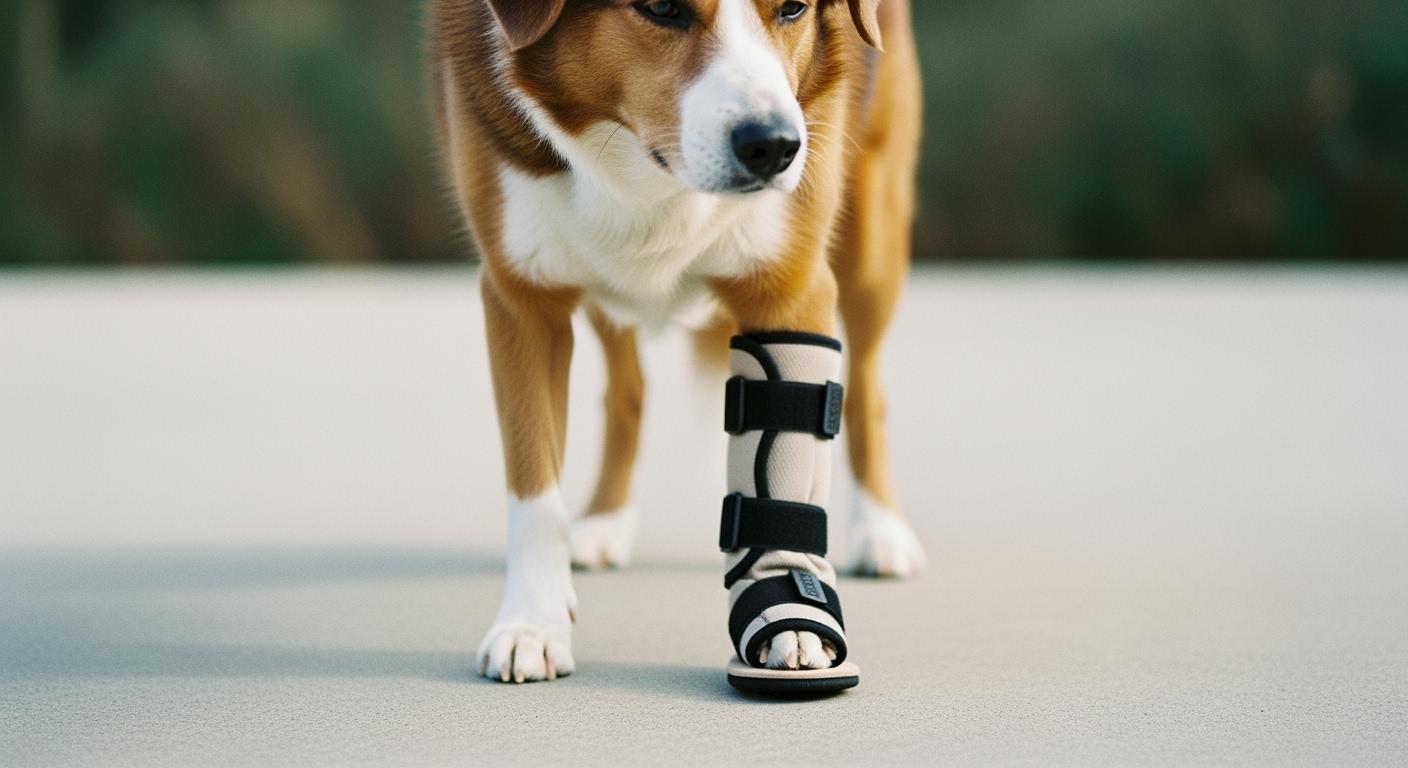
Dogs knuckle. The toes fold under mid-stride, the top of the paw hits the ground before the pad, and every step scrapes skin across pavement or carpet. A dog foot brace for knuckling is supposed to stop that. The toe-lift cord pulls upward, the paw clears the ground, and the pad lands first.
But it does not always work that way.
Two failures repeat across brace designs. First, the brace rotates on the leg. The toe-lift cord shifts off-center and the vertical pull component drops. Toes drag again. Second, the padding over the toe knuckles compresses under repeated load. Friction builds where the dog cannot feel it. Skin breaks down. The dog keeps walking. The wound worsens.
Neither failure announces itself loudly. Both are visible if you know where to look. What follows walks through the mechanics of why a dog foot brace for knuckling fails in these two ways, how to spot each failure before it causes injury, and when even a well-fitted brace is not the right tool.
Why a Foot Brace Twists and the Toe-Lift Fails
Brace rotation is the most common failure because the forces that cause it are built into every step. When a dog walks, the leg does not move in a single plane. It arcs slightly outward with each stride, then inward. That lateral motion applies a twisting force to anything strapped to the lower leg.
A narrow strap at the ankle has minimal surface area in contact with the leg. That small contact patch acts as a pivot, not an anchor. When lateral walking force hits the strap, it rotates around the leg. The toe-lift cord is anchored to that strap, so when the strap rotates, the cord’s pull direction shifts with it.
This is where the physics works against the design. A toe-lift cord pulls the toes upward. That force vector points straight up the leg when the brace is centered. But rotate the anchor point 20 degrees to the side, and the vertical component of the lift force drops. Basic vector decomposition: at 20 degrees of rotation, roughly 6 percent of the vertical lift is lost to the horizontal component. At 45 degrees, nearly 30 percent is gone. The cord still pulls, but more sideways than up. Toes drop. They scrape.
A tighter strap does not fix this. A tighter narrow strap concentrates pressure at the same small contact patch without increasing anti-rotation surface area. It can make rotation worse by creating a harder pivot edge. What changes the outcome is multi-point attachment: a brace that anchors at two or more positions along the leg, creating a broader base that resists twisting. A brace built with multi-point strapping distributes the anchoring force across a wider contact zone so no single strap carries the full twisting load.
Not all products marketed for knuckling address rotation. The table below shows where common product types succeed and where their designs leave the toe-lift vulnerable:
| Product type | What it helps | Where it can fail | Better use case |
|---|---|---|---|
| Regular dog boot | Protects paw pads from rough ground | Does not lift toes; adds weight that can worsen drag | Healthy dogs needing sole protection |
| Paw-protection boot | Shields paw pads and sometimes upper paw | No toe-lift mechanism; knuckling toes still scrape | Dogs with minor scrapes or mild paw injuries |
| No-knuckling training sock | Lifts toes for short rehab sessions | Single elastic cord provides no anti-rotation; can rub if overused | Short, supervised training sessions |
| Dog foot brace for knuckling | Lifts toes, protects upper paw, supports gait | Needs correct multi-point fit to resist rotation | Dogs with mild to moderate knuckling |
Rotation failure is observable. After 10 minutes of walking, sight down the front of the brace. The toe-lift cord or strap should trace a straight line up the center of the leg. Mark the starting position with a small piece of tape if it helps. If the cord has drifted more than half an inch left or right of centerline, rotation is actively degrading the lift. The toes may still clear the ground for now, but the trend points toward failure.
A brace that maintains toe-up control through the full stride depends on this alignment holding. When it does not, the product knowledge gap is not about buying a different brace. It is about recognizing that rotation is a predictable failure mode with clear observable signals, and that anti-rotation design separates braces that work across full walks from those that work only at the start. A structured approach to knuckling-related mobility starts with verifying this alignment before assuming the brace type is wrong.
Use the walk-test table below to map what you see during movement to what it means for brace performance:
| What you see | What it means | Next action |
|---|---|---|
| Paw pad lands flatter | Brace is working | Continue use and monitor |
| Toes still scrape | Toe-lift insufficient | Check cord alignment; adjust fit or try different design |
| Brace twists sideways | Anti-rotation has failed | Refit multi-point straps; verify anchor points are secure |
| Dog kicks too high | Brace may be too bulky | Try a lower-profile brace with same lift mechanism |
| Upper toe area still wears | Padding coverage insufficient | Check padding thickness over knuckles; see H2 below |
| Redness stays after removal | Possible pressure injury | Stop use; shorten sessions; inspect padding at red zone |
| Cold toes, swelling, bleeding, or pain | Circulation or injury risk | Stop use immediately; seek veterinary care |
Where Padding Fails and Skin Pays the Price
Padding looks like the simplest part of a brace. It is the part most likely to be overlooked. It is also where failure causes the most damage because the dog often does not feel it happening.
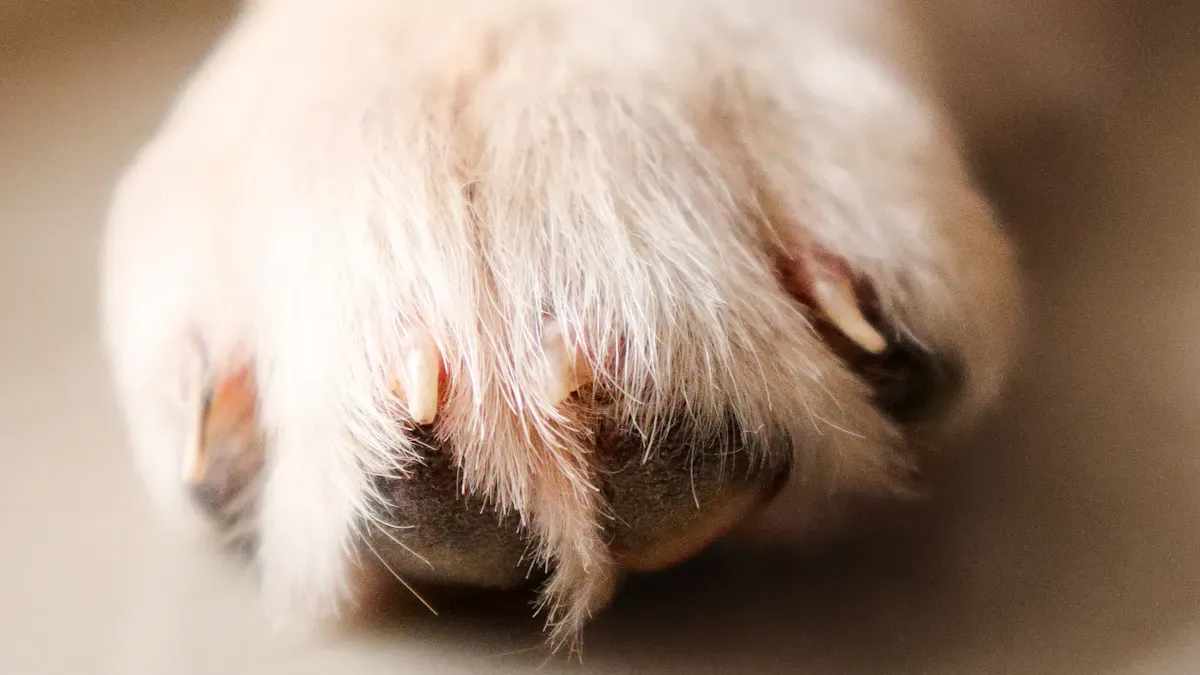
Knuckling frequently accompanies reduced paw sensation. The same neurologic disruption that causes the toes to fold under can also mean the dog does not register pressure, friction, or early-stage skin irritation in the paw. A brace with thin padding over the toe knuckles creates a hazardous situation: sustained pressure on tissue the dog cannot feel, with no behavioral signal to stop.
Here is the mechanical chain. A dog takes a step. Body weight transfers through the leg, and the toe knuckles press into the brace’s interior padding. If that padding is a thin foam sheet, it compresses to a fraction of a millimeter under load. At that point it is not absorbing force. It is transmitting it. The bony prominences of the toe knuckles bear the full interface pressure against the brace shell.
Friction adds a second mechanism. As the leg moves inside the brace, even a well-fitted one allows micro-movement, the compressed padding rubs across the skin over those knuckles. Moisture from sweat or a wet walk accelerates the process. The skin macerates. The surface layer breaks. A wound opens. And because sensation is reduced, the dog does not limp or favor the paw. It keeps walking on damaged tissue.
Thicker, multi-density padding changes this outcome. A denser base layer distributes force across a larger area. A softer contact layer conforms to knuckle contours without creating hard edge pressure. Together they absorb what they were designed to absorb. The same walk, the same forces, but the padding does its job. A daily-use fit protocol that includes post-walk padding inspection catches compression failure before skin breakdown starts.
Rear paw drag creates specific skin safety risks that differ from front-leg knuckling. The rear paw carries more weight bias during propulsion, so the same padding thickness faces higher peak pressure on a hind-leg brace. A padding configuration that works for a front-leg brace under 30-minute sessions may compress fully in half that time on a rear leg.
You can verify padding performance directly. Remove the brace after 20 minutes of walking. Press a finger firmly on any red area over the toe tops for two seconds, then release. If the skin blanches white and refills pink within a second, circulation is intact. The redness is surface-level. If the red patch stays red without blanching, sustained pressure has restricted blood flow to that tissue. That is a pre-injury signal. Shorten wear sessions and inspect the padding thickness over that exact spot.
The 20-to-30-minute redness-fade window is a useful benchmark. Skin that returns to normal color within that window suggests transient pressure that the tissue handled. Redness persisting beyond 30 minutes means the tissue spent too long under load. Cold toes are an emergency stop signal. Remove the brace immediately.
When Toe-Lift Support Is Not Enough
A dog foot brace for knuckling compensates for a mechanical deficit. It lifts the toes when the dog’s own proprioceptive-motor loop cannot. But it cannot compensate for everything.
Worsening knuckling while wearing a properly fitted brace points to progression of the underlying condition. If the toes cleared the ground last week and drag this week with the same brace, same fit, same walk surface, the brace is not failing. The deficit it was compensating for has grown beyond what the brace can offset. This is not a fit problem. It is a mismatch between the brace’s lift capacity and the severity of the knuckling.
Early knuckling signs that worsen over days rather than weeks warrant a pause on brace use and a veterinary assessment. The brace can mask progression by partially correcting the visible symptom while the underlying process accelerates unchecked.
Other stop signals: the dog chews at the brace repeatedly despite fit adjustments. The paw feels cold to the touch minutes after removal. Swelling develops around the strap lines. Non-blanching redness persists in the same spot across multiple sessions. These are not minor irritation. They are signals that the brace, in its current configuration, is creating more tissue stress than it relieves.
Disclaimer: These fit and skin checks assume a short-coated dog where redness and strap marks are visible without parting fur. Double-coated breeds or dogs with dense undercoat may show subtler rub marks that require hand-checking under the coat rather than visual inspection alone. Dogs with angular limb deformities or leg conformation that falls outside typical breed norms may experience pressure points that the standard walk-test protocol does not catch. The brace geometry is patterned for standard leg profiles, and atypical anatomy shifts where the force concentrates.
Häufig gestellte Fragen
How long should a dog wear a foot brace for knuckling each day?
Start with 15 to 30 minutes during the first supervised session. Check skin immediately after removal using the blanching test described above. If skin recovers within the 20-to-30-minute redness-fade window, gradually extend sessions. A brace that passes all walk-test checks may still cause cumulative pressure injury if wear time increases faster than tissue adaptation.
Can a foot brace for knuckling be used on both front and back legs?
Yes, but the force profile differs. Rear legs carry more weight bias during propulsion, which increases peak pressure on the toe knuckles and raises the anti-rotation demand. A brace sized correctly for the limb may still need shorter initial wear sessions on a rear leg because the padding compresses faster under higher load.
How do I know if the brace fits correctly?
Three signals: the toe-lift cord stays centered on the front of the leg after 10 minutes of walking, the paw pad lands before the toes, and skin under the brace returns to normal color within 30 minutes of removal. All three must hold. Any one failing means the fit needs adjustment before continuing use.
Will a dog foot brace for knuckling help all dogs with dragging paws?
No. A brace works by mechanically lifting toes that the dog’s own motor control cannot position correctly. If the underlying knuckling is severe enough that the brace’s maximum lift angle still leaves the toes below the paw pad, or if the dog has no residual voluntary leg movement, the brace cannot compensate. Worsening knuckling on a properly fitted brace is a signal that the condition has progressed beyond what mechanical toe-lift can offset.
