
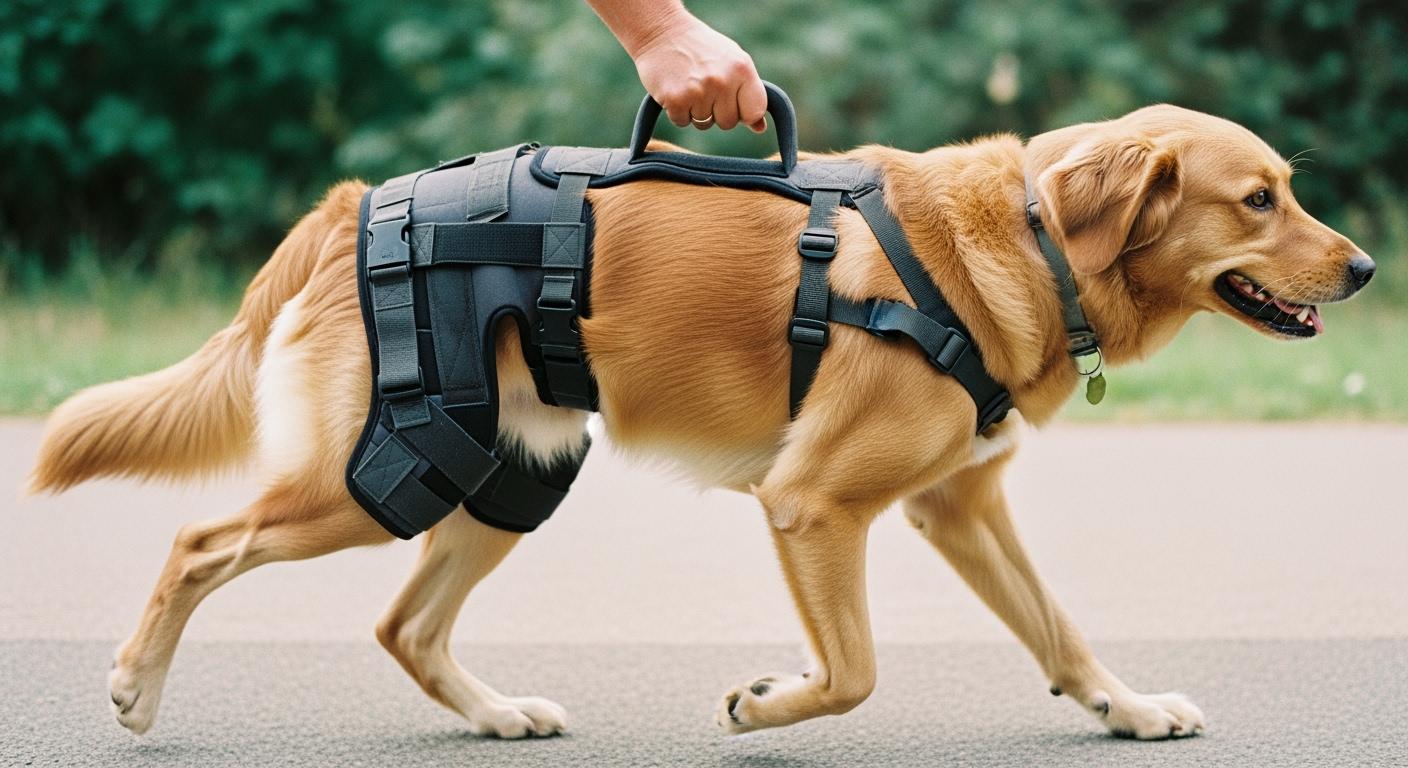
A handle on a hip brace seems simple. You grip it. You lift. The dog stands. But pull that handle even slightly off-center and the entire brace can rotate around the dog’s torso — sliding backward, twisting into the groin, concentrating pressure where padding is thinnest. The handle that was supposed to help just created a pressure point your dog will not tolerate.
What matters is not whether the brace has a handle. It is where the handle sits, how wide the anchoring surface spreads the lift force, and whether the lining grips or slips when you pull. Those three details determine whether you get usable assisted movement or a brace that ends up on the floor.
What Happens When You Pull the Handle Off-Center
Lift force on a hip brace handle travels in a straight line. If the handle is centered over the spine, the force vector runs downward through the pelvic wrap into both sides of the brace evenly. Each thigh strap carries roughly half the load. The brace stays where it was strapped.
Pull from the side instead. Now the force vector angles across the dog’s back at a diagonal. The near-side thigh strap takes most of the load while the far-side strap goes slack. That imbalance rotates the brace — the near side digs in, the far side lifts away from the body, and the entire wrap torques around the torso. Where does the rotation stop? Typically at the groin, because that is where the thigh strap anchors meet the inner leg. The result is concentrated edge pressure in soft tissue.
That fails fast. Twenty steps, sometimes fewer. After ten minutes of assisted walking on a dog with hip dysplasia, run your fingers under the groin-side edge of the brace. Damp, warm skin with a visible red line means the brace rotated and rubbed. Dry, cool skin with no crease means the lift stayed centered and the brace held position. The skin tells you which it was.
This rotation mechanism explains why slipping is rarely just a strap tension problem. Tightening straps harder against a rotating brace only increases the groin pressure. The fix is structural: a handle anchored along the spine line, not offset to one side, paired with a pelvic wrap wide enough to resist torque rather than transmit it.
| Failure scene | What happens | Structural cause | Design fix |
|---|---|---|---|
| Standing up from floor | Brace slides back toward tail | Narrow waist anchor cannot resist upward drag | Wide belly strap or dual waist anchor points |
| Going up 1–3 steps | Brace rotates around torso | Off-center handle creates asymmetric lift | Centered handle, broad pelvic wrap for torque resistance |
| Getting into a car | Groin rubs, brace shifts forward | Thin thigh strap concentrates load on a narrow band | Broader thigh wrap, padded edge binding at contact points |
| Turning indoors | Brace bunches or slips sideways | Smooth lining slides against fur under lateral force | Grip-textured lining, breathable padding that stays put |
| Wearing after short walks | Heat buildup, pressure marks | Non-breathable foam traps moisture and heat | Perforated or open-cell padding, post-wear skin check |
| Weaker design | Stronger design | Why the difference matters |
|---|---|---|
| Narrow handle | Wide padded handle | Wide padding distributes lift across more hand surface; narrow handles concentrate grip force into a thin line that transmits unevenly to the brace shell |
| Side-pull handle placement | Centered handle over spine | Centered placement keeps the lift vector vertical; side pull introduces rotation that torques the brace off-axis |
| Thin thigh strap | Broad hip wrap | A wide wrap spreads load across more surface area, reducing per-square-inch pressure at any single point |
| Smooth lining | Grip lining with breathable padding | Grip texture resists lateral sliding against fur; breathable construction prevents the moisture barrier that accelerates slipping |
| No waist stabilization | Waist or belly anchor | Without a second anchor, the entire brace becomes a single-point lift device — all upward force exits through the thigh straps |
Why the Brace Slides Backward Under Lift
When a dog pushes up from the floor, the hip brace experiences two competing forces: compression from the dog’s own weight settling into the wrap, and upward drag from the handle pulling against the straps. If the waist or belly anchor is too narrow — a single thin strap, for instance — the upward force overcomes friction almost immediately.
Here is the physics of it: a one-inch strap looping around the waist has roughly four to six square inches of contact area on a medium-sized dog. Pull upward with ten pounds of assist force and that contact patch is now carrying all ten pounds in shear. Fur is a low-friction surface. The strap slides. The entire brace shifts backward toward the tail, and the compression that was supposed to stabilize the hip joint is now misaligned by an inch or more.
A wider anchor — four to five inches across the belly or lower chest — multiplies the contact area. Same ten pounds of lift, now spread across twenty to thirty square inches of grip surface. That reduction in pounds per square inch is often enough to keep the brace in place through a standing transition. Daily fit checks before lifting reveal whether the anchor width matches the dog’s build — narrower dogs with deep chests tend to need a belly strap, while barrel-chested breeds often do fine with a wide waist wrap alone.
Mark the brace position with a piece of tape on the fur at the front edge before asking the dog to stand. After standing and taking five steps, check the tape. More than half an inch of backward shift means the anchor surface is not wide enough or the lining is not gripping. Less than a quarter inch of movement is typical and usually acceptable.
When a Handle Helps and When It Overloads the Fit
A handle on a hip brace serves one narrow function well: brief, vertically-guided assistance during a short transition. Standing up from a bed. Climbing two or three stairs. Stepping into a vehicle. In each case the lift lasts seconds, the force is primarily vertical, and the dog is bearing most of its own weight.
The handle was never designed for sustained weight-bearing. When a dog leans heavily into the brace for more than a minute — or when the handler uses the handle to take over a significant portion of the dog’s body weight — two things happen. First, the straps begin to creep against the fur under sustained load, even with a grippy lining. Second, the padding compresses. Compressed padding is thinner padding. Thinner padding transmits more heat and more pressure to the skin underneath. A brace that felt comfortable during a five-second stand becomes hot and irritating after two minutes of continuous lift.
Dogs with severe hind-end weakness, collapse episodes, or post-surgical non-weight-bearing restrictions fall outside what a hip brace handle can safely support. In those scenarios, a full lift harness distributes support across the chest and abdomen rather than concentrating it through a hip brace shell. The brace still provides joint compression and warmth — but the lifting should come from a separate system designed for that load.
Hip brace solutions that combine compression support with separate mobility tools tend to match real-world use better than trying to make one product do both jobs.
Disclaimer: The fit and sliding checks described here assume a short-coated dog where visual inspection of strap position is straightforward. Double-coated or thick-furred breeds may show subtler rub marks beneath the fur — hand-checking by feel is more reliable than visual inspection for these dogs. If the dog’s body conformation falls well outside typical breed proportions — particularly dogs with angular limb deformities or very deep, narrow chests — the anchor-surface logic described here may not catch every pressure point. In those cases, shorter wear sessions with more frequent skin checks are the safer path.
- Fit the brace on flat ground with the dog standing naturally.
- Let the dog bear its own weight before applying any handle support.
- Apply light upward handle support for a few seconds only — lift straight, keep the handle centered over the spine.
- Watch for brace rotation, backward slide, groin pressure, or signs the dog is resisting the lift.
- Remove the brace and check skin for red marks, moisture, or hair disturbance. Recheck gait.
Distinguishing hip support from knee support matters here because a hip brace with a handle loads the pelvic region during lift — if the dog’s primary weakness is in the stifle rather than the hip, the handle may bypass the joint that actually needs assistance. A hip brace built with hind-leg anchoring and a centered lift point targets the correct joint group, but confirming that the hip — not the knee or hock — is the source of instability keeps the handle from being used on the wrong problem.
Häufig gestellte Fragen
Why does the brace twist when I help my dog up stairs?
Stairs force the handler to pull at an angle — the dog is below you or above you, so the handle is rarely directly overhead. That off-vertical pull introduces rotation. A centered handle with a wide pelvic wrap resists this torque better than a narrow, side-mounted handle. If twisting persists, pause on each step and reposition rather than pulling through the rotation.
How do I know if the brace has shifted during use?
Place a small piece of masking tape on the fur at the front edge of the brace before the dog moves. After the assisted movement, check whether the tape is still aligned with the brace edge. More than half an inch of separation indicates the brace slid. Less movement with no skin marks suggests acceptable hold.
Can I use the handle to lift my dog into the car every day?
Brief car-entry lifts — two to three seconds of upward guidance — fall within what a well-anchored handle can do. But daily repeated lifting, especially for heavier dogs, accelerates strap creep and padding compression. Alternating between the brace handle and a dedicated lift harness for car loading spreads the wear across different contact points and gives the skin under the brace time to recover between sessions.
What is the first sign that the handle is causing problems?
The dog tells you before the skin does. Hesitating when you reach for the handle. Turning the head back toward the brace. Sitting down abruptly mid-lift. These behaviors often precede visible redness or fur disturbance. If the dog’s reaction to the handle changes from one session to the next, check the brace fit before assuming the joint pain itself has worsened.
Does a wider handle actually make a difference?
A wide padded handle spreads lift force across the hand, which reduces the tendency to grip harder and pull more abruptly. Jerky, high-force pulls rotate a brace faster than smooth, low-force guidance. Wide handles also tend to be anchored across a broader section of the brace shell — two or more attachment points instead of one — which reduces the leverage that rotates the brace off-axis when the pull is not perfectly vertical.
