
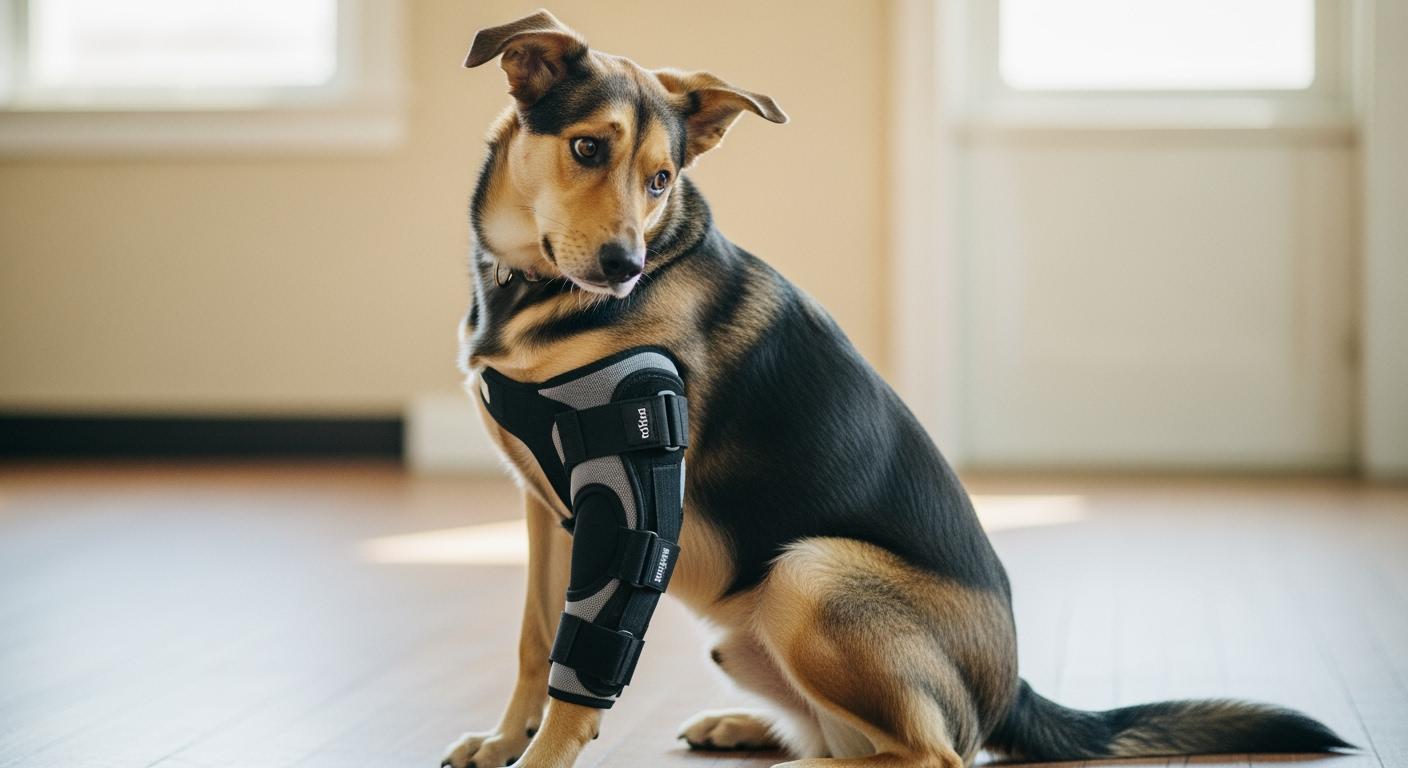
Most dog knee braces for torn ACL hind leg look stable during a straight-line walk across the living room. That test means almost nothing. The brace fails when the dog sits, turns to sniff something, or pushes up from a lying position. Those are the movements that expose whether the hinge actually tracks the stifle joint or drifts under load. And once the hinge drifts, the brace becomes dead weight strapped to a leg.
This is not a fit-sizing problem. It is a structural one. The hinge takes force along one axis during forward walking. Sit, turn, or rise, and the force vector shifts off-axis. If the hinge is a single-pivot design with no polycentric compensation, the entire brace rotates around the thigh. The dog feels the pressure shift, compensates with an altered gait, and loads the opposite leg harder. That secondary strain can turn a single-limb issue into a bilateral problem within weeks.
A fit quality over raw brace strength approach matters here because a brace that grips harder but aligns poorly concentrates force instead of distributing it. Understanding where these braces structurally fail lets you catch problems before the dog tells you with a limp.
Where the Brace Fails During Sitting, Turning, and Rising
Three failure points repeat across most knee brace designs. They are predictable once you understand the mechanics.
Hinge Drift Away from the Stifle Joint Axis
The hinge is the load path. When the dog walks straight, the hinge carries force in a single plane and stays roughly centered over the stifle. Turn the dog, and lateral force pushes the hinge off-axis. A single-pivot hinge has no mechanism to absorb that lateral component. The force has to go somewhere. It transfers into the fabric and straps.
Fabrics stretch. Straps give. The hinge drifts a quarter-inch, then half an inch. At that point the brace is no longer supporting the knee. The dog senses the instability and tightens the surrounding muscles to self-stabilize, which increases joint compression on an already compromised ligament. That is the causal chain: off-axis force leads to single-pivot hinge failure to compensate, which transfers load to soft materials, the brace migrates, the dog muscle-guards, and joint compression increases.
Polycentric hinges reduce this by splitting the pivot across two points, letting each absorb part of the lateral displacement. The hinge stays closer to the joint center through a wider range of motion. After 10 minutes of indoor walking with turns, check whether the hinge is still centered over the stifle. If it has drifted more than a half-inch, the hinge design is not matching the dog’s movement pattern.
Straps Bunch Behind the Knee
When the dog flexes the stifle to sit, the angle behind the knee closes. Any strap routed through that zone bunches. Bunched material creates a focal pressure point. Unlike distributed pressure from a wide padded cuff, a bunched strap concentrates force into a narrow band. The skin under that band gets less blood flow. After 20-30 minutes, the area reddens. Leave it longer, and the skin breaks down.
Straps routed to avoid the popliteal region entirely eliminate this failure mode. The tradeoff is that avoiding the bending zone requires more anchor points above and below the knee, which adds bulk. Whether that tradeoff is worth it depends on wear duration. For dogs wearing the brace less than an hour at a time, a well-padded strap passing near the bending zone may be tolerable. For multi-hour daily wear, routing outside the zone is the safer path. Daily stifle brace fit checks should include running a finger behind the knee after removal to feel for residual indentations.
Thigh Cuff Slides During Turns
The thigh cuff is the primary anchor. If it slides, the entire brace migrates downward. The cuff slides when the inner surface lacks sufficient friction against the fur and when the cuff circumference cannot be locked independently of the lower straps. A cuff tied to the same adjustment as the calf strap will loosen as the dog’s thigh muscle contracts and relaxes during movement. Independent adjustment per anchor point prevents this cascading loosening.
| Daily movement | What failure looks like | Likely product cause | Better design direction |
|---|---|---|---|
| Sitting | Dog avoids sitting, brace pinches or slips | Hinge drifts, straps bunch in popliteal zone | Polycentric hinge, straps routed outside bending zone |
| Rising from rest | Dog hesitates, brace twists | Thigh cuff anchor loosens under muscle contraction | Independently adjustable thigh cuff, high-friction inner surface |
| Slow turning | Brace shifts laterally, dog short-steps | Single-pivot hinge cannot absorb lateral force component | Polycentric hinge, wide strap footprint resists rotation |
| Short leash walking | Brace rides down, dog stops | All anchor points share one adjustment loop | Independent strap tension per anchor |
| Bathroom break | Dog cannot posture, brace blocks flexion | Rigid hinge lacks sufficient flexion range | Hinge with flexion stop matching the dog’s functional range |
| Lying down after use | Dog chews brace, skin creases | Non-breathable lining traps moisture, edges are unfinished | Spacer-mesh lining, rolled and finished edge construction |
The table above maps each movement to a structural cause. What makes a brace suitable is not whether it looks supportive on a product page. It is whether the hinge stays centered through turns and the anchors hold independently through a full sit-rise cycle. Test that. Put the brace on, walk a figure-eight pattern indoors for five minutes, then check each anchor point for position shift.
Design Details That Determine Whether the Dog Tolerates the Brace
A brace that provides perfect support on paper means nothing if the dog refuses to wear it after the third session. Tolerance is a design problem, not a training problem.
Hinge Placement That Follows the Stifle Rather Than Fighting It
The hinge must sit at the stifle’s rotational center. On most dogs, that center is roughly at the junction of the femur and tibia, palpable as a bony landmark on the lateral side of the leg. If the hinge is positioned even a half-inch above or below that point, every flexion cycle creates a lever arm between the hinge and the joint. The longer that lever arm, the more the brace fights the dog’s natural movement. The dog compensates by reducing range of motion, which shortens the stride and loads the hip differently. Hinge type and daily use interact directly: a polycentric hinge tolerates more positioning variance than a single-pivot hinge, but neither works if placed outside the joint’s rotational plane.
For a back leg torn CCL knee brace, the hinge position must also account for the dog’s natural standing angle. Some breeds stand with a more angulated stifle. The hinge stop must match that angle so the brace does not force the joint into an unnatural extension at rest.
Padding That Spreads Load Instead of Concentrating It
Padding fails in two ways: it compresses too much and bottoms out, or it does not compress enough and creates hard edges. The sweet spot is a closed-cell foam layer backed by an open-cell comfort layer. The closed-cell layer handles load distribution. The open-cell layer handles skin contact. When a brace uses only open-cell foam, it feels soft initially but compresses to near-zero thickness under sustained pressure, leaving the strap edge digging into skin.
Check this yourself. Remove the brace after the first 20-minute session. Run your thumb along every strap edge path on the dog’s leg. You are checking for linear indentations that match strap boundaries. A faint outline that fades within 10 minutes is acceptable. A deep groove that persists past 20 minutes means the padding has bottomed out and the strap edge is cutting in. That is not a fit adjustment problem. It is a padding spec problem.
| Product detail | Weak design problem | More suitable design |
|---|---|---|
| Hinge type | Single-pivot, drifts under lateral load | Polycentric, absorbs lateral displacement across two pivot points |
| Thigh anchor | Shares adjustment with calf strap, loosens as muscle flexes | Independent tension lock per anchor point |
| Strap route | Passes through popliteal zone, bunches during flexion | Routed above and below bending zone, wide footprint |
| Edge construction | Cut edge presses into skin, bulk adds heat | Rolled and finished edges, minimal material overlap |
| Inner lining | Non-porous fabric, moisture accumulates at skin interface | Spacer mesh, air-permeable, wicks moisture away from skin |
| Adjustment mechanism | Single strap adjusts all points simultaneously | Per-anchor tension control, tool-free |
| Cleaning turnaround | Slow-dry foam traps odor, dog rejects brace over time | Removable liner or quick-dry construction, machine-washable |
When a Knee Brace Works and When It Does Not
A knee brace for a torn ACL hind leg is a mechanical support tool. It works within a defined envelope and fails outside it. Knowing the boundary prevents misuse.
The brace tends to perform best when the tear is partial and the joint still has some intrinsic stability. The hinge supplements what remains of the ligament’s passive restraint. It also works as a post-surgical support during restricted activity phases, where the goal is protecting the repair from an accidental twist rather than load-bearing during vigorous movement. For senior dogs or dogs with comorbidities that rule out surgery, a well-fitted brace can preserve enough joint stability for quality-of-life mobility: short leash walks, bathroom trips, moving between rooms.
The brace is the wrong tool when the tear is complete and the tibia translates forward freely with no endpoint. No external brace can replicate the restraint of an intact cruciate ligament under full weight-bearing load. The hinge can limit translation but cannot eliminate it. Dogs with very angulated stifles or unusual leg conformation may not fit standard brace geometries. Dogs that panic or thrash when restrained around the leg will not tolerate even the best brace design. A dog that fights the brace creates more joint stress than the brace can offset.
Disclaimer: The fit checks described here assume a short-coated or medium-coated dog where skin is visible beneath the fur. Double-coated breeds may show subtler rub marks that require hand-checking rather than visual inspection. Run your fingers under the fur along every strap path after removal. If the dog’s leg conformation falls outside breed norms this brace is patterned for, particularly dogs with angular limb deformities or very deep chests, the pressure-point checks described here may not catch every fit issue. In those cases, a veterinarian or rehabilitation therapist should assess fit directly.
| Signal level | What you see | What to do |
|---|---|---|
| Green | Hinge stays centered, dog sits and rises without hesitation, no lasting marks after removal | Continue use, check anchor positions daily |
| Yellow | Less than half-inch hinge drift, brief rubbing marks that fade within 10 minutes, mild hesitation on turns | Adjust strap tension per anchor, shorten session, recheck |
| Red | Worsening limp, swelling around the stifle, cold paw, deep strap grooves lasting over 20 minutes, refusal to bear weight | Stop use immediately, have a veterinarian assess |
Break-in and daily wear checks are not optional first-week tasks. They are permanent parts of brace use. A brace that fit last month may not fit the same way this month if muscle mass has changed from altered activity levels.
A knee brace stability and recovery support approach works when the failure points are understood and monitored. The brace is not a set-and-forget device. It is a mechanical interface between a moving animal and a structural support. That interface requires observation, adjustment, and honest assessment of whether the dog is moving better or just moving differently.
Häufig gestellte Fragen
Why does the brace look fine during walking but fail when the dog sits?
Walking generates force primarily in the sagittal plane, which a single-pivot hinge handles adequately. Sitting and turning introduce lateral and rotational forces that a single-pivot hinge cannot absorb. The excess force transfers to the fabric and straps, causing the hinge to drift off the stifle and the brace to lose its support position. A polycentric hinge design reduces this by splitting the load across two pivot points.
How long can a dog wear a knee brace in one session?
Start with 20–30 minutes and check skin immediately after removal. If there are no deep strap marks and the dog moves comfortably, sessions can extend gradually. Most dogs wearing a well-fitted brace with breathable lining can tolerate 2–4 hours with a midday removal and skin check. Remove the brace during sleep and unsupervised rest.
Can a knee brace replace surgery for a torn ACL?
No. A brace provides mechanical support but cannot restore the passive restraint of an intact cruciate ligament. For partial tears, it can supplement remaining ligament function during conservative management. For complete tears with significant tibial translation, a brace alone is typically insufficient. The decision between surgical and non-surgical management should be made with a veterinarian based on tear severity, the dog’s age, weight, and activity requirements.
