
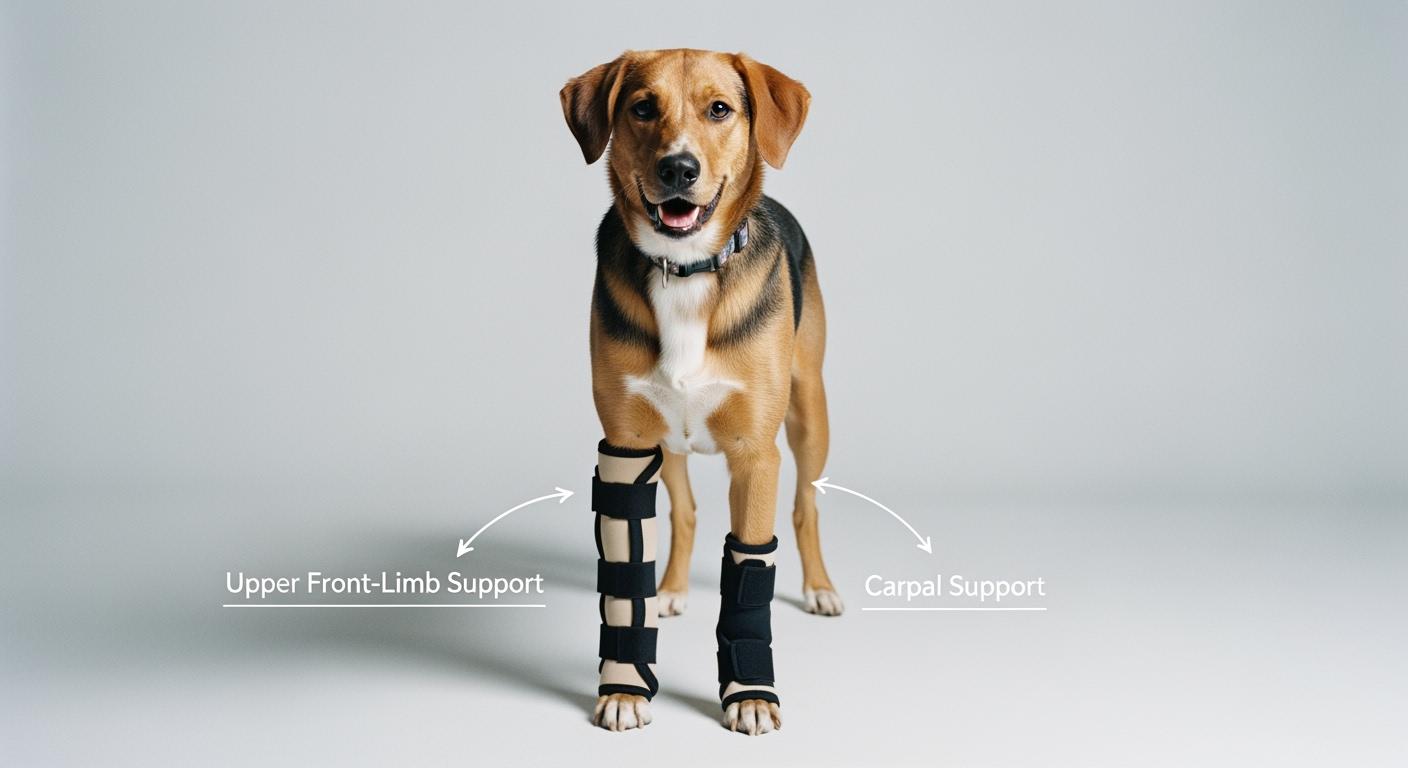
Dog leg brace front should be judged by one practical question: is the support need centered lower at the carpal joint or higher at the elbow or shoulder area. Carpal support usually makes more sense when instability, pain, or weakness appears around the wrist and lower front leg. Upper front-limb support usually makes more sense when the problem shows up higher and affects elbow or shoulder movement. If you want a broader fit-and-comfort reference before comparing support paths directly, start with canine rehabilitation brace fit, comfort, and safety.
Das Wichtigste in Kürze
- Carpal support usually fits better when the problem is lower in the front leg and centered around wrist stability.
- Upper front-limb support usually fits better when pain, weakness, or instability appears higher around the elbow or shoulder.
- The right brace still depends on accurate fit, gradual break-in, and whether your dog can actually tolerate daily wear.
Dog Leg Brace Front: Support Areas Explained
When you search for dog leg brace front, the first decision is support location rather than product style. Front-leg bracing usually follows two main paths: lower front-leg support for carpal or wrist-centered problems, and upper front-limb support for elbow- or shoulder-centered problems.
You can use this table to compare the main support paths more clearly:
| Support Path | Main Area | Usually Best For |
|---|---|---|
| Carpal support | Wrist and lower front leg | Carpal instability, hyperextension, lower-leg weakness, wrist-centered arthritis |
| Upper front-limb support | Elbow or shoulder region | Higher front-leg weakness, elbow discomfort, upper-limb instability, post-surgical support higher on the limb |
| Broader front-leg support path | More than one front-leg zone | Cases where pain, weakness, or instability is not isolated to one support point |
If the problem appears lower, around the wrist or paw-placement zone, carpal support usually makes more sense. If the problem appears higher and affects elbow or shoulder use, upper front-limb support is the better first comparison. For product-side comparison after this section, review the products hub.
You can compare fit and wear guidance in canine rehabilitation brace fit, comfort, and safety and wrist-focused support in dog carpal brace complete guide: front leg support.
Carpal (Wrist) Support
Carpal support braces help dogs with wrist-centered injuries, lower front-leg instability, or carpal hyperextension patterns. These braces focus on the lower front limb and are most useful when the dog shows swelling, wobble, weakness, or abnormal paw placement closer to the wrist than to the elbow. For a deeper wrist-specific comparison, continue to dog carpal brace complete guide: front leg support.
Upper Front-Limb Support
Upper front-limb support braces are more useful when the weakness or pain is centered higher in the leg. These cases often involve elbow discomfort, shoulder-area guarding, or front-leg use problems that do not look wrist-centered. Upper-limb support matters because lower-leg bracing alone may not change the gait enough when the real issue starts higher up.
Dog Leg Braces: Anatomy and Common Injuries
Front Leg Anatomy Overview
To pick the right front-leg brace, you need a simple understanding of where the support zone sits. The front limb can be thought of as three practical regions for bracing: the upper front limb near the shoulder, the middle support zone near the elbow and forearm, and the lower front limb around the carpal joint, paw, and wrist mechanics.
- The upper front limb matters more when the dog guards higher movement.
- The forearm and elbow zone matter when loading and stepping look unstable higher on the limb.
- The carpal region matters most when the dog collapses or wobbles lower near the wrist.
During walking, the front leg carries a large part of the dog’s body weight, so even a small support mismatch can change comfort and stride quality quickly. That is why front-leg bracing works best when the support location matches the real movement problem.
Typical Injuries Requiring Bracing
Dogs can injure different parts of the front limb, and brace value depends on matching support to the correct zone. Use this table to compare common front-leg support situations:
| Front-Leg Problem | Support Path Often Considered |
|---|---|
| Carpal hyperextension or wrist instability | Carpal or lower front-leg support |
| Carpal sprain, lower-leg strain, or wrist-centered arthritis | Carpal support |
| Elbow discomfort, elbow weakness, or upper forelimb guarding | Upper front-limb support |
| Shoulder-area instability or broader front-limb weakness | Upper or broader front-limb support path |
Carpal injuries often show up as lower-leg wobble, wrist drop, or trouble placing weight through the paw correctly. Higher front-limb problems often show up as elbow guarding, reduced reach, or pain when the dog lifts or loads the leg higher up.
For a broader diagnosis-first path before comparing products, use the Solutions by Condition page.
Tip: Always ask your vet to check your dog’s injury before picking a brace. Finding the problem early helps your dog get better faster.
Carpal vs Upper Limb Braces: Choosing the Right Support
Picking the right support for a front-leg injury is mainly a location decision. The better brace is the one that matches where the dog is unstable, sore, or weak during real daily movement. Carpal and upper front-limb braces solve different problems, so this choice should be based on gait pattern and support target rather than on generic “front leg brace” language alone.
When to Use Carpal Support
Carpal support is usually best when the problem is clearly lower in the front leg. These cases often show one or more of the following signs:
- wobble or weakness near the wrist
- swelling around the carpal area
- wrist drop, hyperextension, or abnormal lower-leg angle
- paw-placement problems or reduced confidence loading the paw
- lower front-leg discomfort that becomes clearer after walking
Carpal support is most useful when the brace needs to stabilize the lower front limb rather than the elbow or shoulder area. Use this table as a quick guide:
| Lower Front-Leg Sign | Why Carpal Support Fits Better |
|---|---|
| Wrist-centered swelling or instability | The support need is centered around the carpal joint. |
| Hyperextension or dropped wrist posture | The lower joint needs more controlled alignment. |
| Paw placement looks unstable | Lower-limb support can improve wrist-level control. |
If your dog cannot load the front paw comfortably because the wrist is unstable, carpal support is usually the better first path.
When to Use Upper Limb Support
Upper front-limb support braces are more relevant when the instability or pain appears higher in the front leg. Look for signs such as:
- pain or guarding near the elbow
- shortened reach or reluctance to load the leg fully
- pain higher up when the dog lifts or swings the limb forward
- post-surgical or chronic weakness that is not centered at the wrist
- shoulder- or elbow-area arthritis patterns that change front-leg use
These braces matter when the support goal is higher-limb stabilization instead of lower-joint control. If your dog’s movement problem starts higher than the wrist, upper front-limb support is usually the better first comparison.
Benefits and Limitations
Carpal and upper front-limb braces can both help, but they solve different front-leg problems. The more useful comparison is this:
| Comparison Point | Carpal Support | Upper Front-Limb Support |
|---|---|---|
| Main target | Lower front leg and wrist stability | Higher-limb stability around elbow or shoulder |
| Usually best for | Hyperextension, lower-leg wobble, wrist-centered weakness | Higher-limb guarding, elbow discomfort, upper-limb weakness |
| Main strength | Better lower-joint control | Better higher support coverage |
| Main limitation | Will not fix a higher-limb support problem | May be too broad if the problem is only wrist-centered |
Both types still need correct fit and a gradual daily-use plan. A brace that targets the wrong support zone will not perform well even if the materials and build quality are good.
Tip: Always check if the brace fits well and feels good for your dog. If the dog leg brace is too tight or loose, it can rub, stop your dog from moving, or slow down healing. Ask your vet to help you pick the right brace for your dog’s injury and how active your dog is.
Decision Guide: Which Brace Does Your Dog Need?
Use this decision guide to narrow the support path:
- If pain, swelling, or instability is lower near the wrist, start by comparing carpal support.
- If the dog guards higher movement near the elbow or shoulder, compare upper front-limb support first.
- If the gait still looks abnormal after one support path is trialed, reassess whether the brace target is too narrow.
- If diagnosis is unclear, use veterinary guidance before making the product decision.
The right support improves clarity as much as comfort. If you still need diagnosis-first direction, use the Solutions by Condition page before product comparison.
Fit, Comfort, and Common Mistakes
Proper Fitting Tips
Getting the right fit for dog leg braces makes a major difference in front-leg recovery and wear tolerance. Measure while your dog stands naturally, match the support zone to the correct part of the leg, and always judge fit after movement instead of only during first application. A good fit feels secure without squeezing, rubbing, or changing front-leg stride too much.
Comfort and Daily Use
You want your dog to feel comfortable in the brace every day, so wear schedule should build gradually instead of jumping straight into long wear blocks. Start with short supervised sessions, use the brace during controlled active periods, and increase time only if skin, gait, and brace position all stay stable.
| Break-In Phase | Main Goal | Was zu überprüfen ist |
|---|---|---|
| Days 1–3 | Short supervised sessions only | Redness, rubbing, slipping, altered front-leg swing |
| Days 4–7 | Longer active-period wear if tolerated | Whether the dog still walks comfortably after use |
| Week 2+ | Repeatable daily support during controlled activity | Ongoing skin comfort and stable brace alignment |
Remove the brace during overnight rest or long inactive periods unless your veterinarian gives a different plan. Clean the brace regularly, keep the skin dry, and reassess fit whenever the dog’s gait changes.
A brace only works if it fits well and the dog can tolerate it repeatedly. Too loose, and support is lost. Too tight, and comfort breaks down.
Simple daily front-leg brace log:
| Date | Wear Time | Gait After Use | Skin Check | Next Step |
|---|---|---|---|---|
| Example | 45 min | steady / shorter stride / worse | clear / red / rubbing | hold / increase / reduce |
Mistakes to Avoid
Many front-leg brace problems come from a few repeat mistakes. You can avoid them by matching the support path correctly and checking fit every day instead of assuming the first setup is permanent.
| Common Mistake | Why It Causes Problems |
|---|---|
| Choosing carpal support when the issue is higher up | The brace target is too low to solve the real gait problem. |
| Choosing upper-limb support when the problem is wrist-centered | The brace becomes broader than necessary and may reduce tolerance. |
| Making the brace too tight to stop slipping | This creates pressure, heat, and discomfort. |
| Increasing wear time too quickly | Skin and gait problems show up before the dog adapts. |
| Ignoring daily skin checks | Small irritation becomes full brace intolerance. |
- Measure while the dog is standing, not sitting or lying down.
- Double-check every measurement before choosing a size.
- Watch for licking, chewing, or new pressure spots.
- Never use a brace as a substitute for diagnosis or activity control.
For a broader fit-and-coverage workflow, compare this page with dog leg sleeve guide: fit and daily comfort.
Choosing dog leg brace front becomes easier when you stop treating every front-leg problem as the same support need. Carpal support usually fits better when the issue is lower and wrist-centered. Upper front-limb support usually fits better when the problem starts higher and changes elbow or shoulder use.
For next steps, continue to dog carpal brace complete guide: front leg support, canine rehabilitation brace fit, comfort, and safety, the Solutions by Condition page, or the products hub depending on whether you still need wrist-specific guidance, fit logic, condition planning, or product comparison. Data authenticity note: This article is for educational purposes only. It is designed to help readers compare front-leg brace support paths for dogs, not to replace veterinary diagnosis or individualized treatment advice.
Häufig gestellte Fragen
How do I know if my dog needs carpal or upper limb support?
Check where pain, swelling, or instability starts during walking. Carpal support usually fits lower front-leg problems around the wrist, while upper front-limb support usually fits elbow- or shoulder-centered problems. If it is unclear, ask your veterinarian before choosing a brace type.
Can my dog wear a brace all day?
Use the brace during controlled active periods and remove it during overnight rest or long inactive periods unless your veterinarian gives a different plan. Daily skin checks still matter even when the dog seems comfortable.
What signs show a brace does not fit well?
Watch for licking, chewing, sliding, twisting, shorter stride, redness, or sores under the brace. These usually mean the fit, support location, or wear schedule needs to change.
How do I clean my dog’s leg brace?
Handwash the brace in lukewarm water with mild soap and let it air dry fully before reuse. Regular cleaning helps reduce dirt, trapped moisture, and skin irritation during daily wear.
