
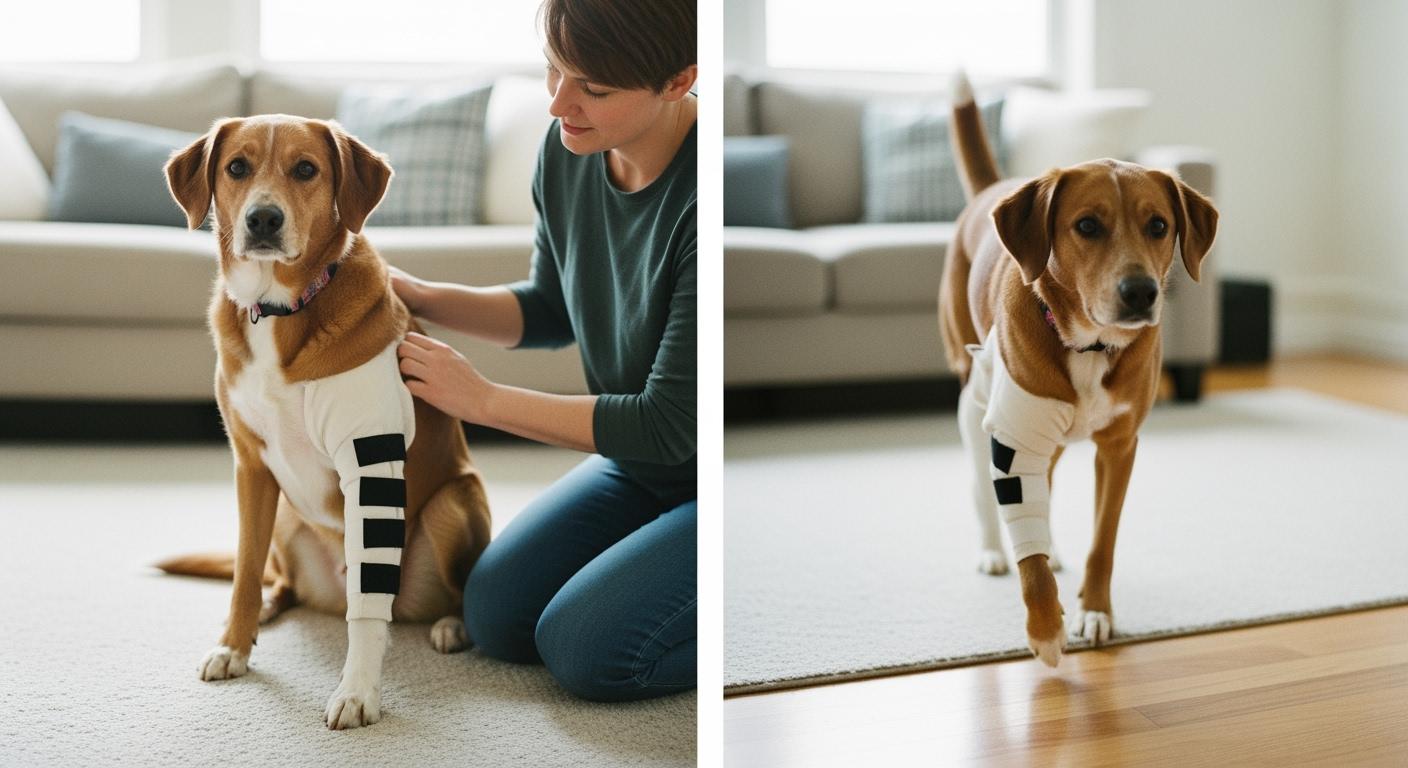
The sleeve slides down for the third time today. You pull it back up. Your dog walks six steps. It slides again. The wound that was fully covered at rest is now half-exposed, and your dog has already turned to lick it. A dog lick sleeve hind leg can look like a complete seal when the dog stands still and fail the moment the stifle bends. Static coverage is not protection. Protection means the wound stays covered through every position the hind leg moves through in a day — standing, walking, sitting, lying down, getting up, shifting weight. If the sleeve cannot track that range of motion, it is a fabric tube sliding around on a moving limb, not a wound barrier. Understanding which product design features separate static coverage from dynamic protection is what determines whether a wound heals undisturbed or stays open to licking.
| Real-use problem | Why the sleeve fails | Better product design |
|---|---|---|
| Gap opens when dog sits | Sleeve lacks flexibility | Flexible bend zones near knee and hock |
| Fabric bunches behind knee | Stiff or bulky construction | Soft, breathable, washable fabric |
| Sleeve slides down during walking | Weak upper anchors | Stable, gentle anchors above hind leg |
| Dog chews the edge | Edge rolls into wound area | Smooth edge shape that stays clear |
| Moisture stays under fabric | Poor ventilation | Breathable, moisture-wicking material |
| Strap leaves deep marks | Tight or rough straps | Soft binding, adjustable fit |
Why a Dog Lick Sleeve Hind Leg Can Look Right at Rest and Fail in Motion
A sleeve that fits perfectly on a standing dog has passed exactly one test — and it is the least demanding one. The hind leg changes shape dramatically through normal movement. The stifle angle opens and closes. The gastrocnemius muscle belly shifts proximally and distally. Skin over the joint stretches on one side and compresses on the other. A sleeve that does not account for these dimensional changes will migrate, gap, or bunch, typically within the first few minutes of movement.
The mechanics are not subtle. When a sleeve is cut as a straight tube with uniform circumference from thigh to hock, it distributes circumferential tension evenly at rest. The moment the stifle flexes, the dorsal contour of the leg lengthens while the popliteal contour compresses. A tube with no differential stretch engineered into specific zones pulls fabric from the compressed posterior region toward the lengthened anterior surface. This moves the distal edge proximally — and the wound window opens. Identical circumferential tension on two surfaces undergoing opposite dimensional changes creates net fabric migration toward the surface under tension. That is not a fit problem. That is a design problem.
This is why wound location on the hind leg determines whether a standard sleeve can work at all. A wound sited directly over the stifle sits at the point of maximum dimensional change — the hardest location to keep covered. A wound mid-tibia faces less shape change but more gravitational slide. The failure mode shifts with anatomy, but the root cause is the same: the sleeve was checked standing still and never rechecked in motion.
Coverage at rest is a snapshot, not a test
Putting the sleeve on a calm, standing dog and seeing full wound coverage creates a false sense of security. The leg is in its most uniform shape. Muscles are relaxed. No shear forces are acting on the fabric. The moment the dog takes a step, stride mechanics introduce cyclic tension along the sleeve’s longitudinal axis. Each step pulls the fabric slightly, accumulates slack at the proximal or distal edge, and redistributes pressure across the skin interface. Over ten strides, a half-inch migration is common. Over fifty, the wound can be completely uncovered.
Mark the sleeve edge position against the dog’s coat before a walk. A small piece of medical tape at the proximal and distal edges is enough. Walk the dog on a non-slip surface for ten minutes. Measure the drift. More than half an inch of edge migration means the upper anchoring system is not distributing load across sufficient surface area to resist the cyclic tension of each stride. The sleeve is ratcheting downward.
| Wound Location | Main Limitation |
|---|---|
| Knee or Stifle | Edge gap opens when sitting or bending |
| Hock or Ankle | Bunching, sliding, pressure on bony points |
| Lower Leg | Twisting, riding up, strap loosening |
| Paw / Toe / Pad | Dog can bend and reach paw past sleeve opening |
| Open/Infected Wound | Traps moisture, hides infection progression |
Why stifle flexion opens sleeve gaps
The stifle does not bend like a simple hinge. It rotates and translates simultaneously — the femoral condyles roll and slide across the tibial plateau. The skin overlying this joint stretches roughly 15–20% along the cranial surface during full flexion. If the sleeve fabric lacks a dedicated stretch zone in this region, it cannot accommodate the elongation. Instead of stretching, it pulls from the nearest available slack — usually the distal opening. The edge rides up. The wound is exposed.
You can observe this directly. Fit the sleeve on a standing dog, note the edge position, then lure the dog into a sit. Watch the distal edge. If it lifts or rolls, the sleeve lacks a functional flexion zone. What you are seeing is fabric migration driven by unaccommodated surface elongation — the most common mechanical failure in hind leg recovery sleeve designs that do not differentiate between standing fit and moving fit. The two are not the same measurement.
Design Features That Hold Up During Rear-Leg Movement
A sleeve that holds position through a full day of movement is not simply tighter or thicker. It is designed around the mechanical demands of the hind leg: cyclic elongation, shear at anchor points, compression behind the knee, and moisture accumulation under occlusion. Four features separate sleeves that work from sleeves that need constant readjustment.
Flexible bend zones at the knee and hock
The most concentrated movement on the hind leg happens at two joints. A sleeve without dedicated flexion relief at these points forces the entire fabric tube to absorb localized elongation — and fabric tubes are not good at localized elongation. What happens instead is predictable. The sleeve bunches in the popliteal fossa, creating a thick ridge of folded material. That ridge becomes a pressure point during sitting. The dog responds by licking or chewing at it. The wound loses coverage. The sleeve becomes the problem.
Bend zones solve this by decoupling the anterior and posterior surfaces of the sleeve at the joint line. A panel of lower-resistance material — typically a lighter-gauge knit with higher elastane content — sits over the joint while structural fabric continues above and below. The joint bends. The panel stretches. The surrounding fabric stays anchored. Nothing bunches. Nothing migrates. This is the same principle that makes lick sleeve solutions work across different hind leg conformations: decouple the moving zone from the anchoring zone, and each can do its job without interfering with the other.
Upper anchors that resist downward migration
Gravity pulls the sleeve down. Every stride adds a small downward impulse. The upper anchoring system is the only thing resisting this cumulative force. Narrow elastic bands concentrate that resistance into a thin line of high pressure around the thigh — the line digs in, the skin beneath it stays compressed and damp, and over hours the band itself begins to roll, reducing contact area further and accelerating the slide. A wide, padded upper band works differently. It distributes the same total retention force across a larger surface area, keeping tissue pressure low enough that circulation is not restricted. The band stays flat. The sleeve stays put.
After 20 minutes of normal indoor activity — walking, sitting, lying down — remove the sleeve and check the skin under the upper anchor. A band that was doing its job leaves a uniform, faint impression that fades within a minute. A band that was too narrow or too tight leaves a deep groove with surrounding redness that persists. That groove is a pressure injury in the making, and it also signals that the anchor was concentrating force rather than distributing it — the same mechanism that eventually causes the sleeve to slide.
Breathable fabric that does not trap moisture
Occlusion creates a microclimate. Body heat, transepidermal water loss, and trapped ambient humidity combine under non-breathable fabric to raise skin temperature and moisture levels at the wound margin. Macerated skin is weaker. Suture lines under macerated skin dehisce more easily. Bacteria proliferate faster. A wound that was healing under a dry dressing can deteriorate within hours under a sealed sleeve.
Breathable knit constructions — cotton-polyester blends with an open stitch pattern — allow vapor transmission while blocking the tongue. The tradeoff is real: higher breathability usually means lower abrasion resistance. For a short-term wound coverage application, breathability matters more, because skin breakdown from moisture happens faster than fabric wear. Press the back of your hand against the inner lining immediately after removing the sleeve. It should feel cool and dry. Warmth signals trapped body heat. Dampness signals trapped moisture. Either is a reason to swap sleeves and let the skin air-dry before reapplication.
Edge construction that resists rolling
A raw-cut fabric edge under cyclic tension will roll. It is a material inevitability — the cut edge has lower bending stiffness than the fabric body, so it curls toward the path of least resistance under tension. When that curl is inward toward the leg, the rolled edge becomes a cord pressing into skin. When it is outward, it creates a lip the dog can grip with its teeth. Neither outcome is acceptable for a hind leg sleeve that needs to resist both slippage and persistent licking.
A finished edge — bound with a thin, flexible tape or folded and stitched flat — eliminates the raw cut face and distributes edge tension along the binding rather than the fabric body. The edge stays flat against the leg. The dog cannot get a tooth under it. This is a small manufacturing detail that determines whether a sleeve survives one wear cycle or twenty.
| Design Feature | Why It Matters for Movement |
|---|---|
| Flexible bend zones at knee and hock | Decouples joint movement from sleeve position; prevents bunching and gap formation |
| Wide padded upper anchor band | Distributes retention force across surface area; resists downward migration without tissue compression |
| Breathable knit construction | Allows vapor transmission; prevents moisture accumulation and skin maceration under the sleeve |
| Bound or finished edge profile | Prevents edge roll into wound area; denies the dog a grip point for chewing |
When a Hind Leg Lick Sleeve Is Not the Right Tool
A hind leg sleeve protects a specific region — roughly from the upper thigh to just above the hock. Wounds outside that region are not protected. The most common mismatch is a paw or toe wound: the dog simply bends the leg and reaches past the distal opening of the sleeve. No sleeve that ends above the paw can block access to the paw. The product is not failing. It is being asked to cover a zone it was never designed to reach.
For wounds below the hock, a full-coverage anti-lick solution that extends over the paw closes the access gap that a leg-only sleeve leaves open. The decision is not about quality — it is about coverage geometry. Measure the distance from the wound to the hock. If the wound sits below the hock, a hind leg sleeve alone cannot seal the distal opening against a determined dog. The dog’s own flexibility defeats the coverage boundary.
Wet fabric and odor are stop-use signals
Moisture under a sleeve is never benign. If the inner lining feels damp to the touch, the wound environment has been wet long enough to saturate the fabric. Odor — particularly a sour or pungent smell — indicates bacterial activity in that moisture. Remove the sleeve. Air-dry the skin completely. Inspect the wound edges for maceration, erythema, or discharge. Do not reapply a sleeve over damp skin.
Rotating between two sleeves is the simplest way to prevent moisture accumulation. One sleeve is on the dog while the other is washed and fully dried. A sleeve that has not dried completely from the last wash reintroduces moisture to the wound bed the moment it is applied. Dry fabric is non-negotiable.
Stop-use signs that require veterinary contact
Some changes under a sleeve cannot be managed by adjusting the fit. Swelling proximal or distal to the sleeve edge means the sleeve is acting as a tourniquet — lymphatic and venous return are being obstructed. Heat radiating from the wound site means deep inflammation. Discharge, bleeding, or a foul smell means infection is active. Limping that was not present before sleeve use means the sleeve is altering gait enough to create a secondary strain. In any of these cases, the sleeve must come off and stay off until a veterinarian evaluates the leg.
A sleeve that hides a deteriorating wound is worse than no sleeve at all. The fabric masks visual changes that would otherwise alert you to a problem. Twice-daily removal and full skin inspection is the minimum monitoring frequency — once in the morning, once in the evening. More often if the dog has been active or the weather is warm.
Disclaimer: This fit guidance assumes a short-coated dog with standard hind-leg conformation. In double-coated breeds, rub marks and pressure points are harder to spot visually — hand-check the skin by feeling for heat, dampness, or thickened tissue rather than relying on visible redness alone. For dogs with angular limb deformities or unusually deep chests, the anchor geometry described here may not catch every pressure point; having a second person observe the dog move from multiple angles will reveal edge lift that a single observer misses.
| Signal | What it looks like | What to do |
|---|---|---|
| Green | Sleeve stays centered, skin calm, dog moves normally | Continue use and monitor |
| Yellow | Mild sliding, light rubbing, short edge licking, dampness | Adjust or replace sleeve, check often |
| Red | Swelling, heat, odor, discharge, bleeding, limping, pain, chewing through sleeve | Stop use, consult veterinarian |
Häufig gestellte Fragen
How do I know if the sleeve fits during movement and not just at rest?
Fit the sleeve on a standing dog. Mark the edge position. Walk the dog for ten minutes on a non-slip floor. Sit the dog. Lay the dog down. Check edge position after each. More than half an inch of migration signals that the anchoring system or bend zones are not matched to the dog’s range of motion. A sleeve that passes the standing test but fails the sitting test is a sleeve that does not fit for real-world use.
What is the difference between a lick sleeve and a cone for hind leg wounds?
A cone blocks access by creating a physical barrier around the head — the dog cannot reach the leg regardless of how it bends. A sleeve blocks access at the wound itself. The tradeoff is compliance versus coverage. Some dogs tolerate a well-fitted sleeve far better than a cone, but a sleeve that migrates provides no protection, while a cone at least maintains its barrier geometry. The deciding factor is whether the sleeve design can hold position through the dog’s full activity range. The choice between lick sleeve and cone turns on whether the dog’s movement pattern defeats the sleeve’s coverage zone — not on which option looks more comfortable at rest.
How often should the skin under the sleeve be checked?
Twice daily at minimum — morning and evening. More often if the weather is warm, the dog has been active, or the wound is producing exudate. Each check requires full sleeve removal. Looking through the fabric or peeking under the edge is not a check. Skin that cannot be seen directly is skin that is not being monitored.
When should a hind leg sleeve be abandoned for a different approach?
Three conditions make continued sleeve use unsafe: the sleeve cannot hold position through normal movement after adjustment, the skin under the sleeve is deteriorating despite dry application, or the wound is getting worse while covered. In any of these cases, removing the sleeve and contacting a veterinarian is the only correct next step. A sleeve is a coverage tool, not a wound treatment. It either protects or it does not — there is no middle category worth gambling on.
