
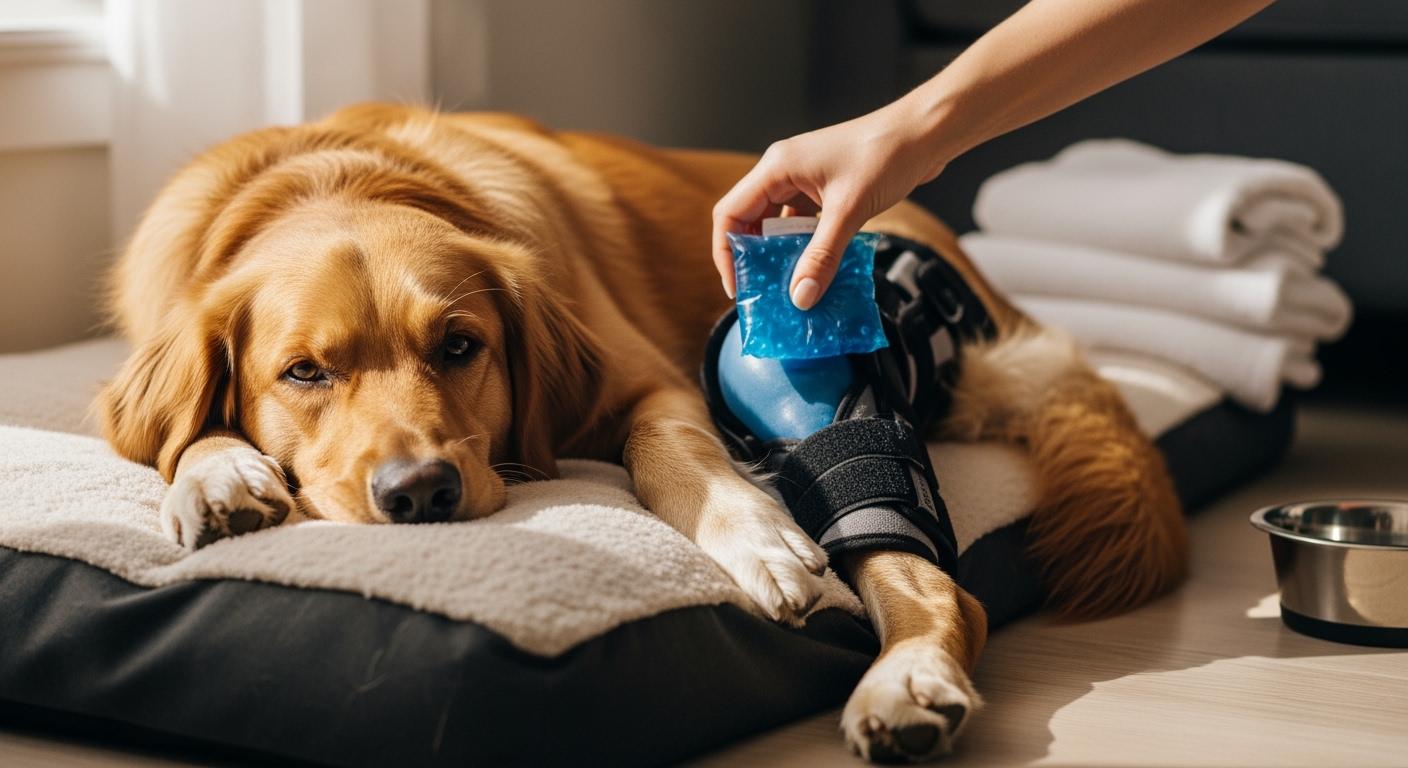
You fit the brace. The hinge lines up with the stifle. Straps settle into place without pinching. The dog walks without a head bob or shortened stride. Then you slide in a gel pack.
Everything changes. The hinge drifts half an inch proximal. One strap bites deeper than the others. Within fifteen minutes the dog is mouthing at the neoprene edge.
This is not a bad brace. It is a cold pack interacting with a brace in ways the two were never designed to manage together. Most dog torn ACL braces lose mechanical support the moment a gel pack is inserted — not because the brace itself fails, but because the added bulk redistributes pressure through every contact surface between the brace and the leg.
Understanding where that redistribution happens, and which structural features prevent it, separates a cold-pack setup that reduces swelling from one that creates a new problem while masking the old one.
Where a Gel Pack Breaks Brace Fit
A knee brace supports a torn ACL by resisting anterior tibial translation — the forward sliding of the shin bone relative to the thigh bone that happens when the cranial cruciate ligament can no longer hold them in alignment. The hinge mechanism translates that resistance through the stifle joint. But the hinge only delivers force along one axis.
Slide a gel pack between the brace shell and the leg. The pack thickness — even a slim 6 mm — tilts the entire brace assembly outward at the top edge and inward at the bottom. Now the hinge axis no longer matches the stifle axis. The two axes cross at an angle.
Here is the cascade that follows. Off-axis hinge rotation torques the proximal strap anchors. They creep distally. As they migrate, the brace shell loses its reference points against the thigh and shin. The dog feels the instability and shifts weight to the opposite leg. That weight shift changes the angle of the stifle during stance phase. The hinge, already misaligned, now binds at the end of its range. Binding transfers force into the skin at the strap edges rather than through the joint surfaces where it belongs. Within minutes the skin under the strap margin reddens. The dog starts licking. Support has already failed.
That fails fast.
Moisture accelerates the whole sequence. A gel pack held against warm skin for ten minutes condenses humidity inside the brace liner. Wet neoprene loses its coefficient of friction against fur. The liner that gripped a dry leg now slides with every step. Micro-movements that were harmless on dry skin abrade damp skin within a single wear session. Flip the liner back after a cold-pack session and check: if the skin feels tacky or looks glazed, the moisture barrier has already broken. That is the moment friction damage begins — hours before visible irritation appears.
Two things go wrong at once: the structural alignment that delivers support degrades, and the skin environment that tolerates brace wear degrades. The cold pack is not the cause of either failure in isolation. It is the catalyst that forces both failure modes to overlap.
| Real-use failure | Why it happens | Better structure or action |
|---|---|---|
| Gel pack makes the brace slide | Bulk tilts the shell, shifting pressure away from anchor points | Flat removable gel pocket placed outside the primary load path |
| Hinge no longer matches stifle | Pack thickness angles the hinge axis off the joint center | Check hinge-to-stifle alignment before and after inserting the pack |
| Strap marks deepen after cold use | Cold pack adds thickness under already-tensioned straps | Loosen straps slightly after inserting gel pack, check skin after each session |
| Dog chews the pocket or brace edge | Pressure or trapped heat signals discomfort | Remove brace immediately if chewing starts, recheck fit before reapplication |
| Knee feels warmer or more swollen after use | Non-breathable liner traps heat and moisture under compression | Use a perforated or mesh-backed liner, stop if swelling increases |
| Signal | What the caregiver sees | Action |
|---|---|---|
| Green | Brace stays centered over stifle, skin normal color and temperature, dog walks with even stride | Continue supervised use |
| Yellow | Light brace migration, mild warmth, shortened stride, dog glances at or licks the brace occasionally | Recheck fit, shorten session to 5–7 minutes |
| Red | Worse limp, visible swelling, heat radiating from knee, cold toes, skin breaks, chewing, panic, refusal to bear weight | Stop use immediately, contact veterinarian |
Structural Features That Keep Cold Therapy From Compromising Support
A removable gel pocket positioned outside the primary strap line — in a dedicated sleeve sewn to the outer shell rather than slipped between liner and leg — keeps the pack from tilting the hinge. The brace maintains its axis alignment because nothing has been inserted between the shell and the stifle. The cold transfers through the shell material rather than requiring direct skin contact. This alone eliminates the two most common failure triggers: hinge displacement and moisture pooling between liner and skin.
Walk the dog for ten minutes with this configuration, then run a finger along the hinge centerline. If the hinge pivot still tracks within a quarter-inch of the stifle joint center, the pack placement is working. If it has drifted, the sleeve attachment point or the pack thickness is wrong for that dog’s leg profile — not for all dogs, but for that specific conformation.
Anti-slip anchoring matters more with a gel pack than without one. The pack adds mass — small, but enough to increase inertial tug during leg swing. A liner that held position during unweighted walking may drift when a cold pack adds even a few ounces of swing weight. The anchoring solution that resists this is not tighter straps. Tightening straps over a gel pack compresses the pack into the leg, which is exactly what causes focal pressure points. The better structure is a non-slip inner surface — silicone-dotted fabric or a high-friction neoprene blend — paired with wide strap distribution that spreads tension across two or more anchor points per strap rather than concentrating it at a single buckle.
Breathability is not a comfort feature here. It is a structural requirement. A liner that does not vent moisture turns a cold pack into a wet compress within fifteen minutes. Perforated neoprene or open-cell mesh-backed liners let vapor escape before it condenses. The practical test: after removing the gel pack, press a dry paper towel against the inner liner for five seconds. If it comes away damp, the liner is not moving moisture fast enough for that dog’s activity level and ambient temperature.
Cold therapy and brace support also need to operate on separate schedules. The gel pack goes in for ten to fifteen minutes — long enough to reduce superficial tissue temperature, short enough to prevent the liner from reaching full moisture saturation. Then it comes out. The brace stays on for longer supervised wear — walking, standing, controlled leash activity — without the pack. This separation keeps the cold therapy window tight and the support window clean. Combining them into a single extended session is where most failures begin. For a deeper look at how stifle brace fit impacts daily wear outcomes across different activity levels, the structural demands shift considerably between a dog that walks on flat ground versus one navigating stairs or uneven terrain.
When Cold Helps, When It Does Not, and When to Stop
Cold therapy has a narrow window where it helps a braced knee: the first 48 to 72 hours after an acute injury, when swelling is driven by active inflammation rather than chronic joint thickening. During this period, applying cold for ten to fifteen minutes — with the brace fitted first and the pack added only after hinge alignment is confirmed — can reduce superficial tissue temperature enough to slow fluid accumulation without introducing the fit problems described above.
After the acute window closes, cold offers diminishing returns. Swelling that persists beyond three days is often mechanical — fluid trapped in the joint capsule due to instability, not active inflammation — and cold will not move it. Continuing cold therapy past this point means accepting the fit-compromise risks for a benefit that no longer exists.
Heat is different. It increases blood flow and can relax muscle guarding around a stiff knee. But heat also increases tissue fluid, which means it should never touch a knee that still has visible swelling. Apply heat only after the acute swelling phase, only at a temperature that feels warm — not hot — against the inner wrist, and only if the dog’s veterinarian has confirmed that the joint is stable enough for vasodilation. Heat plus an unstable stifle equals more fluid in a joint that cannot handle it.
Disclaimer: These cold and heat timing guidelines assume a short-coated dog with normal leg conformation. Double-coated breeds may not show the same external temperature changes — fur insulation can mask skin warming or cooling by several degrees. Dogs with angular limb deformities or very deep chests may distribute brace pressure differently across the stifle. The fit checks described here assume standard breed proportions; if the dog’s leg falls outside those norms, a hands-on pressure check — running a fingertip under every strap edge after five minutes of wear — catches pressure points that visual inspection alone will miss.
Stop-use signals are unambiguous. If the dog’s limp worsens within a session, the brace is either applying force through the wrong axis or the cold pack has shifted the hinge enough to alter joint loading. If the skin under any strap margin turns deep pink or feels warmer than surrounding skin five minutes after pack removal, pressure has exceeded tissue tolerance. If the dog suddenly refuses to place weight on the leg mid-walk — not gradual fatigue but abrupt refusal — that is a pain response, not a fit issue. Remove the brace. Let the leg rest. Reassess before the next session.
A hinged knee brace for dogs distributes support through the stifle joint differently than a soft wrap, and that distinction becomes critical when cold therapy enters the picture. A hinge mechanism is load-bearing; a cold pack that tilts it is directly altering the load path. A soft sleeve has no rigid axis to misalign, but it also provides less translational control. The choice between them shapes what kind of fit failure is possible — and therefore which checks matter most.
Häufig gestellte Fragen
How long should a cold pack stay in a dog torn ACL brace?
Ten to fifteen minutes per session, up to four times daily during the first 48 to 72 hours after injury. The session limit is driven by liner moisture saturation, not by the cold pack losing temperature. After fifteen minutes, most brace liners have absorbed enough humidity that the friction coefficient against skin drops measurably. Remove the pack, check skin condition, and let the liner air-dry before the next session.
Can the brace and cold pack be used together for long walks?
No. The cold pack is a short-duration therapy tool, not a walking accessory. During movement, the added mass of the gel pack increases swing-phase inertia, which amplifies every micro-shift in brace position. Cold therapy should be done with the dog stationary and supervised. For longer walks, remove the gel pack entirely and verify hinge alignment before starting.
What if the dog starts chewing the brace during cold-pack use?
Chewing signals discomfort — pressure, heat, or both. Remove the brace immediately. Do not assume the dog will adapt. Check under every strap for marks, feel the skin temperature along the liner edges, and verify hinge position. Resume only after identifying and correcting the specific trigger.
Does a cold pack work the same way in every dog knee brace design?
No. The variable that matters most is where the pack sits relative to the hinge axis. A pack placed inside the brace — between liner and leg — inevitably tilts the hinge. A pack in an external sleeve transfers cold through the shell without altering the brace-leg interface. The second design preserves support; the first does not. For torn ACL support specifically, fit precision determines whether the brace stabilizes the stifle or merely covers it — and a pack that shifts the hinge by even a few millimeters tips the result toward the latter.
Disclaimer: Every brace-fit recommendation in this article assumes the dog’s ACL injury has been diagnosed by a veterinarian. Swelling, limping, and knee pain have multiple possible causes beyond a cruciate ligament tear — including meniscal damage, patellar luxation, and septic arthritis. A brace applied to an undiagnosed joint condition can delay necessary treatment. Confirm the diagnosis before using any knee brace or cold therapy protocol.
