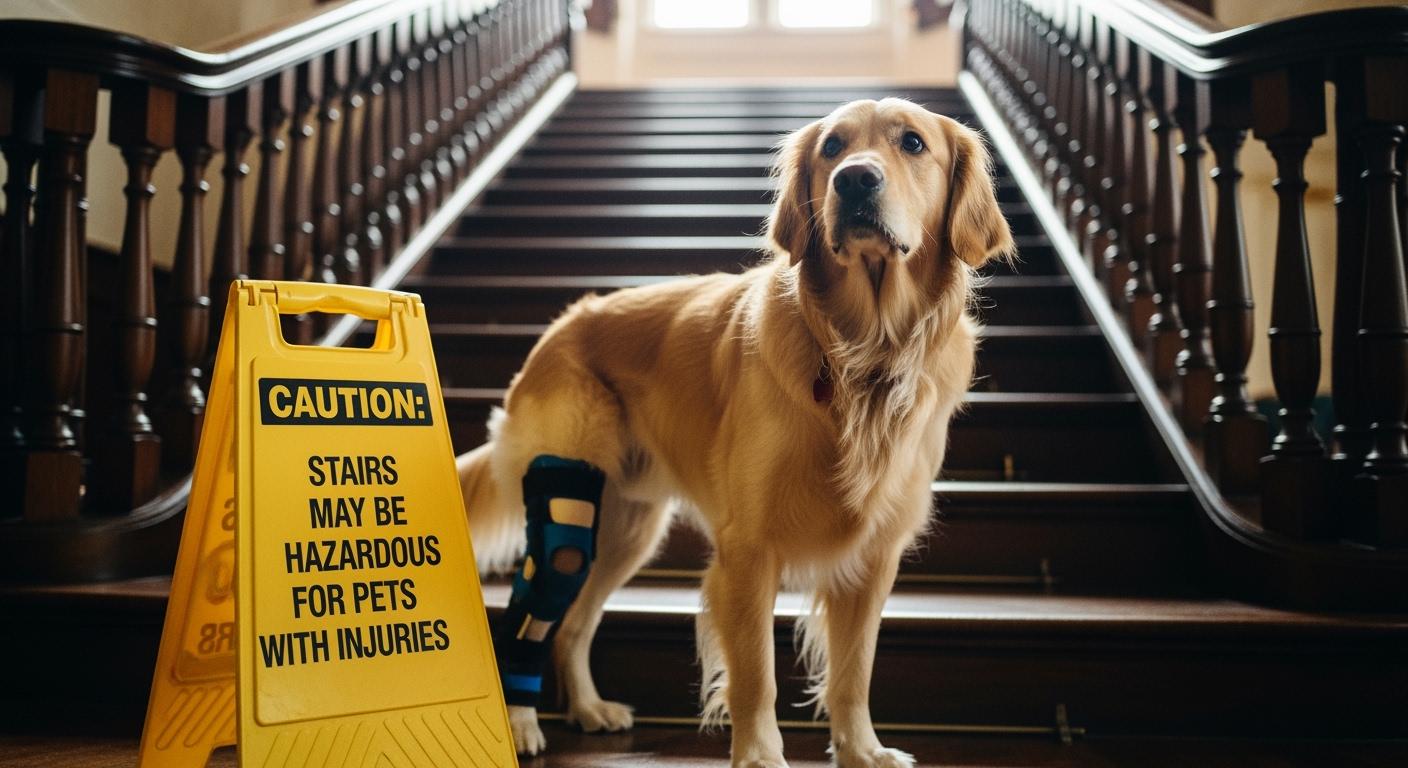
A knee brace lined up with the joint, straps flat, no visible gaps. On flat ground, it holds. Then the dog takes a single stair step and the hinge has drifted half an inch down the leg. The straps bunch behind the knee. What changed is not the fit. What changed is the knee angle.
Deep knee flexion reshapes the leg, and a brace that does not account for that shape change will fail where it matters most — on stairs, car steps, and any surface that forces the stifle past the angle a flat walk demands. The gap between standing fit and movement fit is where most knee braces for torn ACLs lose their hold on the joint.
Where a Knee Brace for Dogs ACL Fails First
Static fit is easy. The dog stands, the brace is positioned, the straps are tensioned. The hinge sits over the joint. Everything checks out. Movement fit is a different problem. The moment the knee flexes past roughly 45 degrees — the angle a typical stair step demands — the leg profile changes. The quadriceps thickens above the knee, the skin behind the joint compresses, and the distance from mid-thigh to mid-calf shortens.
Three things can go wrong in that moment.
Hinge drift. The hinge pivots on a single axis, but a canine stifle does not flex like a simple hinge. There is rotation and translation as the femoral condyles roll and slide on the tibial plateau. When the brace hinge cannot track that compound motion, it drifts distally — often a quarter to half an inch per deep step. Over five or six stairs, the hinge can end up well below the joint line, pressing on the tibial crest instead of flanking the knee. At that point the brace is not stabilizing the joint. It is levering against bone.
Strap bunching. Behind the knee, fabric and webbing have nowhere to go when the joint closes. If the posterior strap is cut wide and straight, the edges roll inward as the knee bends. That rolled edge becomes a cord digging into the popliteal region — the soft tissue behind the stifle. The dog shortens the stride to avoid the pinch. Over days, that compensation shifts load to the other leg.
Lower-shell slide. The distal portion of the brace anchors above the hock. But when a dog steps into a car, the combination of knee flexion and hip rotation pulls the shell downward. Without a mechanical stop that resists distal migration during combined flexion and rotation, the shell drifts. A shell that lands on the hock interferes with tarsal movement. The dog may refuse to load the leg at all.
Here is how different movements stress the brace differently:
| Movement | Why it stresses the brace | Common failure | Better product feature |
|---|---|---|---|
| Flat leash walk | Mild knee flexion, steady pace | Minor strap shift | Flexible anchoring with grip backing |
| Stairs | Deep knee bend beyond 45°, weight shift | Hinge drift, strap bunching | Low-profile hinge, contoured posterior edge |
| Car step-in | Twisting load, uneven weight distribution | Brace rotation, shell slide | Anti-rotation strapping, distal anchor stop |
| Sofa or bed jump | Sudden force, rapid uncontrolled flexion | Brace slips off, bunching | Multi-point anchoring, low bulk |
| Squatting/sitting | Full knee closure, posterior compression | Strap digging, rubbing | Breathable padding, thin posterior profile |
You can verify hinge drift after any stair use: mark the hinge center with a small piece of tape on the dog’s skin before movement, then check whether the hinge still centers on that mark afterward. A shift of more than half an inch means the brace is not tracking the joint.
Red-Yellow-Green After-Movement Check
| Signal | What you see | What to do |
|---|---|---|
| Green | Hinge aligned, straps flat, dog walks evenly, no skin marks | Continue supervised movement |
| Yellow | Slight strap shift, faint redness, dog hesitates briefly | Reposition brace, recheck after 5 minutes |
| Red | Limping, swelling, hinge displaced, skin raw or hot, dog refuses to load leg | Remove brace, rest the leg, contact veterinarian |
Structure and Material Choices That Reduce Slipping and Rotation
Not all knee braces handle deep flexion the same way. The differences come down to three structural decisions made at the design level — decisions that determine whether the brace tracks the joint or fights it.
Hinge Profile and Posterior Clearance
A hinge that protrudes more than roughly 8 millimeters from the lateral side of the brace creates leverage. When the knee flexes and the thigh and calf move closer together, a thick hinge acts as a fulcrum the soft tissues must move around. The brace pushes outward, the straps lose tension, and the hinge drifts. A low-profile hinge — one that sits nearly flush with the brace shell — reduces that outward moment. The brace stays closer to the leg through the full flexion arc.
At the back of the knee, clearance matters even more. If the posterior edge of the brace is cut straight across, material bunches into the closing joint. A contoured or scooped posterior edge gives the skin and soft tissue room to compress without folding the brace material into a ridge. This is not about padding thickness. It is about cut geometry — how the hinge type and posterior cut shape daily brace performance.
Strap Width, Edge Finish, and Anti-Rotation
A narrow strap under side load concentrates force along a thin line. The edge of that strap becomes a pivot point. When the dog twists — stepping into a car, turning on a slope — the strap edge rolls, the brace rotates around the leg, and support shifts off-axis. Wide straps with rolled or finished edges spread the same load over a broader contact area and resist edge-rolling. It is the difference between a line of pressure and a band of pressure.
Rotation control also depends on strap routing. A single strap above the knee and one below can still allow the brace to spin if the straps run parallel. A third anchor point — often a strap routed diagonally or an anchor tab positioned off the main vertical axis — creates a triangulated hold that resists rotational forces more effectively than tightening alone ever could. Tightening a two-strap brace that wants to rotate just concentrates the rotation force on a smaller skin area.
Breathable Padding and Pressure Distribution
Padding serves two functions that can work against each other: cushioning and heat management. Thick foam pads well for the first 15 minutes, then traps heat, softens further, and compresses unevenly. The dog’s skin under a hot, compressed pad becomes damp. Damp skin under pressure develops friction burns faster than dry skin. A thin, open-cell or perforated pad that stays dry does more to prevent rubbing over a multi-hour wear period than a thick pad that goes soggy.
Verify padding performance after 20 minutes of wear: lift the brace edge, run a finger along the skin beneath the pad. Damp or hot to the touch — the pad is not breathing enough for that dog’s activity level. Dry and cool — the pad is managing moisture adequately. This check catches the red flags that signal a brace is not supporting the leg the way it should before visible skin damage appears.
| Design dimension | Too much | Too little | Balanced approach |
|---|---|---|---|
| Hinge thickness | Bulky, levered outward during flexion | Flimsy, bends under lateral load | Low-profile, flush with shell |
| Strap width | Overlaps joint, bunches behind knee | Narrow, rolls at edges, digs in | Broad with finished edges, triangulated routing |
| Padding density | Thick, heat-trapping, compresses unevenly | Thin, transmits shell edges to skin | Open-cell, perforated, stays dry under load |
When a Knee Brace Is Not the Right Tool
A knee brace stabilizes the stifle against flexion and rotation forces within a defined range. When the movement demands fall outside that range, the brace stops being protective and starts being a problem. Recognizing that line is more important than any single product feature.
Stairs that are steep enough to require the dog to hop — lifting both hind legs together onto the next step — exceed what most braces can compensate for. The combined flexion angle, the momentary single-leg loading, and the impact at landing override the brace’s ability to maintain alignment. A ramp at a shallow incline, or a lift harness that offloads weight during step navigation, changes the load equation enough that the brace can do its job.
Car entry is another inflection point. If the dog must plant the injured leg, rotate the body, and spring upward simultaneously, the twisting moment on the brace is high enough that even a well-designed brace can rotate. A ramp or a two-person lift — one supporting the chest, one supporting the hindquarters — removes the twist component and lets the brace handle only the linear loading it is designed for.
Dogs with angular limb deformities, very deep chests, or leg conformation well outside the breed norms the brace was patterned for present a fit challenge that adjustments alone may not solve. When the bone structure creating the brace’s anchoring surface is itself atypical, the fit checks described here may not catch every pressure point.
Disclaimer: this check assumes a short-coated dog where rub marks are visible on the skin surface. Double-coated breeds may show subtler friction signs that require hand-checking — run fingers along the skin under each strap and shell edge rather than relying on visual inspection alone. If the dog’s leg conformation falls outside typical breed proportions, particularly with angular limb deformities or very deep chests, standard brace geometry may leave pressure points that visual checks miss.
The decision to use a brace on stairs or car steps is not all-or-nothing. A brace that holds well during a flat walk can still be useful for daily leash exercise while the dog uses a ramp for stair access. The brace does not need to do everything to be worth using. It needs to do what it can within its design limits — and those limits are set by how the brace is fitted and what daily movement it is asked to handle, and by the structural choices built into the brace itself.
Frequently Asked Questions
How often should the brace fit be checked during stair use?
Check hinge position and strap flatness before the first stair, after every three to four steps, and again once the dog is back on flat ground. The hinge should not have migrated more than half an inch from its starting position. If it has, the brace is not tracking the joint through the full flexion arc, and continued stair use under those conditions risks rubbing and joint instability.
Why does the brace stay in place during walks but slip on the third or fourth stair?
The first stair bend resets the strap tension. Fabric and webbing have a small amount of give. One deep flexion pulls that slack into the system. By the third or fourth stair, cumulative slack plus the outward push of a thick hinge on flexing soft tissue creates enough displacement for the brace to drift. The failure is not sudden — it stacks incrementally with each deep bend.
Can a dog wear a knee brace for stairs without supervision?
No. Unsupervised stair use with a knee brace introduces risks that compound quickly — a slipped brace can become a trip hazard, a rotated hinge can press into bone, and a bunched strap can cut off circulation behind the knee without the dog vocalizing. Supervision catches displacement before it becomes injury.
What is the difference between a brace that slips and one the dog refuses to wear?
A brace that slips is a geometry problem — the cut, strap routing, or hinge profile does not match the dog’s leg in motion. A brace the dog refuses to wear is often a pressure problem — something is digging in, pinching, or overheating. The two can overlap: a slipping brace creates pressure points as it migrates. If the dog refuses to load the leg with the brace on, remove it and check every contact surface for hotspots before reattempting fit.