
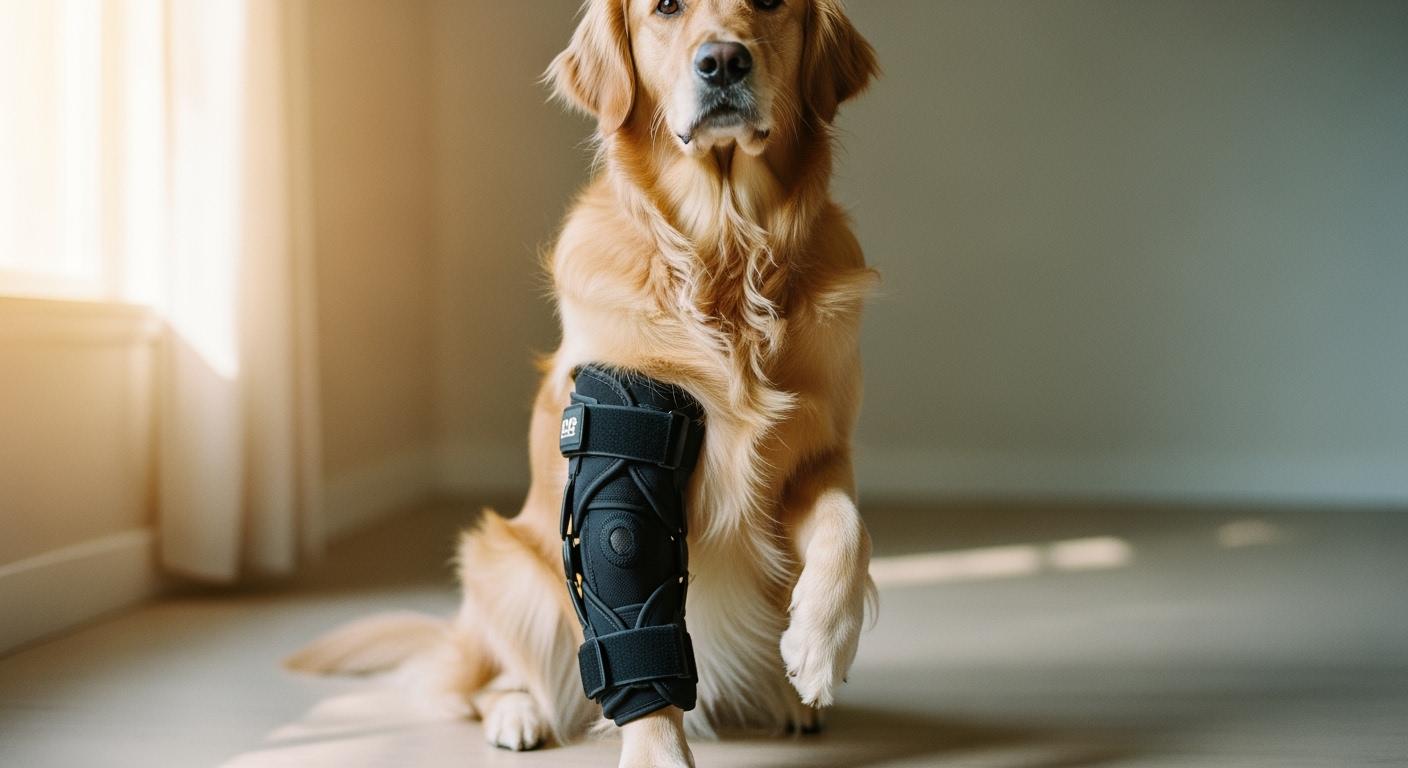
The brace looks centered. The hinge sits right over the knee. Your dog stands still, and everything checks out. Then the rear strap slides backward the moment the dog walks, turns, or pushes up from a sit. That is not a strap-tightness problem. It is an anchoring failure, and pulling harder on the straps only trades one problem for another.
A knee brace that drifts during movement has already lost its support path. The question is not whether you can cinch it tighter. The question is whether the brace has any structure above the knee capable of resisting the forces that pull it downward with every stride.
Why a Knee Brace Looks Secure Standing Still but Slides in Motion
Standing Fit Is Not the Same as Walking Fit
A standing dog loads its knee in one plane. A walking dog loads it in three. The stifle flexes, extends, rotates internally, and translates slightly with each step. A brace checked only in a static stance has never been tested against the forces that matter.
Labradors compound this. Their hind legs drive hard, their thighs are well muscled with a natural taper, and their coat is short and slick. A brace that grips fine on a dry, stationary leg can slide a quarter inch within the first ten strides once motion, coat oils, and muscle contraction enter the picture.
You can catch this before it becomes a skin problem. Fit the brace while the dog stands. Mark the top edge position against the fur with a finger. Walk the dog on a non-slip surface for two minutes. Check whether that top edge has migrated. Even a half-inch shift means the hinge is no longer tracking the joint center.
Why the Rear Strap Moves When the Dog Turns
The rear strap sits at the top of the brace, usually crossing the thigh above the knee. When a dog turns, the femur rotates. If the brace has no independent anchor above the thigh—something connected to a chest harness, a waist band, or a structured cuff that spans enough surface area—that rotation translates directly into strap migration.
Here is the causal chain: femur internally rotates during a turn → the thigh cross-section changes shape → a narrow rear strap without anti-rotation surface area loses its friction patch → the strap edge rolls → the entire brace body shifts distally → the hinge drifts below the joint line → support becomes decorative. This happens in under three steps. A dog that weaves between furniture or pivots to look at a sound will trigger this cycle dozens of times per wear session.
In practice: A brace that has never been observed during a tight turn has never been fit-tested. The standing check is step one of at least four.
Why Tightening Harder Creates Pressure Without Fixing Slipping
Tightening converts a sliding problem into a pressure problem. The brace still slides, but now it slides while digging in. The result is the same migration plus skin damage layered on top.
A narrow strap pulled tight concentrates force along a thin line. Over a thirty-minute walk on a 70-pound Labrador, that line pressure can produce visible strap marks that do not fade within ten minutes of removal. That is the threshold: marks that outlast a short rest signal that the contact patch is too narrow for the tension it carries. The fix is not loosening. The fix is a wider contact surface—or better yet, a structure that resists migration without relying on circumferential squeeze alone. When slipping persists across multiple fit attempts, the issue is usually not the strap but the absence of an anchor path above it, a topic covered in more detail when examining how knee braces for luxating patella lose position through rotation and slip.
The Real-Use Fit Test Before Daily Wear
A fit test that only checks standing alignment will miss every dynamic failure mode. The sequence below catches the three most common ones before they cause skin breakdown or support loss. Run it before the first full-length wear session and repeat it any time the brace is refitted after cleaning or a break in use. For a deeper walk-through of fit sequencing and break-in scheduling, the daily-use fit approach for orthopedic knee braces covers wear progression timing in detail.
Check the Hinge Before and After Walking
Place the dog in a stand. Align the hinge center with the knee joint axis—the bony prominence on the lateral side of the stifle. Press a fingertip into the fur directly over the hinge pivot point to leave a temporary reference mark. Walk the dog at a steady pace on a non-slip surface for two minutes. Recheck the mark.
If the hinge pivot has drifted more than half an inch forward or backward, the brace body has rotated around the leg. That rotation means the hinge is no longer sharing the joint’s axis. From that point on, every degree of knee flexion applies off-axis force to the brace frame, which accelerates further migration. The specific hinge design—whether single-axis, polycentric, or left/right-specific—determines how much drift tolerance the brace has before support degrades, a distinction explored in how hinge type affects daily knee brace fit and joint tracking.
Observable check: After the two-minute walk, the hinge pivot should sit within one finger-width of its starting position. More drift than that means the thigh cuff or rear anchor is not holding—do not proceed to longer wear.
Watch the Rear Strap During Sitting and Standing Up
Sit the dog. Wait three seconds. Call the dog to stand. Watch the rear strap through the full motion.
The sit-to-stand transition produces more thigh circumference change than any other daily movement. As the stifle extends, the quadriceps and hamstring groups shorten and thicken. A rear strap that was tensioned in a stand may become either too tight (digging in) or too loose (gapping) at the top of the motion, depending on strap placement and elasticity. Either outcome breaks the anchor hold. If the strap shifts by any visible amount during two consecutive sit-stand cycles, the brace lacks the thigh-contact geometry or anchor-path design to stay put through normal daily transitions.
Look for Skin Marks After the First Short Session
Remove the brace after ten minutes. Do not check immediately—wait two minutes for transient compression marks to fade. Then inspect under each strap, under the hinge plate, and along any seam that contacts skin.
What counts as a pass: no marks at all, or faint compression lines that disappear within those two minutes. What counts as a fail: any mark still visible after two minutes, any red patch that feels warmer than surrounding skin, any indentation that catches a fingernail, or any sign the dog has been licking the area during wear. This observable verification is the most reliable single indicator of contact-pressure problems, and skipping it is the most common reason fit issues escalate during the break-in period of an adjustable knee brace.
| What the owner sees | Why it may happen | What structure helps | When to stop and seek veterinary guidance |
|---|---|---|---|
| Rear strap slides backward | Weak anchor, slick coat, tapered thigh | Body or harness anchor path | Repeated slipping, skin breakdown |
| Hinge drifts forward/back | Misalignment, wrong size, rotation | Left/right-specific hinge, anti-rotation cuff | Swelling, heat, new limping |
| Brace rotates around leg | Tapered thigh, insufficient contact area | Wider thigh cuff, shaped contact surface | Chewing, pain, cold toes |
| Strap marks persist on skin | Over-tightening, narrow pressure edge | Softer edge finish, breathable lining | Redness, sores, discharge |
| Dog chews the brace edge | Rubbing, heat buildup, discomfort | Removable washable liner, rolled edges | Persistent chewing, open skin |
| Dog walks worse after fitting | Poor alignment, wrong support type | Structured fit test, proper hinge match | Worsening lameness, increased limping |
What Body Anchoring and Anti-Rotation Design Actually Do
A Body Anchor Controls the Slide That Straps Cannot
A strap wraps. An anchor connects. The difference is what happens when the dog moves.
Straps work by circumferential compression—they squeeze the leg and rely on friction between the brace lining and the coat to hold position. This works on a cylinder. A dog’s thigh is not a cylinder. It tapers from hip to knee, changes shape with every muscle contraction, and narrows dramatically above the stifle. Friction alone cannot hold a brace on a downward-tapering cone that keeps changing diameter.
An anchor solves this by transferring retention force to a part of the body that resists downward pull. A chest-connected harness strap, a waist band above the hip, or a structured thigh cuff that spans enough surface area to convert circumferential squeeze into distributed contact—all of these create a mechanical stop. The brace can no longer migrate distally because the anchor path runs to a point that does not move in that direction during leg extension. This is the same principle that keeps human knee braces from sliding down the calf: the anchor is above the muscle belly, not on it. For knee support across a range of stability needs, the design logic that separates anchored braces from wrap-only supports is the same one that determines daily-use reliability, as detailed in the structural differences that make knee braces succeed or fail during real movement.
Note: If the rear strap slides backward more than once per wear session, the anchor path has failed. Tightening the strap will not fix it. The brace needs a different retention structure, not more tension on the same narrow contact line.
A Wider Thigh Cuff Spreads Pressure and Resists Rotation
Rotation resistance is a function of contact area, not strap tension. A narrow strap has a contact patch perhaps half an inch wide. When the leg rotates under it, that thin line of friction has almost no lever arm to resist the torque. The strap rolls, the brace rotates, and the hinge leaves the joint line.
A wider cuff—two inches or more of shaped contact surface—changes the physics. The friction patch is larger, so the same coefficient of friction generates more resistance to rotation. More importantly, the leading and trailing edges of the cuff sit farther from the center of rotation, creating a longer lever arm against twisting forces. That lever arm is what stops a brace from spinning around the leg when the dog carves a tight turn.
| Performance difference | Why it matters | Main limitation |
|---|---|---|
| Wider contact patch resists rotation through larger friction area | Prevents hinge drift during turns and direction changes | Added bulk may interfere with opposite leg during tight tucks |
| Straps placed farther from pivot point increase lever arm against twist | Converts a weak friction hold into a mechanically advantaged stop | Requires precise placement; mispositioned strap adds pressure without anti-rotation benefit |
| Narrow straps fail rotationally due to small friction patch and short lever arm | This is the most common structural cause of brace rotation | Fails even at moderate tension on tapered or slick-coated legs |
Breathable Lining Matters When the Brace Stays On During Movement
A brace worn during activity traps heat. The stifle is a high-motion joint surrounded by muscle that generates warmth with every contraction. If the lining does not move moisture and air, two things happen: the skin softens from humidity, reducing its tolerance to friction, and the dog’s comfort drops, increasing the likelihood of chewing or refusal.
Open-cell mesh or perforated neoprene with a wicking inner face keeps the skin dry enough to maintain its natural friction tolerance. Dry skin under a brace resists abrasion better than damp skin. A lining that stays wet for an hour after a walk signals that the material cannot manage the moisture output of an active dog’s leg. Check this by pressing a dry paper towel against the inner lining immediately after removing the brace. If the towel comes away damp, drying time needs attention. A removable, washable liner makes this manageable; a fixed liner that traps moisture makes it a recurring problem. For product-level examples of how knee pad and brace configurations handle lining, contact surface, and daily durability, hind-leg knee pad designs offer a useful reference for comfort-layer construction.
| Brace structure | Where it helps | Where it may fail |
|---|---|---|
| Soft neoprene wrap | Light support, mild instability, warmth | Slides easily on tapered legs, rotates under torque, creates pressure points when over-tightened |
| Hinged soft knee brace | Better joint alignment, moderate support, limits harmful ROM | Slips without an anchor path above the thigh; hinge drift accelerates once rotation begins |
| Hinged brace with body anchor | Controls downward slide, resists rotation, maintains hinge position through turns | Requires precise initial fitting; added bulk from anchor path may need adjustment for deep-chested dogs |
| Custom orthotic-style support | Maximum stability, tailored to individual leg geometry | Higher cost, requires professional casting or measurement; not a first-line option for mild instability |
When a Knee Brace Is Not the Right Support
When Slipping Repeats After Fit Adjustments
Two adjustment cycles and the brace still migrates. At that point, the problem is not the fit—it is the match between the brace structure and the dog’s leg geometry.
Deep-chested Labradors with a pronounced thigh taper present a specific challenge: the circumference difference between the upper thigh and the area just above the stifle can exceed what a standard strap-based retention system can bridge. A brace that fits the upper thigh girth gaps at the lower edge. A brace that fits the lower edge cuts into the upper thigh. Neither outcome is acceptable for daily wear beyond thirty minutes.
Common reasons slipping repeats: the brace size does not account for the taper ratio; the hinge is left/right-generic rather than side-specific; the dog’s activity level exceeds what the retention design was built for; or the coat type (short, slick, oily) undercuts friction-dependent grip.
Disclaimer: Short-coated breeds like Labradors tend to show rub marks later and more subtly than dogs with thinner or sparser coats. A hand-check—running your palm up the leg under the brace—may catch hot spots that visual inspection misses. If the dog’s leg conformation falls outside the typical proportional range this brace class is patterned for—particularly dogs with angular limb deformities, very deep chests, or unusually heavy muscling—the fit checks described here may not catch every pressure point. In those cases, a shorter wear trial with more frequent skin checks is the safest path.
When the Dog Chews, Limps, or Refuses the Brace
Chewing the brace edge is feedback. It means the brace is causing a sensation the dog wants to remove. That sensation is usually heat, rubbing, or pressure concentration—all of which are structural problems, not behavioral ones.
Limping that starts after brace application and stops after removal is almost always a fit or alignment issue. The brace may be forcing the stifle into a position the joint cannot comfortably hold, or it may be creating pressure over a point that was not painful before the brace applied load to it. A brace that changes a dog’s willingness to move should come off immediately—no “break-in period” rationale overrides a dog that was walking better without the brace than with it.
When Veterinary Rehab or a Custom Orthotic Is the Safer Path
A standard knee brace works within a window: enough instability to need support, not so much that the brace cannot hold alignment under load. Outside that window, other options fit better.
| Situation | Most appropriate support path |
|---|---|
| Partial CCL tears, early instability | Standard hinged knee brace with fit verification |
| Non-surgical candidate due to age or health | Standard knee brace or custom orthotic depending on leg geometry |
| Severe injury, meniscal involvement, open wound | Veterinary evaluation before any bracing attempt |
| Temporary support pre- or post-surgery | Standard knee brace with veterinary guidance on wear schedule |
DIY braces constructed from wraps and household materials carry an additional risk: they apply force to structures they were never designed to stabilize. An improvised wrap can compress the wrong soft tissues, restrict circulation, or create a false sense of stability that encourages activity the joint cannot safely handle.
A knee brace that stays in position keeps the hinge on the joint axis, the straps on their intended contact patches, and the skin under the brace dry and intact. A knee brace that migrates does none of these things, regardless of how tightly it was strapped at the start. The daily verification sequence—hinge position check, sit-stand observation, post-wear skin inspection—takes under five minutes and catches failures before they compound.
Häufig gestellte Fragen
How soon should a knee brace stop sliding after fit adjustments?
A properly matched brace should hold position through a ten-minute walk after no more than two fit adjustment sessions. If migration persists beyond that, the brace-to-leg match is wrong—either the size, the retention structure, or the hinge type does not suit that dog’s leg geometry and coat type. Continuing to adjust past two cycles without a change in approach is the point at which the brace becomes a skin risk.
Can a dog wear a knee brace through a full night?
No. Nighttime wear removes the owner’s ability to observe fit, watch the dog’s gait, and check skin. A brace that shifts while the dog sleeps in a curled position can create pressure points that go unnoticed for hours. Remove the brace overnight. Clean the leg, inspect the skin, and let the area breathe.
What is the single most reliable sign that a brace fits wrong?
Strap marks that are still visible two minutes after brace removal. Transient compression lines that fade within seconds are normal. Marks that persist signal that the contact pressure under that strap exceeds what the skin can tolerate for the wear duration used. Reduce wear time, widen the contact surface, or both—do not ignore persistent marks and continue the same wear schedule.
