
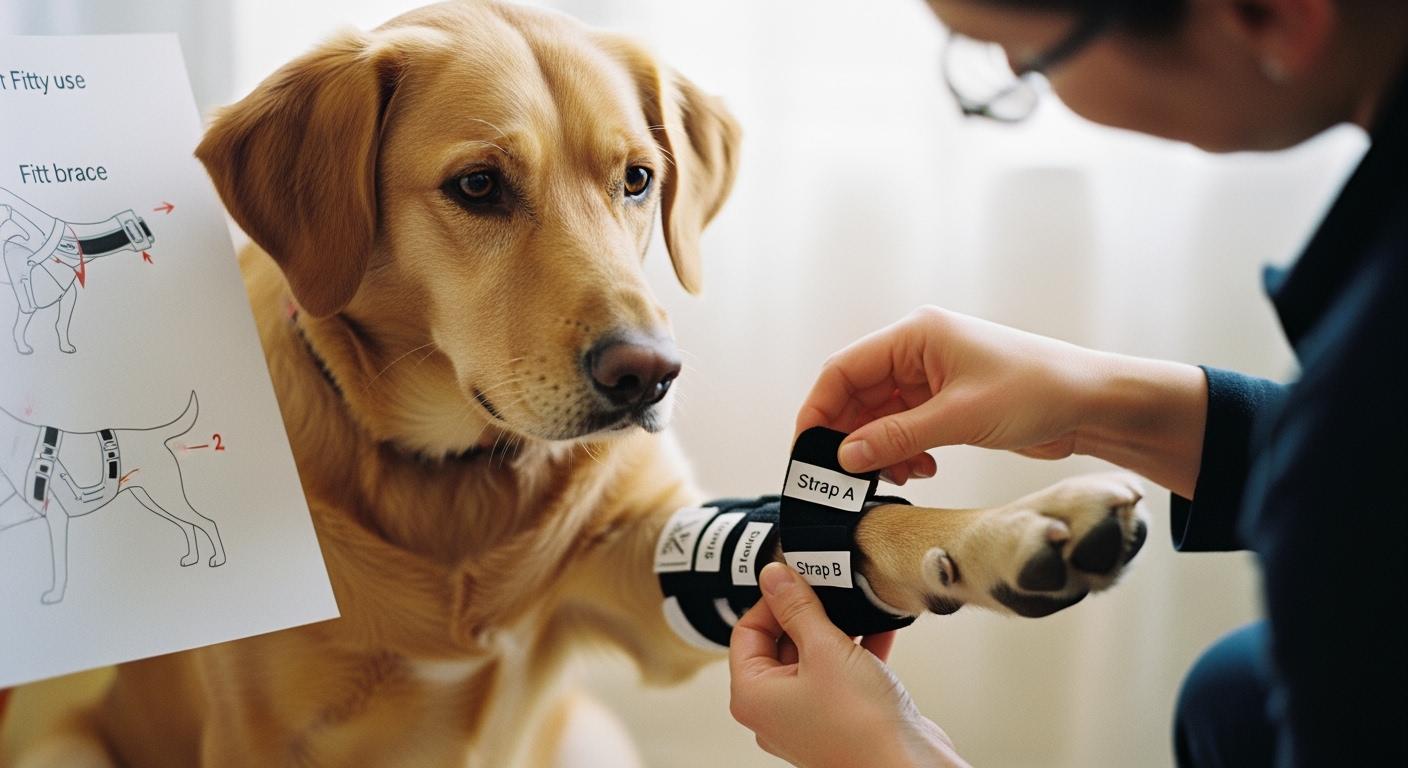
You fit the leg brace for dogs on your dog. It looks secure. The straps are snug. But the dog takes three steps and hesitates — then shortens stride on the supported side. The brace is not slipping visibly. Yet the dog is telling you the support is landing in the wrong place.
This is the gap between looking right and working right. A leg brace can appear perfectly fitted while its internal support structure — the hinge axis, the strap tension distribution, the panel coverage — is failing at the mechanical level. The dog feels it within steps. The owner sees a limp but cannot spot the cause.
Most fitting failures fall into three patterns: the brace is backwards, on the wrong leg, or fastened in the wrong strap order. Each shifts the support geometry away from the joint it is meant to stabilize. And each is preventable with design features that guide correct placement — not features that assume perfect memory from the person fitting the brace.
Where the Fit Fails — and What the Dog Shows You
A backwards brace puts the hinge or support panel on the wrong side of the joint. The brace may wrap the leg completely, but the rigid or semi-rigid elements now face the wrong anatomy. The support lands on soft tissue or bone that was never meant to take directed pressure. The joint itself is unbraced. The dog limps, drags the paw, or stops walking within the first minute.
A left brace on a right leg changes the pressure map entirely. The inner contour shaped to clear a specific bony prominence now presses directly against it. The outer shell designed to sit flush over muscle now gaps open. Strap angles calculated for one side pull the brace into rotation on the other. The dog chews at the brace — not because it is foreign, but because pressure is concentrated at a single point.
A narrow strap concentrates tension along its edge rather than distributing it across its full width. When the dog walks, lateral forces act on the brace — the leg does not move in a single plane. A narrow strap edge has almost no resistance to rotation. It becomes a pivot. The brace twists a few degrees. The hinge axis shifts away from the stifle joint center. Now every step loads the joint off-axis. The structure meant to stabilize the knee begins steering it into uneven loading. The dog shortens stride on that side to reduce the moment arm. The compensation pattern is set within the first walk.
This is the core mechanical failure behind most “the brace does not fit” complaints. It is not a sizing problem. It is a strap-width and tension-distribution problem.
Observable check. After 10 minutes of walking, mark each strap edge position against the fur with a finger. Remove the brace. Has any strap edge shifted more than half an inch from its original line? If yes, that strap is functioning as a pivot, not an anchor. The hinge is no longer aligned with the joint.
The range of leg brace solutions designed for injury recovery and daily mobility support varies in how each addresses this strap-width problem. Wider straps with independent tension control above and below the joint resist rotation better than narrow unified straps that share a single anchor point.
Why Strap Order and Hinge Position Determine Whether Support Works
Fastening the top strap first pulls the entire brace upward. The bottom edge lifts. The hinge rises above the joint line. The dog now has a brace that looks centered but whose mechanical pivot sits proximal to the actual joint axis. Every flexion cycle loads the joint asymmetrically.
Fastening the bottom strap first traps the brace too low. The hinge sits below the joint. The support panel covers bone instead of the joint capsule. The mechanical advantage the brace was designed to provide — reducing load on the damaged ligament or stabilizing the patella — is lost. The dog drags the paw because the brace interferes with normal flexion at the wrong point along the leg.
Numbered strap tabs eliminate this failure mode at the manufacturing level. Each tab carries a sequence number. The user does not need to remember the correct order. The product enforces it. This is not a convenience feature. It is a structural requirement for consistent tension distribution across different users, different dogs, and different levels of experience. Leg brace designs that omit numbered tabs place the entire burden of correct tension sequencing on the person fitting the brace — and tension sequencing is what determines whether the hinge stays on-axis through motion.
The hinge-joint relationship is unforgiving. A stifle joint has a specific axis of rotation. When the brace hinge aligns with it, the brace moves with the joint. When the hinge sits even a quarter-inch anterior or posterior to that axis, the brace fights the joint through every step. The dog feels binding at one end of the range and gapping at the other. The response is predictable: the dog avoids full extension or full flexion, depending on where the bind occurs.
This misalignment also changes how the brace handles the stability demands of ACL-injury support. A brace positioned for ACL recovery needs the hinge axis to track the stifle through its entire range — not just at standing neutral. If the axis drifts during motion, the brace alternately braces and releases the joint through the gait cycle. The dog never trusts the support consistently, so it never loads the leg consistently. Rehabilitation stalls.
| Real-use mistake | What the dog shows | Why the brace fails | Better product detail |
|---|---|---|---|
| Brace put on backwards | Limp, odd gait | Support lands on wrong anatomy | Front/back direction marks |
| Wrong left/right side | Chewing, slipping | Inner contour presses on wrong bone structure | Large left/right labels |
| Straps fastened in wrong order | Brace twists, slides | Uneven tension, brace rotates on leg | Numbered strap tabs |
| Hinge off the joint axis | Refusal to walk, shortened stride | Joint loaded off-axis every step | Hinge alignment mark |
| Top strap over-tightened after slip | Swelling, red pressure marks | Excessive tension compensates for misplacement | Wider pull tabs with independent tension per strap |
Observable check. With the brace on and straps fastened, flex the dog’s leg gently through its range of motion. Watch the hinge relative to the stifle’s bony landmark. Does the hinge stay centered through the full arc, or does it migrate forward or backward? If it shifts more than a quarter-inch, the brace and the joint are on different axes. The dog is compensating with every step — and the compensation will show up as a shortened stride or a reluctance to sit squarely.
When a Leg Brace Is the Wrong Tool
A leg brace designed for the stifle cannot support the hock. A stifle brace wraps the femoral-tibial junction; a hock brace wraps the tarsal joint. These are different mechanical systems with different ranges of motion, different loading patterns, and different bony landmarks. Placing a stifle brace over a hock injury leaves the damaged joint unprotected. The dog continues loading the injury with every step while wearing a brace that feels secure but does nothing for the joint that actually needs support.
The structural differences across rear-leg brace types reflect this — a stifle brace typically has a hinge that tracks flexion-extension in one plane, while a hock brace must accommodate the compound motion of the tarsus. Using the wrong type is not a suboptimal fit. It is zero support on the injured joint plus unnecessary constraint on a healthy one.
Leg braces also assume a leg conformation within breed-typical norms. Dogs with angular limb deformities, very deep or very narrow chests, or significant unilateral muscle atrophy may fall outside the patterning the brace was built around. The fit checks described here — strap position tracking, hinge-axis observation, skin inspection — are designed for dogs whose leg geometry falls within typical breed variation.
Disclaimer: The fit checks in this article assume a short-coated dog with visible bony landmarks. Double-coated breeds may show subtler rub marks that require hand-checking rather than visual inspection — run fingers under every strap edge and along every seam line after removal. If the dog’s leg conformation falls outside breed norms — particularly dogs with angular limb deformities or very deep chests — the hinge-axis check described here may not catch every pressure point, because the bony landmark used for reference may itself be displaced relative to the joint center.
A leg brace is also not the right choice when a hind-leg brace slips persistently during daily wear despite correct sizing and strap sequencing. Persistent slipping usually signals that the leg taper does not match the brace’s internal contour — a shape mismatch, not a tightness problem. Tightening straps further will not fix a shape mismatch. It will only concentrate pressure at the narrowest point of contact and accelerate skin breakdown.

Design Features That Change Whether the Brace Stays Put
Pull tabs look like a small detail. They are not. A narrow Velcro strap end requires pinching a thin edge between two fingertips — force concentrates at that pinch point. A wider pull tab spreads the same pull force across the hand. The result is more even tension through the strap and less tendency to over-tighten one strap to compensate for another that feels loose. When the dog shifts weight during fitting, pull tabs make it possible to adjust quickly without starting over.
Contrast stitching is similarly undervalued. When strap edges blend into the brace body — same color, same texture — a twisted strap is nearly invisible, especially on dark-furred dogs in low light. Contrast stitching makes the strap path visible at a glance. A twisted strap concentrates pressure along a narrow ridge instead of a flat band. The dog feels the ridge within minutes. Contrast stitching lets the user spot and correct it before the dog registers discomfort.
Labels that stay visible after the brace is opened matter more than labels that look good in product photos. A label sewn flat against the inner lining disappears once the brace wraps around the leg. A label printed on the outer shell or on a protruding tag stays readable at the moment of fitting — which is when it is needed. The same applies to direction marks: an arrow on the inside face is useless once the brace is open and being positioned.
| Design feature | What problem it prevents | Why it helps repeated use |
|---|---|---|
| Large left/right labels | Side confusion | Visible before straps touch the leg, eliminates the most common starting error |
| Numbered strap tabs | Wrong fastening order | Removes sequence memory from the fitting process entirely |
| Color-coded strap ends | Strap mix-ups | Instant visual confirmation that each strap is in its correct position |
| Front/back direction marks | Backwards fitting | Prevents reversed application before any strap is fastened |
| Hinge alignment mark | Off-axis joint placement | Lets user confirm hinge-joint alignment visually before the first step |
| Wider pull tabs | Uneven strap tension | Spreads pull force across the hand, reducing single-strap over-tightening |
| Contrast stitching | Twisted or folded straps | Strap edge stays visible against brace body regardless of fur color or room light |
The difference between single and double knee support configurations also changes how these design features perform under load. A double-support brace that lacks independent strap tension per side cannot meter support differently for each leg. The tighter side pulls the entire assembly toward itself. One hinge drifts anterior, the other posterior. Both are wrong. The dog shortens stride on one side and circumducts on the other. Two-leg support becomes zero-leg symmetry.
After fitting, watch one short walk-sit-stand cycle. These indicators help distinguish between a normal adjustment period and a structural mismatch that needs correction:
| Indicator | Pass signal | Fail signal |
|---|---|---|
| Rising from sit | Dog rises without hesitation, weight even | Hesitates more than 3 seconds or shifts weight to front legs |
| Stride length | Supported side stride matches unsupported side | Supported side stride visibly shorter than unsupported side |
| Strap position after walk | All strap edges within half-inch of original mark | Any strap edge shifted more than half-inch from original position |
| Skin after removal | Skin normal, no marks that last beyond 5 minutes | Redness persisting beyond 5 minutes, swelling, or heat under any strap path |
Remove the brace after the test. Check under every strap edge. Check along seam lines and hinge housing edges. Redness that fades within a few minutes is normal pressure adaptation. Redness that persists, swelling, heat, or broken skin means the brace must come off and stay off until the fit is corrected.
| Signal level | What you see | Action |
|---|---|---|
| Green | Normal gait, skin looks normal after removal | Continue supervised sessions, check fit daily |
| Yellow | Mild redness that fades within 5 minutes, light strap marks, dog licks at brace | Shorten session duration, recheck strap tension and fastening sequence |
| Red | Persistent redness, swelling, heat, open skin, severe limping that does not improve after brace removal | Remove brace, stop all use, contact veterinarian |
A leg brace that demands perfect recall of the fitting sequence every time is easy to misuse — by any caregiver, in any lighting, on any dog. Visible labels, numbered straps, direction marks, pull tabs, and contrast stitching remove the memory requirement. They make the correct fit the easiest fit. And when the fit is correct, the hinge tracks the joint, tension distributes evenly, and the brace does what it was designed to do: stabilize, not steer.
