
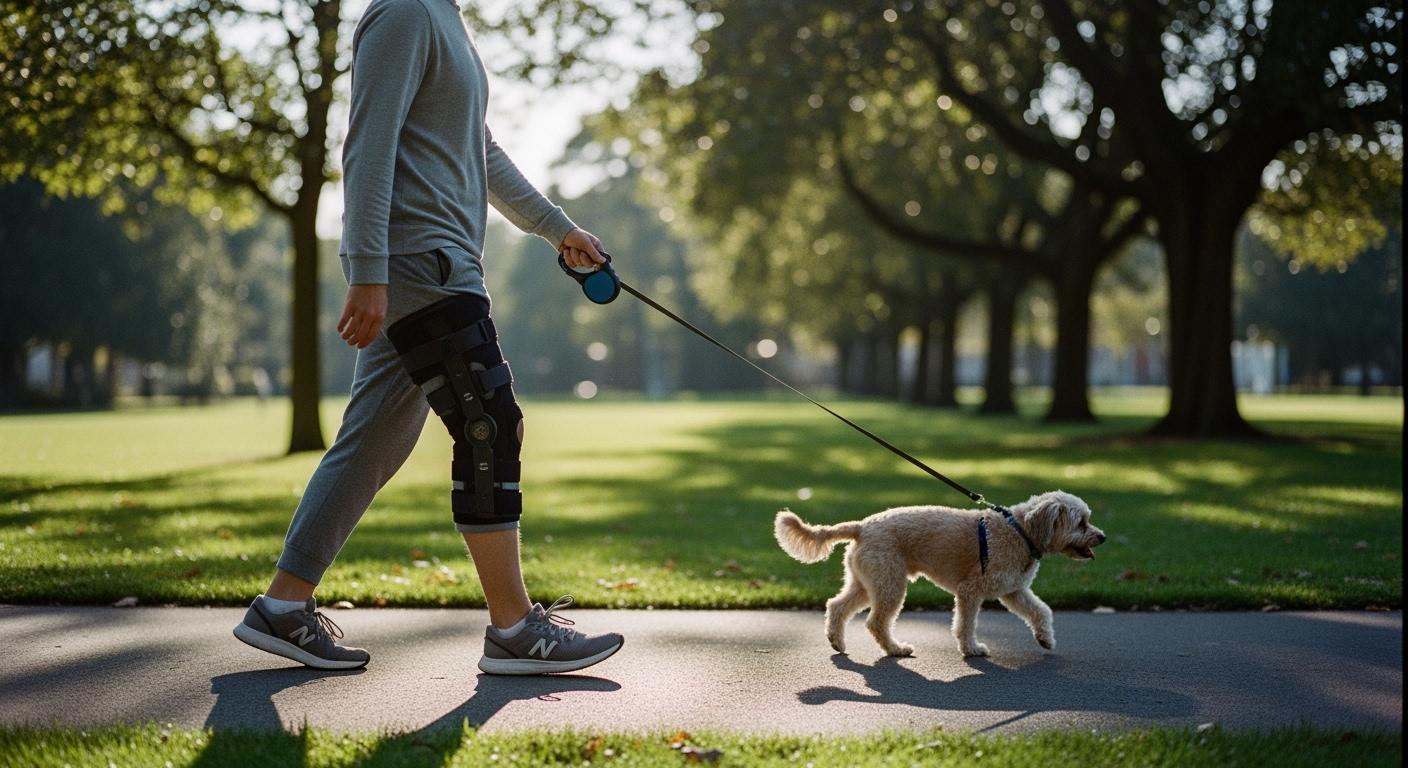
A luxating patella knee brace can look perfectly secure when a dog stands still. Straps sit flat. Padding rests evenly against the leg. Nothing slides. Then the dog climbs a single stair or pivots to follow a sound, and the brace has shifted half an inch toward the hock. That half-inch means the patella is no longer held. The brace is just a sleeve at that point—worn, but not working.
Size gets blamed. It is rarely the real problem.
What matters is whether the brace can anchor above and below a knee that changes shape with every step, whether the side panels resist the kneecap’s tendency to drift sideways during weight transfer, and whether the activity itself exceeds what any soft-goods brace can control. These are mechanical questions, not sizing questions. And they determine whether a walk is supported or the brace is just along for the ride.
| Activity | Brace suitability | Why it may work or fail |
|---|---|---|
| Slow flat leash walk | Yes | Low knee flexion, minimal rotational force, brace stays anchored |
| Short supervised potty walk | Yes | Brief duration, low force, easy to monitor position |
| Stairs | No | Knee flexion exceeds 45 degrees, strap tension shifts, brace migrates |
| Jumping onto furniture | No | High vertical load plus lateral patella drift, brace cannot counter both |
| Rough play | No | Multi-directional force, brace rotates or slides within seconds |
| Fast turns | No | Rotational force at the stifle overcomes strap friction, patella escapes |
| Off-leash running | No | Uncontrolled joint loading, no opportunity to correct brace position |
When the Brace Stays Put—and When It Does Not
A knee brace for luxating patella works within a narrow mechanical window: slow, straight-line movement on flat ground. Inside that window, strap friction holds, hinge alignment stays roughly true, and the side panels can resist the medial drift of the kneecap. Outside it—stairs, sharp turns, any jump—the forces change in kind, not just in degree.
This is why the activity table above draws such hard lines. A brace that holds through a 10-minute flat walk can slide within three stairs. The difference is not wear time or strap tightness. It is the knee angle.
During a stair climb, the stifle flexes well past 45 degrees. The thigh muscle belly shortens and widens, while the lower leg rotates relative to the femur. A strap tensioned for a standing dog is now pulling at a different vector against a different leg contour. That shift in pull direction is what starts the slide. Once the brace migrates even a quarter-inch, the hinge no longer tracks the joint axis. Sideways patella movement—the very thing the brace is meant to limit—now has a gap to escape through.
You can verify this at home. Walk the dog on flat ground for 10 minutes. Mark the brace’s lower edge position relative to a bony landmark—the point of the hock works. If that edge has crept closer to the hock by more than half an inch, anchoring is failing. The walk was less supported than it looked.
A dog’s hind leg tapers from thigh to ankle. That geometry is the root problem for any brace that wraps the stifle. There is no natural shelf or flare for the brace to sit on—only a gradual narrowing that turns every step into a gentle push downward.
Single-point strap configurations make this worse. When a brace uses one strap above the knee and one below, each strap creates a narrow band of pressure. During a walk, the thigh strap sees tension cycles as the muscle contracts and relaxes. Each contraction widens the thigh slightly. Each relaxation returns it. Over hundreds of steps, this cyclic loading works the strap like a very slow ratchet—loosening by microns until the cumulative slack is enough for the entire brace to drop. This is not a defect. It is straight mechanics: a narrow strap on a tapered, contracting surface will always lose position faster than a wider, multi-point configuration that distributes the same tension across a broader contact area.
Materials amplify the effect. Neoprene with a smooth inner face has low static friction against short-coated legs. Add moisture from skin respiration during a 20-minute walk, and that friction coefficient drops further. The brace is now sliding on a micro-layer of humidity. Silicone grip strips or a textured inner lining change this equation—not by making the strap tighter, but by increasing the surface friction that resists the first millimeter of movement. Once a brace starts moving, stopping it is far harder than preventing the start.
A second observable check: after a walk, open the brace and feel behind the knee. If the padding is damp and the skin shows red crease marks that last longer than 20 minutes, the brace is bunching during flexion. That bunching means the posterior edge is not clearing the knee during the swing phase of gait. The brace is fighting the joint’s natural range instead of moving with it. Over weeks, this same pinch point can produce pressure sores that make the dog refuse the brace entirely—not because the brace is the wrong size, but because its posterior clearance was designed for a shallower flexion angle than the dog actually uses.
| Performance Difference | Why it matters | Main limitation |
|---|---|---|
| Narrow vs. wide strap configuration | Wider straps distribute tension across more surface area, resisting the cyclic loosening that narrow straps allow | Wider straps add bulk behind the knee—clearance becomes the trade-off |
| Smooth vs. textured inner lining | Textured or silicone-grip surfaces increase static friction, delaying initial migration on short-coated legs | Textured surfaces trap more debris and require more frequent cleaning |
| Rigid hinge vs. flexible side panels | A rigid hinge resists rotational force better but misaligns more severely when it does shift; flexible panels tolerate small drift but provide less absolute lock | Neither design eliminates the need for activity restriction—they fail differently, not less |
| High vs. low posterior trim line | A contoured, lower posterior edge clears the popliteal region during deeper flexion, reducing pinch and bunching | Lower trim reduces overall coverage, which can trade off side-stability for clearance |
The sizing conversation around luxating patella knee braces that slip or rotate usually starts with circumference measurements. But circumference at rest is the least informative number. What matters is the circumference delta—how much the thigh and lower leg change dimension from stand to stride—and whether the strap system accommodates that delta without losing tension.
When This Brace Is the Right Call—and When It Is Not
Not every dog with a luxating patella benefits from a knee brace. The brace is a mechanical assist for a specific set of conditions. Outside those conditions, it can delay the right intervention or create a false sense of security.
The brace makes sense for grade I and selected grade II luxations where the patella displaces only intermittently, the dog is not in constant pain, and the primary goal is to maintain muscle tone during controlled exercise while limiting lateral patella drift. In these cases, the brace acts as a movement governor—it does not cure the groove depth or correct tibial rotation, but it restricts the kneecap’s escape path during the activity window where muscle strengthening happens. The logic is mechanical: stronger quadriceps and hamstrings create more active joint compression, which helps the patella track more centrally. The brace gives that strengthening a protected window.
This logic breaks for grade III and IV luxations where the patella is permanently displaced or returns only to immediately luxate again. At that severity, the bony groove is too shallow for any external soft-goods brace to hold the patella in place against the forces of walking—let alone stairs. The brace becomes a constant irritant: it presses against a kneecap that is already in the wrong place, loading the medial ridge instead of distributing force through the groove. That is a pain amplifier, not a support device.
Disclaimer: The fit checks and activity boundaries described here assume a dog with standard hind-leg conformation and a short-to-medium coat. Double-coated breeds may show subtler rub marks that need hand-checking rather than visual inspection—run your fingers under the brace edges after each session. Dogs with angular limb deformities or very deep chests may have leg geometry that falls outside the sizing assumptions most off-the-shelf knee braces are patterned for. In those cases, the position checks described here may not catch every pressure point.
The difference between mild and severe luxation cases is not just a number on a vet’s chart. It determines whether the brace loads the joint correctly or concentrates force on the wrong structure. When in doubt, a short wear test—10 minutes on flat ground, with a position check before and after—tells you more than any grade label alone.
For dogs that fall into the right use window, a properly structured luxating patella knee brace with multi-point anchoring and a contoured posterior edge can hold position through controlled walks. But structure alone is not enough. The daily routine matters as much as the brace design. A knee brace matched to the dog’s real movement patterns—not just their standing measurements—is what separates a brace that works from one that is worn but not working.
The same design principles that apply to knee support extend to broader mobility challenges. A comprehensive approach to knee stability and daily support starts with matching the brace type to the actual forces the dog’s leg encounters, not the forces you hope it encounters. And when a brace keeps slipping despite correct measurements, the failure is almost always in the anchoring strategy—not the size chart.
Häufig gestellte Fragen
Can a luxating patella knee brace replace surgery?
No. A brace limits patella displacement during controlled walking; it does not deepen the trochlear groove, correct tibial tuberosity alignment, or tighten a loose joint capsule. Those are structural corrections. The brace manages mechanics, not anatomy. For grade III and IV luxations, surgical correction addresses the root cause in a way no external device can.
How tight should the straps be?
Tight enough that you cannot rotate the brace around the leg by more than 15 degrees with light hand pressure, but loose enough that you can slide one finger under each strap edge without forcing it. If the strap leaves a deep red crease that persists more than 20 minutes after removal, it is too tight—pressure is concentrating at the strap line instead of distributing across the inner padding. If the brace pivots freely with a light twist, it is too loose—anchoring is already gone before the dog takes a step.
Why does the brace stay in place indoors but slide during outdoor walks?
Indoor surfaces are smooth and predictable. Outdoor walks introduce uneven terrain, slight inclines, and variable pace—all of which increase the knee flexion range and lateral force the brace must absorb. The larger point: a brace that passes a living-room test has not passed a real-use test. The first outdoor walk reveals whether the anchoring holds under the conditions that actually matter.
How long can a dog wear the brace per session?
Start with 10-minute sessions on flat ground. If position holds and skin checks pass—no redness lasting beyond 20 minutes, no moisture trapped behind the knee—extend to 20 minutes. Do not exceed 2 hours of continuous wear without a removal-and-skin-check break. Overnight wear is not recommended unless specifically directed by a veterinarian for a documented medical reason. Skin needs the unloaded interval to recover from sustained contact pressure, even from well-fitted padding.
