
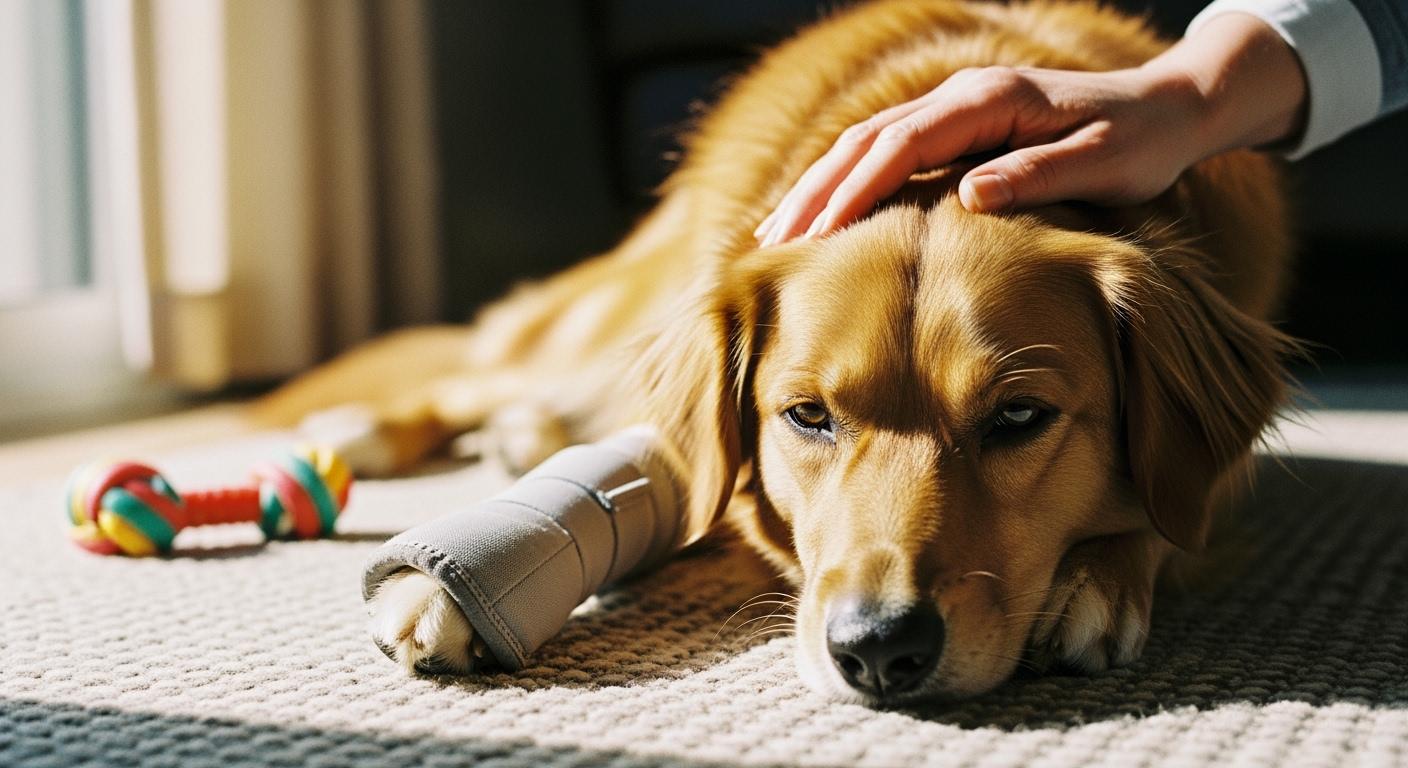
A dog works a leg sleeve hard. In a single day the fabric gets walked on, slept on, dragged across flooring, and pulled against by a tongue that can generate surprising force. Most sleeves block licking on the first wear. The question is what happens by hour six.
Fit rarely fails because the sleeve was measured wrong. It fails because the sleeve shifts. A dog bends a hind leg through a full range of motion—sitting, standing, climbing, turning in a tight circle—and each motion tugs the fabric in a slightly different direction. If the sleeve cannot track that movement, it migrates. Half an inch is enough. The wound edge re-exposes, the dog finds it, and the barrier becomes irrelevant.
The difference between a sleeve that holds position through a full day and one that needs constant readjustment sits in a handful of design decisions. Strap width matters. Cuff construction matters. The fabric’s willingness to slide against itself rather than against skin matters. These are not comfort features. They are the line between a leg sleeve that protects and one that creates a false sense of security.
Where a Leg Sleeve Stops Protecting
Edge Migration: the Half-Inch Problem
A sleeve covers a wound. The dog lies down, gets up, walks across the room. Each transition applies a small shear force at the fabric-to-skin interface. The sleeve’s top edge is anchored—typically by a torso strap or harness—but the bottom edge near the paw has no equivalent anchor. So the bottom edge drifts upward, slowly, over hours.
This is not a sizing error. It is a consequence of how force distributes along a tapered limb. A cylinder applies uniform grip. A dog’s leg is not a cylinder. The thigh is wider than the hock, the hock is wider than the ankle. A sleeve that fits snugly at the thigh has less grip at the ankle, and that grip differential is what the dog’s movement exploits.
The observable check is straightforward. After 20 minutes of normal walking, mark the sleeve edge position with a finger-width reference against a visible landmark—the hock joint or the top of the paw pad. Walk the dog for another 10 minutes. If the edge has moved more than half an inch, the sleeve is migrating. It will continue to migrate. The wound coverage you had at minute one is not the coverage you will have at hour four.
Bunching Behind the Joint
Fabric that gathers behind the knee or hock does more than look sloppy. When the dog flexes the joint, bunched material resists compression. That resistance translates into pressure—not distributed across the fabric panel, but concentrated at the fold line. The fold line presses into skin, restricts blood flow locally, and within a few hours creates the kind of focused irritation that makes a dog fixate on the very area the sleeve is meant to protect.
The physics is simple: fabric has thickness. When it folds, the fold multiplies that thickness by two or three layers. A 2 mm panel becomes a 6 mm ridge. That ridge becomes a pressure point. The dog licks the pressure point. The sleeve has now caused the behavior it was intended to prevent.
Sleeves with vertical stretch zones placed along the joint line reduce this by letting the fabric extend rather than gather. The material yields along the axis of motion rather than piling up perpendicular to it. A sleeve without this feature still blocks the tongue, but it may trade one source of licking for another.
A sleeve should not bunch behind the joint. Put the sleeve on, flex the dog’s leg through its normal range three times, and run a finger along the back of the joint. A ridge thicker than the base fabric means bunching is present. That ridge stays there all day.
How Material Choices Shift Skin Tolerance and Daily Wear Time
Moisture: the Variable Most Sleeves Ignore
A dog’s leg under fabric generates humidity. Body heat, ambient temperature, and the dog’s activity level all push moisture vapor into the space between skin and sleeve lining. If the fabric does not let that vapor escape, the microclimate under the sleeve becomes warm and wet.
Warm and wet skin softens. Softened skin abrades more easily. Within hours, the same sleeve that felt comfortable during application is now sitting against tissue that has measurably less mechanical resistance to friction. The strap that was snug at 9 AM is doing more damage at 2 PM—not because it tightened, but because the skin it contacts has weakened.
The observable test is specific to fabric choice. After 20 minutes of wear, lift the sleeve edge and press a dry finger against the skin underneath. If the skin feels damp or tacky, vapor is not escaping fast enough. If the liner itself feels wet against the fingertip, the fabric is absorbing moisture and holding it—worse than non-breathable, because it actively creates a wet-contact surface.
Mesh panels and knit constructions that separate the liner layer from the outer shell create a vapor path. Moisture moves from skin to liner, then from liner through the air gap to the outer fabric, then out. Without that gap, the liner becomes a wet barrier regardless of how breathable the outer layer claims to be.
Seam Placement and the Pressure Map
A flat seam feels invisible when the dog stands still. It becomes a problem when the dog lies down on a hard surface with the seam side against the floor. Body weight concentrates on the raised seam line. The ridge—even a 1 mm ridge—acts like a dull blade under 40 or 60 pounds of lateral pressure.
| Seam Position | Performance Under Load |
|---|---|
| Flat against the outer leg panel | Minimal ground contact when dog lies on opposite side; low pressure risk |
| Running vertically along the inner leg | Contacts the opposite leg and flooring; moderate friction risk during side-lying |
| Crossing the bony prominence of the hock or knee | Body weight drives the seam ridge directly into bone; highest rub-risk position |
| Offset to follow the muscle belly rather than the joint line | Distributes pressure into soft tissue rather than bone; lower rub risk but requires precise panel cutting |
This is also why sleeve construction depth matters. A sleeve cut from two panels with a single vertical seam has fewer ridge lines than a multi-panel assembly—but it may also fit a tapered leg less closely. The tradeoff is real: fewer seams mean fewer pressure lines, but a looser fit means more migration. Most well-executed designs split the difference with a two-seam layout that routes seams away from bony landmarks without sacrificing too much contour fit.
When a Sleeve Is Not the Right Barrier
Wound Location and Coverage Geometry
A sleeve covers a cylinder. But wounds do not always sit on the cylinder—they sit at the transition zones. A wound directly over the hock sits at a hinge point that opens and closes with every step. A wound high on the inner thigh sits in an area where the sleeve’s top edge meets the torso, a junction that gaps when the dog sits.
A sleeve designed for back-leg recovery assumes the primary coverage zone runs from mid-thigh to above the hock. If the injury sits at the paw or lower ankle, the sleeve’s bottom edge either falls short of the wound or rides directly over it with every step—and a sleeve edge moving over a wound is worse than no sleeve at all.
Wounds in high-flexion zones—the hock joint, the front of the stifle—challenge every sleeve design. The fabric must stretch and recover hundreds of times per hour. Each flexion cycle is an opportunity for the edge to shift relative to the wound margin. A sleeve works best when the wound sits in the middle third of the coverage zone, where fabric motion is lowest, and worst when the wound sits within an inch of either edge.
When Build and Breed Work Against the Design
Short-coated breeds show rub marks faster. The hair coat that provides a natural slip layer is thinner, so the fabric contacts skin more directly and with less buffer. But short coats also make monitoring easier—redness and indentations are visible without parting fur. The trade runs both directions.
Deep-chested breeds with narrow hindquarters present a geometry problem. The leg taper from hip to ankle is steeper, so a sleeve cut for a more cylindrical limb will have a larger grip mismatch between top and bottom. That mismatch accelerates edge migration, and the sleeve that stays put on a Lab may walk up a Greyhound’s leg within an hour.
Disclaimer: This check assumes a short-coated or moderately coated dog. Double-coated breeds with dense undercoat may show subtler rub marks that require hand-checking rather than visual inspection—run fingers under the sleeve edges and feel for warmth, dampness, or skin texture changes that would be hidden by fur density. If the dog’s leg conformation falls well outside the breed norms this sleeve was patterned for—particularly dogs with angular limb deformities or very narrow hindquarters—the fit checks described here may not catch every pressure point.
Coverage Versus Airflow: the Tradeoff
Full-leg coverage blocks more licking access. It also traps more heat. A sleeve that runs from ankle to belly covers every wound and suture within that zone, but it also wraps the largest possible surface area in fabric—and every square inch of covered skin contributes moisture to the microclimate under the sleeve.
A shorter sleeve covering only the wound zone breathes better. The trade is that the uncovered leg above and below remains accessible to the dog’s tongue. If the dog is determined and the wound is within tongue-reach of the sleeve edge, the shorter sleeve buys airflow at the cost of barrier coverage that a bandage might handle differently.
| Coverage Strategy | Performance Difference | Main Limitation |
|---|---|---|
| Full-leg (ankle to torso) | Blocks licking across the entire leg; wound access eliminated | Maximum heat and moisture accumulation; requires more frequent skin checks |
| Mid-leg (above and below wound) | Moderate coverage with better ventilation; less grip mismatch over taper | Exposed skin above and below remains lickable if the dog’s reach permits |
| Local wrap (wound zone only) | Minimum heat buildup; easiest to apply and remove | Edge proximity to wound makes migration risk highest; least lick protection |
No single coverage strategy wins across all dogs and all wound types. A dog that tolerates full-leg coverage and has a wound in the middle-third zone gets the strongest protection. A dog with a wound near the hock on a steep-taper leg may get better real-world results from a mid-leg sleeve with more targeted anti-lick coverage than from a full-leg design that cannot hold its edge position through a day of joint flexion.
Häufig gestellte Fragen
How long before the sleeve’s fit needs to be rechecked?
Check at 20 minutes after application—that is when migration patterns first become visible. Then check every 4 to 6 hours during continuous wear. A sleeve that passes the half-inch migration test at 20 minutes and shows no bunching behind the joint can typically stay in position through a full wear cycle. Remove the sleeve for a full skin inspection at least every 12 hours.
What is the difference between a sleeve that is too tight and one that fits correctly?
A correctly fitted sleeve makes full contact without compressing. The fabric lies flat against the coat and you can slide one finger under any edge without resistance. Too tight: the fabric indents the skin or fur and leaves a visible depression line within 10 minutes of removal. That depression line is a pressure signature—it means the sleeve is applying enough continuous force to displace tissue fluid, and that level of pressure will cause skin breakdown if maintained.
Can the same sleeve design work for a front leg?
The taper direction reverses. A hind leg thickens from ankle to thigh. A front leg thickens from paw to elbow, then tapers slightly to the shoulder. A sleeve cut for hind-leg taper will have its grip gradient upside down on a front leg—the snug end lands at the wrong anatomical point. Front-leg sleeves need a different panel shape, not just a different size label.
Why does the sleeve stay wet inside even when the dog has not been in water?
That is vapor trapped by a non-breathable liner or a construction that lacks an air gap between liner and shell. Body heat drives moisture out of the skin continuously, even at rest. If the fabric cannot pass that vapor, it condenses on the inner surface. The fix is not washing more often—it is a material choice. Look for a construction where the liner layer and outer layer are separated, even if by a thin spacer mesh.
