
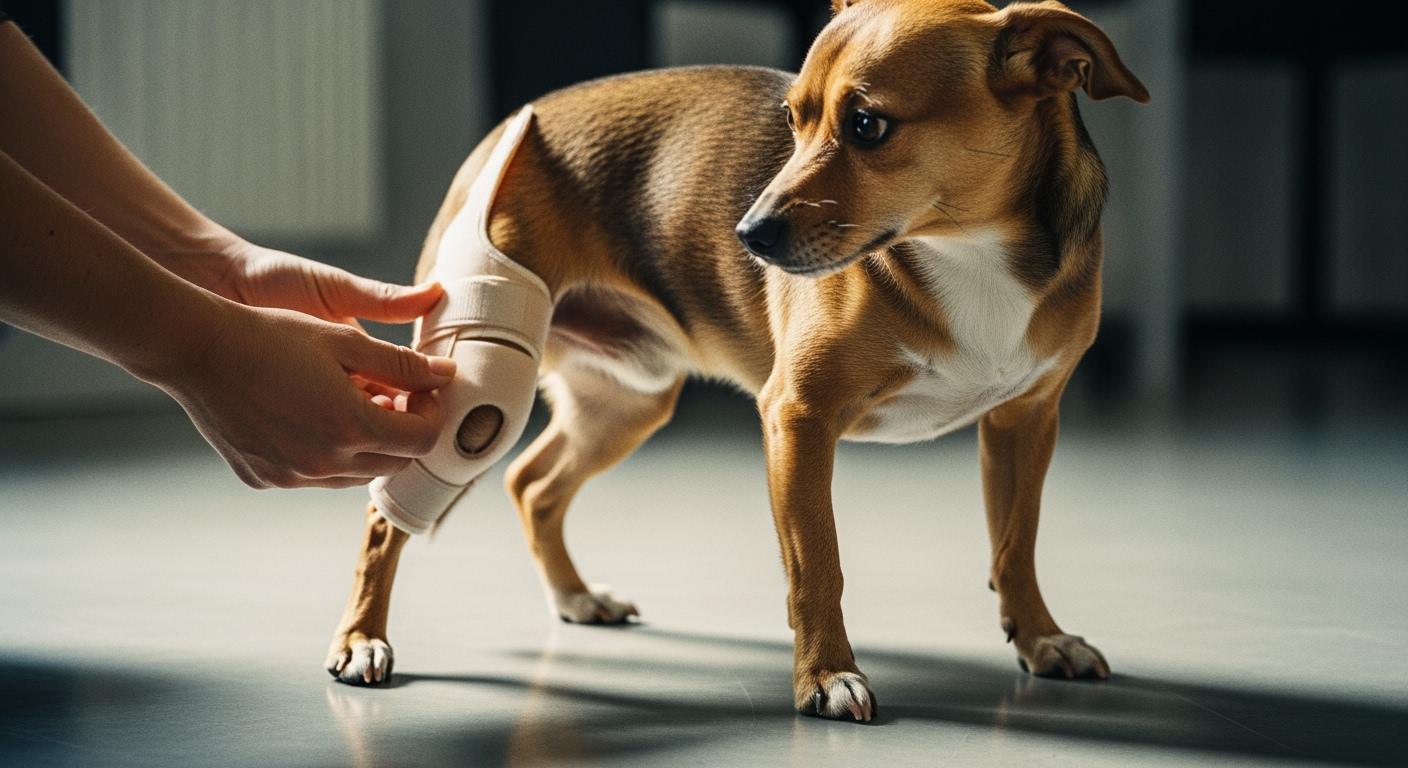
You just put a knee brace on your small dog and something looks off. The brace slides down, your dog walks stiffly, or a red mark appears under a strap after just a few minutes. The first week is not a pass/fail moment for the brace — it is a fit-test period where you watch, adjust, and decide whether the setup is safe. This article walks through the three most common problems — slipping, rubbing, and awkward walking — and tells you what to check, what to adjust, and when the right call is to stop and contact your veterinarian.
Note: This article covers first-week fit checks for small-dog knee braces used under veterinary guidance. It does not replace a diagnosis, a fitting by a professional, or emergency care for sudden pain or loss of function.
Why Fit Hits Small Dogs Harder
Less Room for Error
Small dogs have narrow legs, short tibias, and less surface area for a brace to anchor against. A fit error that would be minor on a large dog — a strap a quarter-inch too loose, a pad sitting slightly off-center — can make a brace unusable on a dog under about 30 pounds. The brace needs to stay aligned with the knee joint through the full stride without migrating, and the margin for that alignment shrinks with leg size. Knee stability and recovery support depend on getting that alignment right, especially for small dogs prone to patellar luxation and CCL insufficiency — a shifted brace on a luxating patella can do more harm than no brace at all.
Bulk Changes the Gait
A knee brace adds noticeable bulk to a small leg. During the first few sessions, your dog may step high, walk more slowly, or hesitate at the start of a walk. This is usually an adjustment response, not a fit failure — the dog is learning to move with the device. What separates normal adaptation from a problem: normal adjustment improves over several sessions, while a poor fit stays awkward or gets worse. If the brace is sized correctly and positioned properly, the mechanical gait change should decrease noticeably within the first few days of short, supervised walks. If your dog continues to hop, drag the leg, or freeze after multiple sessions, the brace type, size, or fit likely needs rethinking.
The Three Signals That Demand Attention
Slipping, rubbing, and awkward walking are not rare side effects — they are the main reasons small-dog brace use fails. Each one points to a different fit problem:
- Slipping or rotating usually means the brace is too loose, the size is wrong for the leg shape, or the straps are tensioned in the wrong order.
- Rubbing, red marks, or damp skin tells you a strap is overtightened, padding is bunching, or the brace is being worn too long without a skin break.
- Awkward walking that does not improve suggests the brace is too bulky for the dog’s stride, restricting normal motion, or forcing the leg into an unnatural position.
If you see any of these, the answer is not to push through. It is to stop, check, adjust, and try again with a shorter session.
First-Week Fit Check Routine
Start Short, Stay Close
The first session should be short enough that you can watch every step: about 10 to 15 minutes on a leash, on a flat non-slip surface, indoors or in a quiet outdoor area. A properly sized knee brace for a small dog needs the leg measurement confirmed against the manufacturer’s size chart before the first session — even a half-size mismatch can cause the slipping and rubbing problems described above. Repeat twice a day for the first few days. Increase session length gradually only if the brace stays centered, the skin looks normal after removal, and your dog walks without obvious distress. Never leave a small dog alone in a knee brace during the first week, and never put the brace on for unsupervised rest or sleep.
Strap and Position Check
Getting the strap tension and sequence right is the difference between a brace that stays put and one that shifts within minutes. Follow this order each time you put the brace on:
- Slide the leg into the brace and check that the joint hinges align with the knee.
- Secure the bottom strap first — snug enough to anchor the brace, not so tight that it digs in.
- Check for wrinkles, pinching, or bunched padding under the strap. Smooth any folds.
- Tighten the middle strap to close any gap at the knee without restricting the joint’s natural range of motion.
- Secure the top strap around the thigh. It should be snug but slightly looser than the lower straps to avoid restricting circulation.
- Confirm the brace sits just above the hock and allows the dog to flex and extend the leg fully.
After strapping, walk the dog a few steps and check that the brace stays centered over the knee. If it shifts immediately, the strap order or tension needs adjusting before you continue the session.
Skin Check After Every Removal
Remove the brace and inspect the skin after every session during the first week. Run your fingers under where each strap sat. Look for redness, indentations that last more than a few minutes, dampness, or broken skin. Mild pinkness that fades quickly is common during break-in. Redness that persists, any open skin, or heat under the brace means stop and do not put the brace back on until the skin is fully healed and the fit has been corrected. If marks do not fade or the skin breaks, contact your veterinarian before the next use.
Escalation rule: If you see open wounds, significant swelling, sudden sharp pain, or your dog refuses to bear weight on the leg, remove the brace and call your veterinarian immediately. Do not wait for the next scheduled session.
| Signal Level | What You See | Was ist zu tun? |
|---|---|---|
| Green — continue | Brace stays centered, skin looks normal, dog walks without obvious distress | Continue supervised sessions, keep daily skin and position checks |
| Yellow — adjust | Brace slides or rotates, mild redness that fades, dog licks or mouths the brace, brief hesitation at walk start | Shorten session, adjust straps, recheck skin after next removal, call vet if signs persist more than a day |
| Red — stop | Open wounds, swelling, heat, severe limping, refusal to bear weight, sudden sharp pain | Remove brace, stop all use, contact your veterinarian immediately |
Daily Fit-Check Table
Use these four checks every day during the first week. A single pass does not guarantee the brace is right — consistency across sessions is what confirms the fit.
| Was zu überprüfen ist | Good Sign | Warning Sign | What to Do Next |
|---|---|---|---|
| Brace position and centering | Stays centered over knee, no sliding or twisting | Slides down, rotates, or bunches during a short walk | Stop, adjust strap order and tension, shorten session, reassess |
| Skin under straps and edges | Normal color, no lasting marks or dampness | Redness that persists, swelling, broken skin, dampness | Remove brace, let skin recover, do not reuse until fit is corrected |
| Walking pattern | Slower but steady, improves over several sessions | Hopping, dragging, freezing, stiff gait that does not improve | Pause use, check fit, ask vet if brace type is appropriate |
| Dog tolerance | Accepts short sessions without distress | Chewing, biting, hiding, panting, repeated escape attempts | Stop, review fit and schedule, consider alternative support |
Troubleshooting the Three Common Problems
If the Brace Slides or Rotates
A brace that migrates during a walk loses its ability to stabilize the knee. The most common cause on small dogs is a fit that is slightly too loose or straps that were tightened in the wrong order. Stop the walk, remove the brace, and reapply using the strap sequence described above. If the brace still shifts after re-tensioning, the size may be wrong for your dog’s leg shape — some small dogs with especially narrow or tapered legs need a different brace style or a custom-fit option to get reliable positioning. Do not overtighten to compensate for a poor size match. Straps that are too tight can restrict circulation and cause pressure injury without actually preventing migration.
If the Brace Rubs or Leaves Marks
Rubbing is almost always a fit or wear-time problem, not a normal part of break-in. Check for strap marks that last more than a few minutes, damp or macerated skin, and any area that feels warmer than the surrounding leg. The most common cause is overtightening — straps pulled too firm in an attempt to stop slipping. The fix is to shorten session length, let the skin recover fully, and reapply with moderate tension. Do not wrap the brace tighter to solve rubbing. If the skin under a particular strap keeps showing marks even with shorter sessions and correct tension, the padding at that contact point may be insufficient or the brace shape may not match your dog’s leg contour.
If Walking Gets Worse Instead of Better
Some gait change is expected in the first few sessions as your dog adjusts to the bulk and feel of the brace. The key distinction: normal adaptation shows improvement across sessions, while a fit or sizing problem stays the same or gets worse. If your dog consistently hops, drags the braced leg, freezes mid-walk, or refuses to move forward after several sessions, the brace is probably too bulky, too restrictive, or the wrong type for your dog’s condition. Remove the brace and ask your veterinarian whether a lighter or differently designed brace would be more appropriate. A brace that changes gait for the worse is not providing meaningful support regardless of how well it stays in place.
If the Dog Bites, Chews, or Tries to Remove the Brace
Repeated biting, chewing, or escape behavior almost always signals discomfort. Dogs do not reject a brace out of stubbornness — they reject it because something hurts, rubs, restricts, or feels threatening. Stop the session, remove the brace, and do a full skin and fit check before the next attempt. If the behavior repeats across multiple sessions with corrected fit and shorter wear time, the brace may simply not be tolerable for this dog, and alternative support tools should be discussed with your veterinarian.
| Problem Seen on Small Dog | Mögliche Ursache | What to Try |
|---|---|---|
| Brace slides or rotates during a walk | Fit too loose, wrong size for narrow leg shape, straps tensioned in wrong order | Reapply with correct strap sequence, check size, consider custom-fit option if shifting persists |
| Rubbing or persistent strap marks | Overtightening, insufficient padding, sessions too long | Reduce strap tension, shorten sessions, let skin recover fully between uses |
| Awkward walking that does not improve | Brace too bulky or restrictive for the dog’s stride | Try a lighter or lower-profile brace, consult vet about alternatives |
| Dog bites, chews, or tries to escape the brace | Discomfort, pain, poor tolerance of the device | Stop session, full skin and fit check, consider alternative support if behavior repeats |
When a Knee Brace Is Not the Right Tool
Undiagnosed Limp or Severe Pain
Never put a brace on a dog whose limp has not been evaluated by a veterinarian. A brace can mask the signs of a worsening condition while doing nothing to address the root cause. If your dog has sudden severe pain, cannot bear weight, or shows a new limp with no diagnosis, skip the brace and get a veterinary exam first. Using a brace without knowing the underlying problem can delay treatment for conditions that get worse with time, such as complete CCL ruptures or meniscal tears.
Advanced Conditions That Need More Than a Brace
A knee brace can provide mechanical support and reduce painful joint motion, but it cannot correct a structural problem like a high-grade patellar luxation, stabilize a completely ruptured CCL, or stop progressive arthritis. For advanced instability, significant swelling that does not resolve with rest, or a condition that has not responded to conservative management, a brace alone is unlikely to be enough. Your veterinarian can help you weigh bracing against surgery, physical rehabilitation, or a combination approach based on the specific diagnosis and severity.
| Bracing May Help When | Bracing Is Likely the Wrong Path When |
|---|---|
| Veterinarian has diagnosed the condition and cleared brace use | Limp is undiagnosed or the dog is in severe pain |
| Dog tolerates short, supervised sessions with clean skin checks | Advanced patellar luxation or complete CCL rupture needs surgical evaluation |
| Owner can check fit and skin after every session during the first week | Swelling, instability, or lameness is worsening despite brace use |
| Brace is part of a larger plan that includes rest, rehab, or post-op recovery | Dog repeatedly refuses, bites, or cannot tolerate the device |
Tip: A daily log with just a few words per session — brace position after walk, skin condition, gait quality, dog’s willingness — helps you spot patterns before they become problems and gives your veterinarian useful data at follow-up visits.
Das Wichtigste in Kürze
- The first week is a fit-test period, not full adoption. Start with 10-to-15-minute supervised sessions, check brace position and skin after every removal, and do not increase wear time unless all checks are clean.
- Slipping usually means loose fit or wrong strap order. Rubbing usually means overtightening or sessions too long. Awkward walking that does not improve across sessions usually means the brace type or size is wrong for your dog.
- Stop and call your veterinarian if you see open wounds, swelling, heat, severe limping, sudden sharp pain, or your dog refuses to bear weight — do not push through discomfort hoping the brace will break in.
Häufig gestellte Fragen
How do I know if the knee brace fits my small dog correctly?
The brace should stay centered over the knee during a short walk without sliding, rotating, or bunching. After removal, the skin under the straps should look normal or show only mild pinkness that fades within a few minutes. If the brace migrates or leaves lasting marks, the fit needs adjustment.
What should I do if the brace slips or rotates during a walk?
Stop the walk, remove the brace, and reapply using the correct strap order: bottom strap first, then middle, then top. If shifting persists after re-tensioning, the size may be wrong for your dog’s leg shape — some narrow-legged small dogs need a different style or custom fit.
Can my small dog wear the knee brace overnight or during rest?
No. The brace is for short, supervised activity only. Leaving it on during rest or sleep increases the risk of pressure sores, skin breakdown, and circulation problems without adding meaningful support. The brace should come off when the dog returns to a resting position.
How long does it take for a small dog to adjust to a knee brace?
Most dogs show improved comfort and steadier gait within the first few days of short, twice-daily sessions if the fit is correct. If awkward walking persists or worsens after multiple sessions, the brace type or size likely needs rethinking rather than more adjustment time.
What signs mean I should stop using the brace immediately?
Remove the brace and call your veterinarian if you see: open wounds, significant swelling, heat around the joint, severe limping that lasts beyond the session, sudden sharp pain, refusal to bear weight, or skin that stays red or breaks down after removal.
This article is informational only and does not replace diagnosis, treatment, or advice from your own veterinarian. GaitGuard designs and sells canine mobility and bracing products, which creates a commercial interest in this topic. Always consult your veterinarian before using a knee brace, and stop use immediately if your dog shows signs of pain, skin breakdown, or worsening gait.
