
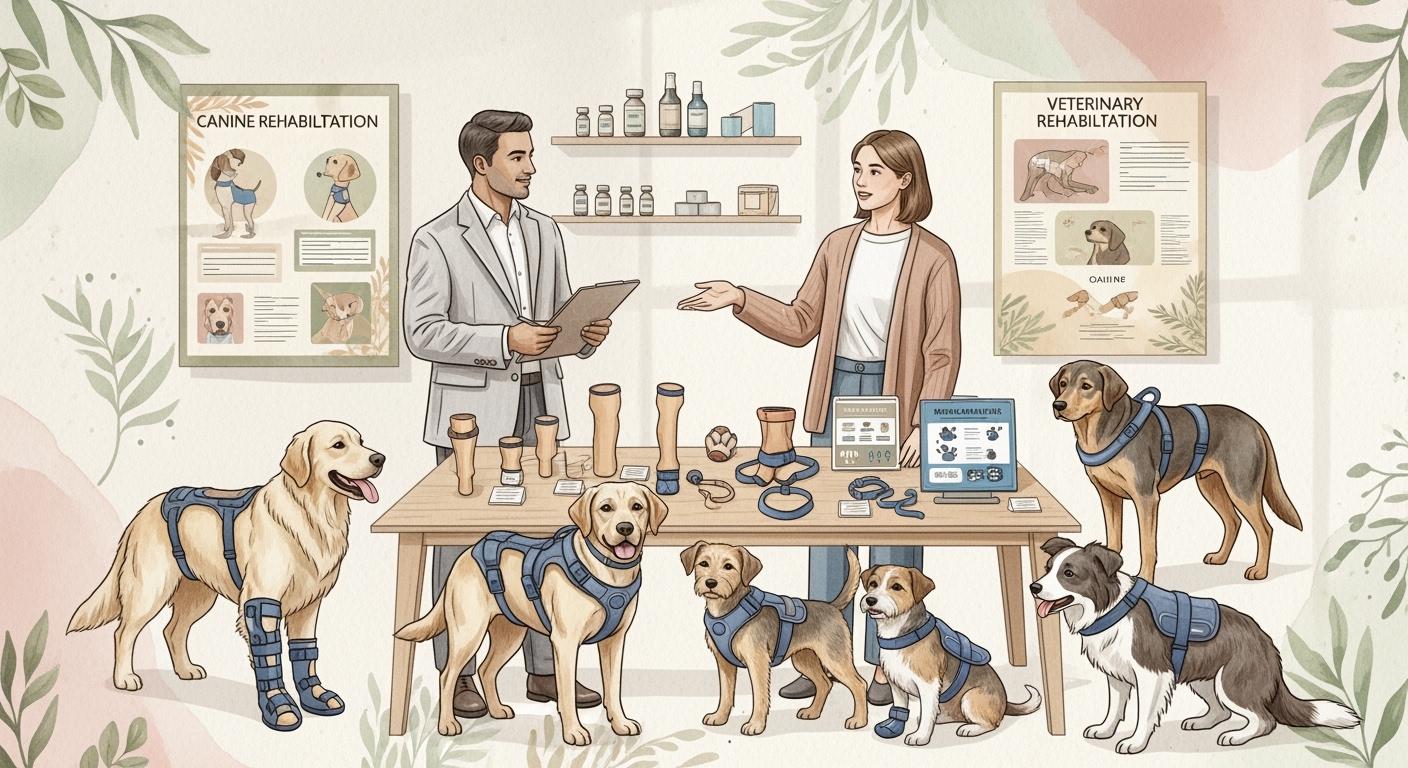
Imagine you run a veterinary clinic or sell veterinary rehab brace wholesale products. You want to trust vendors for good products and dependability. You look at each veterinary rehab brace wholesale to check quality before you buy. Vendors need to show product quality and safety for pets in every veterinary rehab brace wholesale order.
Das Wichtigste in Kürze
Choose fit first when picking dog braces. A good fit keeps dogs safe and comfy. It also lowers the chance of sending braces back.
Always ask sellers to show proof that custom dog braces help dogs heal better. Look for studies or test results to make sure they work.
Use a simple RFQ checklist when you order braces. This helps you get good products that are safe and fit well.
What B2B buyers need in veterinary rehab brace wholesale
When you shop for veterinary rehab equipment for dogs, you need to know what is important. You want every dog to get the right brace. You also want your clinic or business to work well. Different buyers have different needs. But everyone wants good quality, safety, and a steady supply.
Manufacturer vs. distributor vs. private label
You might work at a clinic, run a distribution network, or start a private-label brand. Your job changes what you need from dog braces and other rehab equipment.
Type | Focus | Purpose |
|---|---|---|
Clinics | Quality and fit of braces for patients | Ensure safety and effectiveness for animal rehabilitation |
Distributors | Inventory management and variety for clinics | Provide a range of options to meet clinic needs |
Private-label brands | Higher margins and brand ownership | Create a unique market identity and increase profitability |
Clinics want dog braces that fit each dog well. Safety and comfort matter for every patient.
Distributors need many types of rehab equipment. You want to give clinics lots of choices and keep products moving.
Private-label brands want to be different. You build your brand with custom dog braces and try to earn steady money. You also want to depend less on other suppliers.
Tip: Private-label brands can grow their value and make steady money by selling custom dog braces and rehab equipment.
Fit validation over feature lists
You may see lots of features when you look at custom dog braces. Features are nice, but fit is more important. If a brace does not fit a dog, it can hurt or bother the dog. You want fewer returns and want dogs to stay safe.
Requirement | Why it matters | How to verify |
|---|---|---|
Fit validation process | Lowers returns and stops discomfort | Ask for photo/video fit checks |
You should ask suppliers for clear size charts and guides. Fitting videos help you and your team check the fit before using the brace. Training materials, fitting guides, and break-in schedules help clinics and pet owners use custom dog braces safely. Skin-check instructions help you follow safety steps and spot problems early.
Training materials show you how to use custom dog braces.
Fitting guides and break-in schedules help keep dogs safe and comfy.
Skin-check instructions help you follow safety rules.
Note: Fit checks with photos or videos are better than just reading about features. They help you make sure each custom brace fits the dog before you use it.
Aligning braces with rehab outcomes
You want every dog to get the best results from rehab equipment. You need to know that custom dog braces help dogs move better and feel good. You should look for proof that custom braces help dogs in real rehab cases.
Outcome | Results |
|---|---|
Hip extension ROM gains | All dogs demonstrated gains |
Thigh girth gains | 3/5 dogs showed improvement |
Decreased lameness score | 4/5 dogs improved |
Improvement in walking distance | 3/5 dogs improved |
Better ability to climb stairs | 3/5 dogs improved |
Improvement in CBPI | Noted by 4/5 owners |
You want to see that custom dog braces help dogs walk farther, climb stairs, and have less trouble moving. You should ask suppliers for studies or trial data. This helps you know the rehab equipment you buy really works.
Custom dog braces can help dogs move their hips and legs better.
Many dogs walk farther and climb stairs after using custom braces.
Owners often see less pain and better movement in their dogs.
Remember: Always pick custom dog braces and rehab equipment that match your rehab goals. Look for proof from studies, not just ads.
Why dog braces are a repeat-use rehab equipment
CCLD and osteoarthritis demand
You see many dogs with joint problems in your clinic. CCLD, also called canine ACL disease, affects about 3–5% of dogs in the United States. Osteoarthritis appears in about 2.5% of dogs each year. These numbers show that many dogs need braces for support during rehab. When you offer dog rehab braces, you help dogs move better and feel more comfortable. Braces do not cure disease, but they support dogs as part of a rehab plan. You can expect steady demand for each brace because joint problems are common in dogs.
Contralateral risk and repeat orders
Dogs with CCLD in one knee often face problems in the other knee later. Up to 50% of dogs develop CCLD in the other knee within 12–18 months. This means you may need to order more braces for the same dog. You should plan for repeat orders when you buy braces wholesale. Clinics and distributors see this pattern often. When you track your brace inventory, remember that dogs may need a second brace as part of their rehab.
Braces in the rehab plan
You use braces as a key part of many rehab plans for dogs. Braces help dogs walk, stand, and recover after injury or surgery. You add braces to the rehab plan to support healing and comfort. Many dogs wear a brace for weeks or months. Some dogs need a brace again if they have new joint problems. You should teach owners how to use each brace and check the dog’s skin. When you include braces in your rehab program, you help dogs get the support they need.
Product scope for rehab equipment wholesale buyers
When you look for rehab equipment wholesale, you want to know which braces and gear help dogs most. You need to work with an oem dog brace manufacturer who understands the needs of clinics and distributors. You want to choose products that fit many rehab plans and meet safety standards.
Knee/stifle braces: main uses
Knee and stifle braces help dogs with joint problems. You use these braces for dogs with partial CCL tears or early joint instability. Some dogs cannot have surgery because of age or health. You use braces to give temporary support before or after surgery. A good oem dog brace manufacturer designs braces that help dogs move safely and stay comfortable. You see braces used for chronic joint conditions and gradual rehab programs. You always use braces under veterinary supervision.
You fit braces for dogs that need stability but cannot have surgery.
You use braces to help dogs recover after injury.
You choose braces that support comfort and safe mobility.
Carpal and hock braces: clinic requests
Carpal and hock braces support the wrist and ankle joints in dogs. You request these braces for dogs with sprains, strains, or mild instability. An oem dog brace manufacturer offers braces that help dogs walk and stand better. You use these braces in rehab plans for dogs with chronic joint issues. You want braces that fit well and do not rub the skin. Clinics ask for braces that come with clear fitting guides and safety instructions.
You use carpal braces for wrist support.
You use hock braces for ankle stability.
You want braces that help dogs move without pain.
Anti-lick and lift-assist gear
You add anti-lick gear and lift-assist supports to your rehab equipment wholesale orders. Anti-lick braces stop dogs from biting or licking wounds. Lift-assist straps help you support dogs during walks. You use support harnesses and slings to help dogs stand and walk safely. Rear-support harnesses help dogs with weak back legs or those recovering from joint injuries. An oem dog brace manufacturer supplies gear that fits many rehab needs.
You use anti-lick braces to protect wounds.
You use lift-assist gear to help dogs walk.
You choose harnesses for dogs with mobility problems.
You want a rehab product catalog that covers knee, stifle, carpal, hock, anti-lick, and lift-assist gear. You work with an oem dog brace manufacturer who provides braces and rehab equipment wholesale that meet your clinic’s needs.
RFQ checklist for veterinary rehab brace wholesale
When you ask for a quote for rehab braces for dogs, you need a simple process. You want each brace to fit dogs well and be safe. You check every step before buying wholesale.
Fit and validation requirements
You ask suppliers to show how each brace fits dogs. You look for photos or videos that prove the fit. You want a fit method that uses cast, scan, or measurement. You check if the brace stays in place when dogs walk, sit, lie, or stand. You ask for a fit guide and a break-in schedule. You want fit checks to help dogs avoid skin problems.
Documentation and SOPs
You need documents for every brace. You ask for break-in instructions, skin check steps, cleaning guides, and a list of warning signs. You want a skin redness rule that tells you when to stop and refit. You look for cleaning and drying instructions to keep braces safe for dogs. You want SOPs that help clinics teach owners how to fit and use braces.
Service and refit workflow
You ask suppliers about service and refit steps. You want to know how to fix fit problems for dogs. You check if suppliers offer help for refitting braces. You look for clear instructions on how to report issues and get support.
Copy-paste RFQ checklist
You can use this checklist when you ask for quotes for rehab braces for dogs:
**RFQ Checklist for Veterinary Rehab Brace Wholesale**
- Fit method (cast/scan/measurement) and photo/video validation for dogs
- Anti-rotation stability test during walk/sit/lie/stand
- Skin-contact materials and edge finishing for dogs
- Break-in instructions with interval schedule for dogs
- Skin-check instructions with redness rule for dogs
- Cleaning and drying instructions for each brace
- Declared fabrication time for each brace
- Written warranty terms for each brace
- Clear return/refit policy for each brace
- Support materials for clinics (handouts, fitting guide, red-flag list)
Table 1: RFQ Verification Table
Item | Verified | Notes |
|---|---|---|
Fit method and validation | ||
Anti-rotation stability | ||
Skin-contact materials | ||
Break-in instructions | ||
Skin-check instructions | ||
Cleaning and drying instructions | ||
Fabrication time | ||
Warranty terms | ||
Return/refit policy | ||
Support materials |
Tip: You make dogs safer and lower risk when you follow this checklist for every brace you buy wholesale.
Lead times for custom dog braces
You need to know how long a custom dog brace takes. Lead times help you plan for your clinic or business. When you order a brace, you want to set clear rules for your team and clients.
Fabrication benchmarks
Custom dog braces take different amounts of time to make. Some suppliers finish a brace in 5 business days. Many need 7 to 10 business days. Some special orders take 3 to 4 weeks. If you do not have a written deal for faster service, plan for 3 weeks.
Fabrication Process | Estimated Lead Time |
|---|---|
Fastest custom brace fabrication | 5 business days |
Common custom brace fabrication | 7–10 business days |
Standard custom brace fabrication | 3–4 weeks |
Planning baseline (no SLA) | ~3 weeks |
Planning with SLAs
You should ask your supplier for a written Service Level Agreement. An SLA is a promise for how long each brace will take. If you do not have an SLA, plan for the longest time listed. This helps you avoid delays and keeps your clients updated.
Communicating lead times
You need to tell your team and clients about lead times for custom dog braces. Use the planning table to set clear rules. Always update your clients if the supplier gives you a new timeline. Good communication builds trust and helps you manage your schedule.
Lead-time planning table
Use this table to plan your orders and set rules for each custom dog brace:
Order Type | Lead Time to Expect | Notes |
|---|---|---|
Rush (with SLA) | 5 business days | Written SLA required |
Standard (most suppliers) | 7–10 business days | Shipping time not included |
Custom/complex orders | 3–4 weeks | Use as default if unsure |
No SLA provided | ~3 weeks | Safe planning baseline |
Tip: Always check the lead time for every brace order. This helps you avoid surprises and keeps your rehab program running well.
Policies and warranty for rehab equipment wholesale
Non-refundable custom braces
Custom braces are often non-refundable. Each brace is made for one dog only. You cannot return it if you change your mind. You must check the fit and size before ordering. Non-refundable rules help suppliers avoid losing money. Braces made for one dog cannot be sold to another. You can lower your risk by checking the fit first. Talk clearly with your supplier before you buy.
Return and exchange patterns
Some suppliers let you return or exchange items for a short time. You might have only 14 days to return some products. Other suppliers give you up to 30 days for certain rehab equipment. Always read the return policy before you buy a brace. Short return times mean you must check the brace fast. Set up a plan in your clinic to inspect each brace right away.
Warranty terms
Warranty terms tell you what help you get after buying a brace. Many suppliers give a workmanship warranty for custom braces. This can last about four months. The warranty covers problems with how the brace was made. Ask for the warranty details in writing before you order. The warranty does not cover normal use or wrong sizing. Follow the cleaning and break-in steps from the supplier. This keeps the brace working well.
Policy table (custom, 14-day, 30-day)
Table 3 shows common policy types. It explains what they mean, risks, and how to lower those risks:
Policy Type | Buyer Implications | Risks | Mitigations |
|---|---|---|---|
Non-refundable custom | No returns allowed | Loss if brace does not fit | Use fit validation, confirm measurements |
14-day notice | Short return/exchange | Missed window, limited time | Inspect brace immediately, set SOP |
30-day return | Longer return period | May not cover custom braces | Clarify policy, check eligibility |
Tip: Always read the policy for each brace before you order. You keep your clinic and clients safe by knowing the return and warranty rules.
Clinic SOP for break-in and skin checks
Break-in schedule steps
You need a clear break-in schedule for every dog brace. Start with short intervals. On Day 1, let the dog wear the brace for 30 minutes, then remove it and check the skin. On Day 2, double the time to 1 hour. On Day 3, increase to 2 hours. On Day 4, try 4 hours. Build up to daytime wear, aiming for 8–14 hours each day. Always take the brace off at night unless the veterinarian says otherwise.
Tip: Following a break-in schedule helps dogs adjust and lowers the chance of skin problems.
Skin check redness rule
Check the dog’s skin after each wear. Look for redness where the brace touches the skin. If you see mild strap marks, make sure the redness fades within 20–30 minutes. If redness stays longer, stop using the brace and refit it. This rule keeps dogs safe and comfortable.
Owner handoff education
Teach owners how to check the fit and skin. Show them how to put the brace on and take it off. Give them written instructions for break-in and skin checks. Explain the redness rule. Use fitting demos to help owners feel confident. Training owners reduces skin issues and improves brace safety.
Clinic handoff SOP block
Copy and use this SOP for every brace handoff:
**Clinic SOP for Break-in and Skin Checks**
1. Start with 30-minute wear intervals on Day 1; check skin after each interval.
2. Double interval time each day: Day 2 (1 hour), Day 3 (2 hours), Day 4 (4 hours).
3. Build up to 8–14 hours daytime wear; remove at night unless directed.
4. Check skin for redness after each wear. Redness should fade in 20–30 minutes.
5. If redness persists, pause use and refit the brace.
6. Provide owners with fitting demos and written instructions.
7. Review skin check steps with owners at every visit.
Example: When you train owners to check the fit and follow the break-in schedule, you lower the risk of skin issues. Clinics that use this SOP see fewer complications.
Supplier scorecard and pilot rollout for braces
Scorecard table and scoring
You need a simple way to compare suppliers before buying a lot. Use a supplier scorecard to check each vendor. The scorecard gives 0, 1, or 2 points for each item. You can get up to 20 points total. A higher score means the supplier meets more of your needs.
Table 4: Supplier Scorecard (0–2 Points Each, Total 20 Points)
Item | 0 = Missing | 1 = Partial | 2 = Proven |
|---|---|---|---|
Fit method + photo/video validation | |||
Anti-rotation stability test | |||
Skin-contact materials + edge finishing | |||
Break-in instructions (interval schedule) | |||
Skin-check instructions (20–30 min redness rule) | |||
Cleaning and drying instructions | |||
Declared fabrication time (5 days to 3–4 weeks) | |||
Written warranty terms (e.g., 4 months) | |||
Return/refit policy clarity | |||
Support materials for clinics |
Tip: Use this table for every new supplier. If a supplier scores 16 or more, they are very reliable.
Pilot batch rollout
Do not buy a lot of braces at first. Start with a pilot batch. Order just a few braces to test. Use the scorecard to check each brace in the pilot batch. Look for good fit, comfort, and clear instructions. Give feedback to your supplier. If the pilot batch works well, you can order more later.
Step Set C: Rolling Out Wholesale Purchasing
Pick suppliers with high scorecard scores.
Place a small pilot batch order.
Test each brace for fit and safety.
Get feedback from your team and clients.
Review the results and update the scorecard.
Decide if you want to order more braces.
Tracking complaints and refits
You need to keep track of any problems with braces. Write down all complaints and refit requests. Use this information to update your supplier scorecard. If you see lots of problems, talk to your supplier before buying again. Tracking helps you keep dogs safe and makes your rehab program better.
Note: Careful tracking and pilot batches lower your risk and help you pick the best suppliers.
FAQ for clinics and distributors
Documentation with each brace
You get papers with every brace you order. These include fitting guides and break-in schedules. Cleaning instructions and skin-check steps are also included. These help you teach owners to use braces safely. You also get a list of warning signs to watch for during rehab.
Handling sizing errors
Sizing mistakes can happen sometimes. You should check measurements before you order. If a brace does not fit, talk to your supplier for help. Many suppliers give advice for refitting or adjusting braces. Always follow the fit validation steps to keep dogs comfortable.
Lead times for custom braces
Lead times for custom braces are different. Some suppliers finish braces in five business days. Most take seven to ten business days. Harder orders may need three to four weeks. You should plan for about three weeks unless your supplier gives a written timeline. Good planning helps you manage your orders.
Minimum order quantities
Minimum order amounts depend on the supplier. Some pet brands let clinics order small batches. Others set bigger minimums for distributors. You should ask about order rules before your first order.
After-sales support
You get help after you buy braces. Suppliers help with fitting, cleaning, and refitting. You can ask questions or report problems. Support teams give resources for clinics and owners. Good support lowers risk and helps dogs get better.
Warranty claims process
Warranty claims cover problems with how braces are made. Most suppliers give a four-month warranty for custom braces. You should keep records and contact support if you find a problem. Suppliers help you with the claims process and fix issues.
Customization for breeds
You can ask for custom braces for different breeds. Suppliers offer braces for small, medium, and large dogs. Adjustable straps and hinges help you fit braces as dogs heal. Custom choices make rehab safer and more comfortable.
Training resources
Training resources help you and your team use braces the right way. You get fitting videos, handouts, and step-by-step guides. These help clinics and owners. Training makes braces safer and helps dogs get used to them.
Tip: Always use the papers and support you get with each order. This helps you keep dogs safe and makes rehab easier.
Frequently Asked Questions Table
Question | Answer |
|---|---|
Can I use a human knee brace on my dog? | No. Human braces do not fit dogs and may hurt them. |
How long should my pet wear the knee brace each day? | Start with 1–2 hours and slowly add more time. Use during activity and take off at night unless told otherwise. |
Will my pet accept wearing a knee brace? | Most dogs get used to braces in a few days with good support and a proper fit. |
How do I know if the brace is working? | Look for less limping, more walking, and less muscle loss. |
Can the brace be adjusted as my pet heals? | Yes. Many braces have adjustable parts or can be changed by the supplier. |
You can avoid problems by using the RFQ checklist and supplier scorecard before you buy a lot. Making sure braces fit, having clear rules, and picking good suppliers are more important than just finding the lowest price. Try out new suppliers with small orders first. Always follow the safety steps in the SOPs. 📥 Download the RFQ checklist and scorecard to help you with your next order.
Häufig gestellte Fragen
What documents do you get with each wholesale dog brace?
You receive fitting guides, break-in schedules, cleaning instructions, and a skin-check checklist. These help you use each brace safely and teach pet owners proper care.
How do you handle a sizing error with a custom brace?
Check your measurements before ordering. If the brace does not fit, contact your supplier for refit support or adjustment options. Always follow the fit validation process.
What is the typical lead time for custom dog braces?
Most suppliers need 7–10 business days. Some orders take up to 3–4 weeks. Plan for about 3 weeks unless your supplier gives you a written timeline.
