
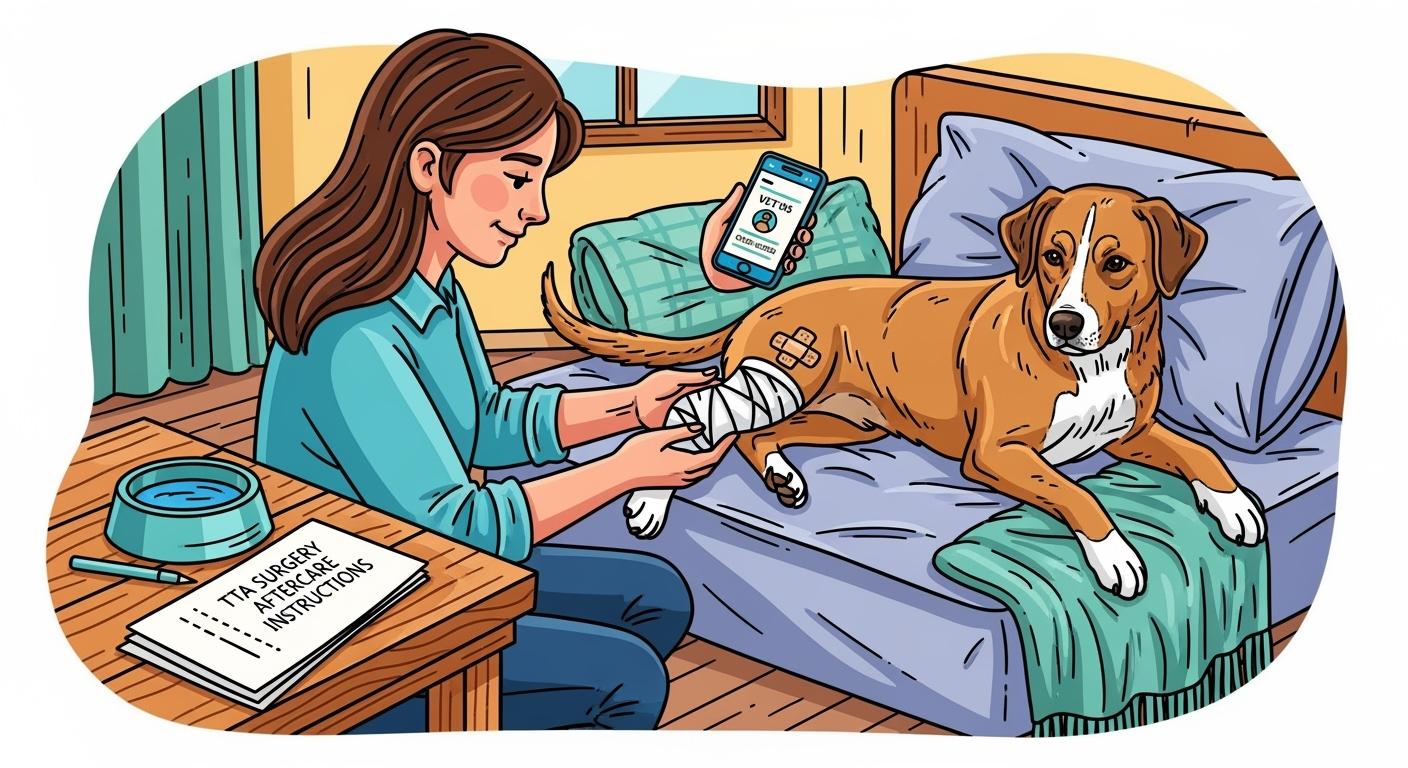
You want your dog to heal well after TTA surgery. At home, you should keep your dog in a small, safe area with non-slip flooring. Use a short leash for potty breaks. Avoid stairs, jumping, and rough play. Watch your dog’s incision for swelling or redness. Call your veterinarian if you see pain, fever, or limping that gets worse. Complications can happen in some dogs, so close monitoring and following post-operative care instructions matter.
Common at-home care steps:
Confine your dog to a crate or small room.
Use a short leash for all outdoor trips.
Avoid running, jumping, and playing.
Your dedication to tta surgery aftercare for dogs helps prevent setbacks and supports a safe recovery. Give medication as directed and reach out for veterinary advice if you notice warning signs.
Key Takeaways
Keep your dog in a small, safe place with floors that are not slippery. This helps stop your dog from slipping or falling while healing.
Always use a short leash when your dog goes outside to potty. Do not let your dog use stairs, jump, or play rough. This helps your dog heal better.
Check your dog’s incision every day for infection signs like redness or swelling. Call your vet if you see any problems.
Listen to your vet about how active your dog should be. Even if your dog looks okay, follow the rules to help healing.
Help your dog get better by making follow-up visits with your vet. Watch for any changes in how your dog acts or moves.
Why TTA aftercare matters
What changes after TTA surgery
TTA surgery changes how your dog’s knee works. The main goal is to make the knee stable and help your dog walk with less pain. After surgery, your dog’s knee joint gets stronger. This lowers the chance of more injuries. Healing starts right away, but your dog still needs help and time.
Physiological Change | Description |
|---|---|
Restoration of stability | TTA surgery stops tibial thrust, so the knee stays steady. |
Reduction of muscle mass loss | Dogs keep more muscle after TTA than after some other surgeries like TPLO. |
Promotion of healing through biomechanics | The surgery changes how the joint moves, which helps the bone heal. |
Early return to function | Many dogs use their leg sooner after TTA surgery. |
Swelling and pain management | Swelling happens first, but it gets better as your dog heals. |
Full weight-bearing timeline | Most dogs step on the leg by day twelve and walk well by six weeks. |
Healing vs. feeling better
Your dog may look better before the bone is healed. You might see your dog walking or wanting to play. This does not mean the knee is ready for normal activity. The bone and implant need time to get strong. Rest keeps the bone and implant safe inside your dog’s leg. If your dog runs or jumps too soon, healing can slow down.
Tip: Always listen to your veterinarian about activity. Even if your dog seems fine, healing may still be happening inside.
Common recovery setbacks
TTA surgery aftercare for dogs helps stop problems that slow down healing. Without good care, your dog can get infections, implant failure, or keep limping. Watch out for these common problems:
Infections can happen if your dog licks or chews the incision. Signs are redness, swelling, heat, or discharge.
Implant failure can happen if your dog moves too much or jumps before healing. This may mean more surgery.
Some dogs keep limping from arthritis and need long-term care.
Recovery Setback | Description |
|---|---|
Infection | Licking or chewing the incision can cause infection and slow healing. |
Implant failure | Too much movement can break the implant, especially in big or active dogs. |
Persistent lameness secondary to osteoarthritis | About 10-15% of dogs may need lifelong changes and medicine. |
TTA surgery recovery depends on your effort to rest, watch, and care for your dog. You protect your dog’s joint, bone, and implant by following the plan. This helps your dog get back to normal life safely and strongly.
TTA surgery aftercare for dogs: Home setup and rest
Safe confinement and flooring
When you bring your dog home after tta surgery, set up a safe recovery area right away. Choose a small room or use gates to create a space about 4 by 6 feet. Make sure the floor is non-slip. Place soft bedding, food, and water within easy reach. Remove any obstacles or hazards. Block access to stairs and furniture.
Use non-slip mats or rugs for traction.
Try paw traction socks or booties if your dog slips.
Lay carpet runners on smooth floors.
Keep the area quiet and calm.
Step 1: Prepare the recovery zone
What success looks like: Your dog rests comfortably, stands without slipping, and cannot reach stairs or furniture.
What means stop and call the vet: Your dog cannot stand, cries in pain, or shows swelling at the surgery site.
Potty trips with support
Always use a standard 4–6 foot leash for potty trips. Attach a harness for extra support. Walk your dog slowly to the potty spot. Stay on non-slip surfaces outside if possible. Do not let your dog run or jump.
Step 2: Support during potty breaks
What success looks like: Your dog walks calmly, uses the bathroom, and returns to the recovery area without limping more.
What means stop and call the vet: Your dog refuses to walk, drags the leg, or shows sudden pain.
Stairs, furniture, and car rules
Block all stairs with gates or closed doors. Do not let your dog jump on or off furniture. For car rides, lift your dog in and out, supporting the back end and chest. Never let your dog jump from the car.
Step 3: Prevent risky movements
What success looks like: Your dog stays on the floor, avoids stairs, and gets in and out of the car with your help.
What means stop and call the vet: Your dog falls, slips, or shows new swelling or pain after movement.
TTA surgery aftercare for dogs starts with a safe home recovery setup. Careful steps protect your dog’s healing leg and help prevent setbacks.
Incision care and lick prevention
Normal vs. abnormal incision changes
Check your dog’s incision every day. Look for any changes. This helps you find problems early. Use the table to see what is normal and what is not. If you see anything abnormal, call your veterinarian for help.
Clinical Signs | Description |
|---|---|
Redness or warmth | Mild redness is okay. Spreading redness or heat can mean infection. |
Swelling or lumps | Small swelling is common. Large lumps or fast bumps need care. |
Discharge | Clear fluid is normal. Yellow, green, or bloody fluid means infection. |
Licking slows healing and can cause infection. | |
Fever | A temperature over 104°F means you should call your veterinarian. |
Lethargy or weakness | Feeling tired or weak may mean pain or a problem. |
Limping or stiffness | Some stiffness is normal. Worse limping needs attention. |
Whining, panting | These can show pain. |
Guarding behavior | Your dog avoids touch or moving near the incision. |
Tip: If you see swelling, heat, colored fluid, or your dog seems sick, call your veterinarian right away.
E-collar and alternatives
Most dogs need an E-collar after tta surgery. This collar stops licking and chewing. Some dogs do better with other choices. The safest option depends on where the incision is and if your dog can reach it. Always listen to your veterinarian’s instructions.
Option | Best for | Not ideal for | Safety notes | Fit tips |
|---|---|---|---|---|
E-collar (plastic) | Most dogs, all incision sites | Dogs with anxiety or small heads | Most reliable for wound care | Collar should go past the nose |
Inflatable collar | Dogs with short necks | Incisions on legs or near mouth | May not block all licking | Should fit snug, not loose |
Incisions on body/trunk | Active dogs, leg incisions | Can trap moisture, check often | Suit should fit closely | |
Soft cone | Calm dogs, minor incisions | Strong chewers, leg incisions | Easier to bend, less protection | Check for gaps or bending |
Note: Your veterinarian’s advice is most important. Pick the option that keeps your dog safe.
Bathing and keeping dry
Keep your dog’s incision dry until the sutures are gone. Do not give your dog a bath during this time. If you need to clean your dog, use a damp cloth away from the incision. Never put your dog in water. If a bath is needed, use Vaseline or ointment on the incision before showering, but only if your veterinarian says it is okay.
Wait until sutures are gone before bathing.
Use spot cleaning for dirty fur.
Keep the incision dry all the time.
Lick prevention options table
Option | Best for | Not ideal for | Safety notes | Fit tips |
|---|---|---|---|---|
E-collar | Most dogs, all incision sites | Dogs with anxiety | Most reliable for post-operative care | Collar should go past the nose |
Inflatable collar | Short-necked dogs | Leg incisions | May not block all licking | Should fit snug, not loose |
Recovery suit | Body/trunk incisions | Leg incisions | Can trap moisture, check often | Suit should fit closely |
Soft cone | Calm dogs, minor incisions | Strong chewers, leg incisions | Less protection than E-collar | Check for gaps or bending |
🐾 The safest choice depends on your dog’s incision and if your dog can reach it. Always follow your veterinarian’s instructions for tta and tplo surgery aftercare.
Comfort and pain management
Cold and warm compress use
You can help your dog feel more comfortable after tta surgery by using cold and warm compresses at the right times. For the first 72 hours, use cold therapy to reduce swelling and discomfort. Wrap a cold gel pack, ice, or a bag of frozen peas in a towel. Hold it gently against your dog’s knee for about ten minutes. Repeat this two times a day. Do not place ice directly on the skin.
After the first three to five days, you may switch to warm compresses if your veterinarian approves. Always wrap the warm compress in a towel or pillowcase. Keep the compress on for no longer than twenty minutes. Warm compresses can help relax muscles and improve comfort once swelling has gone down.
Tip: Never use a heating pad directly on your dog’s skin. Wait until the initial swelling phase passes before starting heat therapy.
Safe sleep setup
A safe sleep area supports your dog’s recovery and comfort. Choose a quiet spot away from busy parts of your home. Use a soft, non-slip bed that is low to the ground. Make sure your dog can get on and off the bed without jumping. Place water nearby so your dog does not need to walk far. Block access to stairs and furniture at night.
Check the bedding daily for wetness or dirt.
Wash the bedding often to keep the area clean.
Keep the sleep space free from toys that encourage rough play.
Pain signals vs. expected discomfort
You play a key role in pain management for your dog after tta surgery. Some mild discomfort is normal, but you should watch for signs that your dog feels more than expected soreness. Veterinary pain scales show that dogs may need extra care if they show these signs:
Whining, panting, or restlessness
Refusing to put weight on the leg
Guarding the leg or snapping when touched
Loss of appetite or hiding
If you see these behaviors, contact your veterinarian. The most effective pain management plans often use a combination of medications and comfort measures. Studies show that certain combinations, like ropivacaine and methadone, can help dogs feel better for longer after tta surgery. Always follow your veterinarian’s instructions for pain control.
If your dog’s pain seems to get worse instead of better, reduce activity and call your vet for advice.
TTA surgery recovery timeline
Phase 1: First 2 weeks (strict rest)
The first part of recovery needs strict rest. Your dog should stay in a quiet, safe spot at home. Use a crate or a small room with a floor that does not slip. Only take your dog outside for bathroom breaks. Always use a regular leash for these trips. Keep walks short, about five to ten minutes. Block off stairs and furniture so your dog cannot reach them. Check the incision every day for swelling or redness. Put cold packs on the knee for ten to fifteen minutes, twice a day, for the first five days. Only do passive range-of-motion exercises if your veterinarian says it is okay.
🐾 Tip: If your dog limps more or looks uncomfortable, do less activity and call your veterinarian.
Milestone/Restriction | Description |
|---|---|
Leash-only bathroom breaks | Walks should be short, slow, and watched. |
Crate or small room rest | Use a quiet area with soft bedding. |
Avoid stairs, running, jumping | Block stairs and use mats to keep your dog safe. |
Incision care | Look at the incision every day for infection signs. |
Cold packs | Use cold packs for ten to fifteen minutes, two times a day, for three to five days. |
Phase 2: Weeks 2–8 (gradual walks)
Start gentle walks in this phase. Begin with ten minutes per walk, three or four times each day. Add five minutes to each walk every week if your dog feels okay. For example, walk ten minutes in week three. Walk fifteen minutes in week four. Walk twenty minutes in week five. If your dog limps more, go back to the last easy walk time. Keep using a regular leash and do not let your dog off leash. Start simple physical therapy exercises if your veterinarian says it is safe.
Note: Most dogs walk much better by six weeks after tta surgery.
Phase 3: Weeks 8–12 (return to activity)
This is the last part of recovery. Your veterinarian may say it is okay for longer walks, up to thirty to forty-five minutes, after checking x-rays. You can add swimming for ten to fifteen minutes a few times each week if your dog likes water. Only let your dog off leash when your veterinarian says it is safe. Do not let your dog run, jump, or play rough until the bone is fully healed.
Safety reminder: Always wait for your veterinarian to say it is okay before letting your dog do more or stopping restrictions.
Progress tracker table
Phase | Time Frame | Activity Goals | Setbacks: What to Do |
|---|---|---|---|
Phase 1 | 0–2 weeks | Strict rest, short leash walks | Do less activity, check again, call vet |
Phase 2 | 2–8 weeks | Slowly walk more, start basic rehab | Go back to easier walks if limping |
Phase 3 | 8–12 weeks | Longer walks, swimming, vet approval | Stop new activity, talk to vet |
🦴 Studies show bones heal in about ten weeks. Most dogs do well after one year. Setbacks can happen. If your dog has trouble, do less activity, check again, and call your veterinarian. Always get rechecks and x-rays before letting your dog run or play off leash.
Home rehab exercises
Helping your dog get stronger after TTA surgery starts with easy rehab exercises. You can help your dog heal by following a simple plan at home.
Passive range of motion basics
Begin with passive range of motion, called PROM, in the first two weeks. This exercise keeps your dog’s knee moving and helps stop stiffness. Gently bend and straighten your dog’s leg. Hold each stretch for five to seven seconds. Do this five times in each session. Try to do PROM two or three times a day if your dog is okay with it. PROM helps blood move better and lowers swelling. Stretching the joint keeps muscles and tissues healthy. Do not force the leg or cause pain. If your dog pulls away, stop and try again later.
Tip: PROM works best when your dog is calm and lying on their side.
Balance and weight-shifting
After two weeks, you can add balance and weight-shifting exercises. These help your dog use the leg that had surgery and feel more sure. Start by gently moving your dog’s weight from side to side while standing. Support your dog under the belly or chest. As your dog gets better, help them shift weight forward and backward. You can let your dog stand on three legs for a few seconds to get stronger. Always keep sessions short and make them fun.
Lateral weight shifts (side to side)
Forward weight shifts (front to back)
Single leg stance (with help, then alone)
Sit-to-stand cues and mistakes
Sit-to-stand exercises help build muscle and control in the back legs. Ask your dog to sit, then stand up slowly. Use a treat or gentle signal. Start with three to five times, twice a day. Watch for mistakes, like your dog using only the front legs or swinging the hips. Make sure your dog sits straight and stands up evenly. If your dog has trouble, do fewer times and try again later.
Weeks | Exercises | Purpose |
|---|---|---|
1-2 | Passive Range of Motion (PROM) | Stop joint stiffness, help blood flow, lower swelling. |
3-4 | Assisted Weight-Shifting, Short Leash Walks | Wake up muscles, help light weight-bearing. |
5-6 | Sit-to-Stands, More Leash Walks | Build back leg strength, improve balance and control. |
7-8 | Incline/Decline Walking, Underwater Treadmill | Grow muscle, help coordination and endurance. |
If you see limping, pain, or swelling, do less and check again. Setbacks can happen during rehab. Always ask your veterinarian before starting new exercises or making them harder. Follow-up visits and x-rays help keep your dog safe before doing harder activities.
🐾 Every dog heals in their own way. Your patience and care help your dog recover better.
Monitoring and red flags
Watching your dog closely after TTA surgery helps you find problems early. Check your dog every day to see how they feel and move. Look at their appetite, energy, incision, and walking. You help your dog heal by spotting warning signs and knowing when to call your veterinarian.
Daily aftercare checklist
Use this checklist each day while your dog recovers. You can print it or save it on your phone. Mark off each step as you finish it. This keeps you organized and helps you notice changes fast.
Care Aspect | Instructions |
|---|---|
Ice | Put cold on the surgery spot for 10 minutes, 2-3 times a day. This helps with swelling and pain. |
Exercise | Keep your dog on a leash for 8 weeks. Slowly let walks get longer if your dog feels okay. |
Wound Care | Clean any fluid with a wet cloth. Do not use creams or ointments. |
Swelling | Watch for too much swelling. A little swelling is normal. |
Licking | Stop your dog from licking the incision. Use an E-collar if needed. |
Doorbells | Turn off doorbells so your dog does not get startled and hurt. |
📝 Tip: Checking your dog often helps you catch problems before they get worse.
Appetite, energy, incision, gait
Look at how much your dog eats and how active they are. Dogs that eat and act alert are usually healing well. Check the incision for redness, swelling, fluid, or smell. Watch how your dog walks. More limping, not wanting to walk, or sudden stiffness can mean trouble.
Here is a table to help you know what to do if you see changes:
What you see at home | What it usually means | What to do next |
|---|---|---|
More swelling | Normal healing or mild irritation | Watch closely; call vet if it gets worse |
More limping | Soreness or too much activity | Do less; call vet if it does not stop |
Licking/chewing incision | Discomfort or boredom | Use E-collar; call vet if wound opens |
Fluid or bad smell from incision | Possible infection | Call your vet for advice |
Not wanting to walk | Pain or injury | Stop activity; call vet right away |
Very tired | Could be illness or just tired | Watch; call vet if it does not get better |
Hot skin or panting | Possible infection or swelling | Check temperature; call vet if over 104°F |
If you see sudden changes, act fast. Early action can stop bigger problems.
Vital signs to watch
You can check your dog’s vital signs at home. This helps you find serious problems early. Use this table to know what is normal.
Vital Sign | Normal Range |
|---|---|
Heart Rate | Puppies: 120-160 bpm |
Small Breeds: 100-140 bpm | |
Medium Breeds: 80-120 bpm | |
Large Breeds: 60-100 bpm | |
Body Temperature | 100.5°F – 102.5°F |
Breathing Rate | 10-30 breaths per minute |
Use a pet thermometer to check temperature. If it goes above 104°F or below 99°F, call your veterinarian. Count breaths while your dog rests. If breathing is too fast, slow, or hard, get help.
🐾 Note: Vital signs that are not normal can mean pain, infection, or other problems.
Emergency signs and when to call the vet
Some signs mean you should call your veterinarian or go to an emergency clinic right away. Watch for these red flags during TTA surgery recovery:
Hard breathing or collapse
Bleeding that will not stop or deep cuts
Trouble peeing or pooping
Bad vomiting or a swollen belly
Sudden limping or broken bones
Tumors that burst or grow fast
Choking or trouble breathing
Straining to pee or poop
Big, swollen belly
Seizures
Hurt eye
Vomiting or diarrhea for more than a day
Heat stroke
Eating poison
Pain or worry that does not get better
🚨 If you see any of these signs, call your veterinarian or an emergency clinic right away.
Caregiver reassurance
Problems can happen during TTA surgery aftercare for dogs. If you see swelling, limping, or pain, let your dog rest and check again. Most problems get better with rest and watching closely. Always get follow-up checks and x-rays before letting your dog do more. Your careful watching and quick action help your dog heal. You help your dog get better and keep them safe from infection and injury. Stay positive and remember healing takes time. Your veterinarian is the best person to ask for help and advice.
Owner FAQs and common errors
Using stairs safely
You want your dog to avoid stairs during tta surgery recovery. If you must use stairs, follow these steps:
Use a rear harness or sling to support your dog’s back end.
Keep your dog on a short leash for control.
Walk slowly and help your dog place each paw.
Choose stairs with non-slip surfaces or add carpet runners.
Carry small dogs if possible.
Tip: Never rush. If your dog slips or hesitates, stop and try again later.
Mobility support tools like slings, harnesses, non-slip socks, and protective boots help prevent falls. Always check with your surgeon before using any device.
Braces after TTA surgery
Some owners ask about braces for tta or tplo recovery. You should not use a brace unless your veterinarian or surgeon approves it. Braces can sometimes cause more harm than good if they encourage early overuse or do not fit well. Always ask your vet before trying any brace or support device.
Device | Use During Recovery? | Safety Note |
|---|---|---|
Rear harness | Yes | Supports mobility, prevents falls |
Sling | Yes | Good for short stairs or steps |
Knee brace | Only with vet OK | May cause overuse if not cleared |
Protective boot | Yes | Prevents scuffing, helps traction |
Caution: Never use a brace or device without your surgeon’s approval.
Ending strict confinement
You may wonder when your dog can leave strict confinement. Wait until your veterinarian reviews x-rays and gives clearance. Most dogs need about twelve weeks before returning to normal activity. Always follow your vet’s advice and watch for setbacks.
Steps to end confinement:
Schedule a follow-up exam and x-rays.
Ask your vet about activity limits.
Gradually increase walks as directed.
Watch for limping or swelling.
Reduce activity and reassess if you see problems.
🐾 Setbacks are normal. If your dog limps or seems sore, reduce activity and call your vet. Always get rechecks before letting your dog run or play off leash.
Care during tta surgery recovery means patience and close monitoring. You help your dog heal by following each step and asking questions. Your careful attention keeps dogs safe and supports strong recovery.
You play a key role in tta surgery aftercare for dogs. Careful steps help your dog recover safely. Watch your dog each day and follow your veterinarian’s advice. Stay alert for changes in your dog’s behavior or incision. Keep in touch with your vet during recovery.
Reduce activity if you see setbacks.
Schedule follow-up checks and x-rays before letting your dog do more.
Every tta journey is unique. Your care and patience help your dog heal and return to a happy life.
FAQ
How long should my dog wear the E-collar after TTA surgery?
Your dog should wear the E-collar until your veterinarian removes the sutures or staples, usually 10–14 days after surgery.
Always check with your vet before removing the collar.
Can my dog go for car rides during recovery?
You can take your dog for necessary car rides, such as follow-up appointments.
Always lift your dog in and out of the car.
Use a harness for support.
Never let your dog jump.
What if my dog refuses to eat after surgery?
Loss of appetite can happen after surgery.
If your dog skips more than one meal, call your veterinarian.
Try offering bland food like boiled chicken and rice, but only if your vet approves.
Is it normal for my dog to limp weeks after TTA surgery?
Some limping is common during recovery.
Time After Surgery | What to Expect |
|---|---|
1–2 weeks | Mild limping likely |
3–6 weeks | Gradual improvement |
8+ weeks | Minimal to no limp |
If limping gets worse, reduce activity and contact your vet. |
