
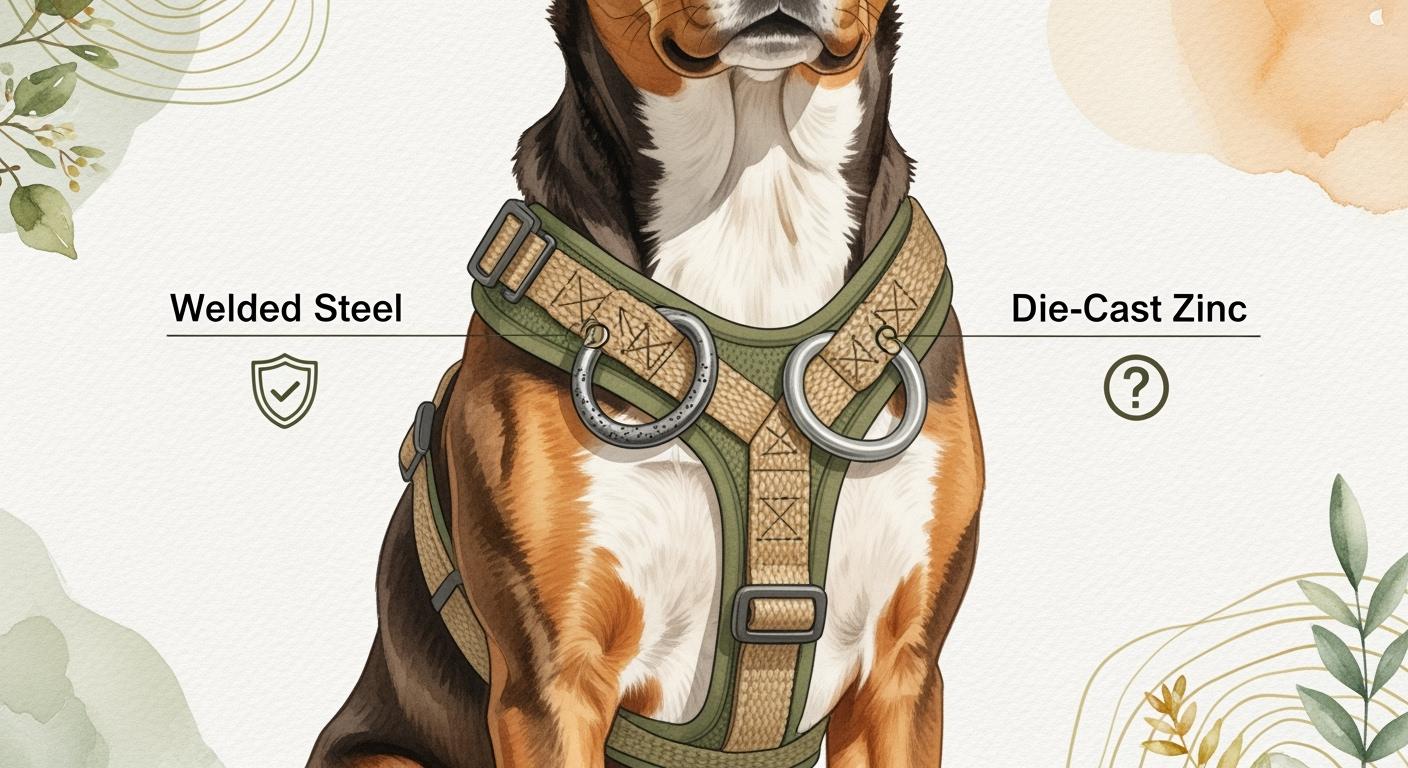
You want the safest choice for your dog’s harness. Welded steel D-rings give you the highest D-ring load capacity for dog harnesses. Strong D-rings protect your pet in both crash-tested and everyday situations. GaitGuard focuses on pet safety harnesses with trusted materials and reliable construction.
Key Takeaways
Welded steel D-rings typically offer higher load capacity than common alternatives and can improve your dog’s safety during sudden pulls or emergencies.
Always choose a harness with a D-ring that exceeds your dog’s weight for maximum protection and reliability.
Inspect D-rings for smooth welds and rust before each use to prevent injury and ensure your dog’s harness is safe.
D-Ring Load Capacity for Dog Harnesses

What Is D-Ring Load Capacity
You need to understand d-ring load capacity for dog harnesses before choosing the right gear for your pet. D-ring load capacity measures how much weight a d-ring can safely hold without breaking or deforming. Manufacturers test d-rings to determine their weight capacity.You see ratings like 10–225 lbs for basic pet gear, but heavy-duty D-rings for industrial use can handle up to 4,500 lbs or more. For dog harnesses, using hardware with a load rating comfortably above your dog’s weight gives you a larger safety margin, especially during sudden pulls or emergencies.GaitGuard uses high-strength welded steel d-rings in their dog protective gear to ensure maximum safety for your pet.
Why D-Rings Are the Weakest Link
You rely on every part of your dog harness to keep your pet secure. The d-ring often becomes the weakest link because it takes the full force of sudden movements, lunges, or impacts. If the d-ring fails, the harness loses its ability to restrain your dog. You should always check the d-ring load capacity for dog harnesses and inspect the material and construction. Welded steel d-rings provide higher weight capacity and durability compared to die-cast zinc or unwelded options.
Glossary: D-Ring Load Capacity
Some of these classifications come from industrial hardware standards. Dog harnesses use only the lower ranges, but the terminology helps you understand how manufacturers describe D-ring strength.
Load Classification | Weight Limit |
|---|---|
LD | Up to 441 lb (200 kg) |
MD | Up to 1,984 lb (900 kg) |
HD | Up to 3,638 lb (1,650 kg) |
XHD | Up to 7,500 lb (3,402 kg) |
SD | Up to 10,000 lb (4,536 kg) |
Load Class A | Up to 3,372 lb (15 kN) |
Load Class B | Up to 28,101 lb (125 kN) |
Load Class C | Up to 56,202 lb (250 kN) |
Load Class D | Up to 89,923 lb (400 kN) |
Load Class E | Up to 134,885 lb (600 kN) |
Load Class F | Up to 202,328 lb (900 kN) |

You should match the d-ring load capacity for dog harnesses to your pet’s size and activity level. Always choose a harness with a d-ring that exceeds your dog’s weight capacity for maximum safety.
Material Comparison: Welded Steel vs. Die-Cast Zinc D-Rings
Welded Steel D-Rings
You want a D-ring that distributes weight evenly and stands up to real-world stress. Welded steel D-rings are widely regarded as a strong, reliable choice for dog harnesses. The welded seam boosts structural integrity, so the ring is better able to hold up under sudden pulls or impacts.You can see the difference in break strength by size:
Size | Estimated Break Strength |
|---|---|
1/2″ | 380 lbs |
3/4″ | 529 lbs |
1″ | 617 lbs |
1.5″ | 617 lbs |
2″ | 617 lbs |

Under extreme force, welded steel is more likely to bend than to snap. This bending behavior is preferred over sudden fracture, because it gives you a chance to notice damage before a complete failure. The wire thickness, often around 4.55 mm in robust designs, adds extra strength for demanding activities. Welded steel construction helps distribute weight more evenly across the harness, reducing stress on any single point.
Material Spec Table
Material | Weld Type | Finish |
|---|---|---|
304 Stainless Steel | Argon Arc | Nickel Plated |
GaitGuard uses seamless welded rings made from high-grade stainless steel. These harness features ensure your dog’s safety during walks, training, or recovery.
Die-Cast Zinc D-Rings
Die-cast zinc D-rings look solid, but they usually cannot match the strength of welded steel. Zinc is a relatively brittle metal. Under sudden force, a zinc ring is more likely to crack or snap instead of bending. This failure mode can put your pet at risk during emergencies. In addition, die-cast zinc D-rings tend to develop weak points more quickly under shock loads, so they are not recommended for crash-tested or high-load harnesses. You may notice that harness features using zinc D-rings feel lighter, but they do not offer the same safety margin.
If you inspect a zinc D-ring, you will see a smooth, cast surface with no visible weld seam. These rings often fail under shock loads, making them unsuitable for crash-tested or high-load harnesses.
Welded vs. Unwelded D-Rings
You can spot a welded D-ring by looking for a smooth, continuous seam where the ends meet. Unwelded rings have a visible gap or overlap. This small detail makes a big difference in safety.
The comparison below uses example reference values from industrial hardware testing to illustrate the difference between welded and unwelded rings. Actual ratings for dog harness hardware will be much lower, but the same principles apply.
Type of D-ring | Load-Bearing Capacity |
|---|---|
Welded | 32.5 kips |
Unwelded | 4.8 kips |
In some industrial tests, weld strength has exceeded the strength of the wire itself, showing how effective a good weld can be. Unwelded rings lack this advantage and tend to fail at much lower loads. For dog harnesses, choosing welded D-rings gives you a stronger, more reliable connection.
Tip: Run your finger along the D-ring. A welded ring feels smooth all the way around. An unwelded ring has a gap or rough spot.
Surface Treatment and Corrosion Resistance
Outdoor use exposes your dog’s harness to water, dirt, and salt. You need D-rings that resist rust and corrosion. The best harness features use surface treatments like nickel plating, zinc plating, or zinc phosphate coating. These finishes create a barrier that protects the metal from moisture and oxygen.
Surface Treatment | Description |
|---|---|
Applying a finish | Minimizes exposure to oxygen, which helps prevent corrosion. |
Zinc plating | A protective layer that can help resist corrosion, though full coverage can be challenging. |
Zinc phosphate coating | Another option for corrosion resistance, providing a protective barrier. |
Stainless steel | More cost-effective in smaller quantities and inherently resistant to corrosion. |
Electroplating adds another layer of defense. This process creates a protective coating that prevents tarnishing and corrosion, especially in wet conditions. Regular cleaning and maintaining these coatings help your harness features last longer. Salt spray testing (ASTM B117) checks how well the finish holds up in harsh environments. GaitGuard’s D-rings pass these tests, so you know your gear distributes weight evenly and stays reliable outdoors.
Load Testing and Crash-Tested Dog Harnesses
You want proof that your dog’s harness features can handle real-life stress. Load testing measures how much force a D-ring can take before deforming or breaking. Welded steel D-rings consistently outperform die-cast zinc in these tests. For example, welded rings distribute weight evenly and withstand forces far above what most dogs can generate.
Crash-tested harnesses require hardware that will not fail during sudden stops or impacts. Welded steel D-rings meet these standards. GaitGuard uses seamless welded rings and tests every batch to ensure safety. You can trust that your harness features hardware that distributes weight evenly, protects your pet, and stands up to daily use.
Note: Always inspect your dog’s harness before each use. Look for signs of rust, cracks, or deformation. Safe gear starts with strong, well-made D-rings.
Choosing the Safest D-Ring for Your Dog Harness
Safety for Different Dog Sizes and Activities
You want your dog harness to match your pet’s size and activity level. Small dogs need less strength, but active or large breeds require hardware that can handle sudden pulls. If your dog enjoys running, hiking, or training, you need a harness with a D-ring that meets strict safety standards. GaitGuard offers D-rings with load ratings such as 300 lbs for medium rings and 500 lbs for large rings. These ratings help you maintain control and reduce the risk of injury during walks or emergencies. When you choose a harness with a strong D-ring, you give your pet a lower risk of injury and better protection.
How to Identify Quality D-Rings
You can spot a high-quality D-ring by checking its construction and finish. Look for welded steel made from heavy-duty nickel-plated material. The welded joint reinforces the frame and prevents bending or distortion. Dimensions like a width of 1.42 inches, height of 1.24 inches, and wire thickness of 4.5 mm show durability. A smooth nickel-plated surface reduces snagging and adds visual appeal. When you inspect your dog harness, run your finger along the D-ring. A welded ring feels smooth all the way around. Unwelded rings have gaps or rough spots that can fail under pressure.
Safety Tip: Always check the D-ring for rust or deformation before every walk. This simple habit helps prevent injury and keeps your dog harness reliable.
Key Features for Maximum Safety
You should look for these features when selecting a dog harness:
Nickel-plated or stainless steel surface treatment
Clear load rating that exceeds your dog’s weight
Smooth finish with no sharp edges
A harness with these features gives you better control and helps prevent injury. GaitGuard’s dog harnesses use seamless welded rings and medical-grade materials to meet high safety standards. You protect your pet and ensure comfort during recovery from injury or daily activities.
You protect your dog best when you choose welded steel D-rings with appropriate load ratings. Independent crash-test programs on dog harnesses with welded steel hardware have shown that this type of ring can maintain its shape and strength under high-impact conditions. When you choose a harness, check for welded construction and rust-resistant finishes.
Strong D-rings should match or exceed your dog’s weight and activity level.
Rust-resistant metal helps hardware stay safe and functional outdoors.
Well-made metal clips and D-rings withstand daily wear and sudden pulls.
Choose brands like GaitGuard that specify welded construction, corrosion-resistant finishes, and clear load ratings to support safety and durability.
FAQ
How do you inspect the handle and D-ring on crash-tested dog harnesses?
You check the handle for secure stitching and test the D-ring for smooth welds. You look for rust, cracks, or bends before using crash-tested dog harnesses.
Tip: You should always pull gently on the handle and D-ring to confirm strength before each walk with crash-tested dog harnesses.
Why does the handle matter in crash-tested dog harnesses?
You rely on the handle for control during emergencies. Crash-tested dog harnesses use reinforced handles to help you guide your pet safely and prevent sudden escapes.
You grip the handle for quick stops.
Crash-tested dog harnesses with strong handles protect your dog in traffic.
What makes crash-tested dog harnesses safer than regular harnesses?
Crash-tested dog harnesses use welded steel D-rings and reinforced handles. You get higher load capacity, better impact protection, and reliable hardware for daily walks and travel.
Feature | Crash-Tested Dog Harnesses | Regular Harnesses |
|---|---|---|
Welded Steel D-ring | Yes | Sometimes |
Reinforced Handle | Yes | Rarely |
Load Capacity | High | Low |
