A brace can look seated and aligned when the dog stands still. Then the dog takes ten steps. The top strap slips half an inch toward the groin. The hinge drifts below the joint line. Within two minutes of walking, the knee is getting almost no support at all.
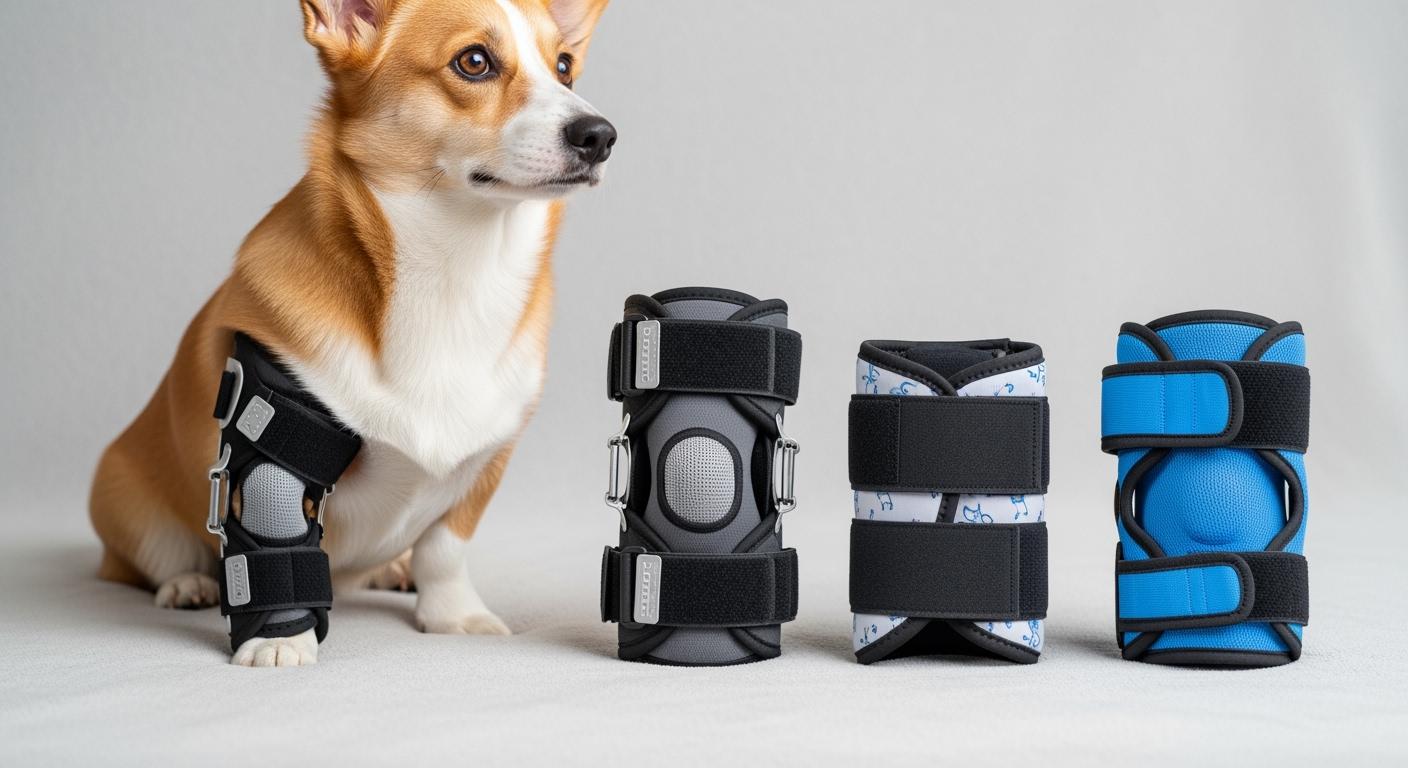
That is not a sizing mistake. It is a geometry problem built into how most ACL braces are patterned. Standard brace layouts are designed around a longer thigh segment — enough vertical real estate to anchor straps, seat a hinge, and keep everything from rotating. On a Corgi, a Dachshund, or a French Bulldog, that real estate shrinks to roughly half. The same strap length that holds securely on a longer leg now has nowhere to go. It bunches behind the knee. It slides into the groin. And the hinge axis — the single most load-bearing alignment point in the entire brace — ends up sitting below or above the joint it is supposed to track.
A knee brace that slips on a small dog is not a minor annoyance. It is a support system that has stopped supporting.
Why Standard ACL Braces Fail on Short-Legged Dogs
Most ACL braces are built around one assumption: enough leg length to run two or three straps across the thigh and calf with a hinge panel bridging them. That assumption breaks on short legs.
The failure happens in a chain. A narrow strap seated on a short thigh has almost no anti-rotation surface. When the dog takes a step and the leg loads laterally, force enters the strap edge — not the flat face. The edge rolls. Once the edge rolls, the entire strap body rotates with it. That rotation pulls the hinge panel off-axis. The hinge drifts away from the joint center. At that point the brace is not stabilizing the knee — it is floating around it, adding bulk without transferring load.
This is not theoretical. Walk a short-legged dog in a standard brace for ten minutes on a flat floor, then check the strap position. If the top strap has migrated more than half an inch toward the groin from its original placement, the hinge is no longer tracking the joint. The brace has already failed for that session.
The second problem is bulk. A thick support panel that works on a Labrador sits differently on a dog with a three-inch thigh. That panel crowds the back of the knee during flexion. The dog compensates by shortening its stride or swinging the leg outward. Over hours of wear, that altered gait loads the opposite leg unevenly. The brace was supposed to protect the injured knee — but it is creating a secondary problem through the hips and spine.
In practice: Fit is not about how the brace looks when the dog is standing. It is about where the hinge sits after twenty strides and a sit. Check alignment after movement, not before.
Short legs compress every tolerance
On a longer leg, a strap can be off by a quarter inch and still hold functional alignment. On a short leg, there is no room for error. The distance from the top of the thigh to the knee joint might be two inches. A hinge that needs half an inch of clearance above and below the joint line consumes the entire available space. Add a strap above and below, and you are out of room before the first buckle closes.
This is why stifle brace design for compact breeds demands shorter strap paths, lower-profile hinge panels, and strap anchor points placed higher on the thigh and lower on the calf — not gathered around the knee where they bunch and interfere with each other.
Watch for these failure signals during a ten-minute indoor walk:
- Strap position shifts more than half an inch in any direction
- Hinge panel rides up or drops below the joint line
- Dog shortens stride or swings the leg outward to clear the brace
- Brace bunches behind the knee when the dog sits
- Dog hesitates before sitting, standing, or turning
If the brace passes these checks after ten minutes of walking on a flat floor, repeat the observation on a gentle slope or after a sit-stand cycle. A brace that holds during steady walking can still fail during transitions — and transitions are where joint load peaks.
What a Knee Brace Must Get Right for Short-Legged Dogs
Solving the short-leg geometry problem is not about making a smaller version of a standard brace. Smaller dimensions with the same strap layout produce the same failure — just at a smaller scale. The layout itself has to change.
Low-profile support that does not crowd the knee
The hinge or support panel on a short-legged dog needs to sit close to the leg with minimal outward projection. A slim panel reduces the lever arm that lateral forces can act on. Less projection means less rotational torque when the dog turns or loads the leg off-angle. That is a structural advantage, not a comfort preference.
Materials matter here in a specific way. A rigid thermoplastic shell transfers load efficiently but has no give — if it is even slightly misaligned, pressure concentrates at the edge. A semi-rigid panel with controlled flex can absorb small alignment errors without transferring them into the skin. For a short leg where every millimeter of alignment counts, that flex tolerance is the difference between a brace the dog tolerates and one it fights.
After wearing the brace for twenty minutes indoors, slide your fingers under the panel edge and feel the skin. Warm is normal. Hot means the material is not breathing. Damp means moisture is trapped. Either condition, left unchecked, produces skin breakdown within days of daily wear — and a dog with a skin lesion under a brace cannot wear it until the skin heals. The design decisions that keep a knee brace stable through daily movement cycles determine whether the brace stays in use or ends up on a shelf.
Strap paths that stay clear of the groin
Strap routing on a short-legged brace must solve two problems at once. The straps must anchor above and below the knee with enough tension to prevent rotation. And they must clear the groin fold and the bathroom zone entirely.
When a top strap runs too close to the groin, two things happen. First, hip flexion during sitting pushes the strap forward — the strap edge digs into soft tissue. Second, during urination or defecation, the strap catches waste and moisture. A damp, contaminated strap against the skin for hours produces irritation that looks like a fit problem but is really a routing problem.
The fix is not a narrower strap. It is a shorter strap path that anchors higher on the lateral thigh, away from the groin crease, with the buckle positioned on the outside of the leg rather than the front. This keeps tension off the soft tissue and away from the bathroom zone.
To verify this after fitting: walk the dog to its usual bathroom spot. Watch the squat posture. If the dog pauses mid-squat or shifts weight repeatedly, the strap is likely pressing into the groin or abdomen. A properly routed strap should not change the dog’s bathroom posture at all.
Edges and liners that do not break the skin
The skin behind a dog’s knee flexes and compresses with every step. If the brace edge is a cut-and-sealed panel border — common on lower-cost builds — that edge acts like a dull blade under repetitive motion. After a few hours, redness appears. After a few days, the skin opens.
Rolled or padded edge binding solves this, but the binding material matters as much as the construction. A cotton binding absorbs moisture, swells, and chafes worse over time. A synthetic binding with a smooth finish stays dimensionally stable when wet. For a brace worn daily, this detail determines whether the skin behind the knee stays intact through weeks of use. Choosing a knee brace based on fit rather than rigidity shifts the outcome from “the brace is strong” to “the dog keeps it on.”
| Performance Difference | Warum das wichtig ist | Main Limitation | Signal weiterleiten | Fehlermeldung |
|---|---|---|---|---|
| Low-profile hinge panel vs. thick bilateral shell | Reduces rotational torque on short legs; less material behind the knee means less bunching during sitting | Lower absolute rigidity — not suitable when the knee needs complete immobilization | Hinge stays aligned after 10 minutes of walking and sitting | Panel rides up or drops below the joint line during movement |
| Short strap path with lateral buckle vs. full-wrap strap | Keeps tension off the groin and away from bathroom zone; reduces strap edge rolling under lateral load | Fewer anchor points mean less adjustability for irregular leg shapes | Strap position unchanged after a walk and bathroom break | Strap slides into the groin or gets soiled during urination |
| Synthetic rolled-edge binding vs. cut-and-sealed panel edge | Edge flexes with skin during knee flexion instead of abrading it; stays dimensionally stable when wet | Adds minor bulk at the seam — may be visible under very short coats | No redness or indentations after 4 hours of supervised wear | Pink patches, hair thinning, or broken skin behind the knee |
| Breathable mesh liner vs. closed-cell foam liner | Allows moisture and heat to escape; prevents the damp-warm environment that accelerates skin breakdown | Thinner liner provides less impact cushioning on very bony knees | Skin is dry and cool to the touch after brace removal | Dampness, odor, or sticky residue under the brace |
Remove the brace after the first four-hour wear session and inspect the skin behind the knee. Use your fingers, not just your eyes — run them along the fold where the brace edge sat. Smooth and cool is a pass. Any ridge, warmth, or moisture is an early warning. A CCL knee brace built for torn ligament support only works if the dog can wear it daily without developing skin problems that force a break in use.
When an ACL Brace Is the Wrong Choice
Not every knee that needs support needs a brace. And not every brace that fits at rest will hold through activity. Recognizing when the brace is not working is as important as recognizing what design features to look for.
Worse movement with the brace on
If the dog limps more in the brace than out of it, something is wrong. The most common cause on a short-legged dog is hinge-axis misalignment. The brace hinge sits above or below the joint center, so knee flexion fights the brace rather than being guided by it. The dog compensates by stiffening the leg — which loads the hip and spine instead of letting the knee move through a protected range.
Check this directly. Watch the dog walk three strides without the brace, then put the brace on and watch three more. If the stride shortens, the leg swings outward, or the dog refuses to load the leg at all, the brace is restricting motion rather than supporting it. Stop using it and reassess the hinge placement.
Persistent slipping regardless of strap tension
Tightening the straps will not fix a geometry problem. If the brace slides down the leg no matter how tight the buckles are, the strap anchor points are too close together for the available thigh length. The brace lacks the vertical spread to resist downward migration. Crank the straps tighter and you compress soft tissue without solving the slide — and add a pressure-point problem on top of the stability problem.
Causes that tightening cannot fix: the tibial shell is too short for the dog’s lower leg, the upper shell sits too high on the thigh, or the entire brace geometry was patterned for a longer-limbed breed. These are not adjustment issues. They are design mismatches.
Skin breakdown, chewing, or swelling
Redness behind the knee after wear. Swelling around the strap line. The dog chewing at the brace or licking the leg obsessively after removal. Each of these signals that the brace is causing tissue damage — and a damaged skin surface under a brace means the brace must come off until the skin heals. That interrupts the very support routine the brace was meant to provide.
When a brace will not stay aligned and comfortable through daily wear cycles, alternative support approaches become worth evaluating — not because the brace concept is wrong, but because this specific brace geometry does not match this specific dog’s leg.
Disclaimer: This check assumes a short-coated dog where skin changes are visible on inspection. Double-coated breeds like Corgis and some terrier mixes may hide early rub marks under dense fur. For these dogs, rely on hand-checking — run your fingers along the brace edges after each removal and feel for warmth, ridges, or dampness rather than relying on what you can see. If the dog’s leg conformation falls outside typical breed proportions — particularly dogs with angular limb deformities, very deep chests that alter standing posture, or significant muscle atrophy on the affected leg — the fit observations described here may not catch every pressure point.
When a veterinarian should reassess
Some signals mean the brace discussion needs to return to a clinical setting. The dog’s gait does not improve after two weeks of consistent brace use. The knee feels less stable over time rather than more. Swelling increases. The dog develops new pain behaviors — vocalizing, refusing to rise, guarding the leg. A brace supports a joint. It does not reverse ligament damage, and it cannot compensate for a degenerative condition that is progressing faster than the support can manage.
Stopping the brace when it is not working is not a failure of the approach. It is the correct decision. A brace that is causing harm delays recovery more than no brace at all.
A short leg changes every requirement for an ACL brace. Strap routing, hinge placement, panel thickness, edge binding — each of these design details behaves differently when the limb segment is two inches instead of five. Test alignment after movement, not at rest. Check skin after every session. And when the brace is not staying aligned, do not tighten it — that only hides the geometry problem behind a compression problem. The brace either tracks the joint through walking, sitting, and transitions, or it is the wrong brace for that leg.
Häufig gestellte Fragen
How long should a short-legged dog wear an ACL brace each day?
Start with 20 to 30 minutes of supervised indoor wear. Increase by 15-minute increments every two days only if skin checks show no redness and the brace stays aligned through the full session. Short-legged dogs often reach a maximum comfortable duration sooner than longer-limbed breeds — the compressed geometry means any fit issue expresses faster.
Can a dog sleep in an ACL brace?
No. Unsupervised wear — including sleep — carries a risk of the brace shifting into a position that restricts circulation or creates pressure points the dog cannot escape. The brace supports the knee during weight-bearing activity. It offers no benefit during rest and introduces unnecessary risk.
What is the fastest way to tell if the brace does not fit?
Walk the dog for ten minutes indoors on a flat surface. Remove the brace and check two things: whether any strap has moved more than half an inch from its original position, and whether the skin behind the knee shows any color change, ridge, or warmth. Both checks together take under a minute and catch nearly every fit failure before it becomes a skin or gait problem.