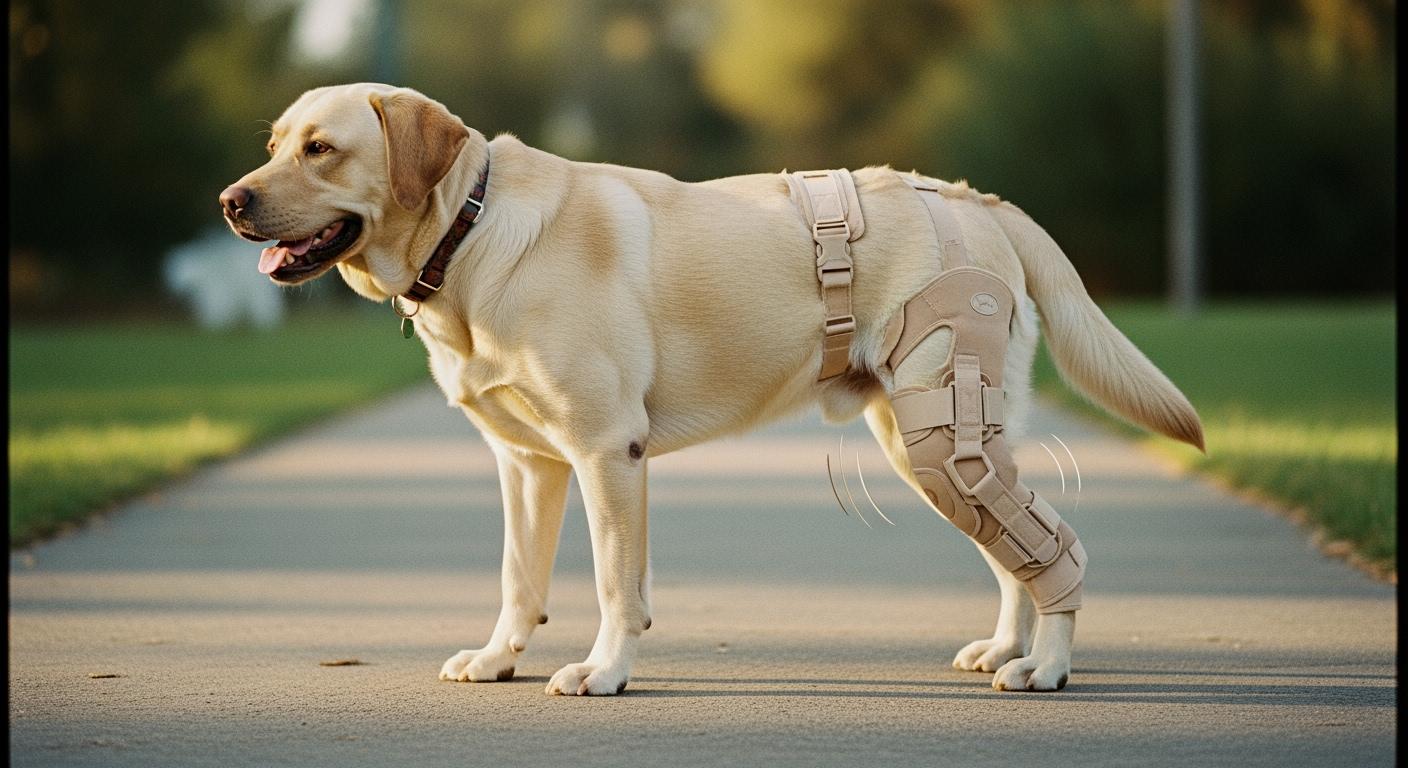
A dog ACL brace has one job: keep the tibia from sliding forward relative to the femur. The hinge does that job. When it aligns with the stifle joint axis, it resists cranial drawer motion. When it drifts, the brace becomes a sleeve with extra weight.
Half an inch off-axis. That is all it takes.
When the Hinge Drifts, Support Collapses
Here is the mechanical chain. A hinge offset from the stifle joint centerline converts what should be a linear constraint into an angled force vector. Load enters the brace through a point that no longer corresponds to the knee axis of rotation. The brace body torques. One side of the inner lining takes more pressure than the other. Within minutes, the dog feels a hot spot forming. It shortens its stride to unload the leg. The compensation shifts weight to the sound limb. And the brace — still strapped on, still looking correct from across the room — has already failed.
The failure is not always dramatic. Sometimes the dog walks but stiffens slightly on the braced side. The hinge creeps downward by a quarter inch over a 15-minute walk. The next day it drifts a little more. The owner tightens the straps. The cycle repeats, and the dog’s gait deteriorates not from the injury but from the brace.
In practice: After a 10–15 minute walk on flat ground, run a finger along the hinge line. If it has moved more than half an inch from the center of the knee joint — up, down, or to either side — support has already degraded. The brace is no longer controlling tibial translation. It is merely wrapped around the leg.
Why hinges drift comes down to two structural weaknesses. A thigh anchor that is too narrow acts as a single pivot point under side loads. The dog steps laterally, the upper anchor rotates, the hinge follows. Soft inner lining materials that compress under sustained pressure gradually lose grip on the fur. The brace inches downward with each stride cycle. Both failures trace back to the same root: the anchor and hinge were designed as separate components rather than an integrated stabilization system.
| What the owner sees | Why support is failing | Better product direction |
|---|---|---|
| Brace slides down the leg | Support zone migrates off the knee joint | Wider upper anchor, anti-slip inner surface |
| Brace rotates around the leg | Hinge no longer aligns with the joint axis | Stable hinge with independent strap adjustment |
| Hinge shifts above or below the knee | Brace loses mechanical connection to the joint | Check hinge placement and anchor width |
| Strap edges leave red marks | Narrow straps concentrate force along a thin line | Wider straps with breathable padding |
| Dog walks stiffly or shortens stride | Brace does not limit cranial drawer motion | Reassess fit; check for downward migration |
| Brace body stretches and bags out | Material loses shape under repeated stride loads | Firmer, lower-stretch materials |
Why Strap Tension Cannot Fix a Brace That Was Never Anchored
Tighten the straps. That is the instinct.
But strap tension and anchor stability are different things. A narrow strap pulled tight concentrates force along a thin edge. The skin underneath reddens. The brace, however, still slides — because the force holding it in place is friction from compression, not mechanical interlock from a wide, contoured anchor that resists rotation.
Think of it in physical terms. A wide upper anchor that wraps the thigh profile resists pivoting because the force required to rotate it is multiplied by the anchor’s contact width. A narrow strap has almost no anti-rotation lever arm. Side loads — a dog stepping off a curb, turning quickly, shifting weight while sniffing — apply rotational torque. The narrow strap edge becomes the pivot. The brace body rotates around it. The hinge leaves the joint line. That fails fast.
The observable check is straightforward. After a short walk, look at whether the brace has rotated even slightly — the hinge shifted left or right of the knee center, the strap edges leaving red marks that do not fade within 20 minutes. Red marks that persist mean the pressure exceeded what the skin can dissipate in a reasonable rest interval. Pressure lines from narrow straps are not a break-in issue. They are a structural mismatch between strap width and the forces of walking.
Tip: Check brace position after every wear session during the first 7 days. Walk the dog on a flat surface for 10 minutes, then mark the hinge position relative to the knee. If it has shifted more than half an inch, the anchor configuration — not the strap tightness — needs reassessment.
Anti-slip inner surfaces change the equation. A silicone-grip lining resists migration without relying solely on compression. The brace stays positioned through surface friction distributed across the entire contact area, not just under the strap edges. When combined with an anchor wide enough to prevent rotation, the brace can survive lateral movement, direction changes, and the thousands of micro-adjustments a dog makes during an ordinary walk.
The product-level distinction that matters most: a brace using independent strap adjustment — where each strap tightens separately — allows the upper anchor to be secured without over-compressing the lower leg. Over-compressing the lower strap to compensate for a weak upper anchor sets off a cascade. Tissue compression leads to discomfort. Discomfort leads to altered gait. Altered gait leads to brace rejection. Every step of that cascade begins with a single design shortcut: linked straps where independent control was needed.
| Signal level | What it means | What to do next |
|---|---|---|
| Green | Brace stays centered over the knee, dog walks no worse than without it, skin appears normal | Continue use, monitor fit daily |
| Yellow | Mild shifting of the brace body, light temporary marks on the skin that fade, dog occasionally notices the brace | Adjust fit, check anchor area and hinge alignment |
| Red | Repeated rotation of the brace, worsening limp, swelling, heat, pain, chewing at the brace, red marks that do not fade | Stop use, consult a veterinarian |
When a Knee Brace Is Not the Answer
A dog ACL brace supports the stifle joint against cranial tibial translation. It does not treat hip dysplasia. It does not stabilize the hock. It does not correct angular limb deformities. Using a knee brace for a hip problem places pressure where it is not needed and leaves the actual problem unsupported.
Breed conformation matters more than size charts can capture. A brace patterned on typical breed proportions may fit a Labrador but fail on a dog with a very deep chest and narrow hindquarters. The thigh taper changes. The anchor sits differently. The hinge may not seat over the joint even when straps are adjusted correctly. Dogs with angular limb deformities — particularly rotational deviations of the tibia — can experience uneven pressure distribution inside a brace designed for straight-limbed movement.
A brace is also not a standalone solution. Fit decisions for a real dog with an ACL injury depend on the injury’s severity, the dog’s daily activity level, and whether the tear is partial or complete. A brace that controls tibial translation during leash walks may not hold up under the forces of a dog that sprints, jumps, or plays with other dogs. The use case defines the performance envelope. Exceed it, and the brace cannot compensate.
Disclaimer: This assessment assumes a short-coated dog where brace position and skin condition can be checked visually. Double-coated breeds — Huskies, Malamutes, German Shepherds with full undercoat — may show subtler rub marks beneath the fur that need hand-checking rather than visual inspection. If the dog’s leg conformation falls meaningfully outside the breed norms this brace was patterned for, the fit checks described here may not catch every pressure point. Work with a veterinarian or canine rehabilitation specialist for conformational outliers.
The brace is also not a substitute for veterinary diagnosis. A dog that walks worse with the brace on — more pronounced limp, shorter stride, sudden refusal to bear weight — needs reassessment, not strap adjustment. Swelling, heat, or red marks that persist beyond 30 minutes after removal signal that the brace is causing harm, not providing support.
Escalation rule: If the dog’s limp worsens within the first three wear sessions despite correct anchor positioning and hinge alignment, remove the brace and seek a veterinary re-evaluation. The brace may simply not be the right tool for that particular injury presentation or leg geometry.
Design Details That Determine Whether the Brace Is Worn or Discarded
A separate but related concern: material memory. Soft, highly elastic fabrics feel gentle in the hand. Under repeated stride loads — hundreds of cycles per walk — they can deform permanently. A brace that conformed to the leg on day one may bag out by day ten. The support zone shifts. The hinge loses its reference position. When comparing fit quality versus raw brace strength, firmer materials with limited stretch hold their geometry through wear cycles — at the cost of requiring more precise initial fitting. The trade-off is real: forgiving materials that feel comfortable out of the box often degrade faster under daily use.
Independent strap adjustment is not a convenience feature. It is a structural requirement for any brace that spans two different leg segments — thigh and calf — with different muscle volumes and taper angles. Single-strap or linked-strap designs force the same tension onto both segments. One segment will be over-tightened or the other under-supported. There is no middle ground. A knee brace that fits for daily orthopedic support depends on getting both anchor zones tensioned independently to match the leg’s actual geometry.
Safer rehab after an ACL tear depends on more than hinge design. The full system — anchor width, inner surface grip, breathability, and strap independence — determines whether the brace stabilizes the joint or becomes dead weight the dog learns to work around. For partial ACL tears where bracing is part of the recovery path, product-level decisions about material and adjustment determine how much of the intended support actually reaches the joint. Knee braces built for torn CCL recovery illustrate the difference: the anchor wraps the thigh profile instead of cinching at a single point, and the hinge placement references the stifle landmark rather than relying on the owner to guess where the joint axis sits.
Häufig gestellte Fragen
Can a dog ACL brace be worn during unsupervised activity?
No. Even a well-fitted brace can shift during running, jumping, or rough play. Unsupervised wear also prevents early detection of skin issues developing under the brace. Use only during supervised activity. Remove for crate rest, sleep, or any period when the dog cannot be monitored.
Why does a brace that fits perfectly while standing fail during movement?
Standing is a static position. Walking involves muscle contraction, stifle rotation, weight transfer, and skin movement — all of which change the leg’s surface geometry. A brace positioned correctly at rest can lose alignment the moment the dog takes its first step if the anchor does not accommodate the dynamic shape changes of a moving leg.
How long before a poorly fitted brace causes visible skin damage?
Pressure lines from narrow strap edges can appear within 10–15 minutes. More insidious is slow-developing friction damage — the brace slides slightly with each step, the skin shows no signs for several days, then breaks down rapidly. Daily post-wear skin checks catch both patterns.
Does a heavier, more rigid brace provide better ACL support?
Not inherently. Support quality depends on hinge-to-joint alignment and anchor stability, not weight or rigidity. A lightweight brace with precise hinge placement and a wide anti-rotation anchor can outperform a heavier, stiffer brace that drifts off-axis within minutes of walking.