
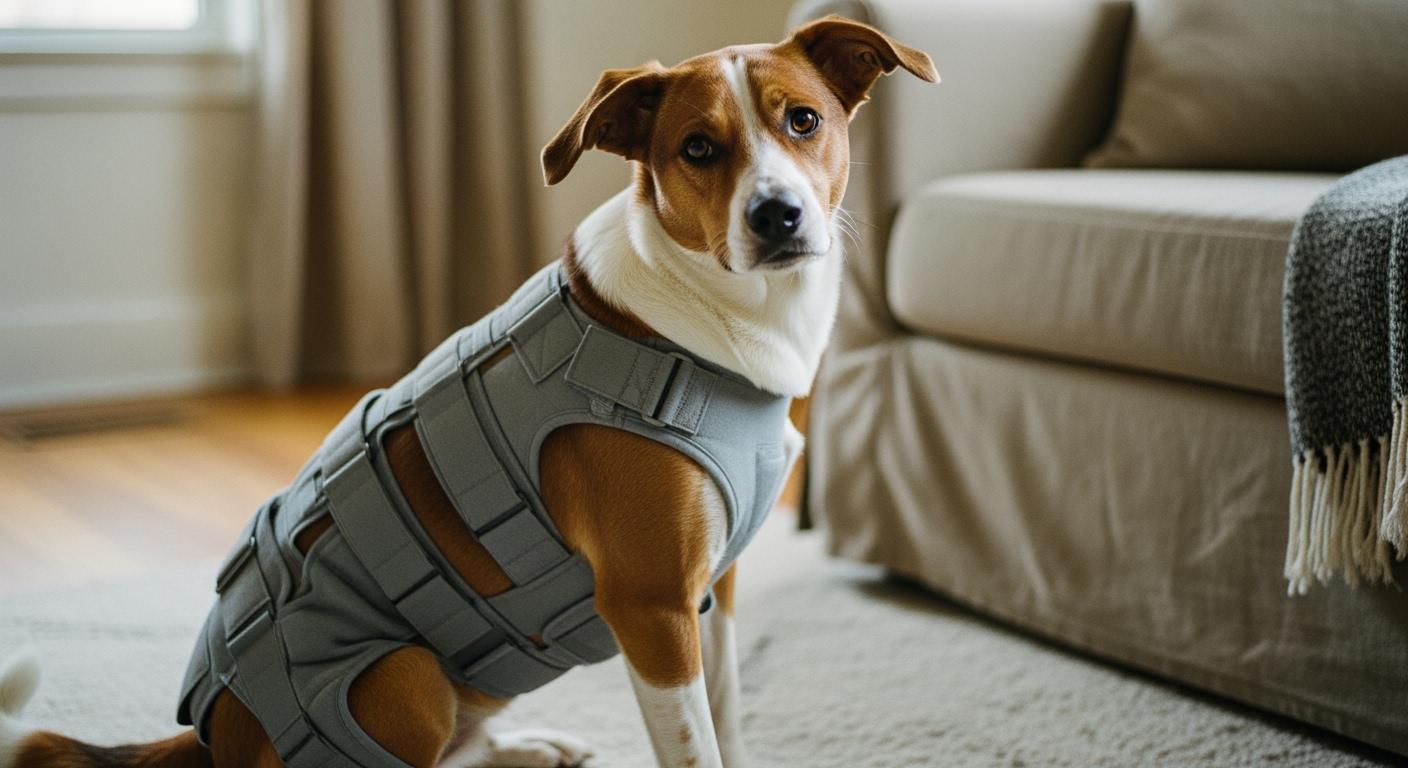
A dog takes three steps across the living room. By the fourth step, the back brace has drifted a quarter-inch. By the tenth, it has ridden up toward the shoulders, and the segment of thoracic spine it was supposed to immobilize now sits under nothing but fabric — no structural stay behind it. The brace is still on. The support is gone.
That is the failure most people miss. They check whether the brace feels snug at rest. They do not check where the dorsal stays sit after ten steps of actual walking. In a back brace meant for IVDD, the difference between functional support and a fabric sleeve doing nothing comes down to three structural details: anchoring, panel width, and edge design.
Where a Back Brace for IVDD Loses Its Hold
Most back braces for dogs rely on circumferential tension — wrap it tight, and it stays. But a dog’s torso is not a cylinder. It tapers. The ribcage widens, then narrows toward the abdomen. A brace tensioned at a single point will migrate toward the path of least resistance, which on a standing or walking dog is almost always upward and forward.
The Slide Problem
When a brace lacks a deep chest cradle and independent belly anchoring, every stride pushes it incrementally out of position. The force chain works like this: hind-limb propulsion drives the torso forward, the brace resists through friction against the coat, friction is weakest at the narrower abdominal section, and the brace creeps toward the wider thoracic zone where circumference tension is lower — exactly the opposite direction from where the lumbar and thoracolumbar support needs to stay.
Half an inch of migration is enough. The rigid or semi-rigid dorsal stays that should bridge across the affected disc space shift cranially, leaving the unstable segment under unsupported soft fabric. The dog’s spine can now flex and rotate through the very motion the brace was intended to block.
An observable check: mark the brace’s dorsal edge against the dog’s coat with a piece of tape before a ten-minute leash walk. Measure the gap between the tape and the brace edge afterward. More than half an inch of drift means the anchoring geometry is not holding — regardless of how tight the straps felt at the start.
Soft Wraps and the Twist Problem
Soft wraps feel gentle. That is their limit. Without semi-rigid or rigid dorsal stays, a soft wrap provides compression but almost no resistance to lateral bending or axial rotation. A dog that twists to look back, shifts weight to one side while rising, or compensates for weakness by leaning — all common in IVDD recovery — can produce enough rotational force to defeat a purely fabric brace.
The structure that matters here is the dorsal frame. Semi-rigid stays made from materials that resist bending across their width but allow a controlled degree of longitudinal flex create a counter-moment against rotation without forcing the spine into a single rigid position. No frame at all, and the brace is a belly band with shoulder straps — it will not stop the twist that aggravates a compromised disc.
Belly Panel Width, Edge Design, and the Pressure That Builds During Rest
Why a Narrow Strap Becomes a Pressure Injury
Force equals pressure times area. A half-inch strap carrying the tension needed to stabilize a medium-sized dog’s spine concentrates that load onto a strip of skin roughly the width of a pencil. During rest, the dog’s body weight adds to that load. The strap edges become ischemia lines — zones where capillary blood flow is occluded by sustained external pressure.
After twenty minutes, remove the brace and check the skin. A wide belly panel — three to four inches across for a medium-sized dog — should leave diffuse, faint marks that fade within minutes. Sharp red tramlines along strap edges that persist for more than ten minutes signal pressure concentration. If those lines appear after every wear session, the skin does not recover fully between uses, and the risk progression moves from erythema to superficial erosion to full-thickness ulceration.
The structural fix is not more padding on a narrow strap. Padding compresses under load and the strap edge still acts as a stress riser. The fix is surface area — a panel wide enough that the unit pressure stays below capillary closing pressure even when the dog lies on it. This is why a lightweight back brace built for IVDD support that pairs dorsal stays with a wide ventilated belly panel addresses two failure points — migration and pressure — in a single structural decision.
Edge Design and What Happens When the Dog Lies Down
Thick, stiff brace edges behave differently in standing versus recumbent positions. Standing up, the edge sits flush against the torso. Lying down, the edge rolls inward under compressive load and forms a pressure ridge against the ribcage and abdomen. The dog shifts posture to escape the ridge. The altered posture loads the spine asymmetrically — exactly the outcome the brace was supposed to prevent.
Low-bulk edges finished with a flexible binding conform during position changes instead of resisting. The edge moves with the dog rather than pushing back. This is not a comfort feature. It is a structural requirement for any brace meant to be worn during rest, which describes nearly all IVDD recovery scenarios.
The shape of the anchoring system matters equally. A support brace guide covering IVDD brace types and fit drills into how different strap configurations — Y-shaped versus parallel, panel-based versus strap-only — distribute force and resist rotation. The short version: angled strap paths that split load across the chest and belly resist migration better than straight circumferential straps, because they create force vectors in two planes instead of one.
| Brace structure | Best use case | Main failure risk | Better design detail |
|---|---|---|---|
| Soft wrap | Mild support, easy wear | Too much flex, allows twisting | Semi-rigid dorsal stays, wider belly panel |
| Semi-rigid back brace | Moderate support, daily walks | Slides, side shift | Deep chest cradle, 3-point anchoring |
| Rigid dorsal support brace | Stronger stabilization | Rubbing, bulk, pressure points | Low-bulk edges, breathable inner layer |
| Back brace plus lift harness | Lifting, severe weakness | Belly compression, shifting | Wide padded belly panel, independent strap paths |
When a Back Brace Is the Right Tool — and When It Is Not
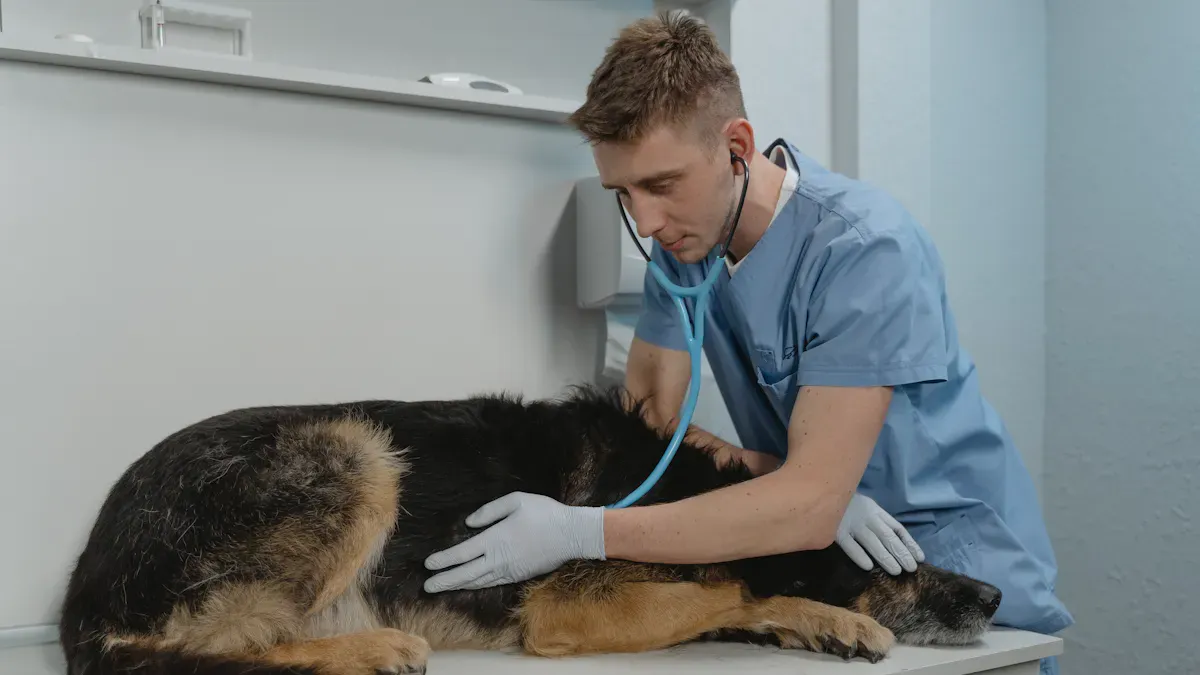
A back brace supports the spine by restricting motion. That is the entire mechanism. It does not decompress the disc, reverse calcification, or restore neurological function. Understanding the brace’s structural limits is as important as understanding where it helps.
Where a Back Brace Fits the Recovery Plan
A back brace for IVDD is most structurally relevant when the goal is motion restriction during recovery from a mild to moderate disc episode, when crate rest alone cannot fully prevent spinal movement during necessary short walks, or as post-surgical adjunct support where the surgeon has cleared controlled movement with external stabilization.
The brace works by creating a mechanical limit on flexion, extension, and lateral bending. The dorsal stays resist spinal curvature. The belly panel prevents the brace itself from becoming a new problem. This combination — not stiffness alone — is what makes the full set of IVDD support solutions for daily mobility effective in practice.
For dogs whose body shape permits secure anchoring and whose recovery protocol includes supervised movement, the brace reduces the risk that an accidental twist or sudden movement re-injures a healing disc. The benefit is mechanical, not biological — it buys time for natural healing by preventing re-injury during the vulnerable period.
Where It Does Not
A back brace cannot substitute for surgical decompression when spinal cord compression is significant. The brace restricts external motion; it does not alter the internal disc-vertebra relationship. Dogs with progressive neurological deficits — worsening proprioception, deepening weakness, loss of bladder control — need a different intervention path entirely.
The brace also fails in dogs whose body conformation defeats standard anchoring geometry. Barrel-chested breeds with minimal abdominal taper, very deep-chested dogs where the ribcage-to-waist ratio is extreme, and dogs under roughly ten pounds where the surface area available for anchoring is simply too small — in these cases, the brace cannot maintain position, and a brace that moves is worse than no brace at all. The same structural logic applies: when fit is wrong, wear time magnifies the damage.
Disclaimer: The pressure-check method described here — checking for red tramlines after twenty minutes of wear — assumes a short-coated dog where skin is visible without parting the fur. Double-coated breeds may show subtler rub marks that require hand-checking the skin surface rather than visual inspection. If the dog’s conformation falls outside typical breed norms — particularly dogs with angular limb deformities, extreme body length-to-height ratios, or very deep chests — the fit checks described may not catch every pressure point, and a hands-on fitting assessment is warranted.
There is also a distinction between spinal stabilization and weight-bearing assistance. Dogs with hind-end weakness from IVDD sometimes need a lift harness, not a back brace — or both, used at different times. The difference between a back brace and a lift harness for IVDD mobility comes down to whether the immediate need is spinal stabilization or assisted weight transfer during stairs and transfers. The tools serve different mechanical functions.
| Signal level | What you see | What to do |
|---|---|---|
| Green | Brace stays centered, dog walks calmly, no skin marks | Continue supervised use |
| Yellow | Light slipping, mild edge pressure, dog hesitates | Adjust fit, shorten walk, recheck |
| Red | Worse pain, paw dragging, belly compression, sores, panic, new weakness | Stop use, call your vet |
Understanding when a back brace for IVDD is useful and what it actually delivers comes down to matching the brace structure to the specific motion the dog needs restricted. A brace built for mild lumbar support will not stabilize a thoracolumbar junction that sees high rotational loads during even slow walking. The match between brace structure and disc location is not a detail — it is the mechanism.
Frequently Asked Questions
How long should a dog wear a back brace each day?
Start with ten to fifteen minutes of supervised indoor wear. If the skin shows no tramlines after removal and the dog’s gait remains calm, increase by ten-minute increments over several days. There is no universal daily limit — the ceiling is set by skin tolerance and the dog’s stress response, not by a clock. Most dogs plateau at a duration where either pressure marks or behavioral fatigue signal the stop point for that session.
Can a back brace fix IVDD?
No. A back brace restricts external spinal motion — flexion, extension, lateral bending, and rotation. It does not alter the internal disc structure, reduce existing herniation, or restore neurological function. The brace is a motion-control tool that creates a mechanical window for natural healing by preventing re-injury. It is part of a recovery plan that may also include crate rest, medication, physical therapy, or surgery depending on severity.
What signs mean the brace should come off immediately?
Remove the brace and contact a veterinarian if the dog shows worsening pain, new or deepening weakness, paw dragging that was not present before, difficulty breathing, belly compression that leaves persistent indentations, open sores or blisters under any part of the brace, panic or extreme agitation when the brace is on, or loss of bladder or bowel control. These are not fit-adjustment issues — they signal that the brace is either structurally mismatched to the dog or that the underlying condition has progressed beyond what external support can address.
How do I know if the brace fits correctly?
A correctly fitted brace stays centered over the spine after ten minutes of walking — mark the starting position and check for drift. The belly panel should leave diffuse, faint marks that fade within minutes, not sharp red tramlines. The dog should walk with a normal stride length and show no compensatory head bobbing, shortened steps, or hesitation. The dorsal stays should bridge across the affected disc space without gaps when the dog stands, sits, and lies down. Run through all three positions — a brace that fits in standing may gap or pinch in sitting.
