
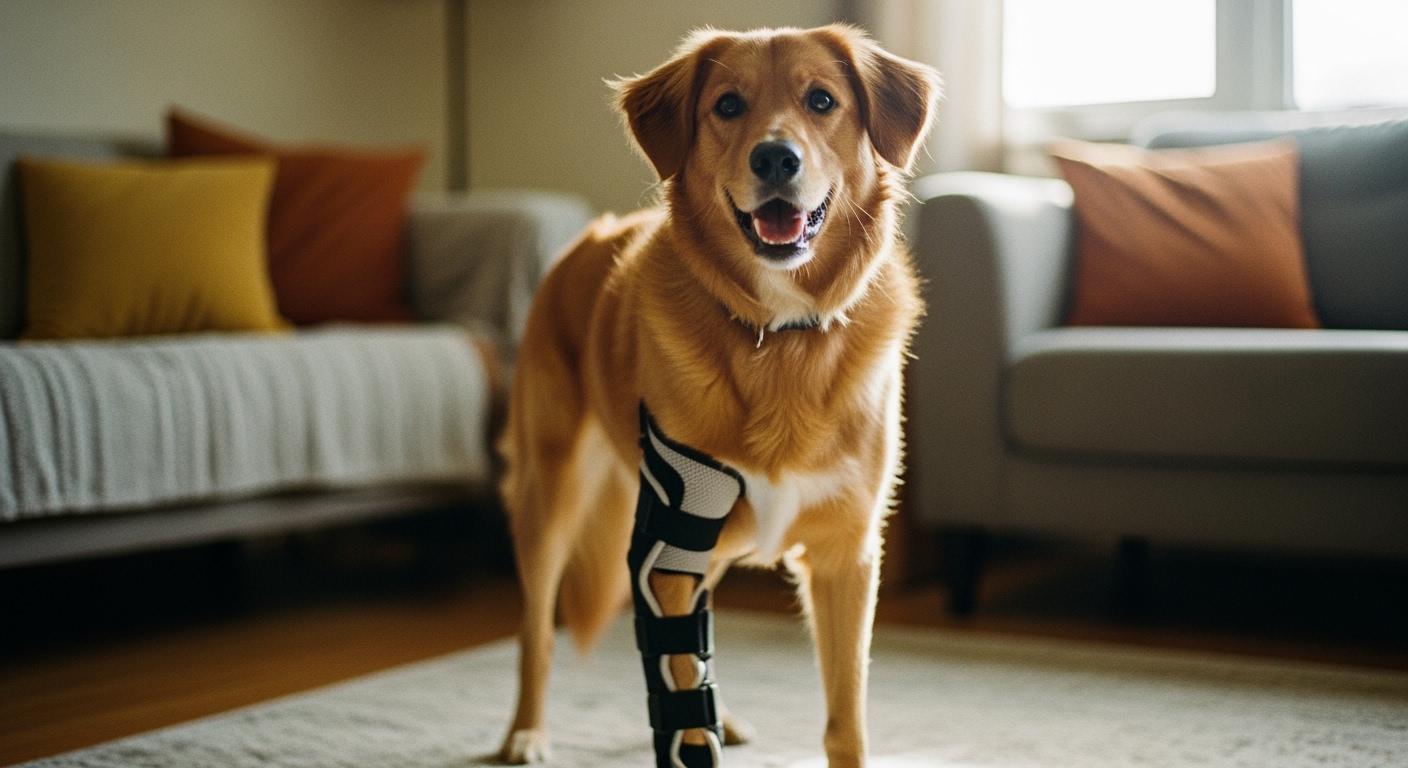
The best dog front leg brace is not the one with the most reinforcement. It is the one your dog will actually wear. A brace that is too rigid, too heavy, or too restrictive can make a dog move less, and a dog that moves less loses muscle, stiffens joints, and recovers slower. The real choice is between light support that preserves natural movement and full support that immobilizes more but demands more tolerance. Matching support level to what the dog can accept day after day is what makes a brace useful, not just well-engineered.
When Light Support Is the Stronger Choice
Why Maximum Support Can Backfire
A full-support front leg brace covers more of the limb and restricts more motion, which sounds like the safer option. But if the bulk, heat, or stiffness makes the dog refuse to walk, the brace is not supporting anything. A dog that associates the brace with discomfort will start resisting before the straps go on. The result is less movement, more joint stiffness, and slower recovery — the opposite of what bracing is meant to achieve. A brace can stabilize the carpus or elbow, but it cannot force a dog to move normally if the support level exceeds what the dog tolerates.
What Light Support Means in Practice
Light support braces use softer materials, cover less of the leg, and allow more natural joint motion. They suit mild weakness, early instability, older dogs with reduced muscle tone, and dogs recovering from minor strains where full immobilization would cause more harm than benefit. Light support helps a dog stay active without the weight and heat of a full-coverage brace. It works best when the primary need is gentle stabilization during daily walks rather than strict joint control.
Front-leg bracing splits into carpal-level and upper-limb support, and light support tends to match carpal-level needs where the dog still has reasonable proprioception and muscle strength. It can help during recovery, but it does not provide the mechanical constraint that a fully unstable joint requires.
When Light Support Is Enough
- The dog has mild carpal sinking or early weakness, not collapse.
- The dog is older or smaller and would struggle with a heavier brace.
- Walks are short and on controlled surfaces, not off-leash or on uneven terrain.
- The dog shows no pain at rest and only intermittent lameness during activity.
When Full Support Is the Right Match
Conditions That Demand More Structure
Full support braces extend further up the leg and include more rigid elements such as stays, splints, or hinges. They are indicated when the joint is significantly unstable, when the dog collapses through the carpus with every step, or when post-surgical protection requires limiting range of motion. Dogs with moderate to severe arthritis, partial tendon tears, or marked carpal hyperextension may need this level of control. A full-support brace can stabilize a collapsing joint and offload damaged soft tissue, but it cannot restore normal joint architecture or reverse advanced degenerative changes.
Front leg stability solutions work across the spectrum from light neoprene wraps to structured hinged braces. The key is matching the brace structure to the severity of instability, not defaulting to the most restrictive option.
Risks of Choosing the Wrong Support Level
A brace that provides too little support leaves an unstable joint unprotected. A brace that provides too much support reduces muscle activation, traps heat, and increases the chance the dog will refuse it. Either mismatch delays recovery. The most common failure pattern is not the brace breaking — it is the dog moving less, developing skin irritation under the brace, or the owner discontinuing use because the dog is clearly uncomfortable.
| Support Type | Best Match | Movement Allowed | Tolerance Risk | Main Limitation |
|---|---|---|---|---|
| Light Support | Mild carpal sinking, early weakness, senior dogs, short controlled walks | Near-natural gait, minimal restriction | Highest tolerance, easiest break-in, lowest heat buildup | Cannot stabilize a collapsing joint or protect a significant tear |
| Full Support | Moderate to severe instability, carpal hyperextension, post-injury rehab | Controlled range, splint or hinge limits flexion and extension | More bulk and heat, requires gradual adaptation, some dogs reject | Over-restriction can cause muscle atrophy and joint stiffness over time |
| Custom Structured Brace | Unique leg shape, prior brace failure, sensitive skin, specific post-surgical needs | Tailored to the injury and the dog’s anatomy | Better fit reduces rejection but cost and lead time are higher | Not needed for straightforward mild-to-moderate cases |
| No Brace — Vet First | Sudden lameness, open wounds, severe swelling, suspected fracture | None until diagnosed | Bracing before diagnosis can mask symptoms or worsen the injury | A brace cannot treat an undiagnosed fracture, infection, or tumor |
Quick decision rule: Choose light support when the dog has mild weakness and can walk with a near-normal gait. Choose full support when the joint visibly collapses or the dog cannot bear weight without structured assistance. Reassess if the dog refuses to move, skin breaks down, or gait worsens with the brace on.
Daily Wear, Break-In, and Skin Safety
Breaking In a Front Leg Brace
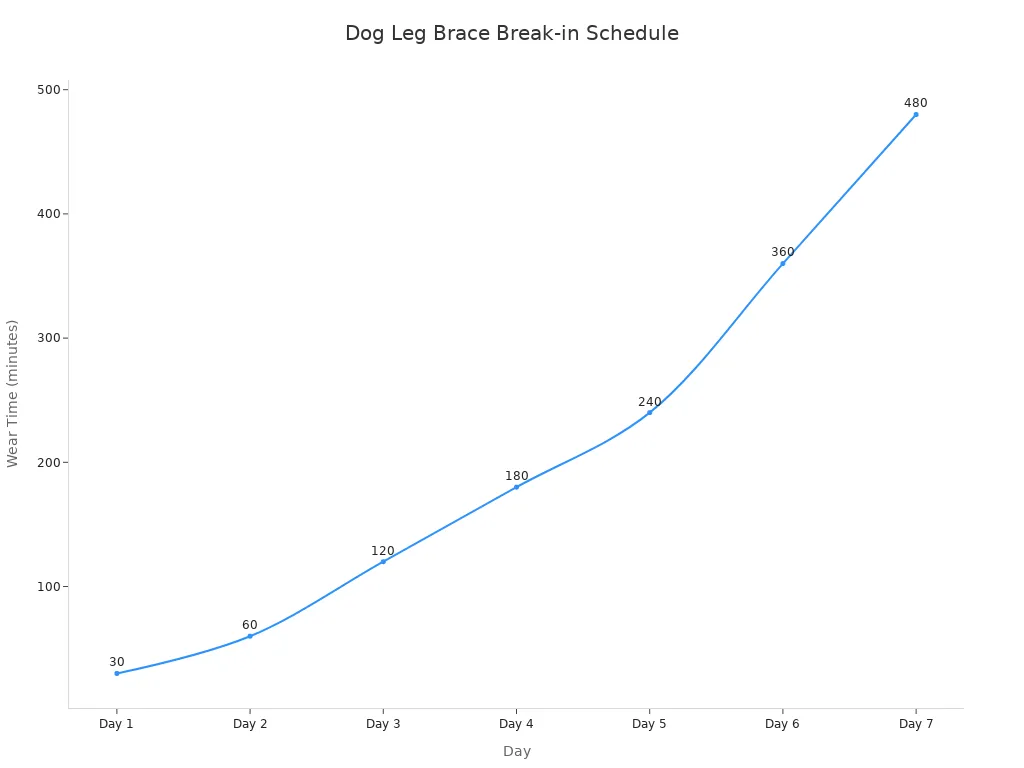
A brace that fits well out of the box still needs a break-in period. The skin, the dog’s movement pattern, and the owner’s checking routine all need time to adapt. Start with 30 minutes on day one, two to three times, and add roughly 30 minutes each day as long as skin stays clear and gait remains stable. Most dogs reach full-day wear within a week, but rushing this process causes the skin problems and aversion that lead to brace failure. Remove the brace at night and during rest unless a veterinarian gives different instructions.
| Day | Session Length (minutes) | Sessions Per Day |
|---|---|---|
| 1 | 30 | 2 to 3 |
| 2 | 60 | 2 to 3 |
| 3 | 90 to 120 | 2 to 3 |
| 4 | 150 to 180 | 2 |
| 5 to 7 | 240 to 360 | 1 to 2 |
Fit, Skin, and Gait Checks
Every time the brace goes on, check three things. First, the brace should sit snug without pinching — you should be able to slide a fingertip under each strap but not rotate the brace around the leg. Second, after removing the brace, inspect the skin for redness, indentations that do not fade within a few minutes, hair loss, or moisture. Third, watch the dog take several steps on a flat surface — any new limp, shortened stride, or hesitation means the fit needs adjustment. Front leg brace fit and wear scheduling determines whether the brace stays in use or gets abandoned after the first week.
Cleaning and Maintenance
A dirty brace causes skin problems. Wipe down the brace with a damp cloth after each day of use. Use mild soap and cold water for deeper cleaning, and let the brace air-dry completely before putting it back on the dog. Never put a wet brace on a dog — trapped moisture against the skin is the fastest route to irritation and infection. Replace the brace if straps fray, stays bend, or the brace develops an odor that does not wash out.
Green, Yellow, Red: Daily Assessment Table
| Status | What You See | Was ist zu tun? |
|---|---|---|
| Green | Stable gait, warm toes, skin clear, dog moves willingly with the brace on | Continue current wear schedule and increase time gradually |
| Yellow | Mild strap rubbing, slight gait change, licking at brace, fatigue earlier than usual | Adjust strap fit, shorten sessions, check skin more often, reassess support level |
| Red | Limping, swelling, open skin, cold or pale toes, dog refuses to move or panics | Stop brace immediately, contact your veterinarian, do not resume without reassessment |
Tip: Check skin and brace fit twice a day during the first week. That first seven days reveals whether the support level and fit are right. If you see yellow or red signs, act on them the same day rather than waiting to see if they resolve.
When a Brace Alone Is Not the Answer
Sudden Lameness, Swelling, or Non-Weight-Bearing
A front leg brace is a support tool, not a diagnostic device. If a dog suddenly cannot bear weight, has visible swelling, or shows signs of severe pain, bracing before diagnosis can mask the real problem or make it worse. Open wounds, rapidly increasing swelling, heat radiating from the leg, or systemic signs such as fever or lethargy are veterinary emergencies, not brace candidates. A brace can help stabilize a known injury after diagnosis, but it cannot replace the diagnosis itself.
Chewing, Panic, or Refusal
Some dogs will not tolerate a brace regardless of fit. If a dog chews at the brace, panics when it goes on, or freezes and refuses to walk, forcing continued use creates stress that undermines recovery. This is not a training failure — it may mean the support level is too restrictive, the brace material irritates the skin, or the dog has a behavioral or sensory intolerance. Brace fit, comfort, and safety during rehabilitation include knowing when to stop and try a different approach rather than pushing through refusal. Different front leg brace types match different needs, and a custom or lighter option may succeed where an off-the-shelf full-support brace fails.
| Condition | Why a Brace May Not Be Enough | Escalation Cue |
|---|---|---|
| Fracture | A brace cannot stabilize a broken bone; surgical fixation is usually required | Non-weight-bearing, visible deformity, severe pain on palpation |
| Infection or open wound | Covering an infected area traps bacteria and worsens the condition | Pus, foul odor, heat, redness spreading beyond a localized area |
| Severe carpal collapse with no muscle support | A brace supports externally but cannot rebuild lost muscle or repair ruptured tendons | Joint collapses even inside the brace, skin breakdown over bony points |
| Neurologic deficit | Dragging, knuckling, or loss of proprioception needs neurologic assessment first | Dog does not correct paw position, scuffs the dorsum of the paw when walking |
Note: Always get a veterinary diagnosis before selecting a brace. A brace supports recovery from a known condition; it does not identify the condition.
Choosing between light and full front leg support is a matching exercise, not a strength contest. Light support keeps a mildly weak dog moving naturally without the bulk that discourages activity. Full support stabilizes a collapsing joint but demands more tolerance and more diligent monitoring. The best dog front leg brace is the one that matches the severity of instability, fits the dog’s leg without causing skin damage, and stays in use because the dog accepts it day after day. For dogs that need structured front-leg support, an adjustable front leg brace with proper strap placement can provide that balance, but only when the support level matches the actual need and the dog tolerates the wear schedule.
Häufig gestellte Fragen
How do I know if my dog needs light or full support for a front leg brace?
Light support matches mild weakness or early instability where the dog still walks with a near-normal gait. Full support matches moderate to severe instability where the joint visibly collapses or the dog cannot bear weight without external help. A veterinary exam is the only way to confirm which support category fits the actual condition.
Can my dog wear a front leg brace all day?
Most dogs can wear a well-fitted brace for up to eight to twelve hours during active periods after a gradual break-in week. Remove the brace at night and during rest. Start with 30-minute sessions and increase slowly. Never leave a brace on unattended until you are confident the fit is safe and the skin is tolerating it.
What should I do if my dog chews or tries to remove the brace?
Chewing usually signals discomfort, poor fit, or sensory intolerance, not bad behavior. Check the fit at every strap point. Inspect the skin for redness or pressure marks. Try shortening sessions. If the behavior persists, the support level may be too restrictive for this dog and a lighter or custom option should be discussed with your veterinarian.
How do I clean a front leg brace?
Wipe the brace with a damp cloth after each day of use. For deeper cleaning, use mild soap and cold water, then air-dry completely away from direct heat. Never put a wet or damp brace back on the dog. Replace the brace if straps fray, structural stays bend, or odors persist after cleaning.
Is a front leg brace safe for every dog?
Not every dog is a brace candidate. Dogs with open wounds, undiagnosed fractures, infections, or neurologic deficits that cause knuckling need a veterinary diagnosis before any brace is considered. A brace supports recovery from a known condition; using one without a diagnosis can mask symptoms or worsen the underlying problem.
A front leg brace is a recovery tool, not a permanent solution. It works best when the support level is matched to the injury, the fit is checked daily, the skin stays healthy, and the dog continues to move willingly. When any of those conditions fails, the approach needs to change.
