
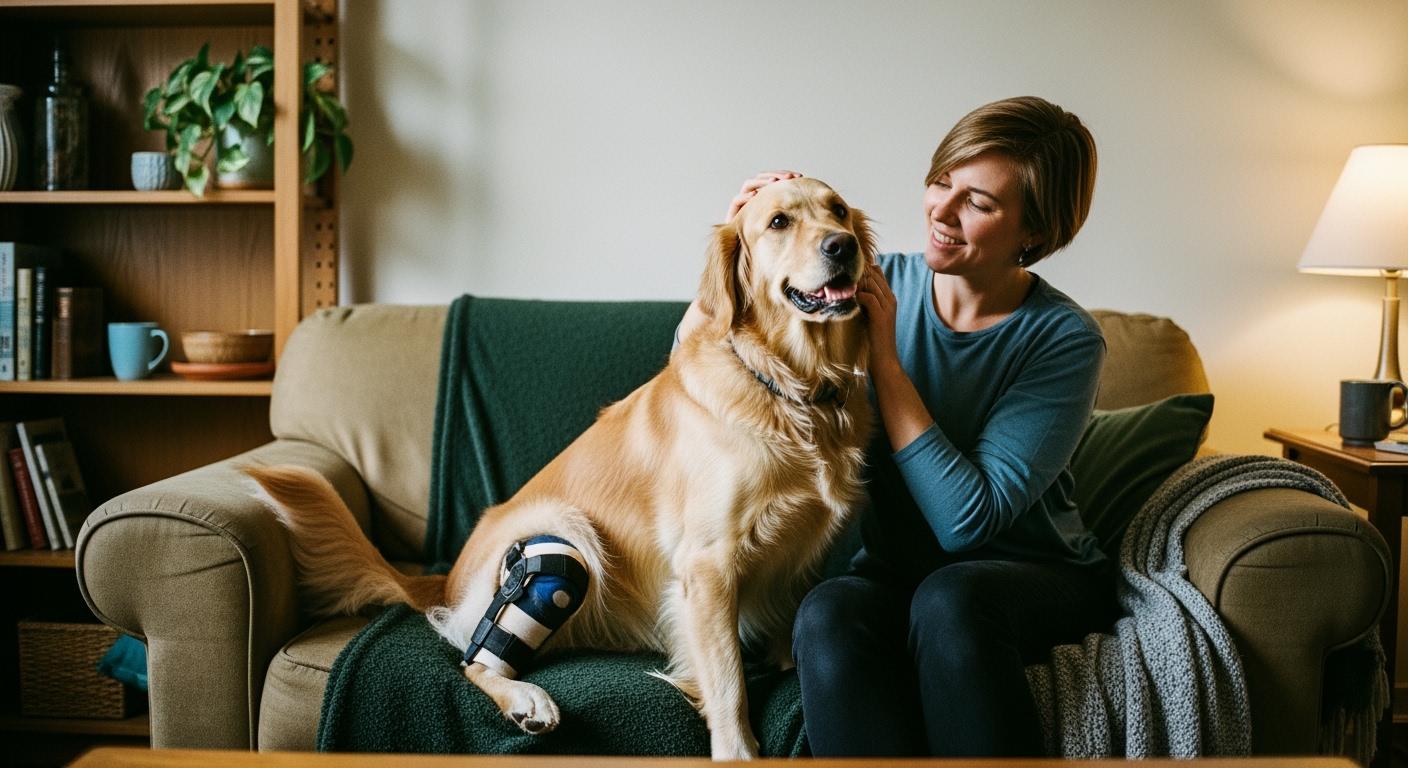
A knee brace slips half an inch. The hinge drifts off the joint line. Support that was centered over the stifle now pushes against soft tissue at an angle the brace was never designed to take. The dog does not yelp or limp. But underneath, strap edges are already digging into skin that has been damp for two hours.
Most daily care advice starts with “check the fit.” That skips the real question.
The real question is what fails first—and why the failure stays invisible until skin breaks.
Where Daily Brace Fit Breaks Down
A knee brace holds position through strap tension. Each strap creates a band of pressure around the leg. When tension is even across all straps, the brace stays aligned over the joint and the load spreads across the full contact area.
That is the design intent. Daily wear does something different.
Dogs shift weight, lie down, climb onto furniture. Each movement changes the shape of the leg under the brace. A strap that was tensioned evenly at the start of the day loosens on one edge while staying tight on the other. The brace rotates—usually downward and inward as the quadriceps relax and the leg narrows.
Here is the mechanical chain that follows: strap tension asymmetry → brace rotation → hinge axis misalignment → off-axis loading of the joint → concentrated pressure at the strap edge closest to the rotation point. That single edge now carries most of the contact force. Instead of distributed pressure across a two-inch strap face, the force narrows to a line contact along the strap border.
Line contact against skin that cannot breathe under the liner. After 20 to 30 minutes, the skin under that edge is warmer, softer from moisture, and far more vulnerable to friction damage than dry skin would be.
This is not a fit problem a “two-finger test” catches. The strap feels snug. The brace has not visibly shifted. But the load distribution has already collapsed.
In practice: Walk the dog for 10 minutes, then remove the brace and run a finger along every strap line. A uniform pink impression that fades within 2 minutes is normal. A deep red line that stays visible past 5 minutes means edge pressure has already concentrated beyond what skin tolerates.
This check works because skin blanching and capillary refill are direct pressure indicators. You do not need to guess whether the fit is right. Narrower legs—common in small and slender breeds—amplify this edge-pressure effect because there is less surface area to distribute the same strap tension.
What Changes After the First Hour
Even a brace that passes a morning fit check can fail by midday. The liner absorbs sweat and the leg circumference changes slightly. The coefficient of friction between the liner and skin drops. What started as a stable interface becomes a low-friction surface where the brace can micro-shift with every step.
These shifts are tiny—a millimeter or two per step. Over a thousand steps, the brace migrates far enough that the hinge pivot no longer coincides with the knee’s axis of rotation.
At that point the brace is not supporting the joint. It is resisting it. Every flexion cycle forces the hinge to fight the dog’s natural motion instead of tracking it. The dog does not limp—not yet—but the wear pattern changes. Joint alignment under load determines whether a brace stabilizes or stresses the stifle over hours of continuous wear.
Heat, Moisture, and the Skin Under the Brace
A knee brace wraps the leg in a shell-and-liner structure. The shell provides rigidity and hinge mounting. The liner sits between the shell and the skin. The space between them is where the problem accumulates.
Body heat radiates from the leg into this enclosed space. Without airflow, the temperature under the brace rises noticeably above ambient skin temperature within 30 minutes of wear. Sweat glands in the skin respond normally—they release moisture. But the moisture has nowhere to go.
A liner made from closed-cell foam or dense neoprene absorbs very little. Sweat pools at the skin-liner interface. The stratum corneum—the outermost skin layer—hydrates and softens. Hydrated skin has roughly one-quarter the shear strength of dry skin. That means the same friction that was harmless on dry skin now abrades the surface.
Materials that prioritize impact absorption over moisture transport create a predictable tradeoff: better cushioning, worse skin environment over multi-hour wear. The liner choice is not about comfort in the first 10 minutes. It determines whether the skin under the brace survives hour three.
This table lays out what the material choice means for daily wear:
| Performance Difference | Warum das wichtig ist | Main Limitation |
|---|---|---|
| Open-cell foam vs. closed-cell neoprene liner | Open-cell breathes and wicks moisture away from skin; closed-cell holds moisture at the surface | Open-cell compresses faster and loses cushioning depth after extended daily wear |
| Perforated shell vs. solid shell | Perforations create convection paths that let body heat escape instead of building under the brace | Each perforation removes structural material—too many and the shell loses rigidity at the hinge mounting point |
| Moisture-wicking inner layer vs. standard fabric liner | A wicking layer moves sweat from the skin side to the outer face where it can evaporate | The wicking gradient only works if the outer shell allows evaporation—a solid shell over a wicking liner still traps moisture |
This is the tradeoff every knee brace makes: more structure means less airflow; more cushioning means more moisture retention. The right balance depends on wear duration, activity level, and the dog’s coat density. A short-coated dog on a 2-hour indoor wear schedule has different liner needs than a double-coated dog doing 4 hours with outdoor time mixed in.
Tip: After removing the brace, press a dry tissue against the inner liner. If it comes away damp, the liner held moisture against the skin for the full wear session. If it comes away dry, the material and ventilation path are keeping up with the dog’s output.
Signs the Heat-Moisture Cycle Is Already Causing Damage
Skin that has been warm and damp under a brace does not always look injured at first glance. The earliest damage sign is not redness. It is texture change. Run a finger over the skin after removing the brace. Skin that feels tacky or slightly rough—compared to the same spot on the opposite leg—has already started superficial breakdown from moisture exposure.
Redness that appears 15–20 minutes after brace removal, rather than immediately, signals a deeper inflammatory response to sustained pressure and moisture—not surface friction alone. This delayed redness pattern tends to predict skin breakdown within 2–3 days if the same wear conditions repeat without adjustment.
When a Knee Brace Creates More Problems Than It Solves
A knee brace is built to stabilize the stifle. That is what it does. But stabilization is only useful when the leg is weight-bearing and the joint is moving through its normal range. In every other context, the brace is just something wrapped around the leg.
A dog that spends most of the day lying down generates more moisture under the brace than a dog that walks periodically—because a stationary leg gets no convection, no movement-driven air exchange, and sustained contact in one position. A brace worn during long crate rest can produce skin damage faster than one worn during active rehab.
Conformation matters too. Dogs with very straight stifles or angular limb deformities may not match the hinge geometry the brace was patterned on. The hinge tracks a specific arc; if the dog’s knee does not follow that arc, the brace loads the joint unevenly with every step. Knee support only holds when the brace geometry and the dog’s actual stifle mechanics align under load. When they do not, the brace can increase lateral joint stress rather than reduce it.
Disclaimer: The fit checks described here assume a dog with relatively straight leg conformation matching the breed standard the brace was patterned for. Dogs with angular limb deformities, very deep chests, or significant muscle atrophy on one side may distribute pressure differently—run through every edge-check and tissue-press test in this article before assuming the brace is safe for extended wear on an atypical leg shape.
Daily Cleaning: What Actually Matters
Cleaning a knee brace is not about hygiene in the abstract. It is about removing the salt, oils, and shed skin cells that accelerate liner degradation and increase friction against the leg. A liner caked with dried sweat becomes abrasive. Microscopic salt crystals embedded in the fabric act like fine-grit sandpaper against hydrated skin.
The cleaning rhythm that matters most: wipe the inner liner with a damp cloth after every wear session, let it dry fully before the next use, and deep-clean based on activity. A brace worn by an active outdoor dog accumulates grit inside the liner that a quick wipe will not reach. Hand-wash the liner separately from the shell if the design allows it.
Check the strap edges during cleaning. Fraying at the edge concentrates the same tension into a smaller contact area—the exact mechanical problem described earlier, now amplified by wear. Replace straps before the edge frays past the stitching.
Häufig gestellte Fragen
How long can a dog wear a knee brace before skin needs a break?
No single number answers this. The limiting factor is moisture accumulation under the liner, not time alone. A brace with a perforated shell and wicking liner worn during light indoor activity may allow 3–4 hours before the skin environment degrades. The same brace on an active dog outdoors in warm weather may need a break after 60–90 minutes. The tissue test—pressing a dry cloth against the liner after removal—tells you whether the current wear duration is within the material’s moisture capacity.
What is the first sign that strap pressure is too high?
A deep red strap mark that stays visible more than 5 minutes after brace removal. Uniform pinkness that fades quickly is normal capillary response to compression. A persistent dark line along the strap edge means pressure has exceeded tissue perfusion pressure and skin cells are already under hypoxic stress at that contact line.
Why does the brace slip even when straps are tight?
Tightness and grip are not the same thing. A strap can feel very snug while the liner-skin interface underneath has become slick from moisture. Once the friction coefficient drops, muscle movement during walking applies enough shear force to shift the brace millimeter by millimeter. The brace does not slip because the straps are loose—it slips because the liner surface no longer grips the leg, even under tension.
Can a knee brace cause joint problems if worn incorrectly?
A misaligned hinge applies force to the joint at an angle it is not built to absorb. Over hours of wear, the off-axis loading can irritate the joint capsule and surrounding soft tissue. The dog may not show lameness immediately—the damage is cumulative, not acute. That is why the alignment check after walking matters more than the static fit check.
