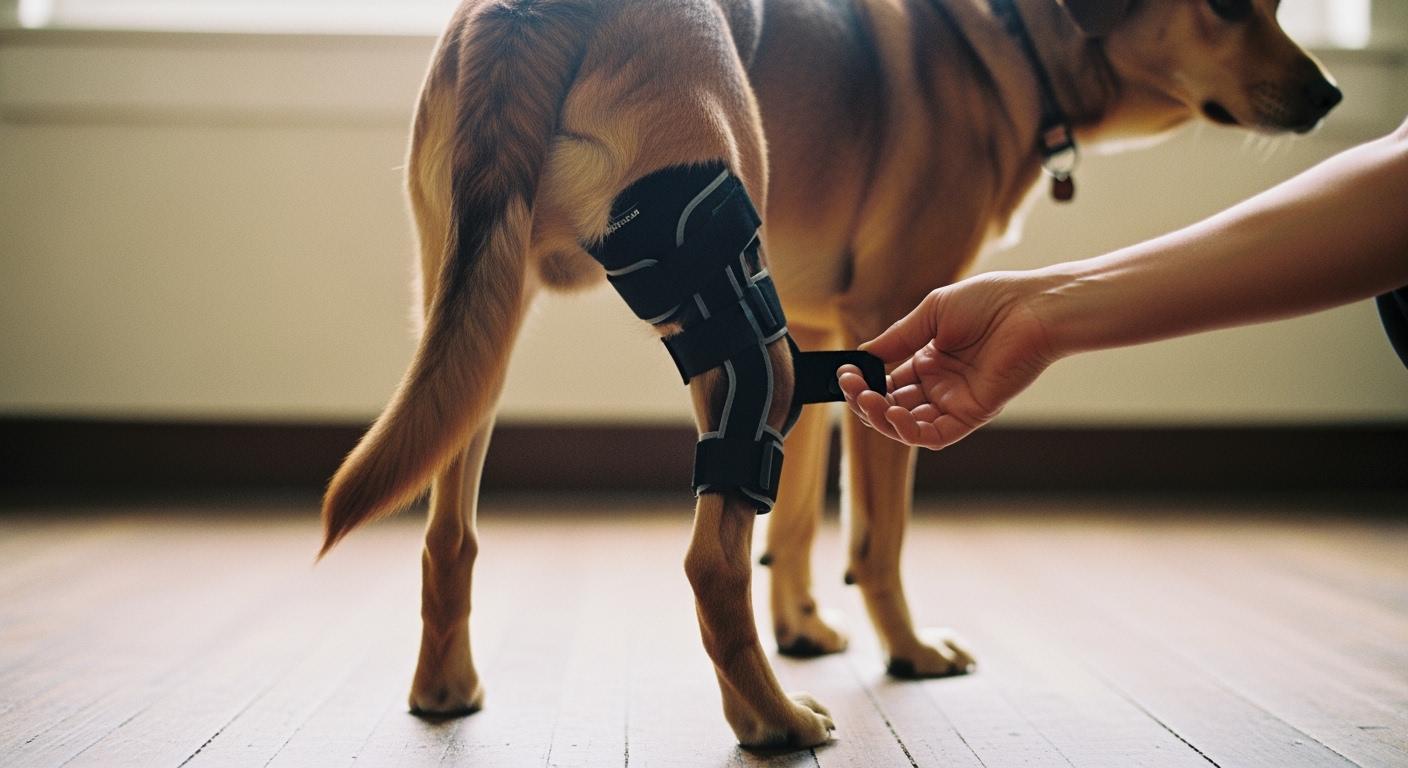
A hind leg brace applied to the wrong joint provides zero support — the affected joint moves freely while the brace wraps something else entirely. The same outcome follows from a brace sized too loose: it rides down the leg within minutes of activity, sitting below the load-bearing zone where it contributes nothing. Active dogs on uneven terrain expose these failures fast; larger breeds accelerate them, because more weight means more force pulling a loose brace off position. The underlying causes are almost always the same — a hinge that does not align with the joint axis, strap coverage too narrow to anchor the shell against muscle movement, or a structural panel too flexible to hold shape under load. What determines whether a hind leg brace actually supports anything is not how tightly it is wrapped or how thick the padding is. It is joint-specific fit, hinge axis alignment, and a rigid enough structure to translate load from the joint into the brace shell.
- Joint mismatch is the leading cause of brace failure — a knee brace does not support a hock injury regardless of how tightly it is applied.
- Brace fit degrades over the first weeks of use as fur compresses and muscles atrophy; what fit on day one often slides by week two.
- Hinge axis alignment matters more than compression tightness — a hinge offset from the joint axis restricts natural movement without providing lateral stability.
Where Hind Leg Braces Actually Fail
Joint Mismatch: The Most Common Error
Wrong joint, wrong outcome. A brace designed for the stifle wraps the femoral-tibial junction. A hock brace wraps the tarsal joint, lower on the leg. These are anatomically separate targets. Applying a stifle brace to a dog with a hock injury leaves the hock completely unbraced — the brace sits above the problem, doing nothing useful, while the dog continues to load the damaged structure with every step.
The same logic applies in reverse. Hock braces are built with rigid plantar support to control hyperextension at the tarsal joint. That geometry is useless for a CCL tear, which requires lateral and cranial stability at the stifle. Guessing based on where the limping looks worst produces this failure pattern reliably. Understanding dog hind leg brace types, fit, and daily use starts with identifying the injured joint correctly before any other decision is made.
| Condition | Correct brace type | Common mismatch | Performance result of mismatch |
|---|---|---|---|
| CCL/ACL tear (stifle) | Stifle brace with lateral hinge | Hock brace or soft compression sleeve | No lateral or cranial stability; limping continues unchanged |
| Luxating patella | Stifle brace with mediolateral tracking control | Compression wrap only | Patella continues to slip; brace adds no tracking control |
| Hock/Achilles injury | Rigid or semi-rigid hock brace with plantar support | Knee or stifle brace | Hyperextension uncontrolled; tarsal joint fully unbraced |
| Hip dysplasia / arthritis | Hip support brace or rear harness | Stifle or hock brace | Load not redistributed; hip joint unaffected by any distal wrap |
Sizing and Fit Failures
Brace too loose: it slides distal within minutes of activity, ending up below the load-bearing zone. Brace too tight: edge pressure concentrates at the proximal and distal strap borders, especially along the medial aspect of the leg where the brace shell presses hardest against soft tissue. That produces skin breakdown and drives brace refusal.
Both failure modes share a feature — they are not obvious at fitting. A brace that feels secure on a stationary dog often drifts under active movement. Testing fit on a moving dog, not a standing one, catches positional drift before it becomes a pattern.
| Failure signal | What it indicates about fit or design | Better design direction |
|---|---|---|
| Brace slides down after 20 minutes of activity | Proximal anchor too narrow or loose; shell lacks structural rigidity | Wider proximal strap, firmer shell panel, anatomical contour |
| Dog chews or removes brace repeatedly | Edge pressure or thermal buildup; brace is irritating rather than neutral | Soft-edge binding, breathable lining, reduced rigid edge contact |
| Lateral wobble visible while walking with brace on | Hinge not aligned with joint axis; shell too flexible to transmit load | Polycentric hinge matching joint anatomy, firmer structural shell |
| Skin redness at strap edges after wear | Strap width too narrow; edge concentration on medial soft tissue | Wider padded straps, redistributed contact zone, soft liner at edges |
How much a brace delivers on rear leg brace stability and mobility support depends entirely on avoiding these fit failures before they become entrenched in how the dog compensates while wearing the brace.
Knee, Hock, or Hip — Why the Joint Match Defines Everything
What Each Joint Actually Requires
Each joint in the dog’s rear leg has a different movement pattern and a different failure mode when injured. The stifle requires cranial-caudal and mediolateral stability — the primary directions a CCL tear leaves uncontrolled. A brace at this joint must resist anterior tibial thrust without blocking the hinge motion of normal gait. For luxating patella specifically, the brace must also control tracking deviation, which requires a design that addresses mediolateral forces, not just compression.
The hock is a different problem. Hock and Achilles injuries involve the plantar surface — the heel equivalent in canine anatomy. Braces for these injuries hold the hock at the correct angle and prevent hyperextension through rigid or semi-rigid plantar support. A stifle brace does not extend far enough down the leg to reach the tarsal joint and provides none of the plantar control needed.
Hip dysplasia and rear-end weakness from arthritis sit at the opposite end of the limb. A knee brace for torn ACL and stifle recovery affects the femoral-tibial junction — it does not redistribute load at the hip or improve rear-end proprioception. Hip conditions typically require a harness-style system that supports the dog’s weight through the torso, not a distal leg wrap.
| Joint type | What the brace must do | What goes wrong without joint-specific design |
|---|---|---|
| Stifle (knee/CCL) | Resist anterior tibial thrust; control mediolateral stability at knee hinge | Unstable stifle under load; CCL tear continues to strain with each step |
| Hock joint | Hold tarsal angle; prevent hyperextension via rigid plantar support | Hyperextension recurs; soft tissue injury load continues uncontrolled |
| Hip joint | Redistribute rear-end weight through torso or pelvis, not distal leg | Distal brace has no mechanical effect on hip loading; hip joint fully unbraced |
CCL Tears: What a Brace Can and Cannot Do
Partial CCL tears and full CCL tears are not the same problem. A partial tear leaves some ligament fibers intact — the joint retains some inherent stability, and a well-fitted stifle brace can reduce the cranial displacement that strains the remaining fibers. That is a real functional benefit for many dogs with partial tears.
Full CCL tears are different. The ligament is gone. A brace can limit gross instability and reduce pain from joint laxity, but it cannot replicate the mechanical function of an intact ligament. Soft wrap-style braces — neoprene sleeves and compression wraps — add warmth and proprioceptive feedback, but they do not provide the structural lateral and cranial control that a hinged shell brace does. Compression is not stability. Among ACL brace alternatives and support comparisons by joint type, the structural differences between designs determine functional outcomes, not brand or material thickness alone.
Note: A stifle brace for CCL injury is a management tool, not a cure. Full tears typically require surgical evaluation. Brace use is most consistently valuable during the post-diagnosis period, or post-surgically as a recovery aid — a veterinary diagnosis before brace selection prevents the most common joint mismatch errors.
Why the Brace Keeps Failing After the First Week
Progressive Fit Degradation
A brace that fits correctly on day one often does not fit the same by week two. Three things change the fit envelope over time: fur compresses under the shell and straps, reducing the interference that held the brace in position; muscles begin to atrophy in the braced limb as the dog shifts weight to the unaffected side; and straps stretch slightly under repeated load cycles, widening the effective fit band. All three changes push in the same direction — looser.
The brace that felt snug at initial fitting now rides lower on the leg, the proximal strap gaps on the medial side, and the hinge sits below the joint axis it was aligned to. Hind leg brace fit and slipping during daily wear is a mechanical progression, not a product defect — but it requires active monitoring and periodic strap adjustment to stay ahead of it.
| Wear stage | Signs brace is still fitting correctly | Signs it needs readjustment |
|---|---|---|
| Days 1–7 | Hinge aligns with joint midpoint; no compensatory gait; no skin redness after removal | Brace rotates medially or slides; dog favors braced limb more than before |
| Weeks 2–4 | Straps hold position after a full walk; no visible slipping at end of wear session | Proximal strap gaps after activity; hinge no longer centered on joint; dog chews at brace edges |
| Long-term management | Gait with brace remains consistent; brace position stable across multiple sessions | Brace sits noticeably lower than at fitting; original strap settings now too loose |
Skin Breakdown and Brace Rejection
Skin problems under a brace are almost always an edge problem. The highest pressure concentrates at the proximal and distal ends of the strap coverage zone, particularly along the medial surface of the leg where the brace shell geometry creates a narrow contact ridge. A brace with adequate interior padding but narrow strap edges still fails here — the padding is in the center, the pressure is at the margins.
When the skin breaks down, the dog begins refusing the brace. This is not behavioral — it is the correct response to discomfort. The brace is creating a problem faster than it is solving one. Soft-edge binding for dog braces addresses this directly by redistributing contact pressure across a wider zone at the strap boundaries, reducing the ridge effect that drives skin breakdown and brace rejection.
| Observed behavior | Likely cause | Recommended action |
|---|---|---|
| Brace slides below joint midpoint during walks | Proximal anchor too loose; fur compression reducing strap grip over time | Readjust proximal strap; consider trimming fur under contact points |
| Skin redness at strap edges after removal | Narrow strap edge concentrating pressure on medial soft tissue | Reduce wear duration; evaluate strap width and edge liner material |
| Dog chews or pulls at brace repeatedly | Edge irritation, heat buildup, or positional discomfort from misaligned fit | Inspect all contact edges; check hinge alignment; remove brace and assess skin |
| Limping continues or worsens with brace on | Brace not on correct joint; hinge axis misaligned; brace has shifted from original position | Verify joint match; check hinge position against stifle or hock; seek veterinary assessment if limping intensifies |
Disclaimer: Remove the brace immediately if skin breakdown, open sores, or significant swelling develop under the brace. These require veterinary assessment before brace use resumes.
Wear Schedule and Activity Limits
How long a dog should wear a brace each day depends on the condition, the dog’s individual tolerance, and how well fit holds during activity. The general pattern starts with short supervised sessions and increases gradually as the dog demonstrates comfort and stable fit — not on a fixed mathematical schedule. A dog with a partial CCL tear and stable fit tolerates a different progression than a post-surgical dog still building tolerance to having anything on the limb.
| Recovery stage | Typical wear time | Key monitoring points |
|---|---|---|
| Early stage (first 1–2 weeks) | 2–4 hours per day in shorter sessions; individual tolerance varies | Watch for slipping, skin changes, or increased limping |
| Mid stage (weeks 3–8) | 6–8 hours per day; remove for sleep and rest periods | Check hinge alignment and strap position after each session |
| Long-term management | Up to 10–12 hours per day in segments; not continuous all-day wear | Skin needs air circulation; the limb needs unbraced load-bearing time to maintain muscle |
Dogs recovering from CCL tears often need several weeks of restricted movement — typically 8–12 weeks for serious injuries. Running, jumping, and unsupervised stair use increase the forces on the brace-to-limb interface and accelerate fit degradation. Controlling activity during this period directly affects how long the brace maintains its position on the leg.
What Better Brace Design Gets Right
Hinge Geometry and Structural Shell
The hinge is the most consequential element of a hinged stifle brace. A monocentric hinge approximates the knee’s range of motion but does not account for the natural instantaneous axis of rotation, which shifts slightly through the gait cycle. A polycentric hinge — two pivot points — tracks closer to actual joint mechanics, which means less restriction on natural movement and better load transfer into the brace shell.
Half a degree of hinge misalignment translates into real instability at the joint during loaded gait. The structural shell must be rigid enough to hold position under the forces generated when a dog pushes off with the rear limb. Soft or semi-rigid shells flex under load — that flexion absorbs the force the brace was supposed to redirect. A back leg torn CCL knee brace needs structural integrity in the lateral shell panel to actually control tibial thrust; thickness without rigidity does not accomplish this.
| Design feature | Why it matters in real use | What fails without it |
|---|---|---|
| Polycentric or anatomical hinge | Tracks joint’s actual rotation axis through gait; reduces compensatory movement | Hinge fights natural movement; dog develops altered gait under brace |
| Wide proximal strap | Distributes anchoring force over larger area; reduces edge pressure; slows positional drift | Narrow strap creates focal pressure and slides under active movement |
| Breathable interior lining | Reduces heat and moisture buildup during extended wear; improves compliance in senior dogs | Heat accumulation drives brace removal; skin maceration risk increases with longer wear |
| Adjustable compression system | Accommodates swelling changes and muscle atrophy without requiring a new brace | Fixed compression becomes too loose as limb changes shape through recovery |
Materials and Senior Dog Tolerance
Breathable, moisture-wicking lining matters most for dogs wearing a brace across multiple hours daily. Neoprene retains heat and moisture — it works for short sessions but creates skin maceration problems over extended wear. For senior dogs with arthritis, the trade-off between warmth (which neoprene provides) and breathability (which mesh or open-cell foam provides) often determines compliance more than any other factor.
Stiffer structural materials increase stability but may reduce willingness to wear in dogs who are not movement-limited by pain. A dog that finds the brace uncomfortable will remove it or refuse it. Brace compliance is a material and design problem as much as anything else. Padding thickness at pressure points reduces edge contact without changing structural performance — this is where well-designed braces separate from padded sleeves.
Dog hind leg braces can reduce load, limit instability, and support recovery when the correct brace matches the correct joint and maintains proper position throughout use. That combination is harder to achieve in practice than it looks. Joint mismatch, progressive fit degradation, hinge misalignment, and edge pressure problems each independently undermine what the brace is supposed to do. Getting those variables right — not just applying a brace and observing — is what separates functional support from something that merely wraps the leg.
Häufig gestellte Fragen
How long should a dog wear a hind leg brace each day?
There is no single correct answer across all conditions. Most recovery scenarios start with short supervised sessions — 1–2 hours — and increase gradually based on how the dog tolerates the brace and whether fit remains stable. A dog showing skin redness, gait changes, or increased agitation should have wear time reduced, not maintained on a fixed schedule. Total daily wear beyond 10–12 hours, even in segments, is generally excessive; the limb needs time without the brace to maintain skin integrity and muscle function.
Can a dog brace replace surgery for a torn ligament?
For partial tears in dogs who are not surgical candidates, or whose owners choose conservative management, a well-fitted hinged stifle brace can provide meaningful support and may allow a reasonable quality of life long-term. Full CCL tears are a different situation — the ligament is no longer functional, and a brace can reduce instability but cannot replicate the mechanical contribution of an intact ligament. Surgery remains the standard of care for complete CCL rupture in most active dogs. Brace use in those cases is most consistently valuable pre-surgery as a management tool or post-surgery as a recovery aid, not as a replacement for surgical repair.
What should I do if the brace slips or rubs?
Slipping means the proximal anchor is no longer holding position. Before adjusting compression, verify the hinge is still aligned with the joint axis — if it has drifted, repositioning the whole brace is the correct first step. Rubbing at edges means contact has become concentrated; reducing wear time and examining whether the strap edges are padded or bare rigid material identifies the fix. A brace that both slips and rubs simultaneously has likely shifted significantly from its original position and needs full repositioning, not minor strap tightening.
How do I clean a dog hind leg brace?
Remove the brace before it gets wet or heavily soiled. Most fabric and neoprene components tolerate hand washing with mild soap and thorough air drying; machine washing can distort rigid shell panels and degrade strap elasticity over time. Metal hinges need to be dried promptly after any moisture exposure — check the hinge pivot points specifically, not just the visible outer metal surfaces. Salt from skin secretions and dried debris both degrade strap grip and affect fit consistency between sessions.
When should I call my veterinarian about my dog’s brace?
Contact a vet if limping increases with the brace on — this may indicate joint mismatch, hinge alignment problems, or an injury being worsened by brace position. Skin breakdown, open sores, or swelling under the brace also require veterinary assessment before resuming use. If the underlying condition has not been formally diagnosed, getting a diagnosis before selecting a brace type prevents the most common mismatch errors from the start.