
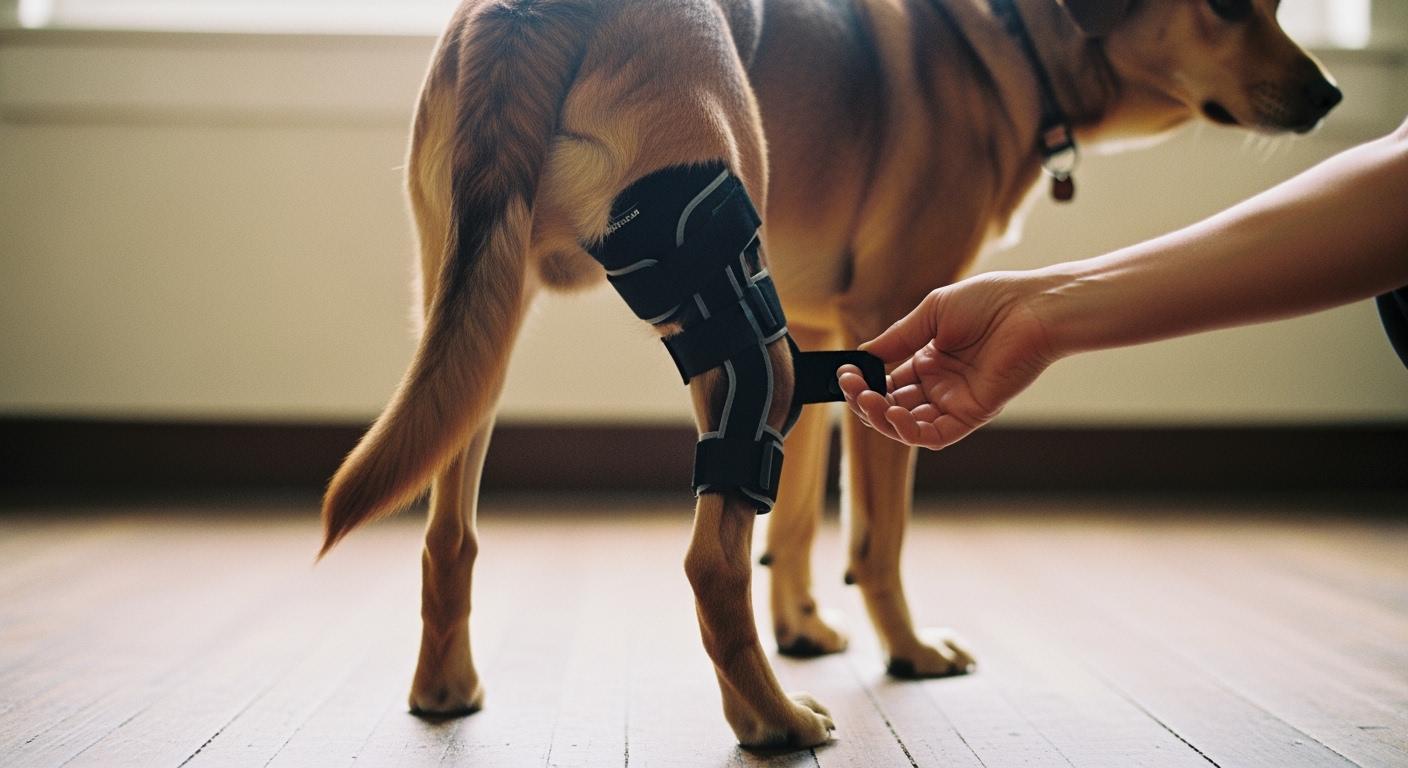
Dog hind leg braces are not interchangeable. A knee brace, hock brace, hip support, and rear lift harness act on different parts of the body and solve different support problems. A brace can only provide useful external support when its structure matches the diagnosed joint, remains in position during movement, and does not create pressure, skin damage, or a new gait change.
The first question is therefore not “How tight should the brace be?” It is “Which joint or body region needs support?” A dog that appears weak in the rear may have a knee, hock, hip, spinal, neurological, or general mobility problem. Selecting from the visible limp alone can place the brace above or below the actual support area.
| Support area | Typical product direction | Primary function |
|---|---|---|
| Stifle or knee | Stifle brace or hinged knee brace | External support around the knee and, depending on design, selected movement control |
| Hock or tarsal joint | Hock brace or hock splint | Support around the lower rear-leg joint and possible control of excessive flexion or extension |
| Hip or pelvis | Hip support brace | External support around the pelvis or upper hindquarters |
| General hind-end weakness | Rear lift harness | Allows a handler to assist rising, toileting, stairs, or transfers |
Key takeaways
- Confirm the affected joint before selecting a hind leg brace.
- A brace that fits while the dog is standing may still slip, rotate, or restrict movement during walking.
- Hinge position matters for hinged designs, but exact joint mechanics vary by dog and product structure.
- Tighter straps do not correct the wrong size, wrong joint, poor suspension, or unsuitable brace geometry.
- There is no universal daily wear schedule for every dog, condition, or brace design.
- Remove the brace and reassess if it causes persistent redness, pressure, swelling, increased limping, or a new gait pattern.
Why joint matching comes first
The rear limb contains several joints with different locations and movement patterns. A brace designed to surround the stifle cannot provide direct support to the hock below it. A hock splint cannot control the knee above it. A distal leg wrap cannot lift the pelvis or replace a rear-support harness.
This is why diagnosis matters. Limping may look most obvious in the lower leg even when the problem originates at the knee, hip, spine, or nervous system. Before selecting equipment, identify the affected structure and define the support goal: compression, external stabilization, limited movement, protection from excessive motion, or handling assistance.
For a broader overview of brace categories and daily-use checks, see the dog hind leg brace types and fit guide.
Knee or stifle support
The canine stifle is the knee joint between the femur and tibia. Braces for this area may use flexible panels, reinforced side supports, or hinges. The required structure depends on the diagnosed condition, instability pattern, anatomy, activity, and veterinary plan.
A hinged brace should remain centered around the knee during controlled movement. If the hinge sits clearly above or below the joint, rotates toward the front or back of the leg, or forces the dog into a shortened stride, the fit or product structure needs reassessment.
Hock support
The hock is the lower rear-leg joint above the paw. Hock braces and splints may be designed to limit selected flexion, extension, or side-to-side movement. Some include a plantar or rear support section, while others provide lighter circumferential support.
The correct hock design depends on the injury and required movement limit. A soft sleeve, semi-rigid brace, and full splint do not provide the same support. More rigid construction is not automatically better; excessive restriction can change gait or transfer pressure to another area.
Hip and pelvic support
Hip support products act around the pelvis, waist, or upper hindquarters rather than the knee or hock. They may provide external contact or selected movement guidance, but they do not correct hip anatomy or lift the dog’s body weight.
When the main need is help rising, toileting, using stairs, or entering a vehicle, a rear lift harness may be more practical than a hip brace. The rear leg support solution page compares different product directions by support need.
Knee, hock, hip, or lift support?
| Observed need | Product type to discuss | What to verify |
|---|---|---|
| Diagnosed knee instability or need for stifle-area support | Knee or stifle brace | Joint coverage, hinge position, rotation control, strap clearance and gait |
| Diagnosed hock injury or need to limit hock movement | Hock brace or splint | Hock angle, paw clearance, pressure behind the joint and intended movement limit |
| Need for external support around hips or pelvis | Hip support brace | Waist suspension, thigh contact, toileting clearance and slipping |
| Difficulty rising, balancing, toileting or completing transfers | Rear lift harness | Handle position, load distribution, groin clearance and handler control |
| Sudden weakness, dragging, knuckling or rapid decline | Veterinary assessment first | Possible neurological, spinal or acute orthopedic cause |
What a hind leg brace can and cannot do
A hind leg brace is an external support device. Depending on the design, it may provide compression, reinforce a selected joint area, guide movement, or limit a defined range of motion. Its role should be described narrowly and according to the product structure.
| Possible function | Important limit |
|---|---|
| External support around a selected joint | Does not repair a ligament, tendon, cartilage, bone, or joint surface. |
| Selected movement guidance or restriction | Cannot reproduce all normal joint mechanics or guarantee stability. |
| Compression or contact around soft tissue | Should not be described as guaranteed pain or swelling reduction. |
| Use during controlled, supervised activity | Does not replace diagnosis, medication, surgery, rehabilitation, or activity restrictions. |
| One component of a recovery or mobility plan | Cannot prevent every fall, further injury, or disease progression. |
CCL tears and knee braces
A knee brace may be considered after a cruciate ligament diagnosis, but partial and complete tears, chronic instability, arthritis, meniscal injury, body size, activity level, and surgical candidacy all change the decision. A brace should not be presented as a universal alternative to surgery or as a device that recreates an intact ligament.
For some dogs, a veterinarian may include bracing in conservative management, preoperative handling, or a postoperative plan. For others, a brace may be unsuitable or insufficient. The decision should remain individualized.
For a product example focused on knee-area structure, see the back-leg CCL knee brace.
Why dog hind leg braces slip, rotate, or rub
A brace can appear secure during fitting and still move out of position once the dog walks, turns, sits, or changes speed. Slipping is usually a combined fit-and-structure problem rather than a simple instruction to tighten every strap.
| Observed problem | Possible cause | What to check |
|---|---|---|
| Brace moves downward | Incorrect size, weak proximal suspension, coat compression, strap stretch or body shape mismatch | Measuring points, upper anchor, strap direction, contour and adjustment range |
| Brace rotates around the leg | Asymmetrical tension, hinge position, shell shape or inadequate anti-rotation control | Left-right strap balance, panel contour, hinge location and movement pattern |
| Redness at strap edges | Concentrated pressure, narrow strap, curled edge, overtightening or repeated movement | Edge binding, strap width, liner condition and pressure after walking |
| Dog chews or resists the brace | Heat, moisture, rubbing, pressure, restricted movement or unfamiliar equipment | Skin, coat, seams, brace temperature, gait and introduction process |
| Limping increases with the brace | Wrong joint, unsuitable structure, poor alignment, pressure or changing condition | Remove the brace and seek veterinary or fitting reassessment |
The hind leg brace fit and slipping guide covers suspension and daily fit changes in more detail.
Fit can change over time
Body weight, swelling, coat thickness, strap stretch, muscle condition, and activity can change how the brace sits. This does not mean that every brace will become loose after a fixed number of days. It means fit should be rechecked whenever position, gait, body shape, or tolerance changes.
- Recheck measurements after noticeable weight or muscle change.
- Compare current strap settings with the original fitting position.
- Inspect whether the hinge or support panel remains centered.
- Check the skin after use, especially around strap and shell edges.
- Do not compensate for major slipping by overtightening one strap.
How to check hinge position
Hinge alignment matters in a hinged brace, but the goal is not to apply one universal geometric rule to every dog. Joint anatomy, product hinge design, shell contour, and movement pattern vary.
- Identify the intended joint. Confirm that the brace is designed for the knee or hock rather than another region.
- Fit the brace while the dog stands naturally. Avoid a crouched, leaning, or rotated posture.
- Check the hinge against the joint area. It should not sit clearly above, below, in front of, or behind the intended movement zone.
- Observe slow controlled steps. Watch for hinge drift, shell rotation, shortened stride, limb circumduction, or resistance.
- Recheck after movement. A hinge that begins correctly but shifts during walking indicates a suspension or sizing issue.
A hinge should guide the brace through movement without forcing the dog into a new gait. Exact alignment and suitability should follow the product fitting protocol and professional guidance.
Dynamic fit check: standing is not enough
Complete the final fit check while the dog moves slowly on a nonslip surface. A static fit only shows how the brace sits before the limb begins loading and changing angle.
| Check | Acceptable | Stop and adjust |
|---|---|---|
| Position | Brace remains over the intended joint or support area. | Slides, rotates, folds or moves below the target zone. |
| Straps | Secure without twisting or digging into soft tissue. | Edges curl, gaps open or one strap carries most of the tension. |
| Gait | Dog takes controlled steps without a new compensation pattern. | Stride shortens, paw turns, leg swings outward or weight shifts abruptly. |
| Skin and coat | No persistent redness, heat, moisture or hair pulling. | Pressure marks remain or skin becomes sore. |
| Behavior | Dog tolerates the brace without repeated chewing or refusal. | Dog freezes, repeatedly removes the brace or shows increasing distress. |
Soft-edge construction can reduce concentrated contact, but it cannot correct poor sizing or wrong brace placement. See the soft-edge binding guide for the relationship between edge construction and contact pressure.
Wear time and activity limits
There is no universal schedule such as two hours in week one, eight hours in week three, or twelve hours for long-term use. Appropriate wear time depends on the diagnosis, brace type, skin response, fit, activity, product instructions, and veterinary plan.
Begin with a short, supervised introduction. The first goal is to confirm that the brace remains in position and that the dog can stand, turn, and take controlled steps without pressure or a new gait change.
- Inspect the skin and brace position after each early session.
- Remove the brace if it slips, becomes damp, or causes persistent marks.
- Do not increase activity simply because the dog is wearing support.
- Do not assume overnight or unsupervised wear is appropriate.
- Follow condition-specific activity restrictions separately from the brace schedule.
- Reassess if the dog’s movement, swelling, body weight, or muscle condition changes.
How brace construction affects fit
Brace performance depends on the complete system: shell or panel shape, hinge type, strap direction, adjustment range, liner, edge binding, and anatomical contour. No single component guarantees a good result.
| Design element | What to evaluate | Common trade-off |
|---|---|---|
| Hinge | Location, freedom of movement, lateral profile and compatibility with the joint | More structure may add control but also bulk and alignment sensitivity |
| Structural panel | Whether it holds shape during movement and distributes contact | Stiffer panels may increase pressure if contouring is poor |
| Proximal strap | Width, anchor position, direction and adjustment range | Wider contact can improve distribution but may add heat and bulk |
| Liner | Surface feel, moisture handling, seam placement and cleaning | Softer or thicker liners can retain more heat and moisture |
| Edge binding | Whether shell and strap edges remain flat during motion | Soft edges reduce contact concentration but cannot correct an incorrect size |
| Adjustment system | Whether separate areas can be tuned without overtightening | More adjustment points increase fitting complexity |
Monocentric and polycentric hinges
Monocentric and polycentric hinges use different pivot arrangements. A polycentric hinge may better accommodate movement in some designs, but it is not automatically superior for every dog or condition. Hinge geometry must be evaluated together with shell placement, anatomical contour, strap suspension, range-of-motion settings, and the product’s intended use.
Soft and rigid structures
Soft sleeves, semi-rigid supports, hinged braces, and splints provide different levels of compression and movement control. A soft design is not “zero support,” and a rigid design is not automatically more effective. The correct level of structure depends on the support goal and the dog’s ability to tolerate the brace.
Neoprene, mesh, foam and other liners
Neoprene can provide stretch, cushioning, and warmth, while mesh or spacer fabrics may offer different ventilation and drying characteristics. Actual heat and moisture performance depends on thickness, perforation, surface fabric, climate, activity, coat, and wear time. Avoid absolute claims that one material always causes or prevents skin problems.
Common mistakes with dog hind leg braces
- Choosing the brace before confirming the joint. A knee, hock, hip, and neurological problem require different decisions.
- Tightening to compensate for the wrong size. Overtightening increases pressure without correcting geometry.
- Checking fit only while standing. Position must remain stable during movement.
- Ignoring hinge drift. A shifted hinge can alter movement and concentrate pressure.
- Using a soft sleeve when defined movement control is required. Match structure to the actual support goal.
- Assuming rigid always means better. Excess structure can reduce tolerance or change gait.
- Following a generic wear schedule. Use the product protocol, veterinary plan, and skin response.
- Continuing after persistent redness or sores. Remove the brace and reassess before further use.
- Increasing activity because the brace is on. Support equipment does not cancel activity restrictions.
- Delaying reassessment when limping worsens. The condition, joint match, or fitting may be wrong.
FAQ
Do dog hind leg braces work?
They may provide external support when the brace type matches the diagnosed joint, fits the dog’s anatomy, remains stable during movement, and is used within an appropriate treatment or mobility plan. A brace cannot guarantee pain relief, healing, injury prevention, or improved mobility.
How do I know whether my dog needs a knee or hock brace?
The location of visible limping is not enough. A veterinarian should identify the affected joint or structure. A knee brace surrounds the stifle; a hock brace acts lower on the rear leg around the tarsal joint.
How long should a dog wear a hind leg brace each day?
There is no universal daily wear time. Follow the product-specific instructions and veterinary plan. Begin with supervised use and check the skin, brace position, gait, circulation, and tolerance after each session.
Can a dog knee brace replace CCL surgery?
A brace should not be presented as a general replacement for surgery. Whether surgery, conservative management, rehabilitation, bracing, or another approach is appropriate depends on the diagnosis, tear, instability, dog, and veterinary assessment.
What should I do if the brace keeps slipping?
Do not keep tightening one strap. Recheck the size, measuring points, upper anchor, strap direction, hinge or panel position, coat compression, and whether the design matches the dog’s body shape. Persistent slipping may require a different structure or professional fitting review.
When should I stop using the brace?
Stop and seek reassessment if the brace causes persistent redness, open sores, swelling, increased limping, new gait changes, restricted movement, repeated refusal, or worsening weakness.
For pet brands and rehabilitation-product buyers
For a commercial hind-leg brace range, knee, hock, hip, and lifting products should not be treated as cosmetic variants of one SKU. Buyers should define the anatomical target, support level, hinge or panel function, suspension method, size grading, pressure zones, liner requirements, use instructions, and fit-validation process before comparing samples.
GaitGuard works with pet brands, distributors, and sourcing teams on canine brace development. Review the custom dog brace manufacturing process when evaluating OEM, private-label, or size-system requirements.
