
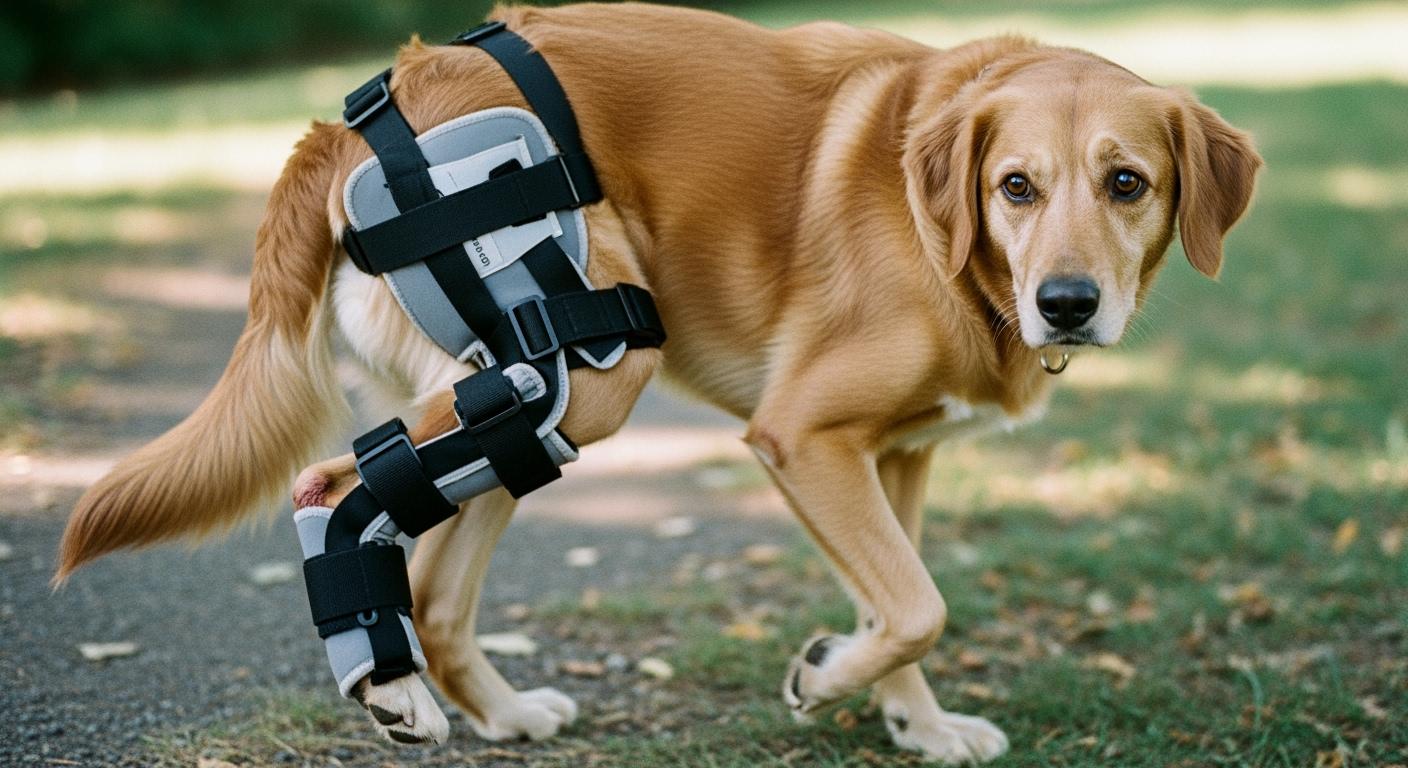
You put a back leg brace on your dog to ease arthritis stiffness, but the brace slips down mid-walk. Or it rubs a red patch into the skin. Or your dog comes back limping harder than before. This is not a sign that bracing is the wrong idea — it is a sign that something about the fit, the match to the joint, or the wear routine needs attention.
A brace can support an arthritic hind leg during short, controlled walks. It cannot reverse arthritis or fix a joint that has already lost cartilage. When slipping, rubbing, or worse limping appears, the most useful thing you can do is recognize which signal means adjust, which means stop, and which means call your veterinarian.
When a Back Leg Brace Helps Arthritis, and When It Does Not
What a brace can do for an arthritic hind leg
A well-fitted back leg brace stabilizes the affected joint during movement. For a dog with mild to moderate arthritis, this can mean less sway, a more even stride, and enough comfort to complete short daily walks. Canine rehab bracing as part of arthritis care works best when the brace matches the specific joint, the fit is checked daily, and the wear schedule builds gradually.
What a brace cannot do
A brace does not restore lost cartilage, reverse joint degeneration, or eliminate arthritis pain at its source. It cannot replace weight management, prescription pain control, or physical rehabilitation when those are indicated. And it cannot help if the brace is placed on the wrong joint — a knee brace on a hock problem, or a brace sized too loosely to provide meaningful stabilization, will at best do nothing and at worst create new problems.
| What a Back Leg Brace Can Do | Main Limitation | Signal weiterleiten |
|---|---|---|
| Stabilize the arthritic joint during short walks | Does not restore joint cartilage or reverse arthritis | Gait looks steadier with the brace on than off |
| Reduce joint sway and improve weight transfer | Cannot replace pain medication or weight management | Dog walks willingly, without freezing or trying to remove the brace |
| Support daily mobility as part of a veterinarian-guided plan | Does not fix instability from a complete ligament tear | Skin stays clean and cool under the brace after each session |
What a Working Brace Looks Like During a Walk
Even stance and steady steps
After the brace goes on, your dog should stand with weight distributed across both hind legs — not shifted onto the unbraced side. On the first few steps, watch for an even stride. The paw on the braced leg should track forward without twisting, dragging, or knuckling under. If the dog immediately shifts weight away or stands stiffly, the fit or the support zone is likely off.
Short, controlled walks as the test
Start with a brief session — a few minutes on flat ground, on leash. The goal at this stage is not exercise. It is a test: does the brace stay in place, and does the dog move at least as comfortably as without it. Watch for limping that appears or worsens during the walk, the dog stopping repeatedly to chew at the brace, or the brace rotating around the leg. Any of these means pause and check before extending wear time.
Tip: Keep the first several sessions short enough that you can watch every step. A leash gives you control and lets you stop the moment something looks off.
Skin check right after removal
Remove the brace immediately after the walk and inspect the skin underneath. Look across the strap lines and around the joint for redness, indentations, chafing, or moisture. Light pinkness that fades within several minutes is usually a normal pressure response. Redness that stays dark, feels hot, or shows broken skin is a stop signal. Checking skin and fit after every session catches irritation before it becomes a wound.
Walk-test checklist
| Check | Was ist zu tun? | Fehlermeldung |
|---|---|---|
| Strap tension | Confirm each strap lies flat and snug, without pinching | Straps leave deep marks, slip, or need constant re-tightening |
| First steps | Watch the dog walk a short straight line on leash | Limping, paw twisting, or weight shifted entirely off the braced leg |
| Behavior | Observe for chewing, licking, or freezing | Dog repeatedly goes after the brace or refuses to move |
| Skin after removal | Inspect under every strap and around the joint | Dark redness, swelling, blisters, or broken skin |
Workflow tip: Run this checklist after the first session with any new or adjusted brace. If every check passes, repeat at least once daily for the first week.
Support Failure: What Slipping, Rubbing, and Worse Limping Mean
Three problems dominate when a back leg brace is not working: the brace slips or rotates out of position, it rubs the skin raw, or the dog’s gait actually gets worse with the brace on. Each has a different cause and a different fix.
Brace slipping or rotating
A brace that slides down or twists around the leg is usually too loose, sized incorrectly, or placed over the wrong joint. Once it shifts, it stops stabilizing anything — and a loose brace can catch, trip the dog, or create friction burns. Brace slipping or rotating during walks should trigger an immediate fit check. Tighten or reposition the straps, and if the brace still will not stay put, the size or the brace type itself may need to change.
Skin rubbing and redness
Rubbing happens when the brace moves against the skin, when straps are too tight in one spot, or when moisture builds up underneath. Light redness that clears quickly after removal is usually manageable with strap adjustment and shorter sessions. Redness that persists, darkens, blisters, or develops into an open sore means stop use immediately. Clean the area, let the skin heal fully, and get a fit reassessment before trying again. Do not place a brace back over damaged skin.
Worse limping or paw twisting
If your dog’s gait looks worse with the brace on than off — more pronounced limping, the paw turning under, the dog dragging the leg — the brace is either on the wrong joint, forcing the leg into an unnatural position, or creating pressure that the dog is trying to escape. Remove the brace. A dog whose movement degrades with support in place is not getting support; the brace is working against the leg, not with it.
Refusal, freezing, or chewing
Dogs communicate brace discomfort by refusing to walk, freezing in place, chewing at the straps, or trying to pull the brace off. These are not stubbornness. They are pain or pressure signals. If the behavior repeats after two fit adjustments, the brace type, size, or support zone likely needs to change — and a veterinary or rehab professional should weigh in.
Signal table: what to do at each level
| Signal Level | What You See | What It Means | Action |
|---|---|---|---|
| [Green] Good fit | Steady stance, even steps, skin clean, no stress | Brace fits and supports the right joint | Continue short sessions, check skin after each use |
| [Yellow] Needs adjustment | Brace slips, rubs lightly, dog chews briefly, mild redness that fades | Fit or placement needs correction | Adjust straps and position; shorten sessions; monitor closely |
| [Red] Stop immediately | Worse limping, paw twisting, refusal to move, swelling, heat, open sores, cold toes | Serious pressure, pain, or wrong support zone | Remove brace, note all symptoms, call veterinarian |
Escalation rule: If gait is worse with the brace on than off, stop use and get a veterinary assessment. A brace should never make walking harder.
Fit Checks That Prevent Problems Before They Start
Measure standing, on all fours
Measure your dog while standing with weight distributed evenly. For a hind leg brace, measuring a back leg brace while the dog stands gives you the thigh circumference and leg length needed to match the brace to the dog. A brace chosen by guess or by weight alone rarely fits correctly.
Check strap tension every session
Straps should sit flat and snug — no gaps, no digging. If the brace shifts during movement, the tension is wrong or the size is off. Do not overtighten to compensate for a brace that is fundamentally too large.
Build wear time across the first week
Start with short sessions and increase only when the dog shows no stress, no skin reaction, and no gait change. Every dog adapts at its own pace. Some settle into a brace within days; others need more time and smaller increments. Watch the dog’s response rather than following a fixed schedule.
Clean the brace regularly
Dirt, hair, and moisture accumulate under a brace quickly. Clean the brace according to its care instructions, and dry it fully before the next session. A dirty brace against the skin accelerates irritation.
| Common Fit Error | Warum das wichtig ist |
|---|---|
| Too loose | Brace slips, rotates, and provides no meaningful stabilization |
| Too tight | Restricts circulation, causes pain, and damages skin |
| Wrong joint placement | Stabilizes a healthy joint while the arthritic joint goes unsupported |
When a Back Leg Brace Is Not Enough
A brace can stabilize a joint, but it cannot carry a dog that cannot bear weight, protect a dog on slippery floors, or replace professional pain management. When the brace alone is not sufficient, other tools and decisions come into play.
Lift support and home traction
If your dog struggles to stand from a sit, navigate stairs, or keep footing on hard floors, a lift-assist harness lets you guide and support body weight during those transitions. Non-slip mats or rugs placed across the dog’s main walking paths reduce the risk of slipping and make each step more secure. These do not replace a brace, but they address problems a brace cannot solve.
When to bring your veterinarian back in
Contact your veterinarian if your dog shows any of the following, with or without the brace in use:
- Lameness that does not improve or progressively worsens
- Sudden inability to bear weight on the leg
- Swelling, heat, or visible deformity around the joint
- Behavior changes — hiding, reduced appetite, or new aggression when the leg is touched
These are not fit problems. They are signals that the underlying arthritis or a new injury needs medical attention.
Home adjustments that reduce daily strain
- Place non-slip runners across tile and wood floors along your dog’s usual routes.
- Block stair access if climbing has become unsafe.
- Keep food, water, and a supportive bed on one level.
- Use a leash and harness for bathroom trips if rear-end weakness makes squatting unsteady.
Note: Home adjustments and mobility tools support daily safety, but they do not treat arthritis. A veterinarian should oversee any ongoing pain or mobility decline.
A dog back leg brace for arthritis can improve daily movement when it fits the right joint, stays in place, and is used as part of a veterinarian-guided care plan. Slipping, rubbing, and worse limping are signals to act — adjust the fit, shorten sessions, or stop and call your veterinarian. Most fit problems can be corrected early. The ones that cannot usually mean the brace is mismatched to the joint, the size, or the condition, not that bracing as a whole is the wrong approach. Managing hind leg arthritis with a back leg brace works best when the brace matches the dog’s actual joint problem, a leg brace that stabilizes the full hind limb is chosen for the correct support zone, and skin, gait, and comfort are checked after every single session.
Häufig gestellte Fragen
How do I know if my dog’s back leg brace fits correctly?
The brace should stay aligned during movement without slipping or rotating. Check strap tension — snug but not digging. After removal, the skin underneath should show at most light pinkness that fades within several minutes, with no deep marks, swelling, or broken skin.
What should I do if the brace slips during a walk?
Stop, remove the brace, and check strap tension and positioning. If the brace consistently slips after repositioning, the size is likely wrong. A brace that will not stay in place cannot provide meaningful support.
Can my dog sleep in the brace?
No. Remove the brace during sleep, crate time, and unsupervised periods. Constant contact prevents the skin from breathing and sharply increases the risk of pressure sores.
How long should each brace session last?
Start with short sessions and build duration gradually based on your dog’s response. A session should end before the dog shows stress, excessive licking, or gait changes. There is no fixed number that works for every dog.
What signs mean I should stop using the brace entirely?
Stop use and contact your veterinarian if you see worse limping with the brace on, swelling, heat, open sores, cold toes, or if the dog refuses to move or repeatedly tries to remove the brace. These are stop signals, not adjustment cues.
Will a back leg brace make my dog’s arthritis go away?
No. A brace stabilizes the joint during movement and can reduce discomfort on walks, but it does not reverse arthritis, restore cartilage, or replace weight management and veterinary pain care.
