
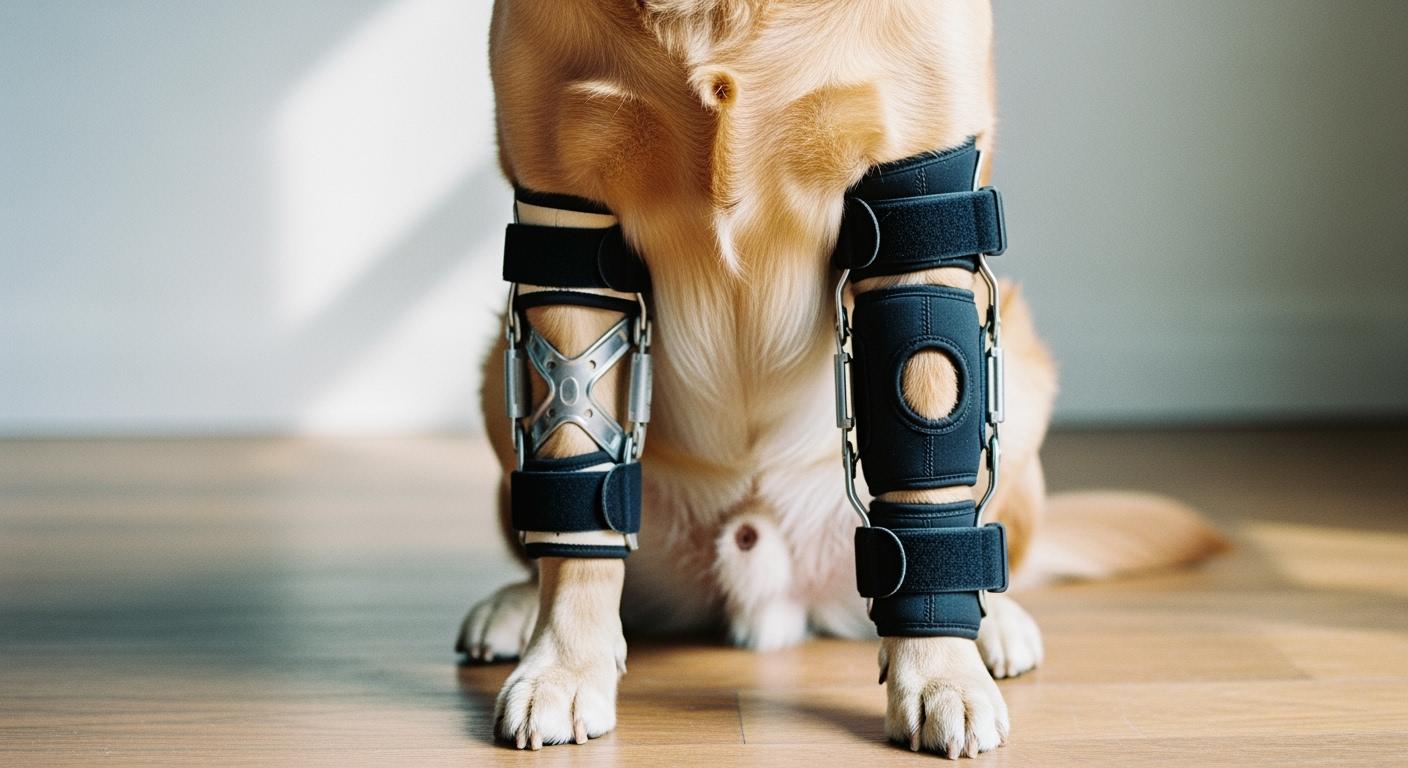
A dog takes a corner at a trot. The outer leg travels a longer arc. The inner leg cuts short. Two single knee braces — one on each leg — follow their own trajectory. Within three strides the shells have drifted apart. One sits half an inch above the kneecap. The other has rotated inward, its strap edge now pressing into the inner thigh.
That is the moment the load path breaks.
A dog double knee brace does not solve this by being tighter. It solves it by connecting both sides through a shared rear anchor — coupling the tension paths so that force on one leg transfers partially to the other, keeping both shells positioned over the joint axis. Two singles cannot do this. They were never designed to. The decision between single or double knee support turns on whether the load path bridges both legs or ends at each strap.
Two Braces, Zero Connection — Why the Load Path Matters
Each Shell Rotates on Its Own Axis
When a single knee brace wraps one leg, it creates a closed force loop: strap tension compresses the shell against soft tissue, tissue resistance pushes back, and the loop holds. That works for one knee in isolation. Add a second brace on the other leg, and you now have two independent force loops running in parallel — never intersecting, never sharing.
The problem fires the moment the dog does anything other than walk a straight line. During a turn, ground reaction force vectors point outward on the outer leg and inward on the inner leg. Each brace shell receives a different rotational moment. No mechanical bridge exists between them, so nothing resists the differential. The outer brace rotates laterally around the tibia. The inner brace drifts medially. Within ten minutes of mixed walking, both shells have migrated off the joint center.
Here is the full causal chain: asymmetrical ground reaction force → unequal rotational moment on each shell → strap tension differential between left and right sides → one strap set relaxes while the other tightens → relaxed side loses its friction lock against the skin → shell slides down the leg’s natural taper → joint center no longer aligns with the brace hinge axis → support becomes misdirected pressure on soft tissue.
Check this yourself: mark the top edge of each shell with a strip of tape. Walk the dog on flat ground for ten minutes. Add two slow turns and one sit-to-stand. If either tape mark has shifted more than half an inch, the load path has failed. That is not a fit issue. It is a structural ceiling — two independent loops cannot share what they were never connected to carry. This is why understanding how knee support solutions handle load transfer between legs matters before choosing a setup.
Where Straps Cross, Skin Pays the Price
Two single braces mean two sets of straps competing for the same anatomical space — the inner thigh, where the legs meet. On a medium-to-large dog, that gap is already narrow. Add four to six strap ends crossing through it, and you have friction surfaces rubbing against each other with every step.
The mechanical problem is specific: strap edges under tension act like dull blades on a curved surface. As the dog moves, inner-thigh skin compresses between overlapping strap layers. Moisture builds because airflow is blocked. Friction breaches the skin barrier within hours — not days. What starts as a pink crease becomes a raw patch, then an open sore. Short-coated dogs show this within a single long wear session. Double-coated breeds hide the damage until the skin surface is already compromised. By the time you see your dog licking the area, the barrier is broken.
After removing the brace, press a dry fingertip against the inner-thigh contact zone. If the skin feels tacky or warmer than the surrounding tissue, moisture has been trapped against the surface. A light crease should fade within three minutes. If it lingers longer, the strap configuration is not just uncomfortable — it is breaking the skin’s moisture barrier. Single versus double support is not about counting braces. It is about whether the strap architecture spares or abuses the inner thigh.
No Bridge Between Knees, No Balanced Support
A shared rear anchor changes the physics. Instead of two isolated force loops, you get one coupled system: rear anchor tension feeds into bilateral strap paths, which connect to the left shell and right shell, and ground reaction feedback flows back through both legs simultaneously. When the outer leg loads heavier during a turn, the anchor transmits a portion of that tension increase to the inner leg’s strap path, keeping the inner shell seated. When the dog shifts weight at a stand, the anchor distributes the positional adjustment across both sides instead of letting one brace slip.
Two single braces have no mechanism for this. Each anchor — typically a waist belt or thigh strap on the individual brace — manages tension only on its own side. There is no cross-body load sharing. The result is predictable: one knee carries more brace pressure than the other, and the under-supported side drifts. Over days of wear, the dog loads one leg differently, and the gait adapts around the asymmetry — trading one problem for another.
| Setup | What happens in real use | Why it fails | Better structure |
|---|---|---|---|
| Two separate single braces | Braces shift and overlap | No shared support path | Purpose-built dog double knee brace |
| Loose shared strap | Anchor slips and twists | Inconsistent tension | Shared rear anchor with independent tension |
| Fixed inner liner | Hard to clean, may cause rubbing | Poor hygiene | Removable washable contact layer |
What Drift Looks Like in Motion
A brace that shifts during a straight walk is underperforming. A brace that rotates during a turn redirects force into soft tissue that was never meant to bear it. The table below maps five common movements to their mechanical failure modes, but the underlying pattern is the same: independent shells respond to asymmetrical load by migrating in opposite directions.
| Movement | Failure signal | Mechanical cause | Design direction that helps |
|---|---|---|---|
| Turning | Brace rotates around leg | Single strap edge becomes fulcrum | Multi-point strap paths, wider padding |
| Squatting | Shell digs into rear knee | Straight edge presses into tissue | Contoured rear cutout, flexible edge |
| Stopping suddenly | Brace slides forward | Unbalanced strap tension | Anti-slip inner contact, shaped shell |
| Straight walking | Brace migrates down | Smooth lining, leg taper | Anti-slip surface, anatomical shell |
| Standing up | Brace shifts position | Poor leg-shape match | Movement-tested shell contour |
Rear Stance Narrows as Braces Diverge
When two single braces drift apart, the dog compensates. The rear legs come closer together — a narrowed stance that reduces the rotational moment on each brace shell but shifts weight distribution inward. Over weeks of daily wear, this compensatory stance loads the medial joint surfaces unevenly. What began as a bilateral knee stability question becomes a gait adaptation that stresses hips and hocks too.
Observe your dog from behind during a straight walk. The rear paws should track at roughly hip width. If the gap between the inner edges of the paws narrows noticeably after fifteen minutes of brace wear — compared to the first five minutes — the braces are driving a stance change. That narrowing is not the dog adapting to the braces. It is the dog reducing the forces that make the braces drift. And paying for it in joint loading elsewhere. Different knee brace types handle this differently — the distinction between a coupled system and two independent shells determines whether rear stance stays stable or narrows over a walk.
Not all knee braces prioritize fit quality over stiffness. A softer brace that stays where it is supposed to delivers more consistent support than a rigid shell that has migrated an inch down the leg.
The Four Things a Double Knee Brace Actually Needs
A Rear Anchor That Couples Both Support Paths
The rear anchor is not just a strap that goes behind the dog. It is the structural member that turns two separate braces into one system. Its job: maintain a consistent spatial relationship between the left and right attachment points regardless of leg position — standing, sitting, turning, climbing stairs.
A well-designed anchor uses a multi-point attachment spread across the rear harness area rather than a single narrow strap. The reason is straightforward mechanics. A single narrow strap under tension acts as a pivot, not a stabilizer. When one leg moves forward and the other back — as happens in every stride — a narrow strap rotates around its center point. That rotation pulls the left shell forward while pushing the right shell back. The exact opposite of what you need. A wider anchor platform with triangulated attachment points resists this rotational moment, keeping both shells centered over their respective joints through the full gait cycle.
Independent Tension for Independent Knees
Dogs rarely injure both knees symmetrically. One side may carry a partial CCL tear while the other shows mild patellar luxation. Or one knee tolerates compression well while the other develops skin sensitivity within an hour.
Independent left-right tension control means each knee gets its own strap tension setting without affecting the other side. This is not a convenience. It is a structural requirement for any dog with asymmetrical bilateral knee issues. Without it, you are forced to choose: over-tighten the sensitive side to match the injured side’s tension, or under-support the injured side to spare the sensitive one. Both choices fail. A contoured shell with anti-slip inner contact and anatomically shaped padding paired with independent tension paths avoids forcing this compromise.
Inner-Thigh Edges That Do Not Dig
The inner-thigh edge is where most braces make their presence known — painfully. A thick, square-cut edge presses into the soft tissue where the legs meet. A rolled or contoured edge with low-profile finishing distributes contact pressure across a larger surface area, reducing the per-square-inch load on the skin.
The difference runs deeper than comfort. A square edge under two pounds of strap tension can generate enough point pressure to slow capillary blood flow in superficial tissue. The skin goes pale under the edge, then flares red after removal, then breaks down into a raw patch over repeated wear cycles. A contoured edge spreads the same two pounds across roughly three times the contact area, keeping perfusion intact during normal wear duration. The edge profile is not a finishing detail. It is a load distribution decision.
Liners That Come Out and Get Washed
Fixed liners accumulate salt, skin oils, and bacteria. Within days, the contact surface becomes abrasive — not from mechanical wear but from crystallized sweat residue acting as microscopic grit against the skin with every step. A removable, washable liner breaks this cycle. Pull it out, wash it, dry it, reinsert it. The contact surface resets to clean fabric against clean skin.
When Two Knees Do Not Need One Brace
Not every dog with knee problems needs both sides braced. And not every dog with bilateral knee issues is a candidate for a double knee brace. Knowing the difference prevents adding a problem rather than solving one.
A single confirmed CCL tear on one knee with a structurally sound contralateral knee does not benefit from doubling up. The healthy leg needs its full range of motion to compensate during rehabilitation. Adding a brace to the uninjured side creates unnecessary resistance and can alter the gait in ways that interfere with the dog’s natural compensation pattern.
Severe hind-end weakness — the kind where a dog cannot rise from a down position without assistance — sits outside what any knee brace can address. These dogs need lift support: a harness with handles or a rear wheelchair. Applying a knee brace to a leg that cannot bear weight adds mass the dog must drag. It does not add function.
Then there are the stop signals. Skin that stays red more than five minutes after brace removal. Swelling above or below the shell edge. Heat radiating from the joint that was not present before wear. A dog that flinches when you reach for the brace. Any one of these means the current setup is causing more harm than benefit. Stop use. Reassess fit, wear duration, and whether bracing is still the appropriate tool for this stage of the dog’s condition.
Disclaimer: The fit checks and wear observations described here assume a short-coated dog where skin changes are visible on the surface. Double-coated breeds, dogs with heavy skin folds, and breeds with atypical leg conformation — particularly dogs with angular limb deformities or barrel chests that alter rear-leg spacing — may show subtler rub marks. For these dogs, rely on hand-checking: run your fingers along the inner thigh and behind the knee after each wear session, feeling for warmth, texture changes, or localized swelling rather than relying on visual inspection alone. If the dog’s leg conformation falls outside the breed norms this brace configuration was patterned for, the fit checks described here may not catch every pressure point.
Häufig gestellte Fragen
Can I just tighten two single braces more to stop the drift?
Tightening increases strap pressure but does not create a mechanical connection between the two braces. Each shell still rotates around its own axis. What you get is more skin pressure on both legs and the same drift — just with added friction damage at the contact surface.
Does a double knee brace work for a dog with one knee significantly worse than the other?
Yes — if it has independent left-right tension adjustment. The shared anchor maintains the structural coupling between sides while independent tension paths let you set different compression levels for each knee. Without independent adjustment, the tighter side dictates the overall fit and the looser side drifts regardless.
What is the single most reliable sign that a brace is not working?
Shell migration. If the brace shell is not centered over the kneecap at the end of a walk, the load path has shifted off the joint axis. Everything else — skin condition, gait quality, willingness to wear — follows from whether the brace stays where it is supposed to be during movement. Mark the shell position before each session and check it after.
How fast can a poorly fitted double knee brace cause skin breakdown?
On a short-coated dog wearing the brace during normal daily activity, moisture buildup under overlapping straps can begin compromising the skin barrier within two to three hours. A visible crease that does not fade within three minutes of brace removal is the earliest reliable sign. If the area feels tacky or warmer than surrounding skin, the surface is already stressed — adjust or pause wear before visible damage appears.
