
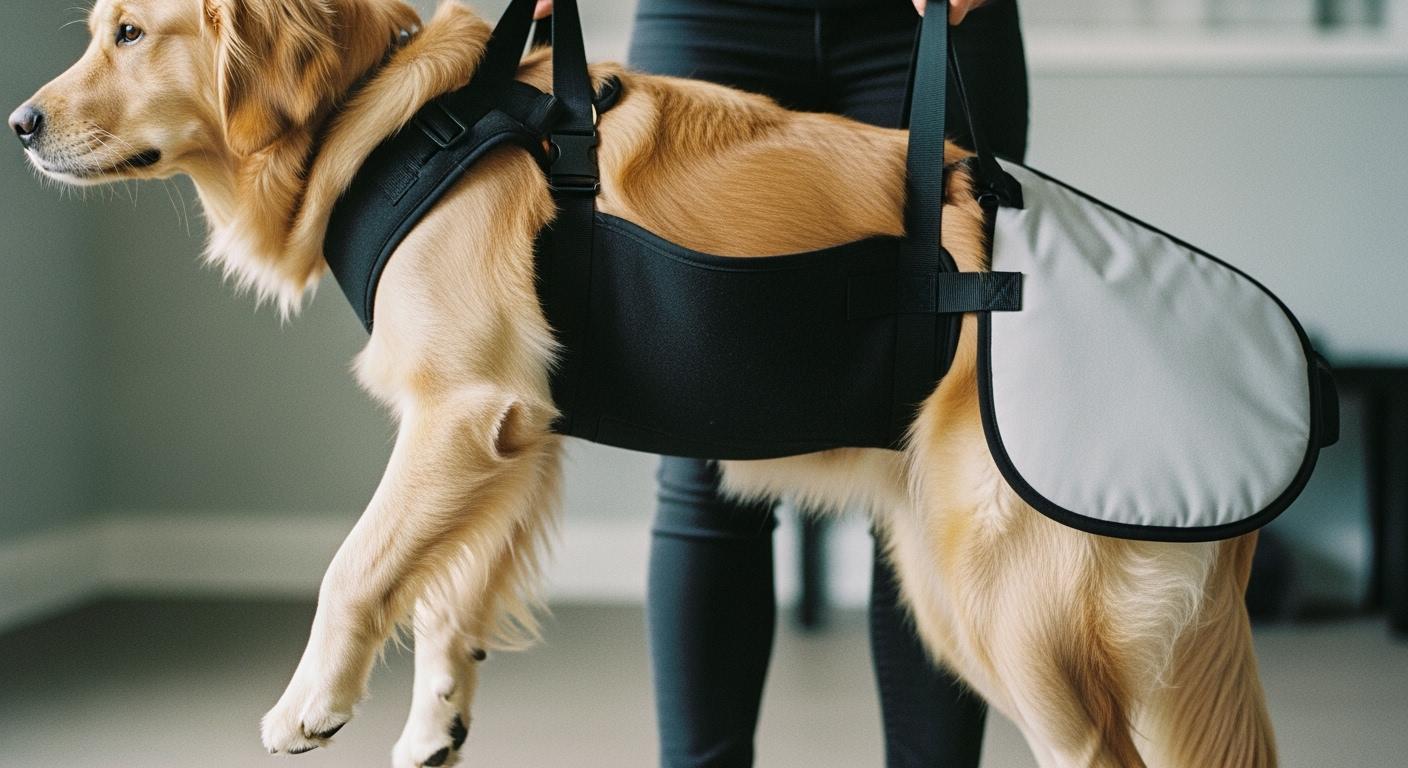
Ten seconds into a lift, the belly panel rolls inward. The dog stiffens. The handler pulls harder on the rear handle, which tilts the dog sideways. What looked like a secure fit at a standstill has already collapsed into a pressure line across the abdomen.
This is not a sizing mistake. It is a structural failure. And it repeats every time the harness is used, because the panel was never built to hold its shape under load.
A dog lift harness lives or dies by the belly panel. Not the handle. Not the strap count. Not the size label. The panel is the load-bearing surface that carries most of the dog’s weight during a lift. When it fails, everything above it — balanced handles, adjustable webbing, padded chest straps — becomes irrelevant. Understanding which design details make a belly panel hold steady, and which ones guarantee it will roll, fold, or drift, is what separates a usable harness from one that sits in a drawer after two attempts.
Where Belly Support Fails in a Dog Lift Harness
Most harnesses are photographed on a dog standing squarely on all four legs. That is the worst possible test. A belly panel under static load tells you nothing about what happens when the dog shifts weight onto the handler’s arm, twists to look back, or takes a staggered step on three legs. The failures worth understanding all happen in motion.
Sagging Is a Structural Failure, Not a Sizing Mistake
Sagging means the belly panel loses its horizontal plane and bows downward under load. The common reaction is to tighten every strap. That makes it worse.
Here is the causal chain that turns a narrow strap into a failure: when a strap that is maybe three-quarters of an inch wide runs under the belly and the handler lifts, all upward force routes through a contact patch no wider than the webbing. That concentrated load compresses soft abdominal tissue against the rib cage. Blood flow slows directly under the strap line. Within a minute or two, the dog feels a sharp, localized sting — not diffuse pressure, but a burning line. The dog tenses its abdomen in response. That reflexive tension tilts the panel surface. The strap, now riding on an angled plane, rolls inward toward its edge. The contact patch narrows further. Pressure per square inch spikes. The handler feels the shift and lifts harder to compensate. The cycle tightens.
A wide panel short-circuits this chain at step one. Force spreads across four to six inches of surface instead of three-quarters of an inch. Peak pressure under any single point stays low enough that the dog does not reflexively guard, and the panel stays flat.
After a 10-minute assisted walk, slide your fingers under the belly panel and trace the edge line. If the panel has shifted forward more than half an inch from where it started — the fur lying flat marks the original position — the anchor system is not holding, regardless of how tight the straps felt at the start.
| What you see | Why it happens | Design factor | Better structure |
|---|---|---|---|
| Belly strap rolls inward | Force concentrates into a thin line | Narrow webbing | Wider padded belly panel |
| Belly panel folds or bunches | Fabric stretches or has no rigid edge | Soft, unstructured panel | Semi-structured panel with bound edges |
| Harness slides toward ribs | Inner surface is smooth, anchors too far apart | No anti-slip, poor anchor geometry | Anti-slip lining, adjustable multi-point anchors |
| Dog tilts during lifting | Lift point is off-center relative to weight | Unbalanced handle placement | Centered handle over multi-zone belly support |
| Red line under panel edge | Pressure not spread evenly across width | Narrow or over-tightened strap | Wide panel with evenly distributed tension |
Why Soft Panels Collapse Under a Weight Shift
Soft padding alone feels generous in the hand. That feeling is misleading. A panel made entirely of compressible foam with no edge structure behaves like a pillow: it conforms to whatever shape presses into it, including a folded shape. When the dog’s weight shifts laterally during a turn, the panel edge on the unloaded side lifts. The loaded side compresses further. The panel loses its flat support plane and becomes a wedge — thicker on one edge, paper-thin on the other. Support is gone.
A semi-structured panel solves this with a bound edge that resists buckling. The binding — often a heavier-gauge fabric folded and stitched flat along the perimeter — acts as a tension ring. It keeps the panel from collapsing inward when lateral force hits one side. The foam inside can compress, but the perimeter holds its shape. That distinction — compressible core, non-collapsing perimeter — is what keeps the support surface flat through a turn, a stumble, or a diagonal lift onto a car seat.
The Design Details That Decide Whether Support Holds
Three structural features determine whether a belly panel stays put or migrates under load: panel width relative to the dog’s underline, edge rigidity, and the geometry of the anchor points that connect the panel to the rest of the harness. Get two right and one wrong, and the harness still fails — just at a different point in the movement.
Panel Width, Edge Binding, and Anti-Slip Lining
Width is the simplest lever and the most commonly undersized. A panel that covers only the narrowest part of the underline — roughly between the last rib and the start of the hind legs — leaves no margin for forward drift. A panel that extends a couple of inches beyond that zone in both directions buys room for movement without losing coverage.
Edge binding is less visible but more consequential. In production, a bound edge requires an additional sewing operation: a separate strip of fabric folded around the raw panel perimeter and topstitched through all layers. That stitch line creates a structural ring. When lateral force hits one side of the panel, the bound edge transfers tension around the perimeter rather than letting the panel lip curl under. Unbound panels — where the outer fabric is simply sewn right sides together and turned — lack this tension ring. They fold at the seam line, which is precisely where the force concentrates during a turn.
Anti-slip lining matters only after width and edge structure are correct. A silicone or rubberized inner surface on a panel that is too narrow simply grips the fur in the wrong location — it holds the panel steady while it pinches. But on a wide, edge-bound panel, the same lining resists the forward creep that happens during stairs and car transfers where the handler’s lift angle changes repeatedly. Lift your dog just enough to unweight the hind legs, hold for 30 seconds, then lower. Immediately check the belly panel’s inner surface. If it feels warm and damp while the outer shell is dry, the panel is trapping heat and moisture — even if it has not visibly shifted. That trapped moisture softens the skin over repeated sessions and makes friction damage more likely.
Why Adjustable Anchors Matter More Than Strap Tension
Anchors are the connection points where the belly panel attaches to the chest strap, the rear strap, or the handle assembly. Their position relative to the dog’s center of mass determines whether the panel pulls evenly or tilts under load. Fixed anchors — sewn at one predetermined point — assume a single body geometry. Most dogs do not match that geometry. A dog with a deeper chest and narrower waist needs the forward anchors set wider apart to keep the panel from pivoting toward the ribs. A dog with a straighter underline and heavier hindquarters needs the rear anchors positioned further back to prevent the panel from sliding forward into the groin.
Adjustable anchors let each connection point slide along a track or reposition across multiple attachment loops. This is not about making the harness tighter. It is about changing the vector of tension so that the lift force pulls straight upward through the panel’s center, rather than at an angle that introduces a rotational component. A harness with fixed anchors may feel snug at a standstill but rotate the panel the moment the handler lifts, because the pull vector is angled forward or backward relative to the dog’s actual center of gravity. The result is the same tilt-and-slide failure that a rear-only lift harness exhibits when the support zone drifts under angled load — the panel moves, pressure concentrates at one edge, and the dog compensates by stiffening.
Getting the anchor positions right also depends on understanding what the harness is meant to do versus what a simple support sling can handle for quick transfers. A sling concentrates force in a narrow band and works for momentary assistance. A harness with multi-point adjustable anchors distributes that same force across a much larger surface, which matters when the lift is sustained — going up a flight of stairs, navigating a ramp, or steadying a dog through a full walk.
When a Lift Harness Works and When It Does Not
A lift harness is designed to transfer a portion of the dog’s weight through the belly panel to the handler’s arm, reducing the load the hind legs must carry. It works best when the dog retains some hind-leg function — enough to bear partial weight, adjust footing, and contribute to forward motion. In that context, the harness fills the gap between what the dog can do and what the task demands.
It is the wrong tool when the dog has no hind-leg function at all. A fully paraplegic dog cannot adjust footing or shift weight to help the handler balance the lift. Every ounce of control comes from the handler’s arm, and even a well-structured belly panel becomes a dead-lift sling under those conditions. The panel may hold its shape, but the handler cannot stabilize a fully passive hind end through turns and transfers with a belly panel alone. A full-body support approach for hind-leg weakness often combines a belly panel with rear-leg components to distribute load across more contact points.
The harness also reaches its limits when the dog’s body shape falls far outside the geometry the panel was patterned for. Deep-chested breeds with very narrow waists — Greyhounds, Dobermans, some sight hounds — have an underline that tapers sharply behind the ribs. A panel designed for a more rectangular torso may sit at an angle on these dogs, with the forward edge pressing into the rib cage while the rear edge gaps away from the belly. The same problem appears in reverse on dogs carrying significant abdominal weight, where the panel rides on a convex rather than flat surface and tends to slide forward regardless of anchor adjustment.
Disclaimer: The fit checks described here assume a dog with a relatively straight underline and normal body condition. Dogs with very deep chests or tapered waists may show different pressure patterns — the forward edge of the panel can press into the rib cage while the rear edge gaps, and the standard finger-clearance test may read as adequate while still creating pressure behind the elbows. Hand-check the skin under both the forward and rear panel edges after every session. On dogs carrying excess abdominal weight, the panel rides on a convex surface that increases forward drift, so check panel position every five minutes during use rather than only at the start and end of a session.
For dogs with partial hind-leg weakness, a daily-use lift harness fit approach that prioritizes panel width and adjustable anchor geometry over strap count or handle style tends to hold up better across varied activities — standing from a bed, navigating a short stair, transferring into a vehicle. The same panel design principles apply, but the use pattern changes: a harness that works for a 30-second car transfer may not hold steady through a 10-minute assisted walk, because sustained motion exposes anchor drift and edge folding that a brief lift never triggers.
The structural choices built into a lift harness — panel dimensions, edge binding method, anchor adjustability, and lining material — determine whether it stays flat and centered through real movement or folds at the first lateral weight shift. A harness that passes the standstill test but fails the walking test is not a fit problem. It is a design problem, and tightening the straps will not fix it.
Häufig gestellte Fragen
How can I tell if the belly panel edge is digging in without visible red marks?
Run your fingertip along the skin directly under the panel edge immediately after removing the harness. If the skin feels cooler than surrounding areas, circulation was partially restricted. If the fur lies in a distinct crease that does not brush out within 30 seconds, the edge was pressing hard enough to compress the undercoat. Both signals appear before visible redness on most dogs.
What is the difference between a belly panel that folds and one that rolls?
A fold means the panel bends along a horizontal crease — the support surface essentially doubles over on itself, creating a lump under the dog. This happens when the panel lacks edge structure. A roll means the panel rotates around its long axis so the edge, rather than the flat surface, becomes the load-bearing contact point. This happens when the panel is too narrow and the force vector is not centered. Folding is a stiffness problem. Rolling is a width and anchor-alignment problem.
Can a lift harness replace rear-leg support during a full walk?
It depends on how much function the hind legs still have. If the dog can place its feet and bear at least partial weight, a well-structured harness can reduce the load enough for a short, controlled walk. If the hind legs buckle or knuckle under with every step, the belly panel alone cannot stabilize the rear — additional leg support or a different assistive approach may be needed. The harness is a load-reduction tool, not a replacement for lost motor control.
Why does the harness stay in place during a straight lift but slide during stairs?
Stairs change the lift angle. On flat ground, the handler lifts mostly vertically. On stairs, the handler pulls both upward and forward to help the dog clear each step. That forward component creates a diagonal force vector that acts on the belly panel at an angle. If the anchors are fixed rather than adjustable, the panel cannot reorient to stay square under the new force direction — it slides toward the point of least resistance, which is usually forward toward the ribs or backward toward the groin. Adjustable anchors let the panel stay aligned with the dog’s body even as the lift angle changes.
