
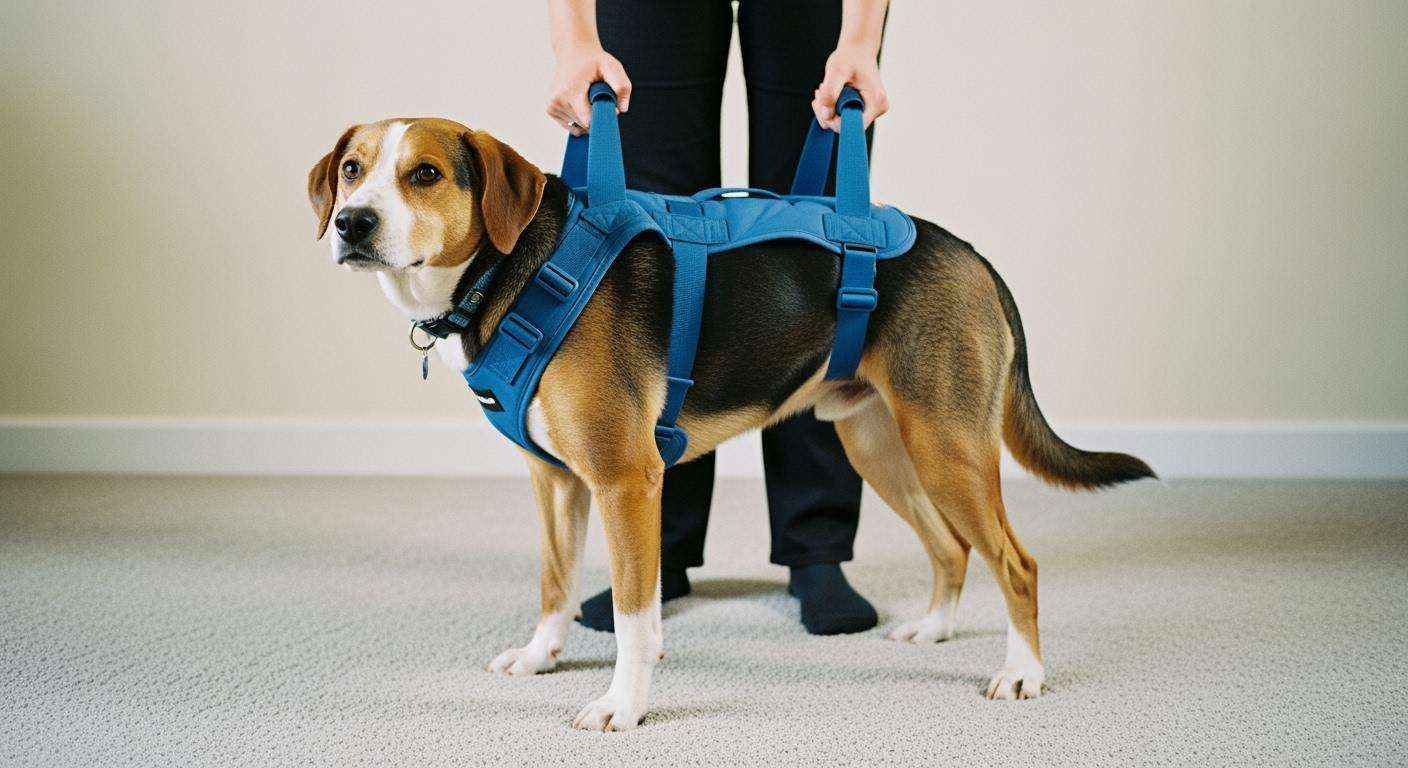
Dog lift harness full body front and rear balance means the harness supports the dog evenly from the chest through the abdomen and toward the rear support zone instead of lifting mostly from one end. This matters when the dog needs help with walking, stairs, standing, or car transfers and cannot stay stable with rear-only support. If you want a broader overview of sling types, fit logic, and daily mobility use before comparing full-body options, start with this dog support sling guide.
Quick check: a full-body lift harness should help the dog stay level, avoid twisting through the shoulders or hips, and make assisted movement feel more controlled instead of heavier or more awkward.
Das Wichtigste in Kürze
- A full-body lift harness is usually the better choice when the dog needs balanced help at both the front and rear instead of support from only one end.
- Good front and rear balance depends on fit, body coverage, handle position, and how evenly the harness distributes weight under light lift.
- If the harness twists, drifts, or creates pressure at one point, the balance is not working yet even if the size looks correct on paper.
Why Front and Rear Balance Matters
Comfort and Safety Impacts
You want the dog to feel steady, supported, and predictable during assisted movement. Balanced support helps reduce extra strain on the shoulders, hips, spine, and abdomen because the harness does not force one body section to do all the work. For dogs that need help with walking, stairs, or bathroom support because of weak hind legs, this dog lift harness solution for hind leg weakness is a useful companion page.
A good harness should:
Fit snugly without twisting or sliding.
Allow your dog’s legs to move freely.
Use soft straps to prevent irritation in sensitive areas like the armpits and groin.
Have padding and wide bands in the chest and belly to support weight.
A well-designed full-body harness should spread pressure across wider support panels instead of creating one narrow lift point. That makes daily handling calmer for the dog and easier for the handler, especially when support is needed more than once a day.
Risks of Uneven Support
If a harness does not balance weight from front to rear, problems usually appear during real movement rather than while the dog is standing still. Uneven support can lead to:
- Shoulder-heavy or hip-heavy lifting that changes the dog’s posture
- Twisting or drifting that makes the handler compensate during walking or stairs
- Pressure concentration at the chest, abdomen, or rear sling area
- Reduced confidence when the dog feels unstable during assisted movement
Studies show that harness design affects how dogs move. For example:
Study | Findings |
|---|---|
Lafuente et al. | Restrictive harnesses limit limb movement less than non-restrictive types. |
Weissenbacher et al. | Y-shaped harnesses improve movement in guide dogs compared to chest-strap harnesses. |
Galla et al. | Some harnesses restrict spine movement, which can change how a dog walks. |
You lower these risks by choosing a harness designed for both front and rear assistance rather than trying to make a rear-only layout do a full-body job. If you want to compare current options, start with the dog lift harness collection and then narrow down to full-body models.
Dog Lift Harness Full Body Front and Rear Balance: Key Features
What ‘Full Body’ Means for Buyers
When buyers look for a full-body lift harness, they usually need a design that supports more than one weak area at the same time. That may mean front and rear weakness together, broader balance loss, or a recovery stage where the dog cannot be helped safely with rear-only support. The difference is not just extra material. It is how the harness distributes load across multiple body zones.
Criteria | Description |
|---|---|
Secure Lifting Points | You get strong handles at both the front and rear for balanced lifting. |
Even Weight Distribution | The harness spreads your dog’s weight evenly, so no area feels too much pressure. |
Robust and Padded Materials | You find strong, padded materials that protect your dog during use. |
Ideal Conditions | You use this harness for dogs with overall weakness, arthritis, or neurological problems. |
A full-body harness usually works best for dogs that need balanced assistance through the front and rear during daily walks, stairs, car transfers, or slow rehab sessions. For a product-level example, review this lift harness for front and hind legs, which is built specifically around front-and-rear support.
Design Elements for Even Support
You should look for design features that keep your dog safe and comfortable. These features help you avoid pressure points and make lifting easier:
Multiple secure lifting handles for better control.
Wide, padded belly bands and chest straps.
Adjustable straps for a custom fit.
Ergonomic shape to match your dog’s body.
Breathable mesh or fleece padding for comfort.
The harness should distribute weight evenly and let you guide the dog without twisting, dragging, or over-lifting. If you want a specific full-body product reference while comparing designs, this Full Body Lift Harness is a useful example because it emphasizes even pressure across the chest and abdomen together with adjustable lift support.
Adjustability and Fit
Fit matters for both comfort and support. You should check these features before you buy:
Feature | Description |
|---|---|
Size Availability | Choose from several sizes to match your dog’s body. |
Adjustment Points | Look for harnesses with many adjustment spots for a snug fit. |
Mix & Match Option | Some harnesses let you pick different sizes for the front and rear. |
Special Consideration | Dogs with wide chests may need a larger front section. |
You want a harness that stays stable during walking, stairs, and car transfers without leaving gaps or creating pressure points. Fit should always be checked in motion, not just at rest. For broader fit and daily-use logic before choosing a full-body model, go back to the dog support sling guide.
Evaluating Balance and Fit
Measuring and Sizing
You need the right measurements because a full-body harness only works when the front and rear support zones sit where the design expects them to. Use a soft tape, record every number, and compare the dog’s shape to the size chart before assuming a standard size will work.
Get your tools ready. Use a soft tape for better results.
Measure your dog’s neck. Wrap the tape around the thickest part. Leave space for two fingers.
Measure your dog’s chest. Put the tape around the widest part. Make sure two fingers fit under the tape.
Measure your dog’s body length. Start at the neck base and go to the tail base.
Tip: Measure twice and record both sets of numbers. Full-body harnesses are more sensitive to sizing errors because the front and rear sections have to work together, not separately.
If you make mistakes with sizing, the harness may not work well. Look at the table below:
Sizing Error Type | Impact on Effectiveness |
|---|---|
Too tight | Makes it hard to move and breathe. It can hurt your dog. |
Too loose | Does not support your dog. Your dog could slip or fall. |
Always compare your measurements to the company’s chart and then confirm the fit on the dog. A two-finger check can help, but a full-body harness still has to be tested during movement to confirm front and rear balance.
Assessing Placement and Adjustments
Correct placement is what turns a full-body harness from a simple lifting tool into a balanced support system. The front section, rear section, and central lift zones all need to sit where the dog can still move naturally without the harness pulling one side harder than the other. Follow these steps:
Read the instructions from the company. Check how to put on your harness.
Put the harness on your dog. Slip it over the shoulders like a jacket.
Check and fix the straps. The sub-pelvic strap should sit under the butt.
Tighten the leg straps. You should fit two or three fingers under them.
Adjust the shoulder straps. They should go straight up and be the same length.
Buckle the chest strap. It should sit in the middle of the chest.
Check the D-ring. It should be between the shoulder blades.
Note: Make your first adjustments at the lower support points, then recheck the shoulder and chest zones. That usually makes front-and-rear balance easier to assess.
Observing Movement and Behavior
Watch the dog move after the harness is fitted. This is where front-and-rear balance becomes obvious. Look for these signs of good support:
Your dog walks normal. Shoulders move easily.
The harness sits behind the shoulders. It does not press on the neck or belly.
Your dog looks happy. If your dog licks lips, yawns, pants, hides, or nips, something is wrong.
No short steps, head tossing, or leaning. These can mean the harness is not right.
Your dog does not have stiff shoulders or high steps. If the back legs work too hard, the front may be too tight.
Tip: A well-balanced harness should make the dog look steadier, not more mechanical. If movement becomes shorter, stiffer, or more hesitant, reassess the fit before continuing daily use.
Consulting Professionals
Vets and rehab professionals are especially useful when the dog has changing mobility needs, weakness in more than one area, or a history of discomfort in wearable support. They can help you check whether the harness is truly balancing the front and rear rather than only feeling secure on the surface.
- They can help decide when a full-body harness is the better option than a simpler support layout.
- They can help identify whether the dog needs rear-only, full-body, or staged support.
- They can help confirm whether the harness is protecting movement instead of changing it.
If you still need a broader decision framework after this article, compare this page with the dog lift harness guide for stairs, walks, and hind-leg weakness so you can separate daily-use needs from full-body balance requirements.
Callout: If your dog has special needs, ask a vet or rehab expert. Their help keeps your dog safe and moving well.
Buyer’s Checklist for Harness Assessment
Measure neck, chest, and body length the right way.
Use the two-finger rule to check fit.
Adjust straps for comfort and even support.
Watch your dog’s moves and actions.
Ask a pro for help if your dog has special needs.
You can use this checklist to check harness balance. This helps you keep your dog safe and comfy.
Common Mistakes and Limitations
Signs of Poor Balance
You can see some signs if a harness does not balance well. These signs can make your dog feel bad or unsafe. Look for these things:
Sign of Improper Balance | Description |
|---|---|
Restrictive Straps | Straps on top of the biceps and supraspinatus tendons stop legs from moving right. |
Girth Strap Position | The strap should be about 2 inches behind the front legs so it does not press on the elbows. |
You might also notice chafing under the legs or around the chest. Sores and pain can show up after using the harness for a while. If the harness puts pressure in the wrong spots, your dog’s muscles and joints can get sore.
If your dog walks in a strange way or seems to hurt, the harness may not fit right. A harness that does not fit can change how your dog walks. Over time, this can cause injuries from doing the same wrong move again and again.
Handling Challenges
You can run into handling problems when the harness looks secure but the front and rear are still not working together. This often shows up on stairs, during car transfers, or when the dog shifts weight unexpectedly. If the harness drifts, twists, or makes the dog panic, the issue is usually balance or placement rather than handle strength alone.
Tip: Before using stairs or car support, do a short walking check first. If the harness is not balanced on flat ground, it will usually feel worse under harder tasks.
When to Consider Other Solutions
Sometimes a full-body lift harness is still not enough, especially when the dog has severe pain, rapid weakness changes, or a body shape that prevents stable fit. If the dog develops new sores, stronger gait changes, or obvious discomfort under balanced support, stop and reassess. A different support layout, a custom option, or a rehab plan may be more appropriate than forcing a standard harness to do more than it can.
Note: A harness can improve daily handling, but it should not replace diagnosis, rehab planning, or veterinary treatment when the dog’s condition is still changing.
You can help your dog by watching for these signs and problems. Checking the harness often helps you pick the best support for your dog’s comfort and safety.
You improve safety and comfort when you check front-and-rear balance before relying on a full-body harness for daily use. Focus on body coverage, handle placement, fit stability, and whether the dog stays level during real movement. For next steps, continue to the Mobility Support Tools Guide, compare use cases on the hind-leg weakness solution page, and then review current full-body and front-and-rear lift harness options. Data authenticity note: This article is for educational purposes only. It is designed to help readers assess front-and-rear balance in full-body lift harnesses, not to replace veterinary diagnosis or individualized mobility planning.
Häufig gestellte Fragen
How do you know if a harness provides balanced support?
Check whether the dog stays level from the shoulders through the hips during walking and light assisted movement. If the harness pulls more from one end, balance is not fully working yet.
Can you use a full body lift harness for all dog sizes?
Most full-body lift harnesses come in multiple sizes, but sizing alone does not confirm balance. Measure carefully, compare the chart, and then test the harness during movement before treating it as ready for daily support.
What should you do if your dog seems uncomfortable in the harness?
Stop and reassess the fit, especially at the chest, abdomen, and rear support points. If pressure, twisting, or discomfort continues after adjustment, consult your veterinarian or rehab professional before continuing full-body lifting.
How often should you check the fit of the harness?
Check the fit every time you use it. Weight change, coat thickness, recovery stage, and support intensity can all change how well front-and-rear balance holds from day to day.
