
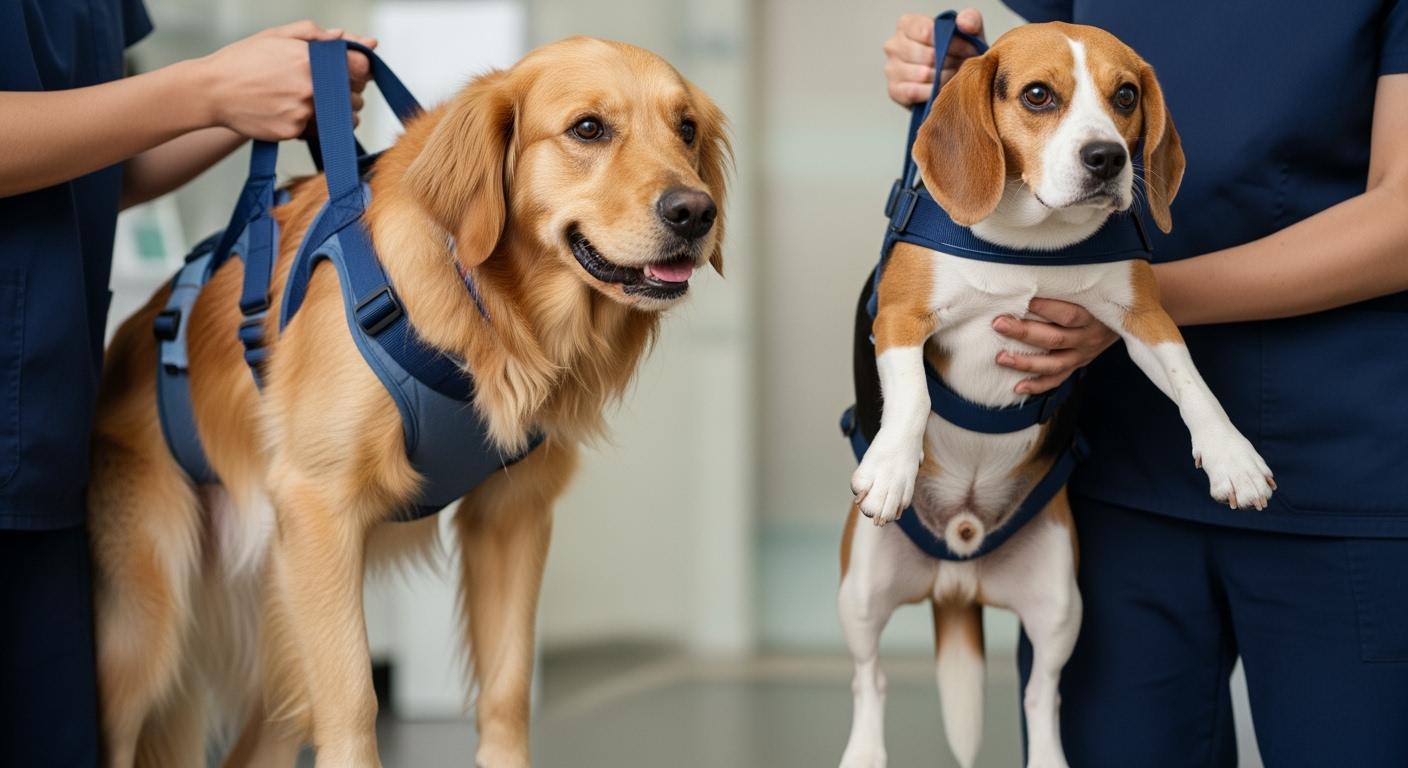
You lift your dog from under the belly. The rear drops. The front tips forward. You pull harder, but your dog still arches, freezes, or fights the lift. The problem is not your strength. It is where the load enters the body. A belly sling pours all the lift force into soft abdominal tissue. The dog’s center of mass sits forward of the lift point, so gravity keeps pulling the hindquarters down while the chest pitches ahead. That rotational imbalance is not something you can muscle through. It is built into the design.
Full-body support addresses this at the structural level. But not all full-body harnesses succeed. A dog lift harness full body support fails when the chest and rear zones are not truly independent, when handle placement drifts off the dog’s center of control, or when narrow panels concentrate force instead of spreading it. Understanding where these designs break is what makes the difference between a dog that moves willingly and one that braces against the lift.
Why Belly-Only Lifting Fails in Real Use
The biomechanics of a single lift point
When a single lift point sits under the abdomen, the dog’s body becomes a two-ended lever with the fulcrum at the sling. The head and shoulders rotate forward. The hips and rear legs rotate backward. This is not a matter of the dog resisting. It is a matter of physics: the combined center of mass of the front and rear body segments lies somewhere between the shoulders and hips, and a belly-only lift misses that point by several inches.
The dog compensates by arching the spine. That arching stiffens the back and can make breathing shallow. Narrow straps compound the problem. A 1-inch strap under an 80-pound dog concentrates that 80 pounds into a contact patch the size of two fingers. The pressure per square inch spikes. The dog feels a sharp, localized force that triggers a withdrawal reflex — freeze, flinch, or fight.
Note: After lifting with any belly-only support, slide your hand under the strap contact area. Warm, damp skin or a visible red line that does not fade within five minutes signals pressure concentration that exceeds what the tissue can tolerate comfortably.
Front-end tipping and rear sag as matched failures
Front tipping and rear sag are not separate problems. They are the two halves of one rotational failure. As the rear drops, the handler instinctively pulls harder and higher. That extra upward force on the front edge of the sling drives the chest strap into the dog’s throat or armpit. The dog tips its head back to relieve throat pressure. The spine straightens into extension. The hind legs lose what little support they had.
That fails fast. The handler feels the dog go rigid. The lift becomes a wrestling match. Neither the handler nor the dog trusts the equipment anymore.
Some dogs with long backs and deep chests — Dobermans, Great Danes, even long-backed Dachshunds — amplify this rotation because their center of mass is further from the lift point. Full-body harness designs for large, deep-chested dogs must account for this extended lever arm, or the same rotational failure reappears despite additional fabric coverage.
Standing fit looks correct. Movement reveals the failure.
You fit the harness. The dog stands still. The straps sit flush. Everything looks right. Then the dog takes three steps and the rear panel shifts a quarter-inch. Another step and that quarter-inch becomes half an inch. The handle that was centered over the hips is now dragging the panel toward the ribcage. The dog’s movement itself peels the support out of position.
Static fit checks only verify geometry at rest. Movement adds dynamic loads: lateral sway, acceleration, deceleration, squatting. Each of these changes the shape of the dog’s body under the harness. Straps that were snug at rest can go slack over the shoulders during a squat. Panels that sat flat on a standing ribcage can gap when the dog turns. The standing fit is the starting point, not the validation.
Tip: After walking the dog 10 minutes in the harness, mark strap positions with a small piece of tape. Check whether any strap edge has migrated more than half an inch from its original position. Half an inch of drift under load predicts full support loss within a longer walk.
Structure Details That Make Full-Body Support Work or Fail
The difference between a harness that holds and one that drifts comes down to a handful of structural decisions. Not all of them are visible in a product photo. Some reveal themselves only after repeated use, when materials have been through sweat, rain, and wash cycles.
Wide padded panels versus narrow belly straps
A narrow strap applies force to a narrow strip of tissue. The pressure per square inch is high. A wide padded panel spreads the same lift force across a contact area three or four times larger. The pressure at any single point drops proportionally. The dog feels distributed contact instead of a concentrated edge. That changes the behavioral response entirely — distributed pressure does not trigger the same withdrawal reflex that a narrow edge does.
Padding material also matters after the first wash. Open-cell foam absorbs water and collapses. Closed-cell foam resists compression but can trap heat. Fleece linings feel soft when new but mat down under friction, especially in the armpit and groin where movement is highest. A material that performs well on a showroom table may degrade within weeks of daily use — and that degradation is rarely visible from the outside of the panel.
Separate front and rear support zones with independent adjustment
Dogs are not rectangular. The chest circumference, ribcage depth, and pelvic width vary independently. A harness with a single adjustment point forces a compromise: tighten for the chest and the rear panel gaps, tighten for the rear and the chest panel restricts breathing. Independent front and rear adjustment points solve this. Front and rear balance in a full-body lift harness depends on each zone being able to match the dog’s actual proportions, not an averaged shape.
The structural reason is straightforward: when the chest panel fits correctly, it stabilizes the shoulder girdle without restricting the forelimbs. When the rear panel fits correctly, it cups the pelvis without riding forward into the groin. Two separate fits. Two separate failure modes. If either zone is wrong, the lift becomes unbalanced and the handler compensates — usually by pulling harder, which accelerates strap migration.
| Support Design | Where It Helps | Where It Fails | Better Structure |
|---|---|---|---|
| Belly-only sling | Quick one-person lift | Abdominal pressure, rear sag, front tipping, dog freezes | Separate chest and rear panels, handles over center of mass |
| Rear-only harness | Hind-leg weakness during transfers | No front support, chest dips, dog pitches forward | Full-body with front chest yoke |
| Full-body with single adjustment | Some weight distribution | Cannot fit chest and rear independently, one zone always loose | Independent front and rear adjustment points |
| Full-body with separate zones and narrow straps | Balanced lift geometry | Edge pressure, strap rolling, skin marks within minutes | Wide padded panels replacing narrow straps |
| Full-body with wide padded panels and independent zones | Balanced, distributed lift with minimal drift | May still lack breathability or potty clearance | Moisture-wicking lining, clear groin-edge cut, washable material |
Handle placement relative to the dog’s center of control
Handle position determines whether the lift vector passes through or misses the dog’s combined center of mass. Handles placed over the belly create the same rotational failure as a belly sling, only with more fabric involved. Handles placed too far forward lift the chest and let the rear sag. Handles placed too far back lift the hips and let the front tip.
The correct handle position sits above the dog’s mid-body, with one handle near the shoulder girdle and one near the pelvis. Two handles allow the handler to micro-adjust the lift angle. If the rear starts to sag, a slight increase in lift on the rear handle levels the dog without jerking. If the front dips, the front handle takes more load. That real-time adjustment is impossible with a single center handle — you get whatever angle the handle position dictates, and if it is wrong, you cannot fix it mid-stride.
A rear-only lift compared against full-body support shows this tradeoff clearly: the rear lift handles only one end of the dog, making it effective for hind-leg-specific weakness but creating an inherent front-end instability that the handler must manage separately.
Breathability, moisture, and skin tolerance over time
A harness panel that blocks airflow turns the covered area into a microclimate. Body heat builds. Sweat accumulates. The skin softens. Softened skin under friction is significantly more vulnerable to irritation and abrasion than dry skin. This is why a harness that feels comfortable during the first five minutes can leave red, irritated skin after a thirty-minute walk.
Moisture-wicking lining pulls sweat away from the skin into a layer where it can evaporate. Mesh panels allow airflow through the harness body itself. But these materials have a shelf life. Wicking treatments can degrade with washing. Mesh can pill and lose open surface area. The product that breathes well on day one may not breathe the same way on day sixty.
Note: After removing the harness, press the back of your hand against the dog’s chest where the panel sat. If the skin feels warmer than surrounding areas or leaves a damp imprint on your hand, the panel is trapping too much heat and moisture for the conditions.
Potty clearance and groin-edge design
A harness that blocks the groin area creates a hygiene problem that is also a fit problem. If the dog cannot squat without the rear panel shifting or soiling, the handler has two bad choices: remove the harness for every bathroom break — impractical on a walk — or let the panel get soiled and continue. Wet, soiled fabric against the skin accelerates irritation and odor retention.
Clear potty clearance is not just about leaving a gap. It is about where the rear panel edge terminates relative to the dog’s anatomy. Too far forward and it restricts rear leg movement. Too far back and it rides into the groin during a squat. The right termination point sits behind the last rib and ahead of the pelvic crest, clearing the entire groin area while still cupping the rear for lift support. Daily-use fit guidance for full-body lift harnesses emphasizes that panel edge placement relative to the groin is one of the most commonly overlooked fit checks — and one of the fastest to cause the dog to refuse the harness.
| Status | What You See | What To Do |
|---|---|---|
| Pass | Dog stands with light handler support, harness stays level through walking and turning, no strap migration or skin marks after 10 minutes | Proceed with planned walk duration; recheck fit weekly |
| Check | Mild rear sag after several steps, strap edges shifted but less than half an inch, slight dampness under panels, dog hesitates at turns | Readjust panels, shorten walk, monitor closely for escalation |
| Stop | Dog collapses, vocalizes, pants excessively, shows belly compression, groin rubbing with broken skin, cold paws, breathing difficulty, sudden loss of balance | Remove harness immediately, contact a veterinarian before any further use |
When a Full-Body Lift Harness Is the Wrong Tool
A full-body support harness works within a specific envelope. Outside that envelope, the harness can mask problems that need veterinary attention, or it can fail in ways the handler cannot manage. Knowing the boundary is part of using the product correctly.
Red flags that need veterinary assessment first
Some signs are not fit problems. They are medical signals. A dog that suddenly cannot bear weight on a limb, that vocalizes at the lightest touch, that has cold paws or blue-tinged gums, or that collapses when lifted even briefly — these are not situations where adjusting strap tension helps. They require a veterinarian’s evaluation before any support equipment is used.
Similarly, a dog with progressive weakness that worsens week over week may have an underlying condition that a harness cannot address. The harness can assist with mobility, but it cannot halt disease progression. Using a harness without understanding what is driving the weakness risks delaying necessary treatment.
Disclaimer: The fit checks and observations described here assume a dog with typical body proportions for its breed. Dogs with angular limb deformities, very deep or very shallow chests, pronounced spinal curvature, or significant muscle atrophy may distribute load differently under the panels. In these cases, the standard fit signals — strap position, skin marks, panel drift — may not reliably catch every pressure point. Hand-checking along panel edges after each use is necessary; visual inspection alone may miss pressure concentrations under a thick or double coat.
When a rear sling, ramp, cart, or stretcher fits the need better
A full-body lift harness gives the handler vertical control — lifting, supporting, stabilizing during walking. But some situations call for different tools. A rear-only sling works when the front legs are strong and only the hind end needs assistance — stair climbs, car transfers, brief rear support. A ramp eliminates the need for vertical lifting altogether. A wheeled cart supports dogs with paralysis or severe weakness who cannot bear weight on any limb. A stretcher is for emergencies where the dog must remain flat and immobile.
The full-body harness is one option in a spectrum of lift harness solutions for dogs with hind-leg weakness. Matching the tool to the specific mobility deficit matters more than having the most capable tool available.
How to test before relying on the harness daily
Before the harness becomes part of the daily routine, run a simple indoor test session that checks for the failure modes described above. Fit the harness while the dog stands on a non-slip surface. Check strap clearance at the chest and rear — snug enough that two fingers slide under with light resistance, but not so loose that the panel can rotate. Lift the dog just enough to take about a third of the body weight off the legs. Hold for 30 seconds. Watch for rear sag, front dip, or the dog stiffening.
If stable, walk five steps and stop. Check strap positions against your tape marks. Walk five steps in the other direction. Recheck. Turn a tight circle. Recheck. This sequence exposes migration that a straight-line walk does not. If straps hold position through all three patterns — static hold, straight walk, tight turn — the fit is likely sound for longer use. Full-body lift harness product designs vary in how they handle these dynamic loads; the test sequence above works across designs because it checks outcomes, not features.
Häufig gestellte Fragen
Why does a full-body harness work differently than a belly sling?
A belly sling has one lift point under the abdomen. A full-body harness uses two independent support zones — chest and rear — with handles positioned near the dog’s center of mass. The dual-zone design prevents the rotational imbalance that causes rear sag and front tipping in a belly-only lift. The critical structural difference is that the lift force is split across two contact areas rather than concentrated on one.
How quickly can strap migration become a problem during a walk?
Migration can begin within the first dozen steps. It accelerates once the initial shift breaks the panel’s static friction against the coat. A strap that moves a quarter-inch in the first minute can drift more than an inch by the end of a ten-minute walk. Checking strap position at multiple intervals — not just at the start — catches migration before the panel loses its support geometry entirely.
Does a full-body harness restrict the dog’s natural movement?
A correctly fitted full-body harness with independent front and rear zones should allow the dog to walk, turn, and squat without restriction. The test is simple: watch the dog’s shoulder extension during a normal stride. If the foreleg reaches forward without the chest panel bunching or the dog shortening its stride, the front zone fit is correct. If the dog can squat for elimination without the rear panel riding forward or the dog hesitating, the rear zone fit is correct.
What is the most overlooked fit variable?
Panel edge termination relative to the groin and armpit. These are the highest-movement zones on the dog’s body. An edge that sits half an inch into the armpit or groin will cause irritation within minutes, even if every other fit check passes. Run a finger along the panel edge after the dog takes several strides — if the edge has migrated into a joint crease, the panel position needs adjustment regardless of how the static fit looked.
