
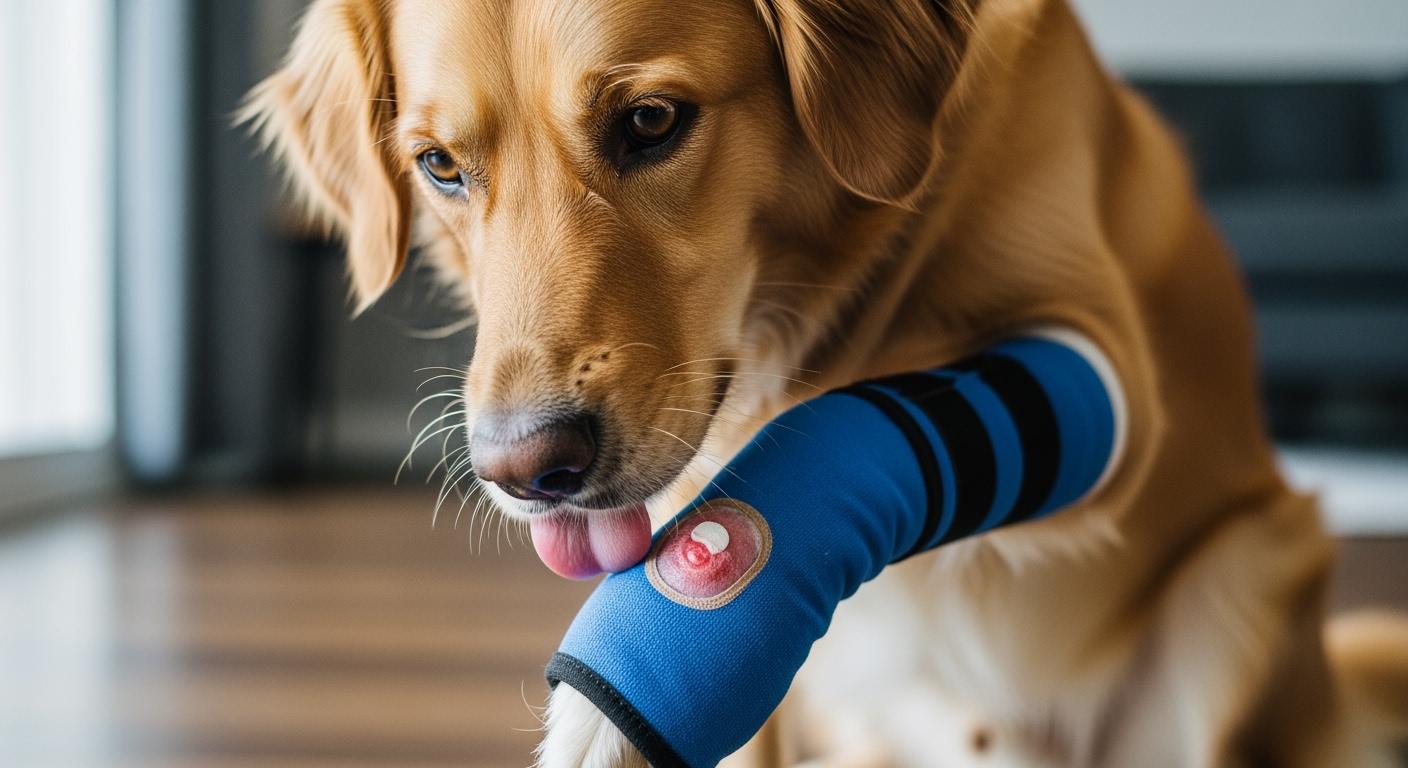
A lick sleeve looks like it covers the wound. Standing still, the fabric stays smooth, the edges sit well away from the incision, and everything checks out. Then the dog sits. The cuff edge drifts half an inch closer to the wound. The dog curls, and the fabric bunches at the knee. By the time the dog turns around to settle, there is a gap wide enough for a tongue.
That is the real test. Not the standing photo. Not the initial fitting. The test is what happens after ten minutes of normal movement when nobody is watching.
Most sleeves that fail do not look wrong. They look fine. The problem is where the coverage stops and what the anchor does when the dog is not standing still. Two structural decisions determine whether a lick sleeve blocks licking or just delays it: how far past the wound the cuff extends, and whether the upper anchor holds position when the leg bends.
Why a Sleeve That Looks Right Still Lets a Dog Lick the Wound
The failure follows a predictable sequence. A short single-leg sleeve slides onto the leg. The owner checks the fit standing up — the wound is covered, the fabric is snug, nothing looks wrong. The dog walks around, lies down, curls into a sleeping position. The cuff edge, which cleared the wound by two inches standing, now sits less than half an inch from it. The upper band rotated slightly during the sit-to-stand motion. The dog notices the gap, bends its neck, and licks.
This is not a fit problem in the sense most people mean. Tightening the straps does not fix it. The failure is geometric: the sleeve is not anchored to a fixed point, so its position relative to the wound changes with every joint angle. A sleeve that depends entirely on circumferential tension to stay in place will shift. The fabric-to-skin friction that holds it in a standing position is not enough to resist the shear force created when a hip flexes or a knee bends.
That is the causal chain: leg flexion → skin surface lengthens along the extensor side → sleeve fabric, if only held by circumferential tension, cannot maintain registration with the underlying anatomy → cuff edge migrates toward the joint → wound exposed.
In practice: Check the sleeve position after the dog has moved through a full sit-stand-curl cycle, not during the initial fitting. Mark the cuff edge position with a small piece of tape on the fur. If that mark has drifted more than half an inch after ten minutes of normal movement, the anchor is not stable enough for unsupervised use.
Edge gaps open under the cuff, not through the fabric
Dogs do not lick through the sleeve material. They lick past the edge. When a dog sits, the skin on the front of the thigh stretches, and the cuff edge — if it has no mechanical stop — slides backward. The same happens at the top cuff when a dog curls: the shoulder flexes, the skin shifts, and the upper edge drops. A dog needs less than a quarter-inch gap to get a tongue through.
| Product structure | Best-fit problem | Common failure | Better use boundary |
|---|---|---|---|
| Short single-leg sleeve | Small wound on a single leg, far from joints | Cuff edge migrates toward wound when dog sits; easy reach-around at top and bottom openings | Do not use for wounds within 2 inches of a moving joint or on dogs that curl tightly when sleeping |
| Longer single-leg sleeve | Larger wound needing extended coverage | Upper band rotates during leg flexion; fabric bunches behind the knee, creating a tongue-sized fold gap | Use only when the wound is away from the knee and elbow; test for bunching after 15 minutes of movement |
| Four-leg or body-connected sleeve | Multi-spot licking across legs | Gaps at joint openings if the connecting panels lack elastic tension; dog switches targets to the gap site | Use for dogs that change lick targets; verify each leg opening stays closed during full range of motion |
| Full recovery suit | Widespread wound areas or post-surgical torso coverage | Poor fit at breed-specific body shapes; excess fabric creates chewable folds | Use only when leg-only sleeves cannot cover the wound zone; test fit in curled sleeping position |
Tighter straps are not a fix for the wrong coverage zone
Tightening a strap increases circumferential pressure. That is all it does. It does not change where the cuff edge sits relative to the wound. It does not prevent rotation. On a short sleeve, a tighter upper band can actually make migration worse — the increased compression creates a pivot point that the rest of the sleeve rotates around when the dog moves.
For dogs with deep chests or angular hind-limb conformation, the standard sleeve pattern may simply not match the leg geometry. No amount of strap tension corrects a pattern mismatch. The sleeve either extends far enough past the wound in every position, or it does not. If it does not, tightening anything will not close the gap the dog’s tongue finds.
Disclaimer: This fit logic assumes a dog with standard leg conformation matching the sleeve pattern. Dogs with angular limb deformities, very deep chests, or breeds with heavily muscled thighs may experience edge migration even on well-designed longer sleeves. For these dogs, the half-inch drift check described above may not catch every pressure point — hand-check under the cuff after movement is the more reliable verification method.
| Signal | What it means | Next action |
|---|---|---|
| Green — sleeve centered, skin dry under fabric, dog ignores the covered area | Coverage zone and anchor hold through the dog’s full range of motion; barrier is intact | Continue use; monitor twice daily at a minimum |
| Yellow — cuff drifted under 1 inch, light skin indentation, dog shows increased sniffing or nosing at the sleeve | Anchor is beginning to lose registration; edge may be approaching the wound | Re-seat the sleeve, check skin under the cuff, supervise the next hour closely |
| Red — dog reaches the wound with tongue or teeth, fabric is wet, skin under the sleeve is damp or red, wound appearance changes | Sleeve has failed as a barrier at the current coverage zone and anchor configuration | Remove the sleeve; contact your veterinarian before reapplying any barrier |
Where Reach-Around Licking Starts and What Structural Choices Change
A dog’s reach path is not a straight line. The neck bends laterally, the spine twists, and the tongue extends well past what the muzzle-to-wound distance suggests. Dogs that seem fully covered standing up can often reach a wound on the inside of the thigh by curling into a tight ball — their muzzle comes at the target from an angle the sleeve was never designed to defend.
The cuff edge is the weak point because it is the only boundary between covered and uncovered skin. Every millimeter the cuff sits closer to the wound is a millimeter less the dog has to stretch. Sleeves designed for hind-leg wounds need more distal coverage than front-leg versions because the hind leg folds tight against the body when a dog curls — the muzzle’s access path is shorter. This is a geometric fact, not a sizing preference.
Cuff proximity to the wound defines the margin of error
When the cuff edge sits directly adjacent to the wound edge, the dog only needs to push the fabric a fraction of an inch to make tongue contact. This is most visible with short single-leg sleeves applied to wounds near the knee or hock. The sleeve covers the wound standing, but the first time the dog sits and the knee flexes, the cuff rides up half an inch, and the wound is exposed at the lower border.
The fix is not a different brand. It is a different coverage length — specifically, a cuff position that keeps at least an inch and a half of fabric between the wound edge and the sleeve opening in the dog’s tightest curled position. Measure that, not the standing length.
Note: Find the wound edge. Mark the sleeve cuff position while the dog stands. Then have the dog lie down and curl. Measure the shift. If it exceeds the distance from the cuff to the wound, the sleeve cannot protect that wound unsupervised.
Sleeve rolling turns coverage into a folded access point
Rolling is different from shifting. Shifting is the whole sleeve moving. Rolling is the cuff edge folding under itself. A rolled edge creates a double fabric thickness at the border — which sounds like more protection — but the fold itself opens a channel. The dog’s tongue finds the crease, pushes into it, and the rolled fabric acts like a ramp guiding the tongue toward the skin underneath.
Anti-roll edges are not cosmetic. A stitched border with a slightly stiffer material or a silicone grip strip changes the failure mode from “roll then gap” to “hold or slide entirely.” The edge either stays flat or the whole sleeve moves — and a whole-sleeve shift is more likely to be noticed and corrected before the dog exploits it. Front-leg sleeves are particularly prone to rolling at the upper cuff because the shoulder’s range of motion pulls the fabric in multiple directions during a single stride.
Joint openings that do not close under tension
Every sleeve has openings — at the top, at the bottom, and in multi-leg designs, at the connections between panels. A dog does not need to defeat the fabric. It just needs one opening that does not close completely when the joint is at maximum flexion. The space behind the knee, the gap at the inner elbow, the looseness at the ankle — these are not defects. They are inherent to sleeving a jointed limb. The question is whether the sleeve’s elastic tension and panel geometry keep those openings closed across the dog’s actual range of motion, not just in a standing pose.
For dogs that switch lick targets — starting at a knee incision, then moving to a paw, then the inner thigh — a single-leg sleeve covering only one limb leaves every other site open. The dog simply changes targets. A multi-leg coverage solution or body-connected design blocks that behavior not by being more restrictive, but by removing the accessible gaps the dog navigates toward.
Structures That Hold the Edge Where It Needs to Stay
Coverage that extends past the wound, not just to it
Covering the wound is not the same as covering past the wound. A sleeve that ends at the wound edge will fail. The dog does not need to reach the wound itself — it just needs to reach the fabric edge and push. Once the tongue gets under the cuff, the wound is accessible.
Effective sleeve coverage means the cuff sits far enough past the wound that even at maximum joint flexion — the dog curled into its tightest sleeping position — the edge has not migrated close enough for the tongue to make contact. This distance is different for every wound location and every dog’s flexibility. The validation is not a measurement. It is a reach test: after twenty minutes of free movement, can the dog touch the wound with its tongue? If yes, the coverage zone is too short for that wound on that dog. Period.
You can verify this without waiting for a failure. Flip back the inner lining after twenty minutes of normal movement — if the fabric inside the cuff is dry and the wound is untouched, the coverage held. If the inner cuff is damp or the wound edges look disturbed, the tongue found a way through.
Anchors that lock to anatomy, not just circumference
A sleeve held on only by elastic tension around the leg is floating. It has no fixed reference point. Every muscle contraction and joint angle change moves the skin under it, and the sleeve follows or resists depending on friction alone.
An anchor that locks to a fixed bony landmark — the shoulder, the iliac crest, a body harness connection — changes the mechanical equation. The anchor point stays stationary relative to the skeleton. The sleeve can stretch and flex along the limb, but its attachment point does not migrate. A wide padded band at the shoulder distributes retention force across a larger surface area, which keeps tissue pressure low enough for all-day wear while resisting the rotational force that makes narrower bands roll.
The difference in production is real. A shoulder-anchored sleeve requires more panel pieces, more seams, and a pattern that accounts for the dog’s shoulder angle — which varies across breeds. A simple tube sleeve with an elastic top band requires one pattern piece and one seam. The former is harder to manufacture consistently, but it is the geometry, not the stitch count, that determines whether the sleeve stays registered to the wound.
Breathable fabric that does not become the next problem
A sleeve that blocks licking but traps moisture under the fabric trades one wound risk for another. Damp skin under an occlusive sleeve macerates. The skin barrier breaks down. Bacteria that were harmless on dry skin multiply in the wet environment. The wound that was protected from licking is now at risk from the sleeve itself.
Breathable sleeve materials allow moisture vapor to pass through the fabric while blocking liquid from the outside. The test is simple: after the dog has worn the sleeve for an hour, slide a finger under the fabric. The skin should feel dry, or at most slightly warm — not damp, not clammy. If moisture is present, the fabric is not moving vapor fast enough for that dog’s activity level and ambient temperature.
| Feature | Why it matters |
|---|---|
| Breathable knit or mesh panel | Allows moisture vapor to escape; wet skin under a sleeve breaks down within hours and creates a secondary infection risk |
| Washable, quick-dry construction | Bacteria and wound exudate accumulate in fabric within a day; a sleeve that cannot be washed and dried between uses becomes a contamination source |
| Soft inner lining without exposed seam ridges | Seam ridges pressed against skin under elastic tension create pressure points that turn into rub sores within a few hours of wear |
Rotating two sleeves — one worn, one washed and drying — is the minimum for daily use. A single sleeve worn continuously without washing accumulates enough bacteria within 24 to 48 hours that the skin under it is at measurably higher risk. Washing and drying routines are not separate from the product’s effectiveness. A sleeve that protects the wound from the dog but damages the skin underneath is a partial failure.
When a Lick Sleeve Is Not Enough
A sleeve is a physical barrier. It works when the barrier geometry matches the dog’s reach path. It fails when the two do not align. Recognizing failure early prevents the wound from degrading under a sleeve that looks like it is working.
Chewing the sleeve itself
A dog that chews the sleeve has identified it as the obstacle between its mouth and the wound. This is not anxiety or boredom. It is goal-directed behavior. The sleeve material is being treated as a chew toy standing between the dog and the itch, pain, or drainage it wants to address. Once chewing starts, the sleeve will be perforated — the only question is when.
If the sleeve fabric shows tooth marks, it has failed as a barrier regardless of whether the wound is still covered. A perforated sleeve lets saliva through. Saliva on a surgical incision or open wound introduces bacteria and moisture. The sleeve is now part of the problem. Remove it.
Disclaimer: This applies to short-coated dogs where tooth marks and skin irritation are visually obvious. Double-coated breeds with dense undercoat may show subtler signs — wet under-fur, a musty smell under the sleeve, or light pinkness that is only visible when the fur is parted. For these dogs, hand-checking the skin under the entire sleeve twice daily is more reliable than visual inspection alone.
Wet fabric and skin that signal moisture failure
Fabric that stays wet against skin for hours causes more damage than licking does in the same period. The mechanism is the same across species: moisture breaks down the stratum corneum, the skin’s outer protective layer, and bacteria colonize the compromised barrier. A sleeve that was put on dry in the morning and is damp by midday has created a wound-risk environment under what was supposed to be a wound-protection device.
The check takes ten seconds. Slide two fingers under the cuff. If the skin is damp, the sleeve must come off, the skin must dry completely, and a dry sleeve must go on. If the same sleeve is damp again within hours on a different day, the fabric breathability is inadequate for that dog’s needs.
Wound deterioration despite sleeve coverage
A wound that swells, reddens, produces discharge, develops an odor, or opens at the incision line while under a sleeve is not protected. The sleeve may be blocking the dog’s tongue, but it is also blocking the owner’s view. Changes that would be caught within hours on an exposed wound can progress for days under a sleeve.
Veterinary instructions always override general sleeve use guidance. If the wound care protocol specifies a cone, a sleeve is not an equivalent substitute. If the protocol permits a sleeve, the monitoring frequency must be higher than for an exposed wound because the barrier hides early warning signs.
Häufig gestellte Fragen
How do I tell if the coverage zone is long enough before I leave the sleeve on unsupervised?
Run a reach test. Put the sleeve on. Let the dog move freely for twenty minutes. Then offer a high-value treat held at the dog’s flank — this triggers the full lateral neck bend. If the dog’s tongue touches the cuff edge, the coverage is too short. Do not leave the sleeve on unsupervised until the dog fails to reach the cuff in this test position across three separate attempts.
Can a dog wear the same lick sleeve all day?
It depends on the fabric breathability and the skin’s response, not on a blanket rule. Remove the sleeve after four hours. Check the skin for dampness and pressure marks. If the skin is dry and unmarked, all-day wear may be viable for that dog with that sleeve. If the skin is damp or shows indentations that do not fade within ten minutes of removal, the sleeve needs more frequent removal and skin checks — at minimum every four hours — or the material is not breathable enough for continuous use.
What do I do if the dog chews through the sleeve?
Remove it immediately. A perforated sleeve is no longer a barrier — it is a wet, bacteria-carrying wrap pressed against the wound. The dog has demonstrated it can and will defeat this sleeve type. Escalate to a rigid barrier — a cone or e-collar — and contact your veterinarian to assess whether the wound needs re-evaluation.
How often does the sleeve need to be washed to stay safe?
Every 24 hours at minimum, sooner if it becomes damp or visibly soiled. Bacteria from the dog’s skin, environment, and any wound drainage accumulate in fabric. A rotation of at least two sleeves — one worn, one washed and fully dried — is the minimum routine for daily use. Wash with a fragrance-free detergent and dry completely before reuse. Residual moisture in a stored sleeve breeds bacteria before it ever goes on the dog.
