
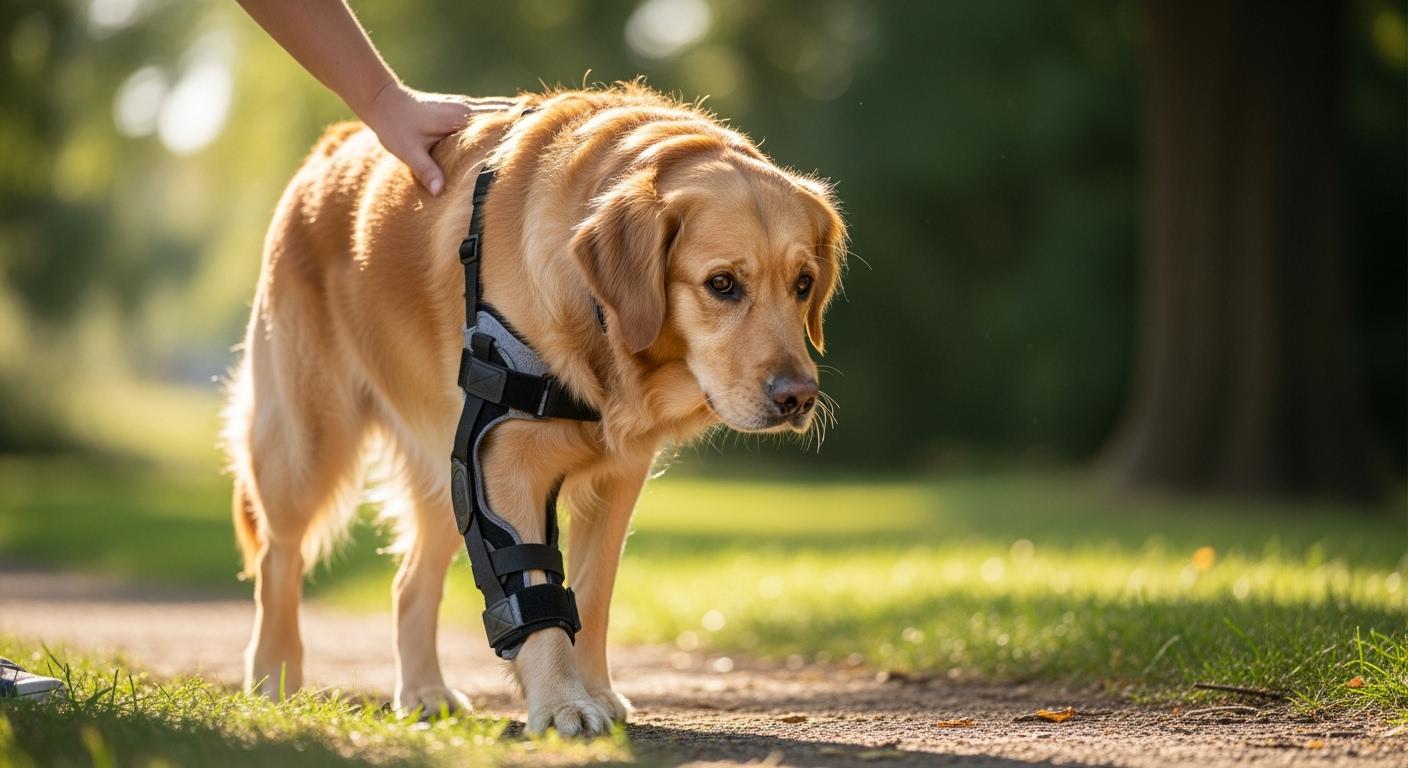
A knee brace can support a dog with luxating patella. But support depends on where the brace sits during movement — not just how it looks at a standstill. The brace that stays centered during a straight walk often twists off the joint the moment the dog turns. Large dogs amplify this. Their weight and the torque of a quick pivot push the brace sideways before the patella has a chance to stay put. Understanding why that happens — and which design details resist it — is what separates a brace that works from one that becomes an irritation the dog tries to shake off.
Where a Knee Brace Loses the Patella During Movement
The most common failure point is not material weakness. It is rotation.
When a dog turns, the force on the knee does not travel straight through the joint. It enters at an angle. A stifle brace resists that angled force through its contact with the leg — primarily through the straps and the inner surface area pressed against the coat and skin. If the straps are narrow, the force concentrates along a thin line. That line becomes a pivot axis. The brace rolls around it, shifting the hinge away from the patella. Once the hinge drifts even half an inch, the brace is no longer resisting lateral patellar movement — it is simply wrapped around the leg in the wrong place.
The causal chain is tight: lateral ground force during a turn → narrow strap contact area cannot generate enough friction to resist rotation → the brace rotates around its own strap edge → the hinge axis shifts off the patella → the patella loses medial-lateral constraint → the dog feels the instability and shortens stride on that side → the altered gait increases rotational load on the next step → the brace rotates further. A cycle that starts with one sharp turn can undo support within a dozen strides.
You can verify this at home. Place a small piece of tape at the top edge of the brace after the first 10 minutes of walking. Walk the dog for another 5 minutes that include two sharp direction changes. Remove the brace and measure how far the tape has moved from its original position on the leg. More than half an inch of drift means rotation is progressively pulling support off the patella, and the strap configuration is not resisting it.
Large dogs and dogs with deep chests place more rotational load on the brace because their center of mass sits higher and shifts further during a turn. A brace that holds position on a 20-pound dog may rotate freely on an 80-pound dog doing the same movement. The forces are not just bigger — they act through a longer lever arm from the hip to the knee.
Why Strap Width and Anchor Design Matter More Than Tightness
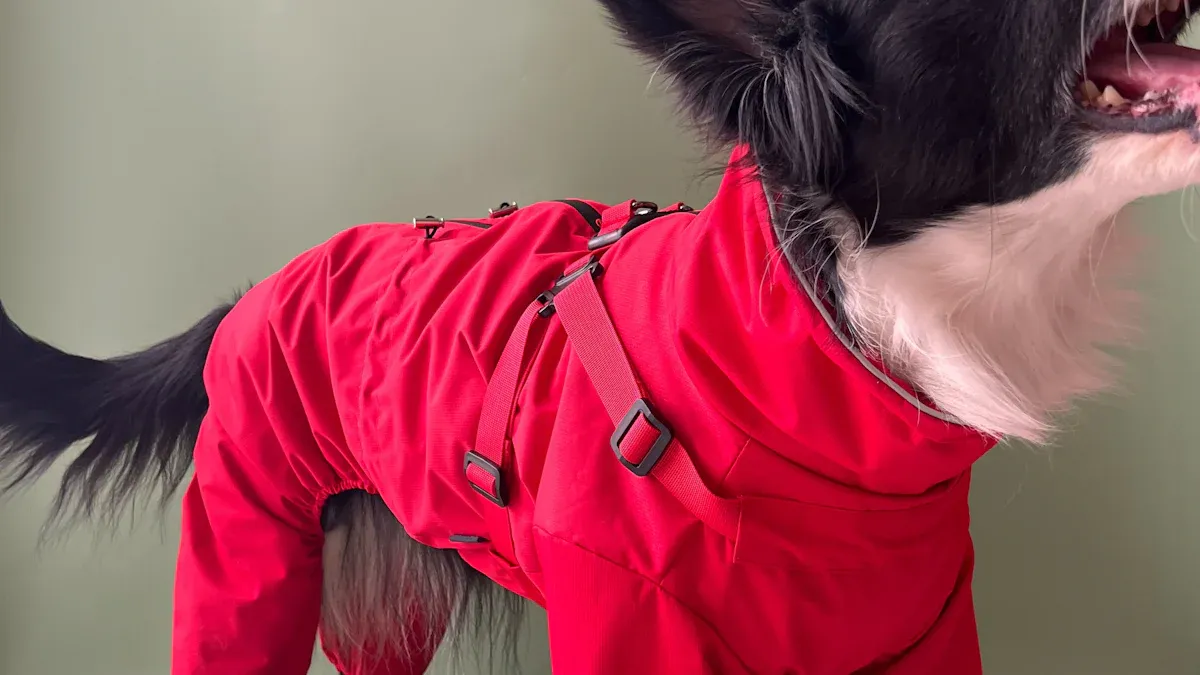
Tightening the straps feels like the obvious fix. It is not. A tight narrow strap concentrates force into a band of high pressure. The skin underneath cannot breathe, heat builds, and within 20 minutes the dog starts reacting to the pressure rather than benefiting from the support. And the brace still rotates — because rotation is resisted by surface area, not by strap tension alone.
Wide straps change the mechanics. A strap that spreads contact across two inches of leg surface creates a friction patch with far more resistance to twisting than a half-inch strap at the same tension. The wider strap also distributes the downward load from the brace body across more skin area, so the brace is less likely to dig in at the top edge when the dog sits or rises. For dogs with luxating patella, this matters especially at the upper anchor — the strap or cuff above the knee — because that is where rotational forces concentrate when the dog pivots.
A knee brace designed with both upper and lower anchoring resists rotation from two points instead of one. The upper anchor holds the brace against upward slide. The lower anchor — below the knee — prevents the bottom of the brace from swinging outward during a turn. Without a stable lower anchor, the brace pivots around the top strap like a door on a single hinge. That single-axis rotation is exactly what pulls support away from the patella.
Breathable inner padding is not a comfort feature. It is a wear-time enabler. Padding that traps moisture softens the skin and increases friction in the wrong way — the brace grips wet skin unevenly, creating shear that produces red marks and eventually raw spots. Padding that moves moisture away from the skin keeps the surface dry and the friction predictable. After 20 minutes of wear, remove the brace and press your palm against the inner liner. If it feels damp and the skin underneath shows defined red outlines matching the strap edges, the padding is not moving moisture and the pressure concentration is too high for longer sessions.
| Brace feature | Weak version | Better version | Why it matters |
|---|---|---|---|
| Strap layout | Narrow, two-strap | Wide, multi-strap | Distributes pressure and resists rotation through larger friction surface |
| Upper anchor | Thin band, single contact line | Broad cuff with multiple anchor points | Prevents the brace from sliding down and rotating during turns |
| Lower anchor | None or single narrow strap | Contoured lower strap below the joint | Stops the bottom of the brace from swinging outward on direction changes |
| Inner padding | Thin, closed-cell foam | Breathable multi-layer with moisture-wicking face | Keeps skin dry so friction stays predictable; reduces hot-spot formation |
| Edge finish | Cut edge or basic binding | Rolled, smooth edge with no hard seam | Prevents skin abrasion at the brace perimeter where movement is highest |
| Anti-rotation control | None beyond strap friction | Wide upper and lower anchors working as a pair | Resists the twisting force that shifts the hinge off the patella during turns |
A knee brace built for luxating patella needs this combination — wide anchors above and below, breathable padding that does not go slick when damp, and enough contact surface to resist rotation without needing strap tension that the dog cannot tolerate. For daily walking support, the difference between a brace the dog accepts for 30 minutes and one it fights after 10 often comes down to edge finishing and pad material — details that are invisible in a product photo but obvious in use.
When a Knee Brace Is Not the Right Path
A knee brace does not reshape bone. It does not deepen the trochlear groove, correct angular limb deformities, or fix a patella that is permanently luxated. Those are structural problems. A brace can provide external medial-lateral constraint — resisting the sideways movement of the patella — but only when the underlying anatomy allows that constraint to translate into joint stability.
Luxation grade sets the ceiling on what a brace can achieve. Grade 1 — the patella displaces but snaps back — is the scenario where consistent external constraint often makes the biggest functional difference. Grade 2 — the patella luxates more frequently but can be manually reduced — may still respond to bracing, especially when the dog is not overweight and the luxation is intermittent rather than positional. Grades 3 and 4, where the patella is out most or all of the time, are not cases where a brace alone typically restores meaningful function. The forces required to hold a permanently luxated patella in place exceed what external strapping can deliver without causing pressure injury.
There are signals that tell you the brace path has run its course. They are observable without veterinary equipment:
| What you see | What it signals | Next step |
|---|---|---|
| Brace stays aligned, dog moves with less skipping | Support is transferring to the joint | Continue supervised use, increase duration gradually |
| Brace drifts more than half an inch during a 5-minute walk with turns | Rotation is overpowering the strap configuration | Stop; a different strap layout or wider anchors may be needed |
| Red marks remain visible 20 minutes after brace removal | Pressure concentration too high or padding not moving moisture | Stop; do not resume until marks resolve and fit is adjusted |
| Dog suddenly refuses to put weight on the leg mid-walk | Acute pain or brace-induced instability | Stop immediately; remove the brace and consult a veterinarian |
| Limping is worse after brace use than before | The brace is not helping or is actively causing harm | Stop; reassess whether bracing matches the luxation grade |
| Toes feel cooler than the other paw after a session | Circulation may be restricted | Stop; the strap tension or fit is too tight |
For dogs where luxation is severe or the patella is permanently displaced, surgical options tend to offer a more durable path. A brace used in those cases may provide temporary comfort during supervised rest, but it is unlikely to deliver functional walking support. The distinction matters because continuing a brace that is not working can create compensatory gait patterns that are hard to unlearn even after the underlying problem is addressed.
Disclaimer: These fit checks assume a short-coated dog where brace edges sit close to skin and red marks are visible. Double-coated breeds may show subtler rub marks that require hand-checking under the brace edges rather than visual inspection. If the dog has angular limb deformities or a very deep chest, the pressure-point checks described here may not catch every fit problem — the brace geometry may not match the limb geometry closely enough for these signals to appear before discomfort sets in.
A knee stability solution for luxating patella works within a specific window: intermittent displacement, manageable rotational load, and anatomy that allows external constraint to transfer to the joint. Outside that window, the brace becomes a source of pressure and frustration rather than support. Recognizing where the window closes is not giving up on bracing. It is using it where it can actually deliver.
Häufig gestellte Fragen
Can a knee brace cure luxating patella?
No. A knee brace provides external constraint — it resists the sideways displacement of the patella during movement. It does not change bone structure, deepen the trochlear groove, or correct the soft-tissue imbalances that allow luxation. In mild or intermittent cases that external constraint can improve function enough to make daily activity more comfortable. In severe or permanent luxation it is unlikely to deliver meaningful support.
How do I know if the brace actually fits my dog?
The brace should stay centered on the knee through a walk that includes sitting, rising, and two sharp turns. After 15 minutes, check: the top edge should not have drifted down the thigh, the hinge should still align with the joint, and the skin underneath should show no defined red marks. If the brace twists, slides, or leaves strap-shaped marks that do not fade within 20 minutes, the fit — or the strap configuration — is not right for that dog’s movement pattern.
My dog started limping more after wearing the brace. Should I stop?
Stop immediately. Increased limping is a signal that the brace is either not transferring support correctly or is creating pressure that the dog cannot tolerate. Remove the brace, check the skin and toe temperature, and do not resume use until a veterinarian has assessed whether the brace matches the luxation grade and the dog’s anatomy.
What is the single most common reason a knee brace fails on a large dog?
Rotation during turns. Large dogs generate more torque through a longer limb, and a brace held by narrow straps rotates around those straps when the dog pivots. Once the hinge shifts off the patella by even a small amount, the brace is no longer resisting lateral displacement — it is just wrapped around the leg in the wrong place. Wider straps and dual upper-lower anchors address this directly by increasing the friction surface that resists twisting.
