
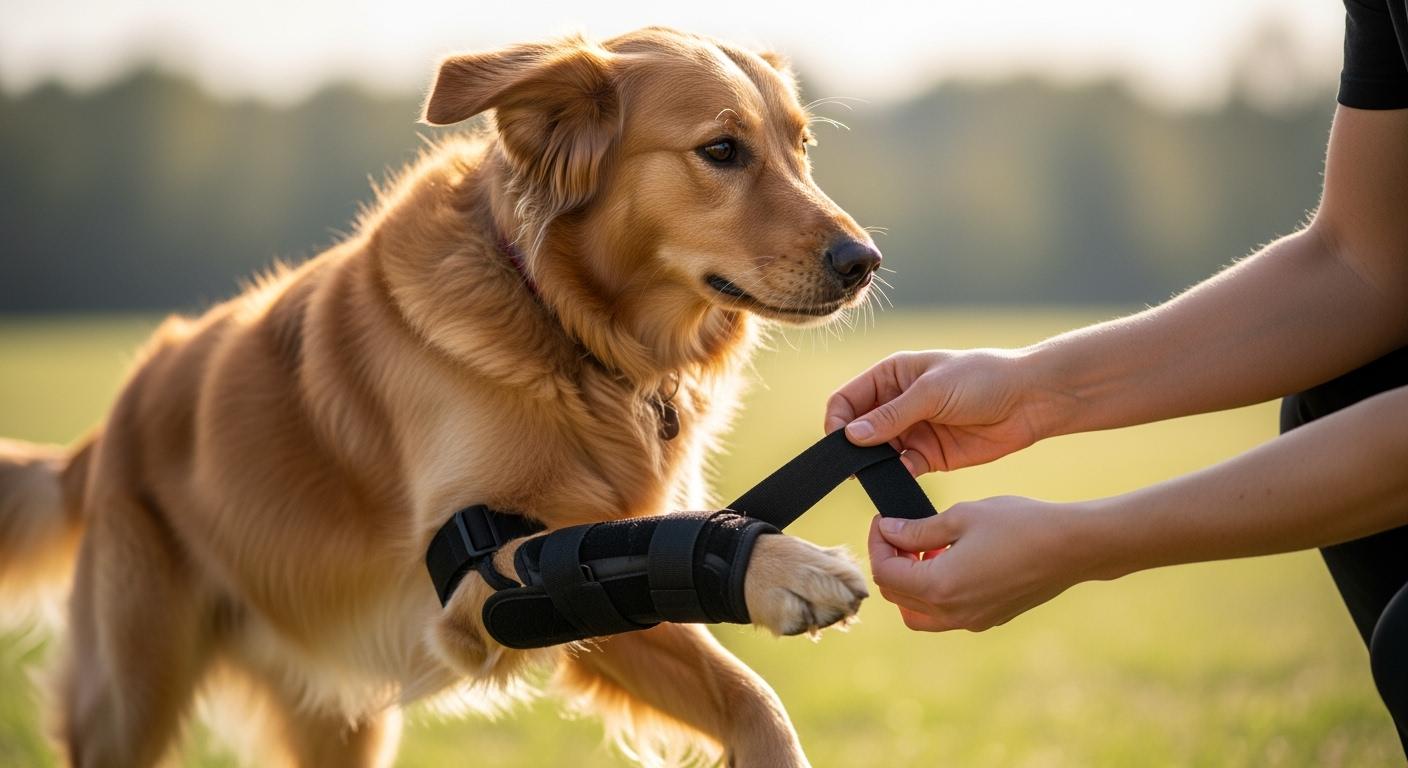
A dog wrist brace that has drifted an inch down the foreleg is no longer a brace. It is a sleeve with an opinion. The joint it was supposed to stabilize now moves freely underneath fabric that shifted elsewhere. The owner tightens the straps. The brace slides again. Something in the product-to-limb interface is failing, and tightening the same flawed fit loop will not fix it.
This is not a training issue. It is a contact-surface problem with a mechanical cause, and the fix starts with understanding what is actually happening between the brace interior and the leg during a stride.
Why a Wrist Brace Starts to Slide
The Circumference Gap Problem
A carpal brace works by creating a uniform pressure boundary around the distal forelimb. When that boundary is unbroken, the brace interior and the leg surface form what amounts to a friction-locked cylinder. The brace cannot rotate or translate without first overcoming static friction across the entire contact area.
Introduce a gap — even a small one, from a measurement taken at rest on a standing dog rather than mid-stride — and the physics changes. The contact area shrinks to a single high-pressure band where the brace actually touches skin. The rest of the interior wall floats. During carpal flexion, the joint widens and narrows at different points along the limb axis. The single contact band becomes a pivot point. The brace rotates around it. After ten strides, it has walked itself half an inch down the leg.
That fails fast. And the failure is not subtle: the dog starts weight-shifting away from the unsupported side, gait changes, and whatever condition the brace was meant to manage now has no mechanical barrier working in its favor. A carpal brace that cannot hold position under load provides less support than no brace at all, because the dog compensates for the foreign object without receiving any joint stabilization in return.
Check it yourself: After 10 minutes of walking, place a strip of tape at the top edge of the brace where it meets the leg. Walk another 10 minutes. If the brace edge has moved more than half an inch from the tape line, the circumference match is off — regardless of what the size chart says.
What Fur and Skin Do to Friction
Brace interiors grip through a combination of liner texture and the friction coefficient of the leg surface they press against. A short-coated dog with clean, dry skin presents a relatively high-friction surface. A double-coated breed with dense undercoat — the carpal brace liner compresses the fur rather than contacting skin — creates a low-friction slip plane. The brace rides on a cushion of hair.
Skin condition matters in the opposite direction. Dry skin flakes create a loose particulate layer between liner and leg, acting like ball bearings at the microscale. Oily seborrhea turns the liner slick. Both reduce static friction, both make the brace migrate faster, and neither is fixed by cranking straps tighter.
Trimming fur to the length where the liner contacts skin, not coat, restores the intended friction interface. But the trim zone must match the full contact patch of the brace interior — trimming only the top band of fur leaves a slick band directly underneath where the brace exerts its highest pressure. That is where it will spin.
What Strap Width and Liner Material Actually Change
Strap Force Distribution and the Roll Failure
Most off-the-shelf carpal braces use two or three narrow straps to secure the brace body to the leg. A narrow strap — under an inch wide — applies force along a thin circumferential line. That line has almost no resistance to rotation in the plane of the strap. When the dog flexes the carpus during a stride, the proximal edge of the leg pushes outward against the upper strap while the distal edge pulls inward. The strap, unable to distribute that differential force across a wider surface, rolls.
Roll is the failure mode. Not looseness. A rolled strap has turned its flat pressure-distributing face into a thin edge pressing into the skin. The edge hurts. The dog reacts — a head turn, a hesitant step, sometimes a bite at the brace. But more critically, a rolled strap has lost its grip on the brace body. The entire assembly shifts. A wider strap, particularly one with a stiffened edge that resists the rolling moment, distributes the flexion force across enough surface area that the edge never becomes the primary load path. The strap stays flat. The brace stays in position.
A well-designed carpal brace anchors the strap anchor points at angles that anticipate the primary flexion direction — straps running perpendicular to the joint axis resist translation; straps running parallel resist rotation. The combination of both is not a styling choice. It is the difference between a brace that holds position through a 30-minute walk and one that needs readjustment after the first block. For a deeper look at how strap configurations interact with carpal anatomy, the carpal brace fit and strap configuration guide walks through the anatomy-to-design mapping in detail.
Liner Material: The Moisture Clock
Every liner material has a moisture performance curve. Neoprene-backed fabric starts with high friction when dry. After roughly 15 to 20 minutes of exercise — sooner in warm weather or on a dog that runs warm — moisture accumulates between the liner and the skin. Neoprene does not wick. The friction coefficient drops. The brace that felt snug at the door now slides with every step.
A liner with wicking properties — open-cell foam, certain knit blends, materials that move moisture away from the skin layer rather than trapping it against it — extends the dry-friction window. It does not eliminate moisture. But it delays the point where friction collapses enough to permit migration. For a dog walking 20 minutes, that delay may mean the difference between finishing the walk with the brace in position and finishing with it bunched above the paw.
Check it yourself: After a walk, lift the top edge of the brace liner and press a dry finger to the skin underneath. Damp skin means the liner trapped moisture instead of moving it. That brace will slide on the next walk too, and the fix is not a tighter strap — it is a different liner interface.
When a Carpal Brace Is the Wrong Tool
A carpal brace stabilizes the wrist joint — the articulation between the radius/ulna and the metacarpals. It does nothing for the elbow, the shoulder, or any weight-bearing structure above the distal forelimb. If the dog is knuckling — dragging the paw, walking on the dorsal surface of the foot — the problem is likely proximal, not carpal. A wrist brace wrapped around a carpus that is not the root cause adds weight to a limb that is already failing to clear the ground. That makes knuckling worse, not better.
Similarly, dogs with angular limb deformities — carpal valgus where the paw splays outward, or carpal varus where it angles inward — place uneven pressure on any cylindrical brace interior. The standard sizing approach, based on two or three circumference measurements, cannot account for the asymmetry of force distribution. The brace will ride up on the longer side and dig in on the shorter side. A front leg brace designed for carpal-only support will not solve a problem that originates at the elbow or shoulder — mistaking the location of dysfunction guarantees the brace fails at its one job.
Activity type also defines the boundary. A carpal brace built for leash walking on level ground — the use case most off-the-shelf designs are engineered for — may not survive repetitive impact from stair climbing, off-leash sprinting on uneven terrain, or sharp turns at speed. The forces multiply, the gaps that were small at rest open under load, and the brace that held fine during a controlled walk slides within minutes. The carpal hyperextension support a brace delivers depends entirely on whether the use scenario matches the design scenario. Push beyond that match and the product knowledge question stops being “why is this brace failing” and becomes “is this the right class of support for what I am asking the dog to do.”
Disclaimer: This fit assessment assumes a dog with typical carpal joint conformation and a short to medium coat. Double-coated breeds may show subtler rub marks that require hand-checking rather than visual inspection — fur can mask redness for days. Dogs with angular limb deformities, fused carpal joints, or breeds with extremely fine bone structure such as Italian Greyhounds may produce pressure patterns that standard circumference-based sizing does not predict. In those cases, fit must be assessed by touch — run a finger under the full contact edge after every walk — not by measurement tape alone.
Häufig gestellte Fragen
Why does the brace slide even when straps are tight?
Tight straps do not fix a circumference gap. They compress the brace body harder against the leg at the strap line but cannot close an air gap between strap lines. The brace pivots around the strap compression points while the gapped zones provide zero friction. If the brace interior and the leg surface are not a continuous contact cylinder, strap tension cannot compensate — it only localizes pressure into narrow bands.
Can a carpal brace be worn during off-leash running?
Most standard carpal braces are engineered for controlled leash walking, not for the multi-directional impact loads of off-leash running. The carpus flexes further and faster during running than walking, and the strap configuration designed for walking-level forces may not resist the rotational loads generated at sprint speed. A brace that holds during a 20-minute leash walk can fail within three minutes of off-leash play.
How do you know if the liner material is the problem versus the fit?
Run the moisture check described above — if the skin under the liner is damp after a walk, the liner is contributing to the slide regardless of fit. Then run the tape test for position drift. If the brace holds position on a short dry walk but slides on a longer walk where the liner becomes damp, the liner material is the dominant failure factor. If it slides on a short dry walk too, the circumference match is the primary issue.
A wrist brace that slides is telling you something specific about the interface between its interior surface and the leg it wraps. Listen to the failure pattern. Circumference gaps, strap roll, liner moisture, fur density, activity mismatch — each produces a distinct failure signature. Identify which one is driving the migration and the path to a stable brace becomes shorter than the walk where it kept slipping.
