
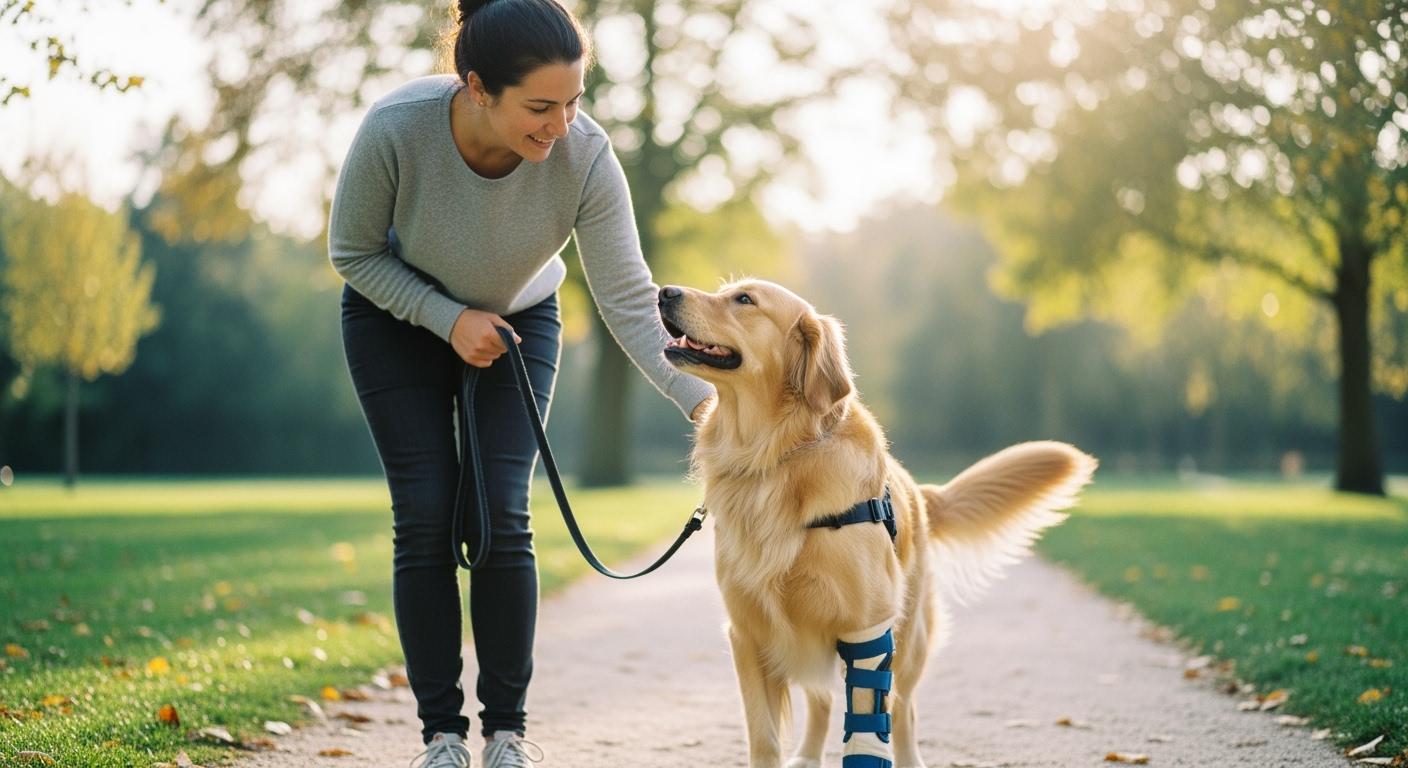
A dog leg brace looks straightforward: wrap it around the leg, tighten the straps, and let the structure do the work. In practice, the gap between how a brace fits on a standing dog and how it holds up during a sudden pivot, a stair climb, or a hour of rest is where most failures live.
Straps that felt secure at rest shift under lateral load. A hinge that lined up with the joint during fitting drifts half an inch once the dog takes ten strides on uneven ground. Liner material that breathed well in a climate-controlled room traps heat and moisture after twenty minutes of normal activity.
These are not rare edge cases. They are predictable outcomes of specific design choices — strap width, hinge placement tolerance, liner material selection — that separate a brace that stabilizes from one that becomes a source of irritation a dog actively resists.
Where a Leg Brace Fails First: Fit Problems That Undo Support
The most common failure does not involve broken buckles or torn fabric. It is a brace that shifts out of position under load, and once it moves, the support it was designed to deliver is gone.
A brace depends on a stable anchor. The leg is a tapered cylinder covered in fur over soft tissue — a challenging surface for any strapped device. When a dog plants the leg and rotates, the force does not travel straight down the limb in a clean vertical line. It comes in at an angle, creating a rotational moment that narrow straps cannot resist.
Here is the causal chain: a ¾-inch strap makes contact along a thin band of the leg. Under lateral force, that narrow contact patch acts as a pivot edge rather than a resistance surface. The strap edge digs in, the underlying tissue compresses, and the brace body rotates around the leg. Once the hinge axis moves off the joint center by even half an inch, the hinge no longer tracks the joint’s natural arc. The brace goes from supporting the leg to fighting its motion. The dog compensates by altering its gait — shortening the stride on that side, swinging the leg outward, or refusing to load the limb altogether.
Wider straps, particularly those that distribute contact across 1.5 inches or more, create a broader friction plane that resists rotation before the edge can dig in. But width alone is not the fix. Strap placement matters equally. Two straps placed close together — both above the joint, for instance — create a single pivot point. Separating the anchor points so one sits above the joint and one below creates a longer lever arm that resists rotation through geometry rather than through compression force.
You can verify this at home. Put the brace on, walk the dog for ten minutes on the surface it normally uses — grass, hardwood, pavement — and then check the brace position against the anatomical landmarks you used during fitting. If the top edge has migrated more than half an inch down the leg, or if the hinge center no longer aligns with the joint space, the strap configuration is not resisting rotational loads. Tighter straps will not fix it. The geometry needs to change.
The difference between a brace that stays put and one that migrates is rarely about how hard you cinch it. It is about whether the strap layout creates a stable resistance plane against the specific rotational forces the dog’s movement generates. A leg brace that slides during normal walking tends to show the same failure pattern — migration starts within the first ten minutes, accelerates after thirty, and leaves the joint unprotected for the majority of wear time.
Materials, Straps, and Weight: Why Similar-Looking Braces Perform Differently
Two braces with similar silhouettes can perform in opposite ways. The differences come down to material choices and how those choices interact with a dog’s daily movement patterns.
Neoprene: Comfort at a Cost
Neoprene is the default liner in most leg braces for a reason. It conforms to contours, provides even compression, and feels cushioned against bony landmarks. But neoprene does not breathe. It traps body heat and prevents moisture evaporation. After twenty minutes of wear, the skin underneath becomes warm and damp — conditions that soften the outer skin layer and make it more vulnerable to friction damage.
Check this yourself: remove the brace after a walk, flip back the liner, and press a dry finger against the skin underneath. If the skin feels wet or tacky, moisture is accumulating. Over repeated wear cycles, that trapped moisture leads to skin maceration and makes the surface more prone to rub marks — even from a brace that fit well on dry skin.
Neoprene also has a limited stretch-recovery cycle count. The foam cells compress with repeated use and do not fully rebound. A neoprene liner that provided firm compression in week one can feel loose by week six, even if the outer straps are pulled to the same holes. This loss of liner resilience is a common reason braces that “fit perfectly” at the start begin to slip a month in.
Outer Shell Rigidity and Gait Interference
A rigid shell transfers load efficiently — that is its job. But rigidity is not free. A stiff outer shell with unyielding edges can create a fulcrum effect: the shell holds the joint in alignment, but the edges concentrate pressure at the top and bottom of the brace where the rigid material ends and soft tissue begins. Dogs with thin skin or low body fat — common in breeds like Greyhounds, Whippets, and some senior dogs — are particularly vulnerable to this edge-pressure pattern.
The weight of the brace shell also matters in ways that are easy to overlook during a fitting session. A dog standing still can tolerate extra weight without showing signs. But after walking for ten minutes, the additional mass on the distal limb changes the pendulum weight of the leg. The dog must lift slightly harder with each stride. Over the course of a thirty-minute walk, that extra effort accumulates. You can observe it: compare the stride length on the braced leg to the unbraced leg after fifteen minutes of continuous walking. If the braced side shortens noticeably, the brace weight or rigidity is altering gait mechanics.
| Performance Difference | Warum das wichtig ist | Main Limitation |
|---|---|---|
| Neoprene liner vs. open-cell foam liner | Neoprene traps moisture; open-cell foam wicks but compresses faster | Neither material solves both breathability and long-term resilience simultaneously |
| Wide straps (1.5″+) vs. narrow straps (0.75″) | Wide straps distribute rotational force across a larger contact patch and are less likely to roll at the edge | Wider straps add bulk and can limit joint flexion if placed too close to the joint line |
| Rigid shell vs. semi-rigid shell | Rigid shells provide more lateral stability but concentrate edge pressure; semi-rigid shells flex with the limb but sacrifice some side-to-side control | The right choice depends on whether the primary need is buckling resistance or all-day wear tolerance |
How materials interact with daily conditions — not how they look on a product page — determines whether a dog tolerates the brace for weeks or rejects it after days. A leg brace designed for recovery support needs material choices that hold up under repeated moisture exposure, friction cycles, and loading patterns that a short fitting session never reveals.
When a Leg Brace Is Not the Right Choice
A leg brace works within a specific range of conditions. Outside that range, it can create problems that are worse than the original issue.
Joint Instability Beyond What a Brace Can Control
Braces resist bending in specific planes. Most stifle braces are designed to limit cranial tibial translation and control varus/valgus rotation. But a brace cannot restore ligament function. If the underlying instability is severe — a complete CCL rupture with significant drawer motion — the brace may reduce the range of abnormal movement without eliminating it. The joint still experiences shear forces with every step. The brace masks some of the instability, but the mechanical problem persists underneath.
The danger is that reduced visible lameness can create a false sense of protection. The dog moves more, loads the joint more, and the unchecked shear gradually damages the meniscus. A brace that reduces pain enough to increase activity without reducing instability enough to protect the joint is a net negative.
Skin and Conformation Factors
Dogs with deep chests and narrow hips — Dobermans, some mixed breeds — often have leg conformation where the thigh tapers sharply from top to bottom. A brace that fits the upper thigh circumference may be loose at the mid-thigh, creating a void where the brace body does not make contact. That void becomes a rotation path: the brace pivots around the upper anchor and the lower section swings freely.
Dogs with skin folds or loose skin around the stifle face a different problem. As the brace moves through the gait cycle, loose skin bunches ahead of the brace edge, then releases. This bunch-release cycle creates friction that can produce skin lesions within days, often in locations that are not visible without removing the brace and palpating the entire leg.
Disclaimer: this fit-check assumes a short-coated dog with relatively uniform leg contour. Double-coated breeds or dogs with heavy feathering may show subtler rub marks that need hand-checking rather than visual inspection — run your fingers along the full circumference of the leg under the brace edges after each wear session. If the dog’s leg conformation falls outside typical breed proportions — particularly dogs with angular limb deformities, very deep chests, or muscle atrophy that creates uneven limb contour — the fit checks described here may not catch every pressure point.
Bilateral vs. Unilateral Need
A dog that needs support on both hind legs presents a different challenge than a dog with a single-leg issue. Bracing both legs doubles the weight the dog must manage. It also changes the dog’s center of mass and proprioceptive feedback from both limbs simultaneously. Some dogs adapt quickly. Others become hesitant or refuse to move. The same brace design that works well on one leg can be overwhelming on two, even when each individual fit is correct.
This is the kind of distinction that matters more than whether a brace is “custom” or “off-the-shelf.” A hind leg brace that performs well in unilateral use may need different strapping or weight considerations for bilateral applications — a factor that is about the product’s design limits, not about whether one option is universally better.

Design Details That Shape Daily Wear
The difference between a brace a dog tolerates for weeks and one it resists after three days often comes down to details that do not show up in product photos.
Strap Attachment and Edge Construction
How a strap attaches to the brace body affects longevity more than the strap material itself. Straps sewn directly onto a neoprene body with a single stitch line concentrate all of the tension load on that seam. Under repeated tension cycles — the dog sits, the strap stretches, the dog stands, the strap relaxes — the stitches work through the neoprene and eventually tear out. A strap anchored through a reinforced grommet or bar tack spreads the load across a wider area of the brace body and extends the functional life of the attachment point significantly.
Edge binding follows a similar logic. Raw neoprene edges fray. Folded and stitched edges resist fraying but create a thicker ridge that can press into skin. The ideal compromise — a thin, flat-seam binding that protects the edge without creating a pressure ridge — is harder to manufacture consistently. It requires tighter tolerance control at the sewing station, and small deviations in stitch placement show up as hot spots on the dog’s leg.
These are not cosmetic differences. A brace with a well-constructed strap anchor and smooth edge binding can withstand daily donning, doffing, and wear for months. A brace where either detail is compromised will show failure within weeks — usually at the attachment points or the edge seams, and usually after the return window closes.
Hinge Placement and the Joint Axis Problem
Hinges look precise on a product diagram. In practice, placing a hinge so that its pivot axis aligns with a dog’s joint axis through the full range of motion is difficult. A dog’s stifle joint does not rotate around a single fixed point. The instantaneous center of rotation shifts as the joint flexes. No external hinge can perfectly track that shifting axis.
What separates a functional hinge from a problematic one is how much misalignment the design tolerates before it interferes with motion. A hinge with a single pivot point and tight clearance tolerances binds when the alignment drifts even slightly. A hinge with some degree of multi-axial float — or a design that uses flexible struts instead of a rigid hinge — accommodates the natural shift in joint axis without fighting the dog’s motion.
The observable test: watch the dog walk with the brace on. If the brace body wrinkles or buckles at the joint during the swing phase, the hinge is binding — it is forcing the brace material to compress because the mechanical pivot and the biological joint are out of sync. That wrinkle is the visible signature of a hinge-joint mismatch. A leg brace with properly tolerated hinge alignment moves smoothly through the gait cycle without bunching material at the joint line.
Liner Attachment and Cleanability
A liner that cannot be separated from the shell for cleaning accumulates debris, skin oils, and bacteria. Over time, the liner surface becomes abrasive — not because the material degraded, but because particulate buildup creates a micro-abrasive surface that irritates skin on contact. A removable, washable liner addresses this. A permanently bonded liner does not, and the brace’s useful life ends when the liner surface condition deteriorates past the point of skin tolerance, even if the structural components are still intact.
This is a design-level distinction. A leg brace with a replaceable or washable liner extends its functional lifespan well past the point where a fixed-liner brace would need replacement — not because the shell failed, but because the skin-contact surface did.
Häufig gestellte Fragen
Why does a brace that fits at rest slide during walks?
Rest fit tests only vertical suspension — gravity pulling the brace down. Walking adds rotational and lateral forces. If the strap configuration does not create a wide enough resistance plane — through strap width, number of anchor points, and vertical separation between upper and lower straps — the brace rotates around the leg under side load. Tension alone does not fix this. The contact geometry has to change.
How quickly should a dog adapt to wearing a leg brace?
Most dogs show an adapted gait within two to four walking sessions of fifteen to twenty minutes each. If the dog continues to shorten stride, swing the leg outward, or attempt to remove the brace after the first week, the fit or hinge alignment likely needs adjustment. Persistent gait alteration past the adaptation window is a fit problem, not an acclimation problem.
What separates a brace that lasts months from one that fails in weeks?
Strap attachment construction and liner material resilience are the two highest-failure items. Single-stitch strap anchors tear through the brace body under repeated tension cycles. Non-removable liners accumulate debris that turns the inner surface abrasive. A brace built for single-leg ACL support faces different durability demands than a brace used for general daily mobility — the failure timeline depends on whether the construction matches the expected load frequency.
Can a leg brace replace surgery for a torn ligament?
A brace can reduce abnormal joint motion but cannot restore ligament function. For partial tears where some ligament restraint remains, a brace may reduce enough tibial translation to protect the joint during healing. For complete ruptures, the brace provides external support that can improve comfort and stability during daily activity, but the ligament itself does not heal without surgical intervention. The brace manages mechanical symptoms — it does not repair the underlying structure.
How do I know if my dog’s brace is causing skin problems I cannot see?
Remove the brace after every wear session and run your fingers along the full circumference of the leg, paying particular attention to areas under strap edges and along the top and bottom brace rims. Feel for warmth, tackiness, or detectable ridges in the skin. Visually check for pinkness that persists more than five minutes after brace removal. If any of these signs appear, reduce wear duration and inspect more frequently until you identify whether the issue is moisture buildup, edge pressure, or a specific strap location.
