
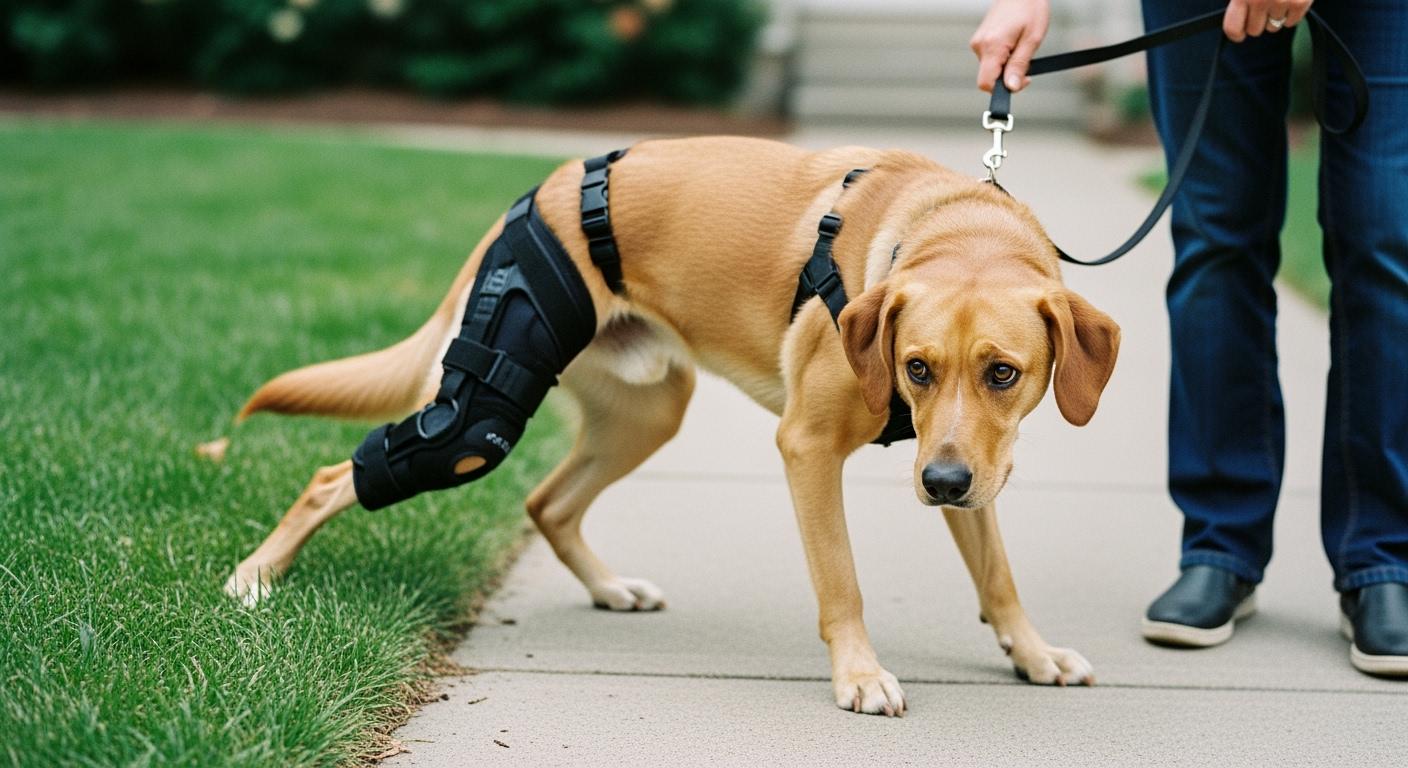
A pet knee brace can look perfect when the dog stands still. The straps sit flush. The hinge lines up. Nothing shifts.
Then the dog takes three steps, turns toward a sound, or drops into a potty squat — and the brace rotates, slides down the leg, or digs a red trench into the skin behind the knee.
That gap between standing fit and moving fit is where most knee braces fail. It is not random, and it is not always about sizing. Three mechanical failure patterns repeat across designs, and each one leaves a signal you can check for after a short walk.
Where a Pet Knee Brace Fails First During Movement
The failures follow a predictable order. A brace loses its lower anchor first — the portion below the knee slips toward the paw. Once the lower anchor migrates, the entire brace has room to rotate around the leg. Rotation pulls the hinge off the knee axis, and an off-axis hinge transfers load into the shell edges instead of the padded contact surfaces. That is when digging starts.
Each step in the chain makes the next one worse. A slipped lower anchor increases rotation. Rotation increases edge pressure. Edge pressure makes the dog adjust its gait, which changes leg shape further, which accelerates the slip. This is why a brace that looks “a little off” at minute two can be fully displaced by minute ten.
These failures show up most during three specific movements:
Turning
When a dog turns, the patella shifts inside the knee capsule and the leg cross-section changes shape. Inside the brace, strap tension redistributes — one side tightens, the opposite side goes slack. If the strap path is narrow or there is only a single circumferential band, that tension imbalance creates a pivot point. The brace rotates around the tightest strap edge.
Here is the mechanical chain: lateral force from the turn → uneven strap loading → the tightest strap edge becomes a fulcrum → the brace body rotates around that fulcrum → the hinge leaves the knee axis → the shell applies force at an angle the knee joint cannot absorb → the dog shortens its stride or refuses the turn.
This type of rotation is especially common in dogs with luxating patella, where the patella is already mobile and the knee profile changes more dramatically during a turn. A knee brace for luxating patella needs more than passive compression — the suspension has to resist rotation specifically, not just hold the brace in place vertically.
In practice: Flooring transitions amplify this. Moving from carpet to tile mid-turn changes the paw’s grip, which changes how the leg rotates under the body, which changes the force vector hitting the brace. A brace that handles flat-carpet turns can still fail on a mixed-surface walk.
Squatting
A potty squat changes the hind leg profile more than any other daily movement. The thigh muscle belly shortens and widens, the knee angle closes, and the soft tissue behind the knee compresses. If the brace shell has a straight or stiff rear edge, that edge presses into tissue that is actively changing volume.
The pressure does not distribute across the padded surface — it concentrates along a single line where the shell rim meets skin. After repeated squats, that line becomes a friction burn. The dog may start avoiding the full squat position, which creates its own problems, or may refuse the brace altogether after a few sessions.
A contoured rear cutout matters here, but so does edge finish. A rolled edge with a flexible transition zone allows the shell rim to move with the tissue instead of pressing into it. This is not just about padding thickness — it is about whether the structural edge has any give in the direction the tissue expands. Stiff shells with sharp trim lines are the worst offenders.
Sudden stops
When a dog stops short — at a curb, at a scent, at a door — the brace experiences a forward momentum shift. If strap tension is not balanced across multiple anchor points, the brace body can slide forward on the leg. The hinge overshoots the knee. When the dog steps again, the brace is already misaligned, and every subsequent step works the hinge further from the joint axis.
| Movement | Failure signal | Mechanical cause | Design direction that helps |
|---|---|---|---|
| Turning | Brace rotates around leg | Single strap edge becomes fulcrum under lateral load | Multi-point strap paths, wider padded contact |
| Squatting | Shell digs into rear knee | Straight edge presses into expanding tissue | Contoured rear cutout, flexible edge transition |
| Stopping suddenly | Brace slides forward | Unbalanced strap tension, weak lower anchor | Anti-slip inner contact, contoured lower shell |
| Straight walking | Brace gradually migrates down | Smooth lining, leg taper reducing friction | Anti-slip contact surface, anatomically shaped shell |
| Standing up | Brace shifts position | Poor static leg-shape match | Movement-tested shell contour |
| Signal level | What to look for after a 10-minute walk | What it means |
|---|---|---|
| Green | Brace centered, skin clear, no limp | Fit and design are working for this movement range |
| Yellow | Brace shifted under half an inch, light strap marks fading within 20 minutes, mild gait change | Adjust strap balance or shorten session; monitor next walk |
| Red | Brace rotated past the knee, deep marks lasting over 20 minutes, paw dragging, limp worsening | Stop use; the current fit or design is not holding under real movement |
Strap, Hinge, and Shell — the Design Details Behind Each Failure
Three structural decisions determine whether a knee brace holds during movement or fails within minutes. None of them are visible in a product photo.
Why a single tight band creates a pivot point
A single circumferential strap acts like a hinge pin — all rotational force concentrates along one narrow line. When the dog turns, lateral load hits the strap edge. Because there is no second anchor point above or below to resist rotation in that plane, the strap edge becomes the axis the brace rotates around.
Multi-point straps change this. With anchor points distributed above and below the knee, rotational force is resisted at multiple levels. No single strap carries enough load to become a fulcrum. The brace stays centered because rotation in any direction is countered by at least two anchor points pulling in opposing directions.
This is observable. Walk the dog for ten minutes on a path that includes at least two turns. Check whether any single strap mark is deeper on one edge than the other. A mark deeper on one side means that strap edge has been acting as a rotation fulcrum — the load concentrated there instead of distributing across the full strap face. Balanced marks across the full width of each strap suggest the multi-point system is sharing load as designed. Patellar luxation knee braces that rely on a single tight band tend to leave this asymmetric mark pattern within the first walk.
Hinge alignment is a moving target
A hinge positioned perfectly at standstill can drift a full half-inch off the knee axis during a turn. That half-inch matters. When the hinge and the knee joint are not coaxial, every degree of knee bend converts some portion of the brace’s support force into a twisting moment. The knee experiences torque instead of stabilization.
Guided hinge designs — where the hinge path is constrained within a track or channel — reduce this drift because the hinge cannot wander laterally even when the shell shifts slightly. Movement-tested contouring of the shell also helps: if the shell shape was developed using standing measurements only, it will not account for how the leg profile changes during the gait cycle.
After a walk, run a finger along the inside of the brace hinge path. If you feel a ridge of compressed padding or a wear line that does not match the hinge center, the hinge has been running off-axis.
Shell edges and the squat problem
The rear edge of the brace shell has the hardest job. During a squat, thigh tissue expands outward and backward. A straight-cut or sharp-cornered rear edge cannot move with that expansion — it resists it. The tissue compresses against a stationary rim. After enough squats, the skin under that rim line shows pinpoint redness or a linear mark that matches the shell contour exactly.
A flexible rear cutout with a rolled edge allows the shell rim to deflect slightly as tissue expands, then return to shape when the dog stands. The difference is not in how the brace looks — it is in whether that rim line appears on the skin after a walk that includes squatting.
| Design element | How it fails | Observable signal | Design direction that reduces failure |
|---|---|---|---|
| Strap configuration | Single band becomes rotation fulcrum | Asymmetric strap marks — deep on one edge only | Multi-point anchors above and below knee |
| Hinge guidance | Hinge drifts off knee axis during movement | Wear line inside hinge path off-center | Guided track, movement-tested contouring |
| Shell rear edge | Straight rim presses into expanding tissue | Linear red mark matching shell contour after squats | Flexible rear cutout, rolled edge transition |
| Inner contact surface | Smooth lining loses grip as leg tapers | Brace migrates downward during straight walking | Anti-slip contact material, contoured lower shell |
When a Knee Brace Is Not the Right Choice
A knee brace stabilizes the stifle joint and can help manage patellar instability, but it has clear boundaries. Recognizing where those boundaries sit prevents using the wrong tool for the job.
Knee braces are designed for stifle-level support — the hinge targets the knee joint axis, and the shell is shaped for the hind leg from mid-thigh to upper calf. They are not interchangeable with other rear-leg support configurations that target the hock or hip. A knee brace positioned to stabilize a hock problem will load the wrong joint and create new pressure points.
Dogs with very short hind legs or heavy muscle bulk in the thigh — some bully breeds, very stocky individuals — may not have enough cylindrical leg length for the brace shell to engage properly. If the distance from the knee center to the top of the calf is shorter than the shell’s lower section, the brace cannot establish a stable lower anchor. Without a lower anchor, rotation is nearly guaranteed.
For dogs with angular limb deformities or leg conformation far outside typical breed norms, the standard shell contour may not track the leg axis correctly. Brace fit evaluations should include a movement check, not just static measurements, because leg shape under load can differ significantly from standing shape.
Knee braces also cannot correct a structural patellar tracking problem. They can limit the range of motion that triggers luxation and provide proprioceptive feedback that encourages a more controlled gait, but the underlying mechanics of the joint — groove depth, ligament tension — remain unchanged. A dog whose patella luxates at every step regardless of support level may need a different management approach. A luxating patella knee brace works best when the patella stays in the groove during supported walking and only luxates during specific higher-stress movements.
Disclaimer: The fit checks described here assume a short-coated dog where strap marks, skin redness, and brace position are visually observable after each session. Double-coated or very heavy-coated breeds may show subtler signs — pressure marks can be hidden under dense fur and may need hand-checking by running fingertips along the skin under each strap and shell edge rather than relying on visual inspection alone. If the dog’s leg conformation falls outside typical breed norms — particularly dogs with angular limb deformities or very deep chests that alter hind-leg stance — the fit signals described here may not catch every pressure point, and a shorter supervised trial period is advisable.
Short-Walk Fit Signals
Most fit problems are visible within the first ten minutes of a supervised walk. You do not need a long session — you need the right movements in the right order.
Start on a flat, non-slip surface. Let the dog walk straight for two to three minutes, then introduce a turn. Watch the brace during the turn, not before or after. Rotation happens during the turn itself — by the time the dog is walking straight again, the brace may have already settled into its new, wrong position. If the brace rotates during the first turn, note how far and in which direction.
Next, wait for a potty squat or encourage one in a familiar spot. Watch the rear edge of the brace as the dog lowers. If the shell rim lifts away from the leg or presses in visibly, the rear contour is not tracking the tissue change. After the squat, check whether the brace returned to its original position or stayed displaced.
Remove the brace after ten to fifteen minutes. Check three things immediately:
- Strap marks — are they symmetric across the full strap width, or deeper on one edge?
- Shell edge line — is there a linear red mark matching the rear shell contour?
- Lower anchor position — did the bottom of the brace stay within a half-inch of its starting point?
Even strap marks that fade within twenty minutes and no shell-edge line suggest the load is distributing as intended. A deep mark on one strap edge means rotation has been happening. A shell-edge line means the rear rim is pressing into expanding tissue during squats. Either signal means the current fit or design is not holding under the movement demands being asked of it.
For daily walking support with luxating patella, these checks are not one-time. Leg shape changes as muscle tone changes. A brace that passed the ten-minute check in week one may need strap adjustment by week three. Run the movement check again if gait changes, if the dog starts hesitating before turns, or if strap marks change pattern.
Häufig gestellte Fragen
Why does the brace fit fine standing still but rotate during walks?
Standing fit tests only one position. During movement, the leg cross-section changes shape, strap tension redistributes unevenly, and lateral forces from turning can turn a narrow strap edge into a rotation fulcrum. A multi-point strap layout resists this because rotational force is countered at more than one anchor level.
How long should a short-walk fit test be?
Ten to fifteen minutes is enough to reveal rotation, migration, and edge-pressure problems. Include at least two turns and one squat in that window. A longer walk does not give better data — once the brace has shifted, continued walking with poor alignment creates skin damage without adding diagnostic value.
Can the brace be worn without supervision?
No. Unsupervised wear means no one is watching for rotation, migration, or skin signals. Problems that would be caught and corrected in minute five of a supervised session can progress to skin breakdown over an hour of unwatched wear. Remove the brace during rest, sleep, and unmonitored time.
What if the brace keeps slipping even after adjustment?
Persistent slippage despite strap adjustment usually points to one of two problems: the shell contour does not match the dog’s leg profile under movement, or the lower anchor section is too short relative to the available cylindrical leg length below the knee. In either case, adjusting strap tension alone will not solve it — the structural interface between shell and leg is the issue, not the tightness of the closure.
