
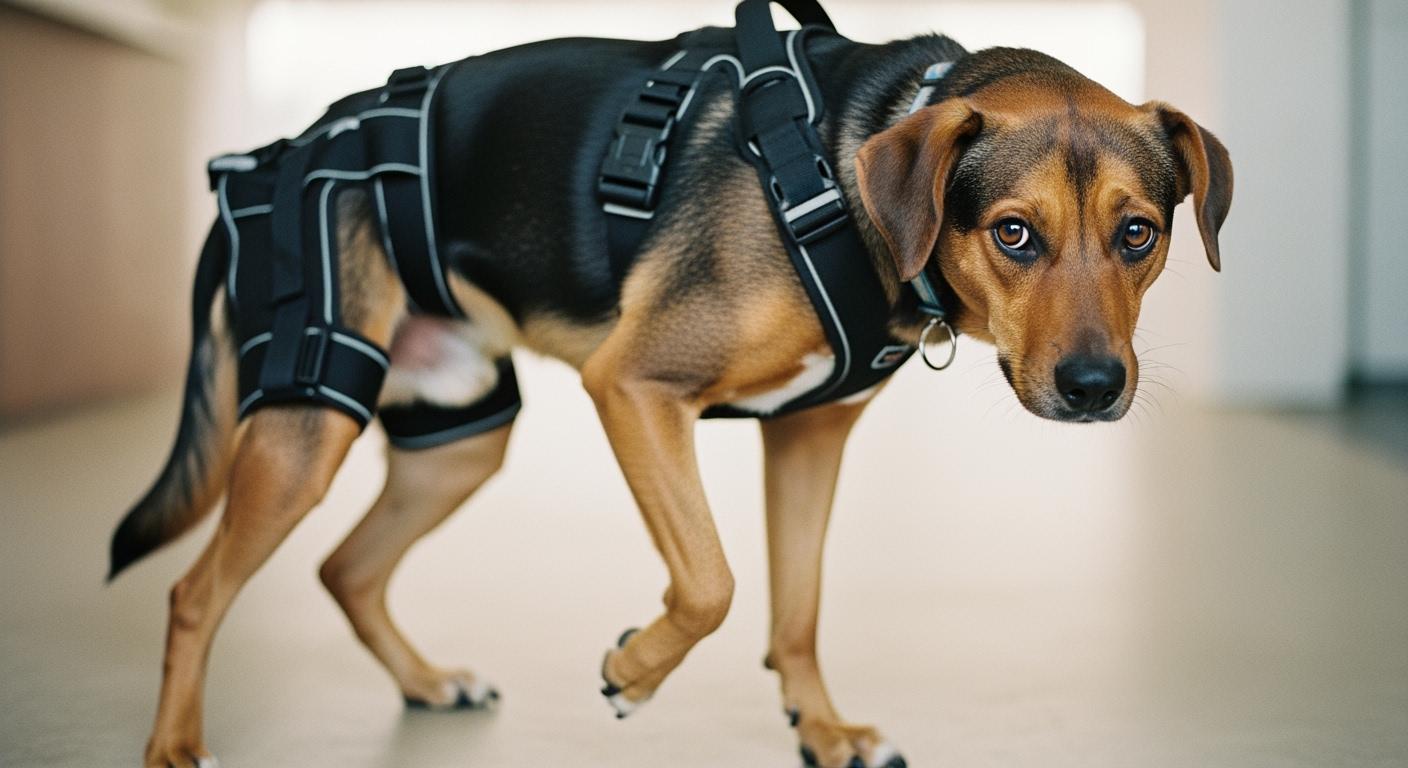
A rear support harness can help a dog stand and walk a few steps. That is the easy part. The problems begin when the dog turns, climbs stairs, or tries to urinate. These moments expose whether the harness structure actually works — or whether it introduces a new set of failures while addressing the original one.
Most harness failures are visible within the first few minutes of use. A harness that sat square at rest slides forward as the dog shifts weight from one hind leg to the other. Front legs that were steady before the lift begin to tremble. The dog stops mid-stair and will not move. This is not about handler technique. It is about how force travels through the harness — and where the structure lets it go.
Where Rear Support Harnesses Fail During Real Movement
A harness that performs well during a static standing lift can come apart mechanically the moment the dog moves. Turns, stairs, and car entry each impose a different force direction on the harness, and each one can exploit a different structural gap.
The underlying problem follows a predictable chain. When a handler lifts from the rear, the upward force enters the harness at the handle attachment point and travels down through the straps toward the dog’s body. If those straps are narrow, the force does not spread. It concentrates along a thin line of contact against the groin and inner thigh. That concentrated force finds the path of least resistance, which is forward, toward the groin. As the harness slides, the pelvic support that was supposed to anchor the hindquarters shifts with it. The rear lift now pulls against soft tissue instead of bone. The front legs, suddenly carrying more load than they were structured for, begin compensating. Compensate long enough, and they shake. That is a force-path problem built into the strap geometry, not a training gap.
After a supported walk, slide two fingers under the rear strap where it crosses the hip bone. If the strap has crept forward visibly from its starting position, the pelvic anchor has already begun to fail.
The failure patterns are consistent enough to map. Narrow straps and short handles produce the same set of problems across different breeds and body shapes, because the physics does not change.
| What happens in use | Why the rear support fails | Better structure or product direction |
|---|---|---|
| Harness slides toward groin | Narrow straps concentrate force at a single edge, and that edge follows the path of least resistance forward | Wider pelvic cradle distributes load across a broader contact surface |
| Front legs shake or buckle | Weight shifted forward as pelvic anchor slips; front legs take on hindquarter load they are not built for | Verify front leg stability before choosing rear-only support; balanced lift geometry |
| Rear panel twists on turns | No anti-rotation surface; narrow contact patch rotates freely around the dog’s body axis | Anti-slip lining, broad pelvic contact patch that resists rotational moment |
| Dog refuses stairs | Handle too short, creating a steep lift angle that jerks the hips on each step | Longer adjustable handles, lower lift angle, second handler for larger dogs |
| Potty area gets blocked | Panel extends too far forward, covering the anatomical clearance zone | Toilet-area cutout positioned to match breed-specific anatomy |
| Skin shows rubbing or trapped moisture | Strap edges dig in under load; non-breathable lining traps sweat against skin | Breathable padding, twice-daily skin inspection during repeated use |
Why the Pelvic Cradle Loses Its Anchor
The pelvic cradle is the one part of a rear support harness that determines whether the lift helps or hurts. If it stays put, force transfers cleanly to the hindquarters. If it shifts, every other failure follows.
Three structural decisions determine whether the cradle holds.
Strap width is the first. A narrow strap makes contact along a single line. Under a dog’s lifted weight, that line becomes a pressure edge. The edge digs, the dog tenses, the tension creates a gap between strap and skin, and the harness slides. A wide pelvic panel spreads the same force across several times the surface area. No single pressure point spikes high enough to trigger the dog’s withdrawal reflex. The harness stays where it was placed. Pressure points from narrow straps most often develop where the rear panel crosses the groin crease — a high-motion zone that amplifies every millimeter of strap movement.
Handle length is the second. A short handle forces the handler to lift nearly straight up. That steep angle pulls the rear panel forward and upward simultaneously, creating a vector that drives the cradle toward the dog’s belly. A longer handle lets the handler apply force at a shallower angle — closer to horizontal — which keeps the lift vector aligned with the dog’s forward movement rather than fighting it. Lift your dog on a flat surface and watch the angle between the handle and the dog’s spine. If that angle is steep enough that the panel visibly pulls forward with each lift, the harness is driving the cradle toward the belly with every ounce of lift force.
Anti-slip lining is the third. Without it, the inner face of the pelvic panel is just fabric against fur — a low-friction interface that rotates freely when the dog turns. On stairs, the lift angle changes with every step, and each change applies a small rotational moment to the panel. Without an anti-slip surface to resist those micro-rotations, they accumulate. After several steps, the panel has twisted far enough to lose its anchor entirely.
Toilet-area clearance is not a comfort feature. It is a structural requirement. If the rear panel extends forward past the anatomical clearance zone, the dog cannot urinate or defecate without the harness interfering. The dog learns to associate the harness with discomfort at the moment of highest biological urgency. That association is fast to form and slow to undo. A harness that blocks potty access will be rejected, regardless of how well it lifts.
When Rear-Only Support Is Not the Right Tool
Rear support harnesses solve one problem: hind legs that need lift assistance while the front end remains stable. The moment the front end becomes part of the equation, the tool is wrong for the job.
Front-leg weakness changes the force balance entirely. A rear harness assumes the front legs can carry the dog’s weight minus whatever the handler lifts from the back. If the front legs are themselves weak — shaking on stairs, buckling after brief standing, favoring one side — then shifting even a portion of the rear load forward creates a cascading overload. The front legs that were barely managing before now face an impossible demand. The dog compensates by leaning, which twists the harness, which shifts more weight forward. The failure loop closes.
Larger dogs amplify every structural limitation. A heavy dog on stairs generates significantly more rotational force on the pelvic panel than a small dog, simply because the lever arm from the dog’s center of mass to the handle attachment point is longer. The same narrow strap that held adequately on a small dog now faces far greater sliding force. A full-body harness distributes the lift across chest and hindquarters, which cuts the rotational moment at the pelvic cradle — not because the materials are different, but because the force pathway is split across two anchor zones instead of concentrated at one.
Disclaimer: This analysis assumes a dog with standard breed proportions. Dogs with angular limb deformities, very deep chests, or body shapes that fall well outside their breed norm may show pressure patterns that visual inspection alone cannot catch. For these dogs, run a hand under every strap contact point after the first few minutes of supported walking — subtler rub marks need tactile checking, not just a glance.
Stairs and car entry expose a different limitation. How a lift harness routes force through the hindquarters depends on whether the dog is moving on a flat plane or an incline. On stairs, the dog’s body angle changes with each step, and the harness must maintain its anchor position through that continuously shifting geometry. A rear-only panel that stays put on flat ground may rotate slightly with each stair step — enough to lose position partway up the flight. For larger dogs on stairs, a second handler or a full-body harness is often the safer path, not because rear support is inherently flawed, but because the loading conditions on stairs exceed what a single rear anchor can reliably hold.
| Dog condition | Rear-only support | Full-body support | Reason |
|---|---|---|---|
| Hind legs weak, front balance stable | Works for standing, short walks, potty breaks | Not needed | Rear lift matches the problem |
| Front legs also weak, balance poor | Not enough — shifts overload forward | Safer choice | Split anchor points prevent front-leg cascade failure |
| Large dog, stairs or car entry | Works only with second handler and longer handles | Often better | Dual lift zones reduce rotational force on each anchor |
Design Features That Change Daily Performance
The difference between a harness that works and one that fails is rarely visible on a product page. It shows up in how the harness behaves under load, during movement, and across repeated use. Four design details separate the two.
Pelvic panel width. A wide panel does more than spread pressure. It creates a contact patch large enough to generate meaningful friction against the dog’s coat, which resists the forward-sliding force that narrow straps cannot counter. Verifying whether the rear panel stays anchored during a supported walk is the single most reliable check — if the panel has not shifted by the end of that walk, the width and surface are doing their job. The contact patch also bridges across bony landmarks — the ischial tuberosities and the iliac crests — converting point loading into distributed support. A narrow strap cannot do this because it lacks the surface area to span between skeletal anchor points.
Anti-slip backing. A silicone or rubberized inner face increases the static friction coefficient between the harness and the dog’s coat dramatically compared to uncoated fabric. That friction resists the micro-rotations that accumulate during turns and stair climbing. In production, the difference between a panel that stays anchored and one that creeps is often just the durometer and pattern density of the anti-slip coating — details that are invisible in a product photo but dominate real-world performance.
Handle length and adjustability. A handle that adjusts across a meaningful range lets handlers of different heights maintain a lift angle that keeps the panel seated against the pelvis instead of pulling it toward the belly. A fixed short handle locks every handler into the same steep angle regardless of their height or the dog’s size. The handle should let the handler guide, not jerk — a lift that changes the dog’s forward momentum abruptly is a lift that is fighting the harness anchor.
Toilet-area clearance. The cutout must be positioned far enough rearward to clear the anatomical zone for the specific breed’s body length. A clearance zone that works for a Dachshund may sit too far forward on a Labrador. Wider pelvic support panels with adjustable clearance zones let the same harness design accommodate different breed proportions without sacrificing the structural anchor that keeps the cradle in place.
Häufig gestellte Fragen
How do I verify the harness fits without relying on the size chart?
Place the harness on the dog and support a standing lift briefly. Mark the strap position at the hip bone with a small piece of tape. Walk the dog on a flat surface, then check whether the tape has moved forward relative to the bone. Visible forward shift means the panel width or anti-slip surface is not holding. Size charts cannot account for coat density, body fat distribution, or the dog’s specific pelvic angle — all of which change how a given panel width performs in practice.
Why does the harness slip forward more on some breeds than others?
Coat type and body geometry interact with the harness surface in ways that a single size chart cannot capture. A short-coated dog with a deep chest and tapered waist — common in sighthounds — presents a downhill slope from pelvis to ribcage that encourages forward sliding. A double-coated breed with a broader, flatter back provides more natural friction. If a harness slides consistently on a particular dog despite correct sizing, the issue is usually the mismatch between the panel’s contact geometry and the dog’s body slope, not the size label.
What are the signs that mean stop using the harness and reassess?
Front leg trembling that begins during supported walking and continues after releasing the lift. A harness that shifts forward visibly during a single stair climb. Redness, dampness, or hair loss at any strap contact point found during twice-daily skin checks. Sudden refusal to move while the harness is on — especially in a dog that previously accepted it. Any of these signals means the current harness configuration is not matching the dog’s real movement needs, and continuing with the same setup tends to worsen the underlying fit failure rather than resolve it.
If the dog shows sudden paralysis, severe pain, repeated falling, swelling, open sores, cold paws, or loss of bladder or bowel control, stop using the harness and contact a veterinarian before further mobility attempts.
