
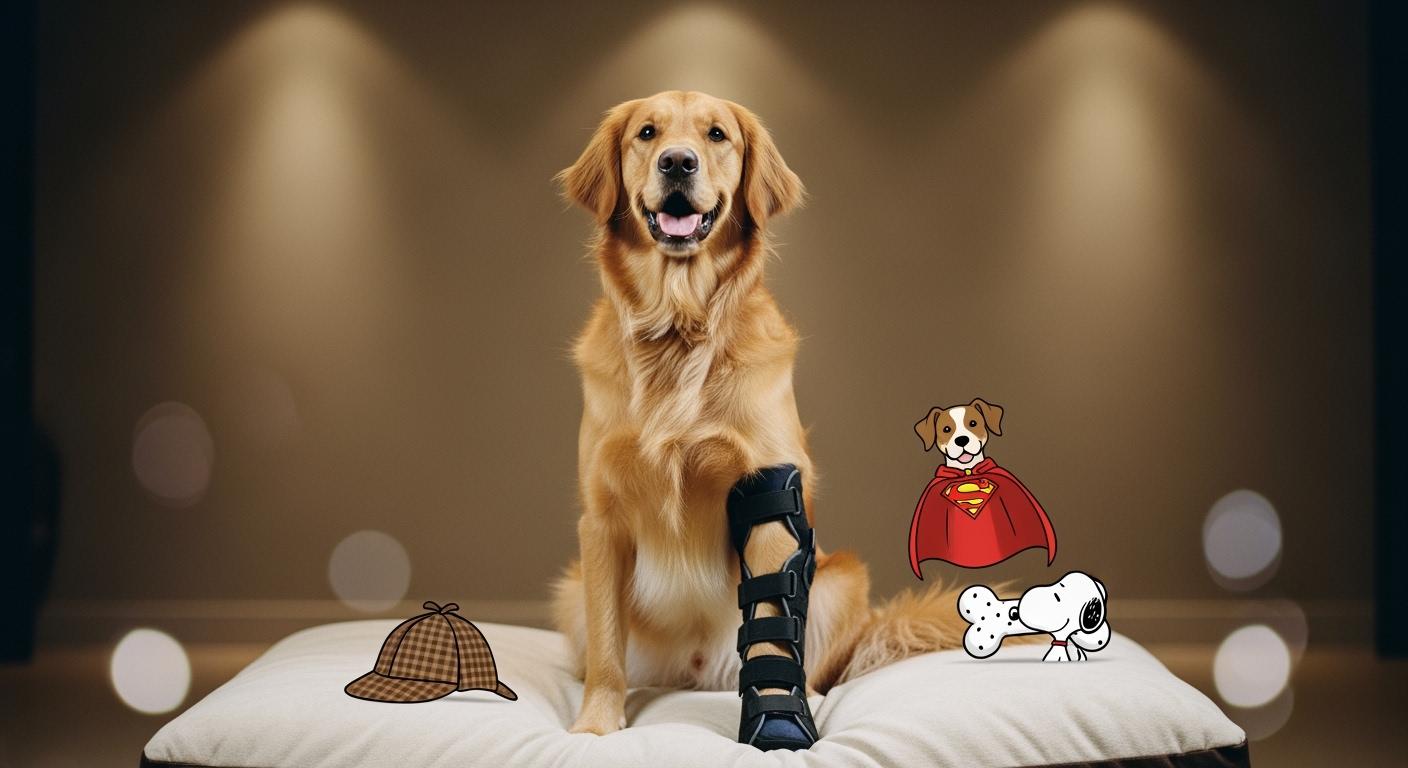
A knee brace that holds position while a dog stands still can migrate halfway down the leg within ten strides of a walk. On a small dog — a Chihuahua, a Pomeranian, a French Bulldog — the problem compounds. The leg tapers more sharply from thigh to hock. The stride is shorter and quicker. Every step pumps the brace a little farther from the stifle joint it is supposed to stabilize. What looks like a sizing error on a measuring tape is often a geometry mismatch between a cylindrical brace design and a conical leg.
Why a Knee Brace Slips on a Small Dog’s Tapered Leg
You check the measurement chart. The circumference matches. The brace goes on snug. Ten minutes later, it has ridden down toward the hock and the kneecap is getting no support at all. This is not a one-off fit mistake. It is a predictable outcome of putting a straight-tube brace on a leg that changes diameter continuously along its length.
The leg is a cone, not a cylinder
A small dog’s hind leg narrows from the thigh down through the stifle to the hock. The cross-section changes shape — not just size — along that path. A brace built as a straight wrap, even one cut to the right circumference at a single measurement point, cannot maintain consistent contact across that changing profile. As the dog walks, the wider upper portion pushes the brace downward because the narrower lower leg offers less grip surface area. The brace migrates.
This is not solved by tightening the straps harder. In fact, overtightening a cylindrical wrap on a conical leg concentrates pressure at the narrowest point — the hock — while leaving contact gaps above the stifle. The dog feels pinching at the bottom and looseness at the top simultaneously. Discomfort. Instability. Both at once.
A contoured cuff that follows the leg’s natural taper distributes contact pressure along the entire support zone. When the cuff curvature matches leg geometry, the brace resists downward migration through surface contact friction — not through strap compression. That distinction matters for small breeds with delicate skin and thin muscle coverage over the bone. A luxating patella knee brace built with a contoured cuff holds position through geometry, not through pressure.
You can verify this at home. After a 15-minute walk, mark the brace’s top edge position with a small piece of tape on the fur. Walk another 15 minutes. If the tape has moved more than half an inch relative to the brace edge, the cuff geometry is not holding — regardless of how tight the straps felt when you started.
Short strides multiply the problem
Small breeds take more steps per minute than large dogs. A Pomeranian or Chihuahua might reach 160 to 180 strides per minute at walking pace. Each stride flexes and extends the stifle. Each flexion changes the muscle profile under the brace. Each extension pushes the brace a tiny bit farther down. Over a 20-minute walk, that adds up to roughly 3,000 micro-migration cycles.
This is why slipping and rotation dominate real-use complaints about luxating patella knee braces. The stride frequency on short legs leaves no recovery time between migration cycles. The brace never gets a chance to settle back. The strap path matters here: when straps cross the stifle joint at a single narrow band, every flexion cycle pulls slack from one side and feeds it to the other. A knee support solution built for luxating patella needs a strap path that distributes retention force above and below the joint, not just cinching at the narrowest circumference.
Rotation, Edge Rub, and What Strap Path Design Actually Determines
Sliding is the most visible failure. Rotation is the one that does more damage before anyone notices. When a brace twists around the leg during movement, the support structure shifts off the patella’s tracking line. The hinge — if there is one — no longer aligns with the joint axis. The dog compensates by altering its gait, which loads other structures in ways the brace was never designed to handle.
How an unbalanced strap path creates rotation
Imagine the stifle joint as a hinge with a single pivot axis. During flexion, the tissues on the inside and outside of the leg change length at slightly different rates — the medial side compresses more on a dog with a luxating patella because the kneecap tracks laterally. If the brace straps are spaced evenly above and below the joint but the tension is symmetric, the brace resists the natural asymmetry of the joint’s movement. It twists.
The causal chain runs like this: asymmetric tissue displacement during stifle flexion → uneven tension across the strap plane → rotational torque around the leg’s long axis → brace body rotates a few degrees per step → hinge axis and joint axis diverge → edge of the brace contacts skin at an angle instead of flat → concentrated friction at one point → within days, a red patch, then a sore, then the dog refuses to wear the brace.
That fails fast.
A systematic fit check for small dog knee braces catches rotation early. After each walk, lift the brace edge and look at the fur pattern underneath. Fur that lies flat in one direction before the walk but is pushed sideways or swirled after indicates rotational shear — even if the brace looks straight from the outside. This is the earliest warning sign, visible before skin turns pink.
Padded edges near high-friction zones reduce the damage when rotation does happen, but they cannot prevent rotation itself. Only a strap path balanced for the joint’s actual movement pattern — not symmetric spacing, but balanced tension distribution during flexion — keeps the brace tracking straight. A guide to orthopedic knee brace fit and daily support walks through what balanced tension looks like in practice: the brace should resist twisting when you gently attempt to rotate it by hand, without any single strap being pulled tighter than the others.
| What happens during use | Likely reason | Better product structure | What to check next |
|---|---|---|---|
| Brace slides down toward hock | Cuff too straight or too short | Contoured cuff, taller support zone | Fit at thigh and above hock |
| Brace rotates outward | Unbalanced strap path | Balanced strap layout, shaped cuff | Strap position and tension symmetry |
| Red line under a strap | Strap tension too high | Wider strap, padded underside | Skin after 10 min of removal |
| Edge rub behind the stifle | Hard edge, thin padding | Rolled padded edge | Padding thickness at the fold |
| Dog chews or refuses the brace | Discomfort or poor fit | Softer lining, contoured shape | Behavior during first 5 min of wear |
| Brace lining stays damp | Moisture, no wicking layer | Replaceable lining, breathable fabric | Lining condition post-walk |
Tip: If the brace has a hinged side bar, run your finger along the hinge axis after the dog has walked for five minutes. The hinge should feel cool or room-temperature against the skin underneath — not warm. A warm spot directly under the hinge means concentrated friction, which means the hinge is not tracking the joint’s actual pivot point.
When a Knee Brace Cannot Do the Job
A knee brace for luxating patella supports the stifle by maintaining the kneecap’s tracking line during movement. It works when the patella luxates intermittently — slipping out during certain movements, then returning. It works when the primary need is mechanical guidance, not structural restraint.
It does not work when the patella is permanently locked out of the trochlear groove. No amount of external cuff pressure will relocate a chronically fixed luxation. It does not work when the dog has developed significant muscle atrophy in the quadriceps group — the brace can guide the kneecap, but it cannot generate the muscle force needed to keep the joint tracking properly through a full stride. It does not work as post-surgical fixation. A brace is not a substitute for internal stabilization when a surgeon has already determined that structural repair is necessary.
Mild and severe patella luxation cases place fundamentally different demands on a brace. A grade I or II luxation — where the kneecap slips but returns — typically responds to a well-fitted contoured brace that guides tracking. A grade III or IV luxation — where the kneecap stays out or requires manual reduction — may exceed what any external brace can address alone.
Disclaimer: The fit checks described here assume a short-coated small-breed dog where skin and fur changes are visible without parting the coat. Double-coated breeds like Pomeranians may show subtler rub marks that need hand-checking rather than visual inspection — run your fingertips under the brace edges, not just your eyes. If the dog’s leg conformation falls outside typical breed norms for which this brace style is patterned — particularly dogs with angular limb deformities or excessively straight stifles — the fit checks here may not catch every pressure point. A veterinarian familiar with your dog’s specific joint structure should evaluate the brace fit before extended daily use.
| Signal | What it means | Action |
|---|---|---|
| 🟢 Green | Brace stays stable, skin looks normal, dog walks without compensation | Continue use, monitor fit every few days |
| 🟡 Yellow | Mild slipping, light rubbing, brief chewing, damp lining, intermittent lameness | Adjust fit, shorten wear time, inspect skin twice daily |
| 🔴 Red | Swelling, cold toes, heat under brace, odor, discharge, pressure sore, worsening limp, repeated refusal | Remove brace, contact your veterinarian |
Häufig gestellte Fragen
How is a knee brace for luxating patella different from a general leg wrap?
A luxating patella brace is built to guide the kneecap’s medial-lateral tracking — it has a contoured cuff shaped for the stifle’s specific profile and a strap path balanced around the patella’s line of movement. A general leg wrap provides circumferential compression but does not control patellar tracking direction. The difference shows up in whether the brace resists rotation during flexion or simply squeezes the leg uniformly.
What is the first sign that a brace is causing more harm than help?
Not redness. Not limping. The first sign is a change in how the dog places the foot on that leg. A dog that starts externally rotating the paw — turning it outward during stance — is often shifting weight away from pressure or misalignment under the brace. This happens before skin damage. Watch the paw angle during the first few walks.
Does fur length affect how a knee brace fits?
Yes, and in two directions. Thick fur compresses under the brace, so a measurement taken over a full coat will read larger than the leg actually is once the fur mats down after 20 minutes of wear. The brace that fit perfectly at the start of the walk is now loose. Conversely, breeds with very short, slick coats get less natural cushioning between the brace lining and the skin, making edge padding thickness more critical. For thick-coated small breeds, re-measure after the coat has been compressed for 15 minutes and use that dimension for fit decisions.
