
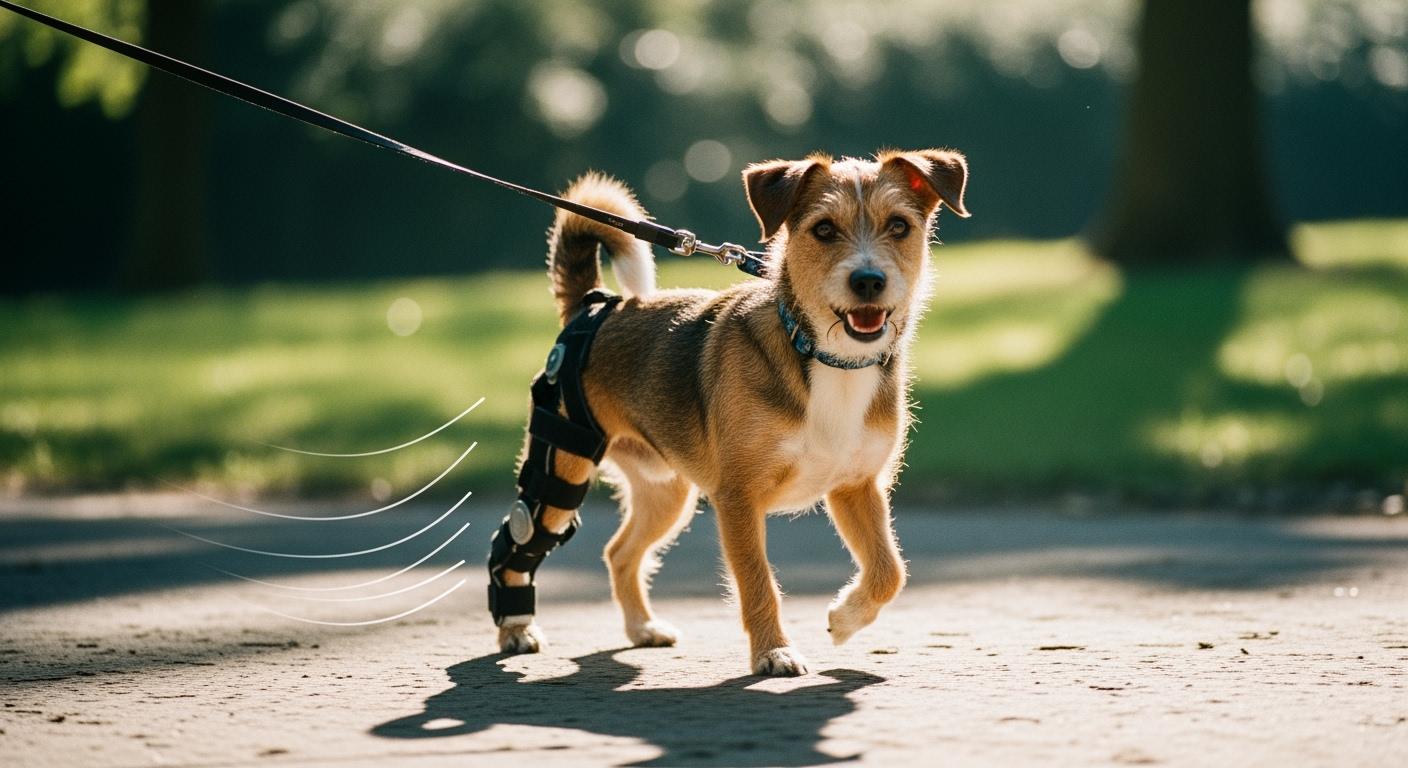
A stifle brace for small dogs can measure correctly against a size chart and still fail the moment the dog walks. The brace slides down the thigh, the hinge drifts off the knee joint, and within minutes the dog is high-stepping, freezing mid-stride, or chewing at the straps. The problem is not careless measuring. It is a geometry mismatch between standard brace proportions and the leg shape of a small dog.
Small dogs carry less muscle mass and shorter bone segments, but the real variable is the rate at which the thigh tapers into the lower leg. That steep drop-off leaves far less surface area for a brace to grip. When a brace cannot maintain its position under load, every other design feature — hinge precision, strap tension, liner material — becomes irrelevant. The brace has already lost the joint.
Why Small-Dog Thigh Taper Defeats Size-Chart Sizing
Most stifle brace size charts lean heavily on weight. Weight tells you almost nothing about the cross-section change from mid-thigh to just above the knee. In a 12-pound dog, the thigh circumference can drop by 30 to 40 percent over less than two inches of leg length. That is a steep cone. A brace cut for a gradual taper — the kind found on larger breeds — will grip the upper thigh adequately but leave the lower half of the brace floating. Once the dog takes a step and the knee flexes, the unsupported section shifts.
Here is the chain of events that follows. The brace slips downward. The hinge, which was positioned over the knee joint at standing, now sits below it. Knee flexion applies force through an off-axis pivot point instead of a matched rotational center. That off-axis input concentrates pressure on one side of the joint capsule. The dog compensates by shortening the stride or externally rotating the leg. Within days, the altered gait pattern produces secondary soreness above or below the original problem site.
This is why knee brace fit for small dogs turns on leg geometry, not body weight. A brace that cannot hold its hinge-to-joint relationship through a full stride cycle is not providing joint stabilization — it is providing resistance the dog has to work around.
In practice: After 10 minutes of walking on flat ground, slide two fingers under the brace at the mid-thigh. If the gap has opened more than a quarter-inch compared to standing fit, the taper mismatch is already eating into support.
Strap width and the anti-rotation surface
Narrow straps concentrate retention force along a thin line. On a small-dog leg, that line sits on top of a rounded, low-muscle surface. When the dog moves laterally or pivots, the strap has no surface width to resist rotation. The edge digs, the strap rolls, and the brace twists around the leg. Multi-point straps spread the same total retention force across two or three wider bands, each contributing part of the hold. That configuration creates an anti-rotation surface — the wider combined footprint resists torque better than any single strap ever could, regardless of how tight it is pulled.
Check this directly: walk the dog for 10 minutes, then mark the strap edge position against the fur with a finger. Walk another 5 minutes. If the strap has migrated more than half an inch from the original mark, the brace is rotating under load. Small-dog knee brace fit checks during movement catch slippage that standing inspection misses entirely.
When Hinge Bulk Fights a Short, Quick Stride
A low-profile hinge does not mean a weaker hinge. It means the structural elements that provide medial-lateral stability are arranged in a flatter plane, reducing the protrusion off the side of the leg. This matters disproportionately for small dogs because the ratio of hinge thickness to leg diameter is far higher than in a large dog wearing the same hinge design. A 6-millimeter hinge housing on a 40-millimeter leg diameter occupies 15 percent of the available space. That same hinge on a large-breed leg might occupy 5 percent. The small dog feels the bulk geometrically amplified.
Stifle brace design for daily use on small dogs must account for this ratio, not just scale the dimensions down proportionally from a large-breed template. A scaled-down large brace still carries hinge proportions calibrated for a different leg diameter — and a different stride length.
| What the buyer checks | Why it matters for small dogs | Common failure | Better design direction |
|---|---|---|---|
| Brace length | Matches short stride | Misses knee or slides | Small-dog-specific length |
| Hinge or support thickness | Avoids bulk | Blocks flexion | Low-profile hinge |
| Upper strap layout | Holds brace in place | Bunches or slips | Multi-point adjustment |
| Liner breathability | Prevents heat and marks | Skin gets hot or red | Breathable lining |
| Edge softness | Protects skin | Causes pressure marks | Soft edge binding |
| Adjustment range | Fits unique leg shape | Too tight or loose | Flexible adjustment |
| Cleaning and drying ease | Keeps brace fresh | Odor or moisture | Easy-clean materials |
Walk the dog on a non-slip surface for 10 minutes and watch from the side at leg level. A normal stride should show the knee tracking forward and back smoothly. If the dog lifts the whole leg upward before swinging it forward — a marching step — the hinge is likely blocking flexion. Remove the brace and repeat the walk. If the marching step disappears, the brace profile is the cause. A structured walking plan with a stifle brace catches this pattern early, before the dog develops a compensatory habit that outlasts the brace wear period.
When the Brace Should Be Paused or Replaced
Three signals tell you the brace is working against the dog rather than with the joint. None of them are subtle.
Gait gets worse instead of steadier
A stifle brace should not make a dog limp more. If the dog was weight-bearing before the brace and begins toe-touching or carrying the leg after wearing it, the brace is introducing a new mechanical problem — most often hinge-joint misalignment or a flexion block. Pause use immediately. Test the dog’s gait without the brace. If the limp resolves within minutes of removal, the brace fit or geometry is the cause, not the underlying condition.
Skin tells the pressure story
Red marks that fade within 20 minutes of brace removal are within normal tolerance. Marks that persist longer, feel warm to the touch, or show any broken skin are pressure injury signals. On small dogs, the most common sites are the leading and trailing edges of the upper strap and the point where the hinge housing contacts the leg. Check these spots twice daily during the first week.
The brace cannot stay centered
If the brace has rotated more than 30 degrees around the leg or slipped more than half an inch below the original knee reference point within a single 10-minute walk, the geometry is fundamentally mismatched. Repeated strap tightening will not fix this — it only increases pressure at the edges while the brace continues to migrate. The brace needs a different length, taper profile, or strap configuration.
Disclaimer: Short-coated small breeds show rub marks and pressure signals visibly; double-coated breeds may hide early skin changes under the fur. For dense-coated dogs, rely on hand-checking — run fingers along strap edges and hinge contact zones after every wear session rather than waiting for visual signs. Dogs with angular limb deformities or unusually deep chests may fall outside the conformational norms this brace geometry was patterned for, and the fit checks described here may not catch every pressure point.
| Status | What you see |
|---|---|
| Green | Brace stays centered, dog walks steady, skin looks normal after removal |
| Yellow | Mild shifting, short-term red marks that fade within 20 minutes, slight awkwardness that improves |
| Red | Worse limp, swelling, heat, open skin, cold paw, panic, chewing, refusal to move |
A stifle brace for small dogs is not a smaller large-breed brace. It needs a taper-matched shell, a low-profile hinge, and a multi-point strap layout that resists rotation on a leg with less surface area to grip. Knee braces built for CCL tears that incorporate these geometric adjustments tend to hold position through a full stride cycle better than braces that scale dimensions without recalibrating the proportions.
If any red-zone signal appears, pause use and have a veterinarian assess whether the brace geometry matches the dog’s leg conformation. A fit and support plan built around small-dog proportions starts with confirmation that the brace can physically track the joint through the dog’s actual range of motion — not just look correct at a standstill.
Häufig gestellte Fragen
How long should a small dog wear a stifle brace each day?
Begin with 10 to 15 minutes of supervised walking on flat, non-slip ground. If skin and gait checks pass, increase by 5 to 10 minutes per session. The total daily wear time matters less than whether the brace holds position for the full duration of each session. A brace that stays aligned for 15 minutes but shifts at 20 is not ready for 20.
Can a dog sleep in a stifle brace?
No. Unsupervised wear during sleep removes the ability to catch pressure buildup, shifting, or skin changes. The brace is a movement device — it is designed to manage joint loading during activity, not to immobilize during rest.
What is the first sign the brace does not fit?
Usually it is the dog shortening the stride or high-stepping within the first 5 minutes of walking. Visible brace slippage often comes later. Gait changes precede visible migration — the dog feels the interference before you can see it.
Why does the brace slide even when the straps feel tight?
Tight straps do not fix a taper mismatch. If the brace shell is cut for a more gradual thigh-to-lower-leg slope than the dog actually has, tightening the straps only increases edge pressure while the brace continues to migrate downward during flexion. The fix is a brace length and taper profile that matches the leg, not higher strap tension.
