Imagine your dog limping after a long walk or after knee surgery. A dog knee brace is a helpful device that keeps the knee steady. It lowers pain and helps healing by stopping strange movement. You can help your dog feel better, but always listen to your veterinarian’s advice.
Key Takeaways
A dog knee brace helps the stifle joint. It lets your dog walk easier and have less pain. – Braces help dogs with injuries like torn CCLs or after surgery. They help dogs heal and move better. – Always ask your veterinarian about fitting and using a brace. This makes sure your dog is comfortable and heals well.
What Is a Dog Knee Brace?
What Is a Dog Knee Brace?
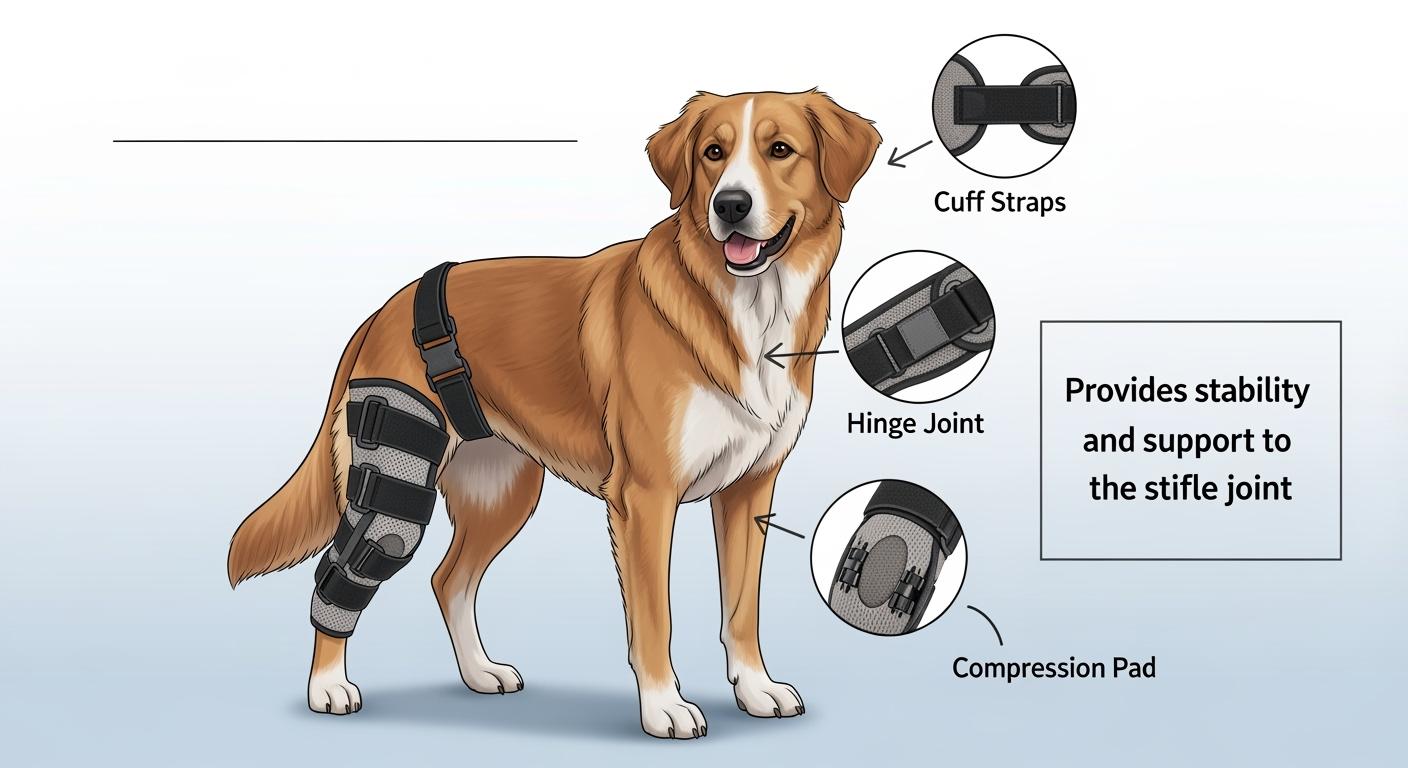
A dog knee brace is a special support device that you place around your dog’s knee joint. You use it to help your dog walk better and feel less pain when the knee is hurt or weak. Dog knee braces keep the knee steady and help your dog move with more confidence.
Which Part of the Leg Does It Support?
The brace supports the stifle, which is the dog’s knee. The stifle connects the femur (thigh bone) to the tibia (shin bone). When you use a stifle brace, you help keep these bones in the right place. This support is important for dogs with injuries to the cranial cruciate ligament (CCL), which is like the ACL in people.
Briefly explain how it works: support, stabilization, pain relief, and improved mobility.
Dog knee braces work by holding the knee joint steady. They limit harmful movements that can make injuries worse. The brace gives gentle compression, which helps reduce swelling and pain. It also helps your dog use the leg more, so muscles stay strong. Many owners ask, “How do ACL knee braces for dogs work?” The answer is: they stabilize the knee, reduce pain, and help your dog walk better.
Tip: The best dog knee brace uses medical-grade materials and fits well, so your dog feels comfortable and safe.
When Do Dogs Need a Knee Brace?
Veterinarians often recommend a dog knee brace for dogs with a torn CCL, a luxating patella (when the kneecap slips), ligament sprains, or after knee surgery. For example, Bella, a 9-year-old Labrador, had a partial CCL tear. Her vet suggested a hinged brace instead of surgery. After a few weeks, Bella walked with less pain and enjoyed her walks again. Brands like GaitGuard focus on quality and innovation to help dogs recover and stay active.
Key Medical Terms Related to Dog Knee Braces
Stifle – what it is and why it matters.
You might see “stifle” in your vet’s notes or on a brace box. The stifle is your dog’s knee joint. It joins the thigh bone and shin bone. The stifle lets dogs walk, run, and jump. If this joint gets hurt, moving is hard and hurts.
The stifle joint is like a person’s knee. It helps dogs move and carry weight. Stifle disease means problems with the cranial cruciate ligament, which is like the ACL in people.
A brace can protect the stifle and help your dog move better.
CCL – Cranial Cruciate Ligament – role in stability and common injuries.
The cranial cruciate ligament (CCL) is a strong band in the stifle. It connects the femur and tibia. This keeps the knee steady. Your vet may call it the “ACL” because it is like the one in people.
The CCL is a main stabilizer in the stifle. It links the femur and tibia in this tricky joint. In people, it is called the ACL. The CCL stops the shin bone from moving forward and controls how the stifle turns. If the ligament tears, it can be a small or big tear. This causes the back leg to feel weak, wobbly, and sore.
About 11% of dogs at the vet have CCL injuries.
These injuries make the stifle loose and cause pain and limping.
Dogs with CCL injuries may need a knee brace to help them heal.
Patella – brief note on patellar luxation, if relevant.
The patella is the kneecap. It sits in front of the stifle and helps the knee move. Sometimes, the patella slips out of place. Vets call this “patellar luxation.” You might see this word in X-rays or vet notes.
Patellar luxation is common in small dogs like Pomeranians and Chihuahuas.
About 1.3% of dogs in a big study had patellar luxation.
This problem can cause arthritis and limping that lasts.
Medial luxation happens more than lateral luxation.
Treatment can be surgery or using a brace for help.
Meniscus – simple explanation of its cushioning function.
The meniscus is a small piece of cartilage in the knee. It acts like a cushion between bones. The meniscus soaks up shock and helps the joint move. If your dog tears the meniscus, the knee will hurt more and feel less steady.
The meniscus helps spread weight and takes in stress. It also keeps the knee from bending too far. Meniscus injuries often happen with CCL tears. These injuries can make things worse and speed up joint problems. Many dogs need surgery for meniscus injuries, but a brace can help the joint while healing.
Conservative management – what it means when vets use this term.
Your vet may say “conservative management” for knee injuries. This means treating your dog without surgery. Conservative management uses rest, medicine, and rehab therapy. A dog knee brace supports the joint and lowers pain.
Conservative management can help your dog move and slow down arthritis. Some dogs get better this way, but others may still need surgery.
Post-operative / Rehab – how braces can be used in these phases.
After surgery, your dog needs time to heal. Vets often suggest a dog knee brace during recovery. The brace keeps the knee steady and helps your dog walk safely.
Statistic / Finding | Description |
|---|---|
79% Return to Normal Function | 79% of dogs with carpal ligament instability got back to normal when using the right knee brace. This shows how important a good fit is. |
88% Recovery Success Rate Post-Surgery | Studies show 88% of dogs feel less pain and move better after surgery when they use a knee brace. |
88% Owner-Reported Mild to No Lameness | 88% of owners said their dogs had little or no limping while wearing stifle orthoses. This means good symptom control. |
Vets say a well-fitted brace helps dogs heal faster and live better. GaitGuard uses strong materials and adjustable designs to make sure the brace fits and helps healing. Always listen to your vet and check the brace fit often.
Tip: Pick a brace with straps you can adjust and soft padding. This keeps your dog comfy while healing.
Product & Design Terms for Dog Knee Braces
Orthosis / Orthotic brace – what “orthotic” means.
You might see “orthotic” when looking for dog knee braces. In vet care, an orthotic device helps weak or hurt joints. Dog knee braces are orthotic devices that support your dog’s knee. They are helpful if your dog has a cranial cruciate ligament tear. You can use these braces before or after surgery. They also help if surgery is not possible. Orthotic braces help your dog walk better and heal faster.
Hinged vs. Non-hinged brace – how this affects movement and support.
Dog knee braces come in two main types: hinged and non-hinged. A hinged brace has a joint that lets your dog bend the knee. Non-hinged braces keep the knee steady but limit movement more. The table below shows how they are different:
Feature | Traditional Dog Knee Braces | Hinged Dog Knee Brace |
|---|---|---|
Support Level | Moderate | High |
Movement Restriction | Some movement | Natural movement |
Comfort | May be less comfortable | Needs professional fit |
Ease of Use | Easy to put on | May need help |
Cost | Less expensive | More expensive |
Pick a hinged dog knee brace for bad injuries. Hinged braces are good when your dog needs to move the knee more naturally.
Unilateral vs. Bilateral – when each type is used.
Dog knee braces can help one leg (unilateral) or both legs (bilateral). Use a unilateral brace if only one knee is hurt. Pick a bilateral brace for hip dysplasia, arthritis, or if both knees need help. The table below explains when to use each one:
Type of Brace | Clinical Indications |
|---|---|
Bilateral | Hip dysplasia, arthritis, post-surgery, neurological issues, ligament injuries, weakness |
Unilateral | Injury in one knee, other knee healthy |
Compression – how gentle compression helps.
Gentle compression from dog knee braces helps in many ways:
It keeps the joint steady and stops more injury.
It lowers strain on ligaments and helps healing.
It lets muscles heal in a natural way.
It limits movement that could make things worse.
It helps reduce swelling.
It spreads weight to take off pressure.
Support / Stabilization – what brands mean by these words.
When brands say their brace gives “support” or “stabilization,” they mean it keeps your dog’s knee steady. This helps your dog walk with less pain. It also stops the knee from moving in ways that can hurt it. Support and stabilization are important for healing and comfort.
Common material terms: neoprene, rigid frame, padding, breathable fabric, anti-slip straps, etc.
Dog knee braces use different materials for comfort and strength. Here are some common words you might see:
Material Type | Impact on Comfort and Durability |
|---|---|
Medical-grade materials | Safe and gives good support |
Hypoallergenic orthopedic padding | Soft, helps stop skin problems |
High-temperature thermoplastic frame | Strong, keeps the knee steady |
Aircraft-grade aluminum, stainless steel | Tough, lets the knee move naturally |
You might also see neoprene for flexibility, breathable fabric for comfort, and anti-slip straps to keep the brace in place. Custom and semi-custom dog knee braces use these materials for different dogs and activities.
Tip: Always check if the brace fits and feels good. Try it inside first and let your dog get used to it. Ask your vet if you have questions.
Main Functions and Indications of Dog Knee Braces
Core Functions of a Dog Knee Brace
provide extra stability to the stifle
A dog knee brace gives extra support to the stifle joint. This helps your dog stand and walk better. The brace stops the knee from moving in painful ways. It helps your dog feel safer when walking.
reduce pain and limping
Dog knee braces lower pain and limping. If your dog has knee problems, you see less limping with the brace. The best brace helps your dog feel good during walks and play. Your dog can enjoy moving around more.
support healing during rehab or conservative management
You can use a dog knee brace during rehab or conservative care for a torn CCL/ACL. The brace lets the hurt leg rest and heal. It helps your dog get stronger without hurting the joint. The brace makes recovery easier for your dog.
Dog knee braces do more than just support. They help your dog walk better and know where the joint is. Braces help healing, lower tiredness, and cushion falls. Your dog’s muscles get time to rest and heal.
When Vets Commonly Recommend a Brace
partial/complete CCL tear
A dog knee brace for torn acl helps with a partial or complete ccl tear. This injury makes the knee weak and sore.
post-surgery protection
After surgery, a dog knee brace for torn acl keeps the joint safe. It helps your dog heal faster and keeps the knee steady.
chronic joint disease in senior dogs
Older dogs with joint disease get help from dog knee braces. These braces support joints and help dogs move better. You can also use a dog knee brace for luxating patella if your dog’s kneecap slips.
Emphasize that a knee brace is an assistive tool, not a cure.
A dog knee brace does not fix injuries. It helps your dog move and feel less pain. Always listen to your vet and use the brace as part of your dog’s care plan.
Types of Dog Knee Braces
Briefly classify common types:
Soft neoprene braces with straps
Soft neoprene braces are made from stretchy, soft material. You wrap them around your dog’s knee and fasten the straps. These braces are good for small injuries or when your dog first needs help.
Rigid or semi-rigid braces
Rigid or semi-rigid braces have hard frames. They give strong support and stop the knee from moving the wrong way. You might pick this type if your dog has a bad injury or needs more help after surgery.
Single-leg vs. dual-leg designs
Single-leg braces help just one knee. Dual-leg braces help both knees at once. Dual-leg braces often have a strap that goes over the hips or waist.
Braces with waist/hip straps to prevent slipping
Some braces have waist or hip straps. These straps keep the brace from sliding off. This is helpful if your dog moves a lot or if the brace falls off easily.
For each type, note basic pros and cons and typical use cases.
Type | Pros | Cons | Typical Use Case |
|---|---|---|---|
Soft neoprene braces | Light, simple to use, comfortable | Not enough support for big injuries | Small sprains, early healing |
Rigid/semi-rigid braces | Very strong, stops bad movement | Bigger, needs careful fitting | After surgery, big ligament tears |
Single-leg design | Helps one knee, not bulky | Does not help the other knee | One knee hurt |
Dual-leg design | Helps both knees, keeps balance | Harder to fit right | Both knees weak or hurt |
With waist/hip straps | Stops slipping, stays on better | Takes more time to put on | Active dogs, loose braces |
Tip: Try different braces inside first. Watch your dog walk and make sure the brace feels good before going outside.
Choosing the Right Dog Knee Brace: Measurements and Fit
Explain where and how to measure:
thigh girth, above/below stifle, leg length, etc.
You want your dog’s knee brace to fit well. Start by measuring your dog’s leg in several places. Use a soft tape measure and keep your dog standing for the most accurate results.
Measure the distance from the top of the thigh down to the stifle (knee).
Measure from the stifle down to the hock (the ankle joint).
Wrap the tape around the widest part of the upper thigh to get the thigh girth.
Measure the circumference around the stifle area.
Stand behind your dog and check which leg needs support—right or left.
Write down each number. These measurements help you choose the right size.
Give simple guidance on:
reading size charts
importance of a snug but not overly tight fit
trying the brace indoors first and letting the dog adapt gradually.
Look at the size chart from the brace manufacturer. Match your measurements to the chart. Pick the size that fits your dog’s numbers best. The brace should feel snug but not squeeze the leg. You want it to stay in place without causing discomfort.
Let your dog wear the brace indoors first. Watch how your dog walks and moves. Give your dog time to get used to the new feeling. Most dogs need a few days to adjust.
Tip: A good fit helps your dog heal and move comfortably. Always check the brace after walks.
Mention signs of poor fit: slipping, rubbing, red marks, or increased limping.
Watch for signs that the brace does not fit well:
Slipping or sliding out of place
Rubbing or red marks on the skin
Limping or favoring a leg
Excessive licking or biting at the brace
Restlessness or vocalizing
If you see these signs, stop using the brace and talk to your veterinarian. A poor fit can cause pain and slow down recovery.
Safe Use, Monitoring, and Veterinary Guidance
Recommended wearing time (activity vs. rest).
Your dog should wear the knee brace for 6 to 12 hours each day. Put the brace on when your dog is active. This means walks, play, or exercise. Use it outside or in new places. Also use it when your dog meets other dogs. Take the brace off when your dog is resting or sleeping. Only leave it on at rest if your veterinarian says so.
Wear the brace during:
Walks
Playtime
Exercise
Time outside
New places
Meeting other dogs
Remove the brace when your dog is:
Resting
Sleeping
In a safe place
Skin and coat checks after use (redness, chafing, dampness).
Check your dog’s skin and fur each time you take off the brace. Look for red spots, rubbing, or wet areas. Almost half of owners see some skin problems after using a knee brace. If you see any skin trouble, change how the brace fits or ask your veterinarian for help. Checking often and making small changes keeps your dog comfy.
When to stop using the brace and contact a vet: sudden pain, refusal to walk, swelling, etc.
Stop using the brace and call your veterinarian if you see:
Sudden pain or yelping
Not wanting to walk or use the leg
Swelling near the knee or paw
Red, sore, or bleeding skin
Signs your dog is upset or hurting
Remind readers to follow their veterinarian’s treatment plan and use the brace as part of a comprehensive approach.
Always do what your veterinarian says for your dog’s care. The knee brace helps most when used with other care steps. Use the brace, give rest, and do gentle exercise. Go to regular check-ups. Your veterinarian can change the plan as your dog gets better.
Remember: The knee brace helps your dog heal, but your veterinarian’s advice is most important for long-term health.
FAQ: Common Questions About Dog Knee Braces and Terms
Do knee braces replace surgery?
You might wonder if a dog knee brace can take the place of surgery. Most veterinary experts say surgery is the gold standard for severe ligament injuries. However, not every dog is a good candidate for surgery. Some dogs are too old or have health problems that make surgery risky. In these cases, a brace can help your dog heal and stay comfortable.
Dr. Lisa Freeman, a veterinary orthopedic specialist, explains that braces work well as part of conservative treatment, especially when you combine them with physical therapy and weight control.
Braces offer crucial support for dogs who cannot have surgery, and studies show they help the knee heal naturally.
Note: Always talk to your veterinarian to decide what is best for your dog’s health.
Can small dogs use a dog knee brace?
Yes, small dogs can use a dog knee brace safely and effectively. Modern braces fit dogs of all sizes. Designers use soft, durable materials that keep small breeds comfortable. The best dog knee brace limits harmful movement and supports the knee joint. Regular use helps prevent muscle loss and keeps your dog active.
Braces help with pain relief and improve how your dog walks.
Vets recommend braces for small dogs with knee injuries because they are safe and low-risk.
How long does my dog need to wear the brace each day?
Most dogs wear their brace for 6 to 12 hours daily. You should put the brace on during walks, playtime, or any activity. Remove it when your dog rests or sleeps unless your vet says otherwise. Always check your dog’s skin after taking off the brace.
What if I don’t understand the terms on the product page or vet report?
If you see words you do not know, ask your veterinarian for help. You can also look up simple explanations online or ask the brace manufacturer. Understanding these terms helps you make better choices for your dog’s care.
Can a brace be used on both back legs?
You can use braces on both back legs if your dog needs support on each side. Some braces are made for one leg, while others support both. Your veterinarian can help you choose the right type for your dog’s needs.
When you understand dog knee brace terms and functions, you make better choices for your pet. You can:
Talk clearly with your veterinarian.
Decide on the best treatment for your dog.
Learn about braces as non-surgical options.
Every dog is unique. Always follow your vet’s advice.
More Questions About Daily Use
Can a dog knee brace help with arthritis?
Yes, you can use a dog knee brace to support joints and reduce pain from arthritis. Your dog may walk more comfortably with extra stability.
How do you clean a dog knee brace?
You should hand wash the brace with mild soap and cool water. Let it air dry before you put it back on your dog.
What if my dog tries to chew the brace?
Try using a soft cone or distraction toys. You can supervise your dog until they get used to wearing the brace.