
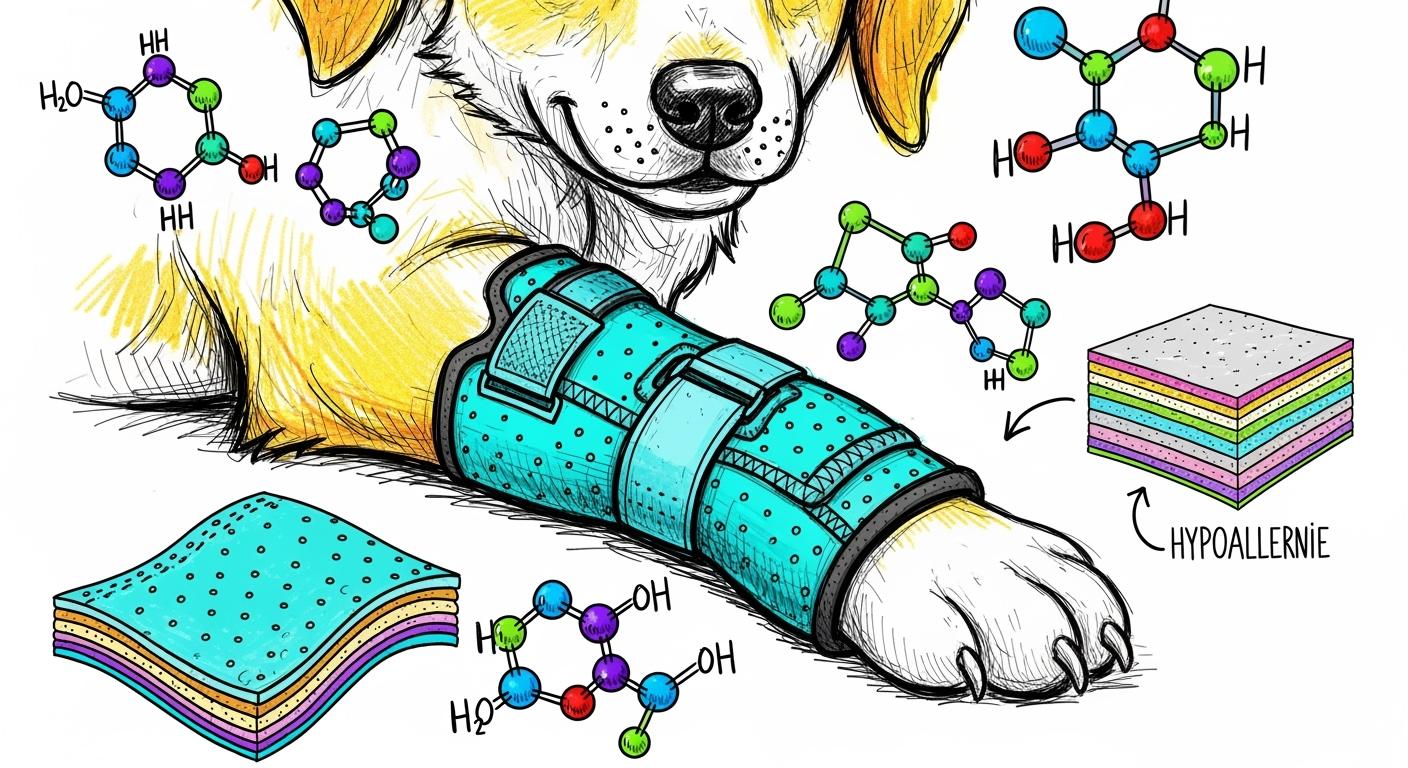
Medical-grade neoprene for dog braces is often presented as a single sign of quality, but the phrase alone does not explain how a brace will feel, fit, ventilate, or hold its shape. The finished result depends on the foam type, blend, thickness, surface fabric, lamination, perforation, edge binding, seams, straps, and overall brace structure.
This knowledge-base guide explains the practical differences among chloroprene rubber (CR), styrene-butadiene rubber (SBR), and blended foam used in canine support products. It also shows why material names should be evaluated together with the construction of the complete dog brace, rather than treated as a guarantee of comfort or support.
Data authenticity note: Material properties vary by formulation, supplier, thickness, density, lamination, and production method. A general label such as “medical-grade,” “CR,” “SBR,” or “neoprene” is not enough to define the performance of every finished brace.
Key Takeaways
- “Medical-grade neoprene” should not be treated as a complete material specification. The exact foam, thickness, textile layers, adhesive system, and finished construction still need to be understood.
- CR, SBR, and CR/SBR blends can each be produced in different grades. No single material label automatically determines comfort, durability, or suitability.
- Closed-cell foam has limited airflow. Heat and moisture management depend on perforation, coverage area, thickness, laminated fabric, edge design, fit, and wear duration.
- Thicker foam can add bulk and cushioning, but it does not replace splints, hinges, stable straps, correct sizing, or pressure distribution.
- Skin tolerance depends on the complete contact system, including fit, seams, edges, moisture, movement, and the individual dog—not only the foam name.
What Neoprene Means in a Dog Brace
In a dog brace, neoprene usually refers to a flexible foam core laminated with one or more textile layers. The foam supplies thickness, flexibility, and a degree of cushioning. The outer fabric affects surface feel, abrasion resistance, stretch behavior, hook-and-loop attachment, and how easily the brace can be sewn or edged.
The word “neoprene” is sometimes used broadly in product descriptions. One brace may use CR foam, another may use SBR foam, and another may use a CR/SBR blend. Even when two materials have the same general name, their density, hardness, stretch recovery, odor, surface finish, and thickness tolerance may differ.
What “Medical-Grade Neoprene” Does—and Does Not—Tell You
The phrase “medical-grade neoprene” may be used to communicate that a material is intended for prolonged contact or a health-related product category. However, the phrase by itself does not identify the exact composition, supplier grade, test scope, thickness, foam density, surface textile, adhesive, or finished-product construction.
It should therefore be treated as a starting description rather than proof that a brace is automatically breathable, hypoallergenic, clinically tested, or suitable for every dog. Those conclusions require product-specific information and, where applicable, supporting documentation that matches the actual material used.
The most useful questions are practical: What is the foam type? How thick is it? What fabric is laminated to it? Is it perforated? How are the edges finished? Where do seams and closures contact the body? How does the complete brace remain aligned during movement?
CR, SBR, and CR/SBR Blends
| Material direction | General characteristics to evaluate | What the label does not guarantee |
|---|---|---|
| CR foam | Can be selected where resilience, environmental resistance, surface feel, or a particular stretch profile is required. | Comfort, airflow, skin tolerance, correct thickness, or consistent finished-brace fit. |
| SBR foam | Often considered when cost control, softness, flexibility, and general cushioning are important. | That every SBR grade behaves the same or is limited to short-term use. |
| CR/SBR blend | Can balance cost, flexibility, resilience, and processing requirements depending on the formulation. | A fixed percentage, performance level, or suitability for a specific brace structure. |
CR should not automatically be described as the only acceptable material for long-term canine braces, and SBR should not automatically be described as unsafe or low quality. Formulation and construction matter. A well-finished blended foam in an appropriate structure may perform better than a poorly laminated material sold under a premium label.
Closed-Cell Foam, Heat, and Moisture
CR and SBR brace foams are commonly supplied as closed-cell materials. Closed cells help the foam resist direct water absorption, but they also limit airflow through the foam itself. This is why a solid neoprene panel should not be described as naturally breathable without considering the complete design.
Heat and moisture beneath a brace are affected by several connected variables:
- foam thickness and coverage area;
- perforation size, spacing, and placement;
- the type and weight of the laminated textile;
- strap overlap and layered sections;
- how tightly the brace is fitted;
- activity level, climate, coat density, and wear duration.
A brace with a small foam panel and open coverage may manage heat differently from a full-wrap brace made from the same nominal material. Material comparisons should therefore be made in the context of the complete product.
Thickness Changes Flexibility, Bulk, and Contact Pressure
Foam thickness influences how a brace bends, compresses, and occupies space around the limb or body. Thinner foam generally creates less bulk and may follow movement more easily. Thicker foam may add cushioning and a firmer feel, but it can also increase heat retention, edge pressure, strap stack-up, and difficulty fitting around joint contours.
Thickness alone does not determine support level. A soft wrap made from thicker foam does not become a hinged brace, and a thinner material can still be part of a stable design when combined with suitable splints, panels, straps, and alignment features.
| Construction variable | Possible effect on the finished brace | Common failure to check |
|---|---|---|
| Thinner foam | Lower bulk, easier bending, closer contouring. | Insufficient cushioning, curling, or loss of shape if the rest of the structure is weak. |
| Thicker foam | More cushioning and a firmer hand feel. | Heat buildup, bulky overlap, hard edges, or restricted joint clearance. |
| Soft foam | Flexible contact and easier compression. | Excessive collapse, strap migration, or poor shape retention. |
| Firmer foam | More structure and resistance to compression. | Pressure concentration or reduced conformity around changing body contours. |
Perforation and Airflow
Perforation creates openings through the foam and can improve ventilation compared with an otherwise identical solid panel. Its effect depends on the number, size, and position of the holes, as well as the fabrics laminated over the foam. A dense outer textile or several overlapping layers can reduce the practical airflow gained from perforation.
Perforation also changes the mechanical behavior of a panel. Too much open area can reduce tear resistance or allow the panel to deform around strap anchors and seams. The design should balance ventilation with the strength required by the intended brace structure.
Practical point: “Perforated neoprene” describes one construction feature. It does not prove that an entire brace will remain cool, dry, or irritation-free during prolonged wear.
Lamination: Foam Is Only the Core
Neoprene foam is commonly laminated to nylon, polyester, jersey, loop fabric, or another textile. The surface layer can change stretch recovery, abrasion resistance, hook-and-loop compatibility, hand feel, drying behavior, and sewing performance.
A material may feel soft when new but still fail if the lamination wrinkles, separates, stretches unevenly, or becomes rough after repeated bending. The adhesive and lamination process also matter. It is not enough to describe an adhesive as “eco-friendly” or “skin-safe” without a defined specification or supporting documentation.
| Layer or detail | What it influences | What to inspect |
|---|---|---|
| Outer textile | Abrasion resistance, appearance, stretch, and hand feel. | Pilling, snagging, color transfer, surface roughness, and uneven stretch. |
| Inner contact textile | Contact feel and moisture behavior against the coat or skin. | Rough fibers, folds, exposed adhesive, and seam placement. |
| Lamination bond | Whether the foam and fabric move as one structure. | Bubbles, wrinkles, edge lifting, or separation after bending. |
| Loop-compatible surface | Closure placement and adjustment range. | Premature fuzzing, weak engagement, and hook damage to nearby areas. |
Edges, Seams, and Closures Often Matter More Than the Foam Name
Many brace complaints begin at a contact edge, seam, strap junction, or hook-and-loop corner rather than in the center of the foam panel. A material described as premium can still create problems when the binding is stiff, the seam allowance forms a ridge, or the closure shifts into a high-motion area.
- Edge binding: should bend with the panel without creating a sharp lip.
- Seam placement: should avoid concentrated rubbing at flexion points and bony areas.
- Hook-and-loop: hook surfaces should not contact the coat or skin during normal movement.
- Strap anchors: should spread load without tearing or distorting the foam.
- Panel shape: should preserve clearance around the intended joint and avoid bunching when the limb bends.
Skin Tolerance Is a Fit-and-Construction Issue
No foam label can guarantee that a brace will be suitable for every dog. Skin response may be affected by pressure, friction, moisture, movement, coat type, previous skin sensitivity, cleanliness, wear duration, and individual tolerance to the complete material system—including textiles, dyes, adhesives, bindings, and closures.
Redness, swelling, broken skin, persistent dampness, unusual odor, or a change in movement should not be treated as a normal material break-in period. The brace should be removed and the fit, wear schedule, and veterinary guidance reassessed. Educational material about foam construction does not replace diagnosis or individualized wear instructions.
How to Compare Dog-Brace Material Samples
A useful sample review looks beyond the supplier’s material name. Inspect the complete laminated panel and the finished brace after bending, stretching, fastening, and repeated adjustment.
- Odor: note unusually strong or persistent chemical odor, but do not use odor alone as proof of composition or safety.
- Thickness: compare several areas for obvious variation, especially near seams and strap anchors.
- Stretch recovery: check whether the panel returns evenly after controlled stretching.
- Lamination: bend and roll the panel to look for bubbles, wrinkles, or early separation.
- Perforation: inspect hole consistency, tearing around holes, and whether fabric layers block the openings.
- Edges: feel for stiff binding, exposed thread, sharp corners, or thick overlap.
- Closures: repeat fastening cycles and check whether the hook damages nearby fabric.
- Shape retention: confirm that the brace does not twist, roll, or collapse after repeated flexing.
Material Selection by Brace Structure
| Brace structure | Material priorities | Construction questions |
|---|---|---|
| Soft sleeve or wrap | Flexibility, edge softness, stretch recovery, and low bulk. | Will it roll, migrate, or compress unevenly during movement? |
| Brace with removable splints | Stable splint pockets, controlled panel stretch, and reinforced anchor zones. | Does the foam hold the splint position without creating hard pressure lines? |
| Hinged brace | Panel stability, hinge clearance, strap-load distribution, and durable reinforcement. | Does the material deform around the hinge or allow alignment to drift? |
| Back or body support | Coverage balance, heat management, contouring, and resistance to rolling. | Do large panels trap heat, bunch behind the legs, or shift during sitting? |
| Carpal or hock support | Joint clearance, edge finishing, closure position, and controlled flex. | Does the panel crease or press into the joint when the limb bends? |
The correct material choice is therefore connected to the support structure. Foam cannot compensate for incorrect joint geometry, unstable straps, poor size grading, or insufficient clearance.
Consistency During Production
Once a material direction is selected, production consistency still needs attention. Changes in foam source, thickness, textile weight, color, adhesive, perforation, or lamination can alter how a brace feels and fits even when the product name remains unchanged.
Useful review points include material identification, surface condition, thickness consistency, lamination quality, cutting accuracy, seam placement, strap position, finished size, and packaging condition. GaitGuard’s quality review page explains how order-related material, workmanship, size, and packing details may be checked during production.
Material Decisions in OEM/ODM Development
For a private-label brace program, the material decision should follow the intended brace structure, target price range, size system, support level, contact zones, packaging format, and required documentation. A foam name should not be finalized separately from the prototype and finished construction.
GaitGuard can discuss material direction, thickness, lamination, strap layout, size logic, and sample review within an OEM/ODM pet orthotics project. Available material options and documents should be confirmed for the specific project before any certification or performance claim is used in product content.
Conclusion
Medical-grade neoprene for dog braces should not be evaluated as a stand-alone quality label. CR, SBR, and blended foam can each vary by formulation and production method, while thickness, perforation, lamination, edges, seams, closures, and fit determine how the complete product behaves.
A better material decision starts with the brace structure and contact zones, then confirms the foam and textile construction needed for that design. This approach produces a clearer specification than relying on broad terms such as “medical-grade,” “hypoallergenic,” or “breathable” without product-specific support.
FAQ
Is medical-grade neoprene a complete material specification?
No. The phrase does not by itself define the exact foam composition, thickness, density, surface textile, adhesive, perforation, testing scope, or finished brace construction. Those details should be reviewed separately.
Is CR always better than SBR for dog braces?
Not in every product. The appropriate direction depends on the formulation, brace structure, flexibility target, durability expectations, cost range, thickness, lamination, and contact design. Material grade and finished construction matter more than a simple label comparison.
Is neoprene naturally breathable?
Closed-cell foam has limited airflow. Practical ventilation depends on perforation, panel coverage, thickness, laminated fabrics, overlapping straps, fit, activity, climate, and wear duration.
Does thicker neoprene provide more orthopedic support?
Thickness may add cushioning, bulk, or a firmer feel, but it does not replace a correctly designed support structure. Splints, hinges, straps, panel geometry, alignment, and sizing determine how the brace controls movement and distributes pressure.
Can neoprene be described as hypoallergenic?
That description should not be assumed from the foam name alone. Individual tolerance can be affected by the complete material system, including the foam formulation, laminated textiles, adhesives, dyes, bindings, closures, moisture, friction, and fit.
