
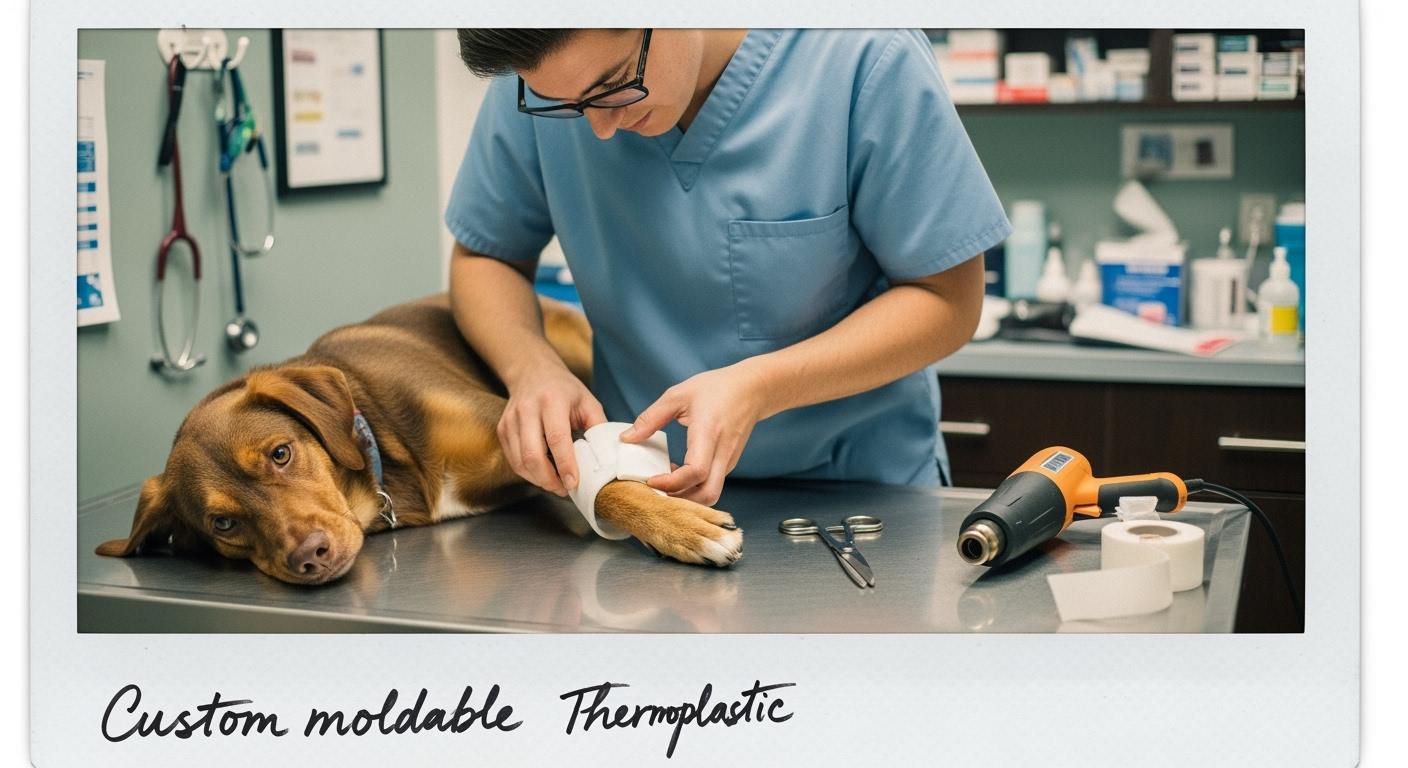
Imagine your canine patient needs immediate support after an injury. You reach for thermoplastic splints for dog braces and create a personalized solution in minutes. Personalized care means you mold splints that match each patient’s anatomy. Ongoing adjustments help maintain comfort, and custom bracing can support better recovery. Thermoplastic splints give veterinary teams a practical way to provide individualized orthopedic support at the point of care.
Key Takeaways
Thermoplastic splints offer personalized support for canine patients, allowing for immediate customization at the point of care.
These splints are remoldable, enabling adjustments as swelling changes, which enhances comfort and supports effective recovery.
Using thermoplastic splints improves workflow efficiency in veterinary clinics by eliminating long wait times and providing instant, tailored solutions.
Thermoplastic Splints Science
What Is Low-Temperature Thermoplastic?
You use low-temperature thermoplastic sheets to create personalized splints for each patient. These materials become soft and rubbery at 70–75°C (about 160°F), allowing you to mold them directly onto the patient’s limb. After cooling to room temperature, the splint hardens and provides rigid support. The table below highlights the key properties that make these splints ideal for veterinary orthopedics:
Property | Description |
|---|---|
Formability | Moldable when heated, rigid when cooled |
Activation Temperature | Softens at 70–75°C for 1–2 minutes |
Curing Time | Hardens in 3 minutes |
Weight Bearing | Supports weight after 15 minutes |
Reheating Capability | Remoldable for personalized adjustments |
Cutting Ease | Easily trimmed with scissors when warm |
Application Method | Cleaner than plaster, similar to traditional casting |
Glass Transition Temperature & Rigidity
You rely on the glass transition temperature to ensure the splint remains rigid at room and body temperatures. Low-temperature thermoplastics used for splints are selected so that they stay stable and “glassy” during everyday use, giving your patient consistent support. This property helps prevent unwanted softening or changes in rigidity once the splint is applied, making it more reliable for orthopedic use.
Radiolucency in Imaging
Radiolucency is a major advantage for personalized splints.
You can monitor bone healing in your patient with minimal interference from the splint material.
Unlike metal braces, thermoplastic splints generally create far fewer imaging artifacts.
This allows clearer X-rays and helps you track recovery progress with greater confidence.
Perforated Design & Breathability
Perforated thermoplastic sheets allow air circulation, keeping your patient’s skin healthy. Breathability reduces moisture buildup and skin irritation. You can offer personalized comfort and support, especially for long-term wear. These features also enhance proprioception and joint stability, helping your patient regain mobility faster.
Glossary:
Thermoplastic Splints: Heat-moldable, personalized orthopedic devices made from low-temperature thermoplastic materials. You use them for point-of-care customization, enabling additive corrections and personalized bracing for each patient.
Thermoplastic Splints for Dog Braces: Clinical Workflow
Instant Custom Fit Process
You can transform your clinical workflow with thermoplastic splints for dog braces. These splints allow you to create personalized support for each patient right at the point of care. You eliminate long wait times and avoid the delays of traditional casting or off-the-shelf braces. You heat the thermoplastic sheet to 160°F, mold it directly onto the patient’s limb, and watch it harden within minutes. This process gives you a custom fit that matches the patient’s anatomy and needs.
Thermoplastic splints can provide better support and comfort than generic, off-the-shelf options because they are molded directly to the limb. As swelling changes, you can adjust the fit so the brace remains effective throughout recovery. This approach provides immediate immobilization, which is often important for rehabilitation timelines. Custom thermoplastic splints for dog braces are typically used for short-term periods, often up to 2–3 months, and can be remolded as the patient’s condition evolves.
Tip: You can use thermoplastic splints for dog braces in combination with custom neoprene braces or custom orthotic braces for enhanced stability and comfort.
Step-by-Step Molding Guide
You follow a simple, efficient process to mold thermoplastic splints for dog braces:
Heat:
You immerse the thermoplastic sheet in hot water at 160°F (70–75°C) for 1–2 minutes. The material becomes soft and rubbery, ready for shaping.Mold:
You place the softened sheet onto the patient’s limb. You shape it to match the contours, ensuring personalized support. You trim the edges with scissors if needed. You can use GaitGuard’s pre-cut sheets for faster application.Cool:
You allow the splint to cool at room temperature. It hardens within 3 minutes, providing rigid, stable support. You check the fit and make sure the patient feels comfortable.Secure:
You attach the splint using straps or integrate it into GaitGuard’s Dog Protective Gear. The gear features a pre-sewn pocket designed to hold thermoplastic splint sheets, making the process even easier. You slide the splint into the pocket for a secure, personalized fit.
Note: You can use three-dimensional printing or 3d-printed prostheses for complex cases, but thermoplastic splints for dog braces offer instant customization and additive corrections at the point of care.
Remoldability & Adjustments
You gain a major advantage with thermoplastic splints for dog braces: remoldability. You can reheat and reshape the splint as the patient’s swelling changes or as healing progresses. This flexibility allows you to make cost-effective adjustments without replacing the entire brace. You save time and resources while maintaining personalized care.
You monitor the patient’s recovery and adjust the splint for better support. You can modify the fit, add padding, or reshape the splint to accommodate changes in anatomy. This capability supports a tailored rehabilitation process and improves patient outcomes.
Callout: Remoldable thermoplastic splints for dog braces help you respond quickly to changes in the patient’s condition, ensuring optimal healing and comfort.
GaitGuard’s Pre-Cut Sheets Solution
You streamline your workflow with GaitGuard’s pre-cut thermoplastic sheets. These sheets come in sizes that fit most patients, allowing you to select the right option and mold it instantly. You reduce preparation time and minimize waste.
GaitGuard’s Dog Protective Gear integrates seamlessly with thermoplastic splints for dog braces. The gear features a pre-sewn pocket for splint sheets, making application fast and secure. You can combine the splint with anti-licking gear, rehabilitation equipment, and the auxiliary lifting strap for comprehensive care.
The 3d spacer mesh technology in GaitGuard products enhances airflow and comfort, which is crucial for recovery.
You provide effective pressure relief, reducing the risk of sores and discomfort.
The gear is machine washable and quick-drying, ensuring hygiene during treatment.
The sandwich construction with a 3d pile creates micro-springs that distribute pressure evenly.
The 3d mesh allows air circulation, keeping wounds dry and supporting healing.
You promote a stable and hygienic environment for recovery.
Made with 4mm to 6mm 3d spacer mesh, the gear provides support without bulk.
You offer breathability and flexibility, enhancing comfort during daily activities.
You can use thermoplastic splints for dog braces with 3d-printed prostheses or three-dimensional printing for advanced cases. You achieve personalized customization and additive corrections, supporting better patient outcomes in veterinary orthopedics.
Tip: You can integrate thermoplastic splints for dog braces with other GaitGuard products, such as anti-licking gear, rehab gear, and the lifting strap, to create a complete recovery solution for your patient.
Custom Thermoplastic Splints vs. Traditional Bracing
Plaster, Fiberglass, and Off-the-Shelf Braces
You encounter several options in veterinary orthopedics when choosing bracing for your patient. Plaster casts, fiberglass splints, and off-the-shelf braces have served clinics for decades. Plaster casts offer rigid immobilization but lack adjustability and workflow efficiency. Fiberglass splints provide lighter support but often require more time for application and adjustments. Off-the-shelf braces deliver convenience but rarely match the personalized fit your patient needs.
Feature | Plaster Cast | Thermoplastic Splint | Fiberglass Splint |
|---|---|---|---|
Fit | Generic | Personalized | Generic |
Workflow Efficiency | Time-consuming | Point-of-care, fast | Moderate |
Adjustability | Low | High (remoldable) | Low |
Clinical Outcomes | Reliable, rigid | Personalized, adaptable | Reliable, lighter |
Unique Benefits & Limitations
With custom thermoplastic splints, custom braces, and custom orthotic braces, you can achieve a highly personalized fit. These options allow you to mold the device directly to your patient’s anatomy to improve comfort and acceptance. Because the material is remoldable, you can reheat and reshape the splint as swelling changes, making additive corrections simple and cost-effective. Some reports describe similar adjustment rates between thermoplastic splints and 3D-printed prostheses, highlighting how important customization is for achieving good clinical results.
You should consider limitations in clinical studies. Small sample sizes and homogeneity in dog size may affect generalizability. Some studies focus only on pressure changes, missing other mechanisms of injury. Real-world scenarios often differ from controlled measurements, so you must monitor your patient closely.
Recent veterinary practice shows that different thermoplastics work best for various patient sizes. You use thinner materials for small dogs and cats, thicker ones for larger breeds. You rely on custom thermoplastic splints for post-surgical recovery, trauma management, nerve compression relief, and chronic conditions. You use them for general stability, short-term immobilization, and when modifications are needed.
Common complications with traditional bracing include skin irritation, friction wounds, and brace slippage. You resolve most issues with adjustments or rest periods, but personalized splints reduce these risks.
Clinical Technology Glossary: Thermoplastic Splints
Term | Definition |
|---|---|
Thermoplastic splinting material | Material used to fabricate custom splints that can be remoulded for comfort and functionality. |
Immobilise joints | The primary function of splints to restrict movement in the affected area. |
Dynamic splints | Splints designed to increase range of motion while providing support. |
You use splints to immobilise joints, protect injuries, reduce pain, and allow functional activities.
You apply them for undisplaced fractures, to avoid or correct deformity, and as protective splints during exercise.
You select dynamic splints to increase range of motion when needed.
Tip: You can combine custom thermoplastic splints with custom neoprene braces, 3d-printed prostheses, and three-dimensional printing for advanced cases. This approach supports personalized care and optimal patient outcomes in veterinary orthotics.
You deliver personalized care with custom thermoplastic splints in veterinary orthopedics. These devices can improve patient comfort, may help speed up recovery, and support additive corrections over time. Training helps you master assessment and customization so that thermoplastic splints become a routine part of your toolkit. Explore GaitGuard’s personalized gear, custom neoprene braces, and 3D-printed prostheses to build flexible solutions for different cases. Stay updated on 3D printing, digital modeling, and eco-friendly material innovations to keep offering better personalized options for your canine patients.
FAQ
How do thermoplastic splints improve workflow efficiency in veterinary clinics?
By molding thermoplastic splints at the point of care, you can significantly improve workflow efficiency. You eliminate long wait times for external fabrication and customize support for each patient instantly, which streamlines your veterinary workflow.
Can you remold thermoplastic splints for a patient as swelling changes?
You reheat the splint at 160°F and reshape it for the patient as swelling changes. This additive correction makes splints a cost-effective option in veterinary clinical applications.
Are thermoplastic splints compatible with 3d-printed prostheses in veterinary printing?
You combine thermoplastic splints with 3d-printed prostheses. You use printing technology for advanced cases. You provide personalized patient care in veterinary orthopedics.
