
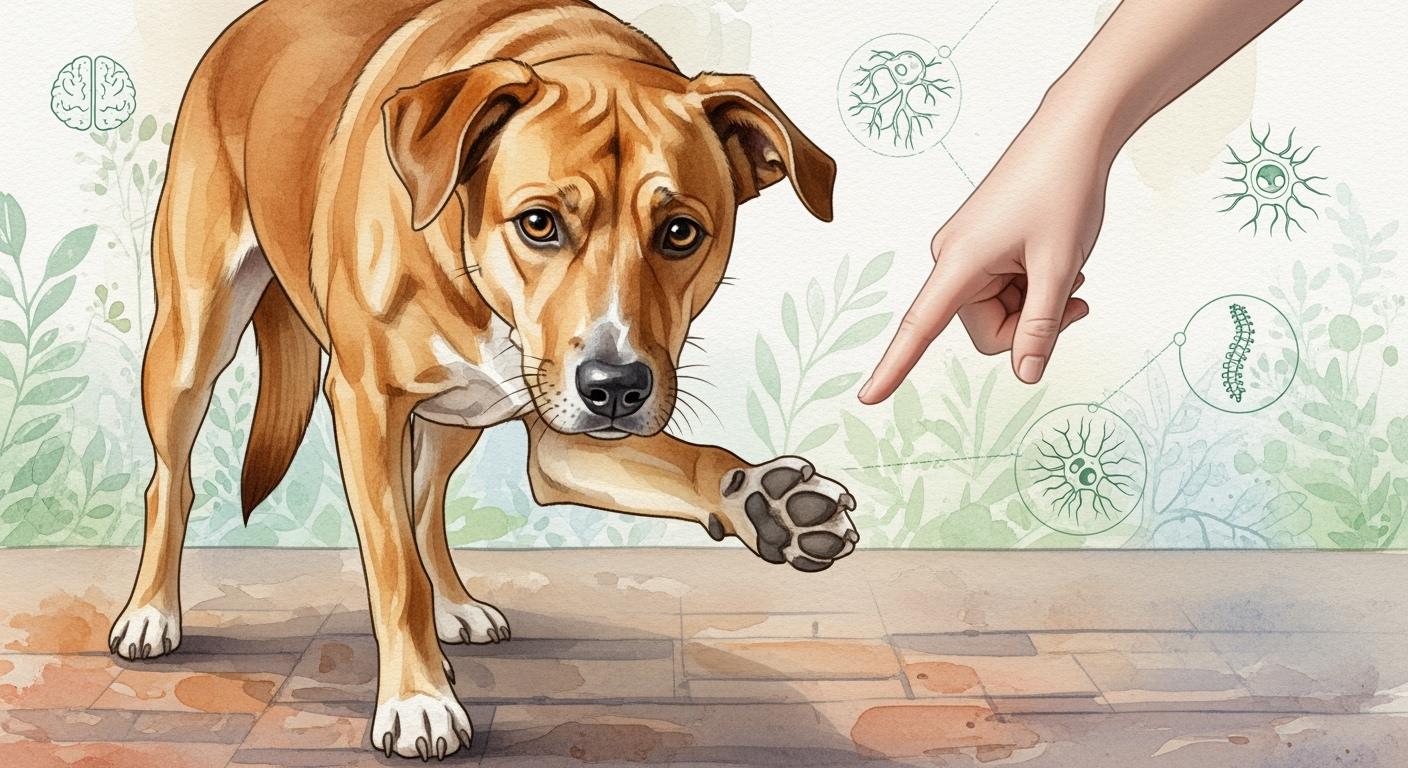
Dog knuckling paws means your dog’s paw flips so the top touches the ground instead of the pad. You may see your dog drag the paw or scuff the nails. This sign often shows up in dogs with nerve problems. Dog knuckling paws can warn you about serious issues. If you notice dog knuckling or changes in how your dog walks, you shoDog knuckling paws means the top of a dog’s paw turns under or drags against the ground instead of landing normally on the paw pad. Owners may notice scuffed nails, scraped paw tops, toe dragging, stumbling, or a dog that places one foot strangely during walks.
Knuckling can be mild and occasional, but it can also be an early sign of a neurologic, spinal, nerve, orthopedic, or paw-related problem. This article explains what dog knuckling paws can look like, which warning signs need a veterinarian quickly, how to record symptoms clearly, and how to reduce paw injury and slipping risk while waiting for professional guidance.
Key Takeaways
- Dog knuckling paws happens when the paw folds under, drags, or lands on the top instead of the pad.
- Scuffed nails, scraped paw tops, stumbling, leg weakness, or uneven paw placement should be taken seriously.
- Sudden inability to walk, severe pain, rapid worsening, paralysis, or bladder and bowel changes need urgent veterinary attention.
- Home care can protect paws and reduce slipping, but it should not be used as a substitute for diagnosis.
- Support gear may help protect the paw or make controlled handling easier, but it cannot treat the underlying cause of knuckling.
What Dog Knuckling Paws Looks Like
Dog knuckling paws can show up in different ways. Some dogs briefly place the paw upside down and then correct it. Others drag the toes for several steps, scrape the nails, or walk with the top of the paw touching the floor. A dog may also stumble more often, cross the back legs, or seem less aware of where the feet are placed.
This problem is often connected to body awareness, nerve signals, muscle control, pain, or joint stability. It does not always mean the same condition in every dog. That is why the first step is not to guess the cause, but to describe the pattern clearly and decide how urgent the situation looks.
Signs owners may notice
- One paw curls under while standing or walking.
- The top of the paw scrapes the floor.
- Nails become unevenly worn or scuffed.
- The dog stumbles, trips, or drags the toes.
- The dog crosses the back feet or walks in an unsteady line.
- The problem gets worse on smooth floors or when the dog is tired.
- The dog seems weak, painful, or reluctant to walk.
When you describe the problem to a veterinarian, be specific. Say which paw is affected, whether the change was sudden or gradual, whether it happens on every walk or only sometimes, and whether there are pain, bladder, bowel, or appetite changes.
Red Flags That Need a Vet Quickly
Knuckling should not be ignored when it appears suddenly or worsens quickly. Some cases involve pain, spinal cord compression, nerve changes, severe weakness, or another condition that needs prompt care. If the dog cannot stand, cannot walk, collapses, or seems painful, treat it as urgent.
Call your veterinarian or an emergency clinic if you notice:
- Sudden knuckling that appears without warning
- Rapid worsening over hours or a single day
- Inability to stand or walk
- Dragging the back legs
- Severe pain, crying, trembling, or guarding the back or limb
- Loss of bladder or bowel control
- Repeated falling or inability to get up
- Knuckling with fever, extreme tiredness, or major behavior change
While waiting for advice, keep the dog calm and limit movement. Use soft bedding, prevent slipping, and avoid stairs, jumping, rough play, or forcing the dog to keep walking. If the dog is large or painful, ask the clinic how to transport the dog safely before lifting.
Common Causes Your Vet May Check
Dog knuckling paws can come from several types of problems. Some are neurologic. Some involve the spine, nerves, muscles, joints, or paws. Puppies, adult dogs, senior dogs, and dogs recovering from injury may all show knuckling for different reasons.
Spinal and neurologic causes
Spinal conditions can affect how signals travel between the brain, spinal cord, and limbs. Intervertebral Disc Disease (IVDD), spinal inflammation, trauma, or other neurologic disorders may cause paw dragging, weakness, pain, or changes in bladder and bowel control. Sudden changes in walking ability should be checked quickly.
Degenerative or progressive conditions
Some older dogs develop progressive weakness, poor coordination, or back-leg dragging over time. Degenerative conditions may start subtly, with scuffed nails, mild hind-end weakness, or paw placement changes. These cases still need veterinary evaluation, because early records and safe handling can help guide care.
Peripheral nerve, orthopedic, or paw-related causes
Knuckling can also be linked to peripheral nerve injury, orthopedic pain, joint instability, paw wounds, muscle weakness, or altered weight bearing. In puppies, unusual paw placement may have different causes from senior dog knuckling, so it should not be handled with a one-size-fits-all plan.
If your current article previously included long breed, puppy, nutrition, or imaging discussions, keep those points brief. This page should stay focused on recognizing the symptom, understanding urgency, protecting the paw, and knowing when support gear is only temporary help.
What to Record Before the Vet Visit
A clear symptom record helps your veterinarian understand what changed and how quickly. A short phone video can be especially useful because many dogs walk differently at the clinic than they do at home.
Useful details to record
- Which paw or paws knuckle
- Whether the front legs, back legs, or all legs are involved
- When you first noticed the change
- Whether the problem started suddenly or slowly
- Whether it happens on all surfaces or mainly on slippery floors
- Whether the dog is painful, tired, weak, or reluctant to move
- Any bladder, bowel, appetite, or behavior changes
- Whether the dog recently slipped, fell, jumped, or had surgery
Do not try to repeatedly force a paw-position test at home. If you gently notice that the dog does not correct the paw position, write it down and let the veterinarian perform a proper neurologic exam.
What to Expect at the Vet
The veterinarian may watch the dog stand, walk, turn, and place the paws. They may check reflexes, pain response, limb strength, muscle loss, paw sensation, spinal pain, and whether the dog corrects abnormal paw placement. This helps narrow where the problem may be coming from.
Depending on the exam, the veterinarian may discuss imaging, lab work, medication, rest, rehabilitation, referral, or supportive equipment. Imaging decisions depend on the dog’s symptoms, urgency, pain level, and suspected cause. Avoid making the article sound as if one imaging tool is always best for every dog.
Safe Home Setup While You Wait for Guidance
Home setup should reduce slipping, paw scraping, and sudden movement. The goal is not to train through knuckling, but to protect the dog until the underlying cause is understood.
Reduce slipping and sharp turns
- Use non-slip rugs or runners on smooth floors.
- Block stairs unless your veterinarian allows stair use.
- Keep the dog in a smaller safe area if movement is unstable.
- Use a leash indoors if the dog rushes toward doors or food bowls.
- Remove clutter from the path between bed, water, food, and potty exit.
- Avoid slippery outdoor surfaces, steep slopes, and fast turns.
Protect the paw surface
Knuckling can scrape the top of the paw, wear the nails unevenly, and create small wounds. Check the paw after each necessary walk. Look for redness, cuts, swelling, heat, broken nails, damp skin, or hair loss from dragging.
Paw protection may help reduce scraping on some surfaces, but it must fit correctly. Loose booties, twisted socks, or poorly fitted supports can make slipping worse. Use protective items only when they improve safety and do not change the dog’s gait in a harmful way.
Support Gear: What It Can and Cannot Do
Support gear may help owners manage daily movement while a dog is being evaluated or treated. The right choice depends on the dog’s body part, weakness pattern, paw condition, size, and veterinary guidance.
The important boundary is simple: support gear can help with handling, paw protection, traction, or controlled movement, but it does not diagnose or fix the cause of dog knuckling paws.
| Support option | May help with | Risk if misused | Fit or use check |
|---|---|---|---|
| Rear sling | Hind-end weakness or short assisted movement | Chafing, poor balance, uneven lifting | Keep lift gentle and check belly contact areas |
| Full-body lift harness | Dogs needing more balanced support | Shoulder strain, rubbing, over-lifting | Adjust straps evenly and avoid sudden lifting |
| Paw protection booties | Scuffed nails, scraped paw tops, rough surfaces | Slipping, twisting, pressure marks | Check paw position and remove if gait worsens |
| Knuckling sleeve or sock | Mild paw dragging or supervised short use | Restricted circulation, rubbing, false confidence | Follow fitting instructions and inspect skin often |
| Traction socks | Indoor slipping on smooth floors | Tripping if loose or twisted | Use only if the dog walks more steadily |
Be careful with claims such as “relieves pain,” “maintains spinal stability,” or “prevents falls.” A better explanation is that support gear may make handling more controlled, reduce paw scraping, and improve traction in selected situations when it fits correctly.
For broader product planning, anatomical fit before mass production matters because rehab gear must match real movement, not just static measurements.
Skin, Paw and Brace Checks
Skin checks are not optional when a dog is dragging or knuckling. The paw top, nails, toes, wrist, hock, and strap contact areas can become irritated quickly if gear shifts or if the dog drags the paw repeatedly.
Check before use
- The paw is clean and dry.
- There are no open wounds under the gear.
- The support item sits straight and does not twist.
- The dog can stand without panic, falling, or obvious pain.
- The gear does not force the paw into an unnatural position.
Check after use
- Look for redness, heat, swelling, sores, damp skin, or hair rubbing.
- Check whether nail scuffing has increased.
- Watch whether the dog walks worse after the support item is removed.
- Stop use if the dog chews, resists, collapses, or becomes more painful.
Do not use a fixed Day 1 to Day 7 wear schedule unless it comes from the product instructions and the dog’s veterinary plan. Wear time should depend on fit, skin condition, comfort, diagnosis, and whether the dog is walking better or worse with support.
When Support Is Not Enough
Support gear should make necessary handling safer. It should not be used to delay care when symptoms are worsening. If the dog is suddenly weak, painful, unable to walk, repeatedly falling, or losing bladder or bowel control, home management is not enough.
Use this simple triage guide
| Situation | What it may mean | Action |
|---|---|---|
| Mild paw scraping that is stable | Needs evaluation, but not always emergency-level | Record video, protect the paw, and contact the vet |
| New knuckling with stumbling or weakness | Possible neurologic or mobility change | Call the vet the same day for guidance |
| Rapid worsening, severe pain, or repeated falling | Potential urgent neurologic or spinal problem | Keep the dog still and seek urgent veterinary care |
| Cannot stand, cannot walk, paralysis, or bladder changes | Emergency warning signs | Contact an emergency clinic immediately |
A clear symptom log, a short walking video, safe transport, and paw protection can help while you wait for care. They do not replace diagnosis.
B2B Product Notes: Avoid Overpromising Support Gear
For clinics, rehab providers, distributors, and private-label product buyers, the safest product communication is clear about limits. Support gear for dog knuckling paws should not be described as a cure for neurologic disease, IVDD, degenerative myelopathy, or other underlying conditions.
More useful product information includes fit range, contact areas, material softness, traction design, cleaning instructions, skin-check guidance, safe-use boundaries, and when owners should stop use and contact a veterinarian.
FAQ
What should you do first if you notice your dog knuckling?
Limit movement, prevent slipping, check the paw for scraping, record a short video, and contact your veterinarian for guidance. Sudden weakness, severe pain, inability to walk, or bladder and bowel changes should be treated as urgent.
Can knuckling in dogs get better with home care alone?
Do not assume home care is enough. Some mild paw protection and traction changes may reduce injury risk, but the cause of knuckling still needs veterinary evaluation.
How can you protect paw skin during knuckling?
Use non-slip surfaces, keep nails trimmed, check the paw tops after walks, avoid rough surfaces, and use booties or paw protection only if they fit well and do not make the dog slip or walk worse.
Should a dog wear a knuckling brace all day?
Not by default. Wear time should follow veterinary guidance and product instructions. Remove the support item to check skin, clean the gear, and prevent pressure problems. Stop use if rubbing, swelling, pain, or worsening gait appears.
Dog knuckling paws should be taken seriously because it can be a visible sign of a deeper movement or neurologic problem. The safest approach is to recognize the sign early, prevent paw injury, avoid slippery surfaces, record what changes, and get veterinary guidance before relying on support gear.
