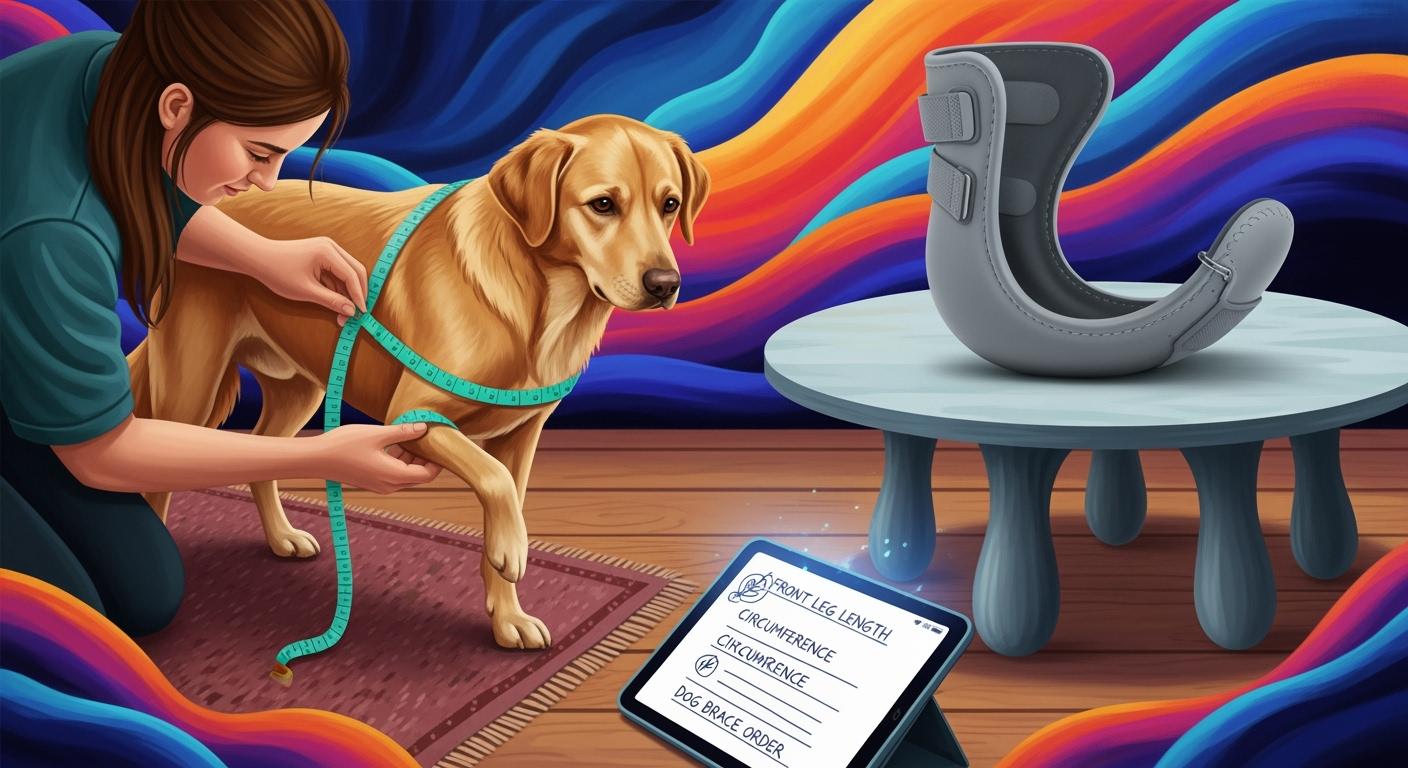
You want your dog to feel comfortable and supported. Dog brace sizing can seem tricky, but you can master it with the right steps. Accurate measurement may help your dog move better and recover safely. Gather a flexible tape measure, a camera, and some treats. Ask a helper to join you so your dog stays calm and steady.
Tip: Always measure your dog while standing on a non-slip surface for best results.
Key Takeaways
Getting the right measurements is very important for your dog’s comfort and movement. A brace that fits well can help your dog feel less pain and move better.
Always measure your dog when it is standing on a surface that does not slip. This makes sure you get the right measurements and do not make mistakes.
Use a soft tape measure and do not rush. Write down each measurement carefully. Take clear photos to help remember.
After you put the brace on, check how it fits. Make sure the straps are snug but not too tight. Look for any signs that your dog feels uncomfortable or has skin problems.
If your dog’s size is between two options, ask your vet or the brace company for help. This will help you pick the best size for your dog.
Why accurate measurement matters for dog brace sizing
Comfort and mobility benefits
You want your dog to walk, run, and play with less pain. Accurate measurements may help your dog brace fit well, which can support better movement and comfort. When you measure carefully, you give your dog the best chance to move naturally. A good fit may help reduce dog knee pain and joint pain. Dogs with knee problems often show more energy and balance when their brace fits right.
Researchers have studied how proper brace sizing affects dogs. The table below shows what they found:
Study | Findings |
|---|---|
Carr (2016) | Significant improvement in weight distribution after 90 days of brace use, indicating better mobility and pain reduction. |
Lee et al. (2021) | Owners reported improved mobility and comfort in dogs after brace fitting, highlighting the importance of proper fitting and veterinary support. |
Muršec et al. (2025) | Observed improved weight distribution and gait symmetry in dogs fitted with custom knee orthoses, supporting earlier findings on functional balance. |
You may notice your dog stands straighter and walks with less effort. These changes can make daily life easier for both you and your pet.
Risks of poor fit and sizing errors
If you guess your dog’s size or measure in a hurry, the brace may not fit well. A poor fit can cause new problems. Your dog may feel more dog knee pain or start to limp. Loose braces may slip or twist, which can lead to falls. Tight braces may rub the skin and cause sores. Dogs with knee problems need extra care, so always check the fit before use.
You may see redness, hair loss, or swelling if the brace does not fit. Watch for these signs and ask your vet if you have concerns. Careful dog brace sizing may help prevent these issues and support your dog’s recovery.
Prep and tools to measure your dog at home
Getting your dog in the right stance
You want your dog to stand comfortably before you begin. Place your dog on a non-slip mat or blanket. This may help your dog feel secure and prevent slipping. Make sure your dog stands with all four feet centered and weight evenly distributed. Gently guide your dog’s head into a neutral position. You can kneel in front of your dog or have a helper stand nearby to keep your dog calm. If your dog shifts or sits, pause and encourage a relaxed stance. A symmetrical posture may help you measure your dog more accurately.
Tip: Lift each limb gently if needed to help your dog stand squarely. Keep the head and neck relaxed for best results.
Essential tools and tape tension tips
Gather your tools before you start. You need a flexible soft tape measure, a phone camera for reference photos, and treats to reward your dog. Ask a helper to assist you. The flexible tape measure allows you to follow the shape of your dog’s body. This may help you avoid errors and get precise measurements. Use gentle tension—snug but not tight. You should be able to slide one finger under the tape. This method may help prevent irritation or slippage when you fit the brace. Proper sizing may help your dog move comfortably and get the support needed.
Flexible soft tape measure for accurate measurement
Helper to keep your dog steady
Treats to reward calm behavior
Phone camera for reference photos
Quick reference card for measuring
Use this quick reference card to guide you as you measure your dog. Clinic and retail staff may share this script with owners for home measurement:
Measurement Script:
“Let’s measure your dog together. Start with your dog standing on a non-slip surface. Make sure your dog stands squarely with weight on all four feet. Use a flexible tape measure and keep it level. Measure each limb separately. Record the numbers and take a photo for reference. If you notice swelling, write it down and check again later. Ask your vet if you have questions.”
Step | What to Do |
|---|---|
Prepare area | Use non-slip mat, gather tools, treats, helper |
Position dog | Stand squarely, head neutral, relaxed posture |
Measure | Use flexible tape, gentle tension, record left/right |
Take photos | Snap clear reference photos |
Record notes | Note swelling or special concerns |
Following these steps may help you measure your dog with confidence and accuracy.
How to measure your dog for a brace
Measuring your dog for a brace may seem challenging, but you can do it with the right steps. You want to help your dog get the best support possible. Follow this guide to collect accurate measurements and choose the right size.
Universal measuring steps for all brace types
Veterinarians recommend a clear process for measuring your dog. You can use these steps for any brace, including a well-fitted knee brace.
Prepare your tools and space
Gather a flexible soft tape measure, a phone camera, a helper, and treats. Choose a well-lit area with a non-slip mat.Position your dog
Ask your dog to stand with weight on all four feet. Make sure your dog’s head stays in a neutral position. A helper can keep your dog calm and steady.Take circumference and length measurements
Measure the thigh circumference: Wrap the tape around the upper thigh, about 1 inch below where the leg meets the body. Keep the tape snug but not tight.
Measure the knee circumference: Find the center of the knee joint and wrap the tape around this spot.
Measure the hock to knee length: Place the tape at the knee and measure down to the hock joint.
Measure the lower leg circumference: Find the spot halfway between the hock and the paw, then measure around the leg.
Note your dog’s weight and breed. Some braces use this information for sizing.
Record each measurement
Write down the numbers as you go. Do not guess or round up. Double-check each measurement for accuracy.Check for swelling or bandages
If your dog has swelling or wears a bandage, write this down. Measure again after swelling changes.Match your measurements to the product’s size chart
Use the numbers you recorded to find the best size on the manufacturer’s chart. If your measurements fall between sizes, ask your vet for advice.
Tip: Always measure your dog while standing. Measuring in a sitting or lying position may lead to errors because muscles and joints change shape.
Common mistakes to avoid
Guessing or rounding numbers
Using a stiff ruler instead of a soft tape
Measuring while your dog sits or lies down
Not double-checking your work
You can reduce errors by following each step and using the right tools.
Worked example: Measuring for a knee brace
Suppose you want to order a perfect knee brace for your dog. You measure the upper thigh and get 10 inches, the knee circumference is 7 inches, and the hock to knee length is 6 inches. The size chart shows:
Size | Thigh Circumference | Knee Circumference | Hock to Knee Length |
|---|---|---|---|
Small | 8–12 in | 6–8 in | 5–7 in |
Medium | 12–16 in | 8–10 in | 7–9 in |
Your dog’s numbers fit the small size. If one measurement is close to the next size, ask your vet before choosing. This may help you avoid a brace that is too tight or too loose.
Quick conversion example
If your dog’s thigh measures 10 inches, you can convert to centimeters using the quick reference card:
10 in x 2.54 = 25.4 cm
This helps if your product’s chart uses metric units.
Recording left vs right limb measurements
Dogs often have small differences between their left and right legs. You should measure both sides, even if you only need one brace. Write down each number and label it “left” or “right.” This helps you avoid confusion and ensures the brace fits the correct leg.
Having two people can make this step easier. One person can hold your dog steady while the other measures. If you order a pair of braces, use the numbers for each side. This may help your dog get the best fit and support.
Taking clear reference photos
Photos play an important role in the measuring process. You should take clear pictures of each measurement. Make sure the tape measure and the numbers show in the photo. Take the photo in a well-lit area. Show the entire leg in the frame.
You can also record a short video to check your dog’s leg alignment. These photos and videos may help you, your vet, or the brace company confirm the measurements. Good photos may help prevent mistakes and ensure the brace fits correctly.
Note: Clear and accurate photos may help verify your measurements. They also provide a record if you need to ask for help.
By following these steps, you may help your dog get a perfect knee brace that supports comfort and movement. Careful measuring, recording, and photo-taking may help you avoid common mistakes and support your dog’s recovery.
Dog brace sizing by brace type
Picking the right brace means you must know where to measure. Each brace type needs you to measure different spots on your dog’s body. Getting the right dog brace sizing can help stop fit problems and keep your dog comfy.
Knee brace measurement points
You need to check three main spots for a knee brace. These spots help you pick the best fit, especially for a custom knee brace.
Upper thigh circumference: Put the tape around the thigh, halfway between the groin and knee bend.
Circumference above the hock: Place the tape just above the hock joint.
Distance from thigh to hock: Measure along the outside of the leg, over the knee.
Always write down left and right sides. This step helps if your dog’s legs are not the same size.
Hock and carpal/tarsal brace measurements
For hock and carpal braces, you measure both around and along the leg.
Above and below the hock or carpus: Wrap the tape just above and just below the joint.
Length of the brace: Measure from the paw base up to the joint.
For splints, measure from the longest toenail to the end spot.
Dog brace sizing for these braces can help stop slipping or pinching.
Neck, shoulder, and hip brace measurements
Neck, shoulder, and hip braces use other spots for measuring.
Neck: Measure where a collar goes.
Shoulder: Measure from the ground to the top of the shoulder.
Hip: Measure around the thigh and from the shoulder to the thigh.
Some harnesses also need a chest measurement.
Comparison table: brace type, required measurements, common fit issues
Always look at your product’s size chart. Ask your vet if you are not sure.
Brace type | Measurements needed | Most common fit failure | Quick fix |
|---|---|---|---|
Knee (stifle) | Thigh, above hock, thigh-to-hock distance | Top strap loosening during movement | Recheck tension, adjust straps |
Hock/Ankle | Above/below hock, brace length | Brace slips down or rotates | Add padding, check snugness |
Carpal/Wrist | Above/below carpus, brace length | Pinching at wrist fold | Loosen slightly, add soft wrap |
Neck | Neck circumference | Too tight, restricts breathing | Choose next size up, remeasure |
Shoulder | Withers height, chest | Slides off or restricts movement | Adjust harness, check fit |
Hip | Thigh, shoulder-to-thigh | Rubs inner thigh or slips | Add padding, adjust straps |
If circumference is between sizes | If length is between sizes | What to do next |
|---|---|---|
Pick the bigger size | Pick the shorter length | Ask your vet or brace provider |
Add more padding if needed | Do not use braces past joints | Take new measurements after swelling goes down |
Dog brace sizing can help you get a brace made just for your pet. Careful measuring and checking can help you avoid common problems.
Fit-check and troubleshooting after measuring
Strap, skin, and movement checks
You want your dog to feel comfortable and safe in a properly fitting brace. After you put the brace on, check the straps first. You should fit one finger under each strap. This may help prevent rubbing and keep the brace secure. Look at your dog’s skin after removing the brace. Watch for redness, hair loss, or sore spots. These signs may show the brace is too tight or loose.
Let your dog take a few short, controlled steps. Watch for limping, toe dragging, or changes in walking. If your dog shows more dog knee pain, stops using the leg, or seems upset, remove the brace. Ask your vet before trying again.
Tip: If you see swelling, heat, or your dog tries to chew the brace, stop and call your vet.
What to do if measurements are borderline
Sometimes your dog’s measurements fall between two sizes. You want an accurate fit to help reduce dog knee pain and support healing. Follow these steps:
Compare your numbers with the sizing chart from the brace company.
If your dog is between sizes, contact customer service for advice.
Watch your dog closely during the first wear. Add padding if needed for comfort.
A properly fitting brace may help your dog move better and feel less dog knee pain. If you see any problems, ask your vet for help.
Printable fit-check checklist
Use this checklist each time you measure or try a new brace. Print or save it for easy reference.
Step | What to Check |
|---|---|
Strap check | One finger fits under each strap; no pinching |
Skin check | No redness, sores, or hair loss after removal |
Movement check | Dog walks without tripping or toe drag |
Comfort check | No signs of pain, limping, or chewing at brace |
Re-check later | Inspect skin and movement after 30–60 minutes |
If you notice pain, worsening lameness, or skin injury, stop using the brace and call your vet. Careful checks may help you spot problems early and keep your dog safe.
You are important for your dog’s comfort and healing. Measuring your dog the right way can help stop problems like skin sores or the brace not working. Write down your numbers and take good photos. If you are not sure, ask your vet or the brace company for help. You can also use online guides and tools to make things easier.
Check your measurements twice and take clear pictures.
Talk to your vet or the brace company if you have questions.
Use online help and guides for more support.
“A good fit helps the brace work with your dog’s body, not against it.” — Dr. Lisa Kramer, DVM
Getting ready and paying attention can help your dog heal, move well, and stay safe.
FAQ
How often should you re-measure your dog for a brace?
You should re-measure your dog if you notice weight changes, swelling, or after surgery. Dogs may change shape during recovery. Measuring again may help you choose the right size. Ask your vet if you are unsure.
What if your dog’s measurements fall between two sizes?
If your dog’s numbers fall between sizes, choose the larger size or ask the brace company for advice. Adding padding may help improve comfort. Always check the fit after the first use.
Can you use a regular ruler instead of a soft tape measure?
A soft tape measure works best. It follows your dog’s body shape and gives more accurate numbers. A ruler may miss curves and lead to mistakes. Use a flexible tape for best results.
Should you measure your dog while sitting or lying down?
Always measure your dog while standing. This position gives the most accurate results. Sitting or lying down may change muscle and joint shape, leading to errors.
What should you do if the brace causes redness or sores?
Remove the brace right away. Check your dog’s skin for irritation. Let the area heal before trying again. Ask your vet for advice before using the brace again.