
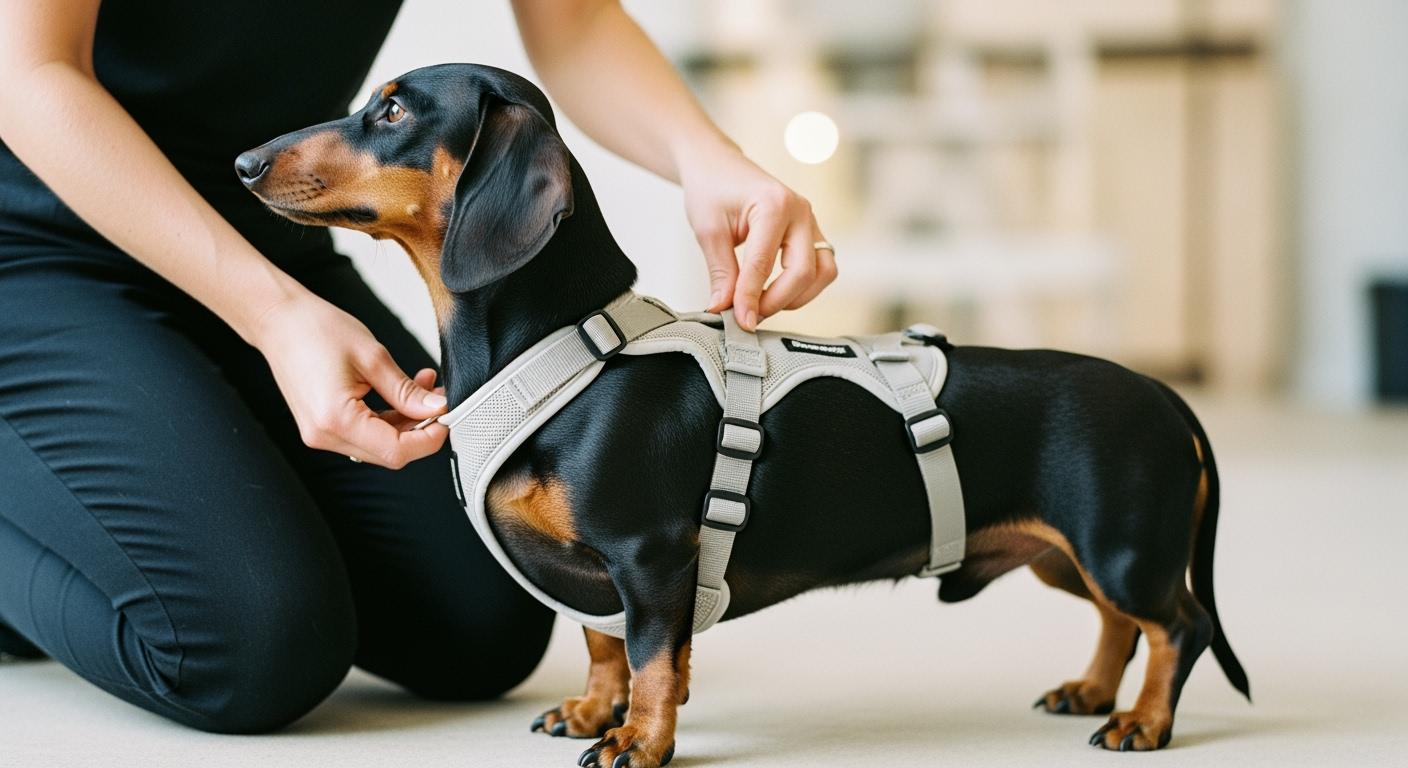
A dachshund IVDD support harness can help a handler steady, guide, or partially lift a dog during short, controlled movements. It does not repair a damaged disc, stabilize every part of the spine, or replace veterinary treatment. Its practical value depends on whether the harness matches the dachshund’s long torso, short legs, support needs, and current veterinary activity restrictions.
This guide focuses on the breed-specific fit questions that a general dog harness guide may miss: front-to-rear balance, panel length, low ground clearance, strap position near the armpits and abdomen, toileting access, and whether the lifting points keep the body level rather than tipping the chest or hindquarters.
Safety boundary: A harness is a mobility-assistance tool, not a diagnosis or treatment plan. A dog with sudden pain, worsening weakness, loss of coordination, or bladder or bowel changes needs prompt veterinary assessment rather than repeated harness adjustment.
Quick Answer: What Should a Dachshund IVDD Harness Do?
- Support the part of the body that actually needs assistance: front, rear, or both.
- Keep lifting force distributed across broad chest, belly, or pelvic panels rather than one narrow strap.
- Allow the handler to keep the long torso reasonably level during assisted standing or short transfers.
- Stay clear of the throat, armpits, genitals, and areas of irritated skin.
- Remain centered without twisting, rolling, or sliding toward the dog’s front or rear.
- Allow toileting without soaking or contaminating the support panel.
For a broader overview of IVDD movement support, crate-rest routines, and mobility tools for dogs of different body types, see the IVDD dog lift harness guide.
Why Dachshund Harness Fit Is Different
Dachshunds combine a long trunk with short limbs and relatively low ground clearance. That body shape changes how a support harness sits and how lifting force travels through the product. A design that works on a taller, shorter-bodied dog may place the front and rear support points too close together on a dachshund.
A long torso needs front-to-rear balance
If a harness lifts mainly under the chest, the hindquarters may remain low. If it lifts mainly under the abdomen or pelvis, the chest may tip downward. For dogs that need assistance at both ends, separate front and rear lifting points give the handler more control than a single handle positioned near the middle of the back.
The goal is not to make the spine perfectly rigid. The practical check is whether the dog can be steadied without visible sagging, abrupt tipping, twisting, or pressure concentrated at one edge of the harness.
Short legs reduce clearance for straps and panels
A belly panel that hangs too low can interfere with the front or hind legs, collect dirt, or shift during toileting. Leg openings that are too large may let the harness rotate. Openings that are too small may rub behind the elbows or along the inner thighs. Check the product while the dog is standing and while taking a few supervised steps, because a harness can appear centered at rest but migrate during movement.
Body length cannot be inferred from chest girth alone
Two dachshunds with similar chest measurements can have different torso lengths, rib-cage shapes, weights, and support needs. Chest girth is important, but it should not be the only measurement used when selecting a full-body support harness. Compare the manufacturer’s size chart with the dog’s chest girth, torso length, abdominal circumference, and the locations of the front and rear support panels.
Choose the Harness Type by the Support Task
| Harness type | Most relevant task | Main fit question |
|---|---|---|
| Walking harness | Leash attachment and guidance for a dog that can bear weight | Does it avoid throat pressure and remain clear of the armpits? |
| Rear-support sling or harness | Assistance for weak hind legs during standing or toileting | Does it stay behind the rib cage without sliding into the abdomen or genital area? |
| Front-support harness | Assistance when the front end needs help | Does the chest panel avoid the throat and allow shoulder movement? |
| Full-body lift harness | Balanced assistance when both front and rear support are needed | Can the handler control both ends without the long torso sagging or rotating? |
| Back brace | Trunk-support use considered under professional guidance | Is the goal trunk support rather than lifting? A back brace and lift harness are not interchangeable. |
Do not choose the most complex harness automatically. A dog that walks independently may only need a well-fitted walking harness for controlled leash guidance. A dog that cannot rise or balance without help may need front, rear, or full-body assistance selected with the veterinary or rehabilitation team.
Seven Structural Checks Before You Buy
- Front and rear lifting points: For full-body assistance, check whether the handler can support the chest and hindquarters separately. One center handle may not provide enough control for a long-bodied dog.
- Panel length: The product should reach the intended support zones without extending into the throat, armpits, groin, or tail base.
- Broad load-bearing surfaces: Wider padded panels generally spread handling pressure more evenly than narrow webbing placed under the abdomen.
- Independent adjustment: Chest, belly, and rear adjustments should be controllable separately. Tightening one strap should not pull the entire harness forward.
- Edge construction: Inspect seams, binding, hook-and-loop edges, buckles, and handle attachments for hard contact points.
- Toileting clearance: Confirm that the rear panel and leg openings allow urination and defecation without contamination.
- Low-profile hardware: Bulky buckles placed under the chest or close to the elbows can create pressure when a short-legged dog lies down.
Padding can improve contact comfort, but more padding is not automatically safer. Thick material can trap heat, bunch at the edges, or change the effective size. The better question is whether the padding stays flat, dries adequately, and avoids concentrated pressure during the intended use period.
How to Measure a Dachshund for a Support Harness

Use a soft measuring tape and keep the dog standing naturally if this can be done without forcing movement. Follow the selected manufacturer’s measurement landmarks rather than assuming every brand measures from the same points.
- Chest girth: Measure around the widest part of the rib cage, usually behind the front legs.
- Abdominal girth: Measure where the middle or rear support panel is intended to sit, not over the narrowest point unless the size chart specifically instructs this.
- Torso length: Measure between the manufacturer’s stated front and rear landmarks. Do not substitute a nose-to-tail or collar-to-tail measurement unless requested.
- Neck or lower-neck circumference: Use only when required for the front section of the chosen harness.
- Weight: Treat weight as a secondary check, not a replacement for body measurements.
Between sizes? Do not assume that choosing the larger size and tightening every strap will solve the problem. Excess panel length or oversized leg openings can still cause rotation. Ask the supplier which body measurement controls the size decision.
Step-by-Step Fit Check
- Open all adjustable sections first. Place the harness without pulling a tight opening over a painful or weak limb.
- Position the front panel. It should sit on the chest rather than pressing into the throat. Check that the front legs can move without the edge cutting into the armpits.
- Center the middle support area. The belly panel should lie flat and should not roll into a narrow band.
- Position the rear support section. Keep it clear of the genitals and confirm that it does not slide forward into the soft abdomen.
- Adjust left and right sides evenly. Uneven strap length can rotate the harness and change the lifting angle.
- Check contact with flat fingers. You should be able to inspect under the straps without forcing space. The common two-finger check is only a starting point; strap width, coat thickness, padding, and harness design affect what a secure fit feels like.
- Observe standing posture. Look for tipping, panel gaps, edge curling, twisted straps, or pressure under a buckle.
- Test only the movement allowed by the care plan. Watch a few controlled steps or a short assisted stand. Stop if the harness shifts, the dog resists, or movement worsens.
Signs the harness is too loose
- The body rotates inside the harness.
- The chest section slides toward the throat.
- The rear panel moves into the abdomen.
- Legs step through the wrong opening.
- The long torso visibly sags between the front and rear support zones during lifting.
Signs the harness is too tight or poorly positioned
- Edges press into the armpits, chest, abdomen, or inner thighs.
- The dog cannot take the permitted steps normally.
- Buckles or seams leave a distinct indentation.
- The dog pants, freezes, repeatedly turns toward the harness, or resists movement.
- Redness remains after the harness is removed.
For more detailed rubbing and pressure checks, use the dog harness chafing prevention guide.
Using the Harness for Potty Breaks and Short Transfers
Follow the veterinarian’s instructions for activity restriction and assisted movement. Do not use a harness as permission to add walks, stairs, swimming, or exercises that are not part of the care plan.
- Prepare a short, non-slip route before moving the dog.
- Attach the leash before opening the recovery area.
- Use slow, even assistance rather than sudden upward pulling.
- Keep the chest and hindquarters at a similar level when full-body support is required.
- Allow the dog to bear only the amount of weight approved by the veterinary team.
- Return the dog to the recovery area after the permitted task.
Do not lift by one handle unless the product is designed for it
A walking harness handle may be intended for brief guidance, not full-body lifting. Before lifting, confirm the product’s intended load path and whether both front and rear support points must be used. When carrying a dachshund by hand, support the chest and hindquarters rather than letting the long torso hang between them.
Skin, Coat, and Pressure Checks
Inspect the skin before and after use, especially behind the front legs, under the chest, along the abdomen, around the inner thighs, and beneath buckles or seam intersections. Long coats can hide early redness and can mat under damp or moving straps.
| Finding | Immediate response |
|---|---|
| Mild temporary coat flattening without skin change | Recheck strap position and continue close observation. |
| Persistent redness, repeated licking, or hair breakage | Remove the harness and reassess size, edge contact, moisture, and movement. |
| Swelling, broken skin, discharge, or an open sore | Stop use and contact the veterinary team. |
| Harness repeatedly shifts despite adjustment | Do not keep tightening. Recheck size and harness type. |
Do not deliberately rotate the harness to a different position each day. Support panels are designed to sit at specific anatomical zones. If the intended position creates repeated pressure, the fit, size, material, or product type needs review.
When a Harness Is Not Enough
A support harness cannot determine whether neurological function is worsening. Stop the movement attempt and contact a veterinarian promptly if the dog develops new or worsening:
- inability to stand or support weight;
- dragging, crossing, or loss of coordination in the limbs;
- yelping, trembling, guarding, or severe reluctance to move;
- loss of bladder or bowel control, difficulty urinating, or other elimination changes;
- rapid decline compared with the previous veterinary assessment.
If the hind legs are dragging or neurological signs have changed, review the dog dragging back legs safety steps and seek professional assessment rather than continuing a fit test.
Dachshund Harness Selection Checklist
- The harness type matches the actual support task.
- Chest, abdominal, and torso-length measurements match the supplier’s chart.
- Front and rear lifting points are far enough apart for the dachshund’s body length.
- Support panels are broad, flat, and clear of the throat and groin.
- The harness stays centered during the permitted movement test.
- The dog can toilet without the rear section becoming contaminated.
- Edges, seams, and buckles do not press into the armpits or abdomen.
- The product instructions clearly state whether handles are for guidance, partial lift, or full lift.
- The veterinary team has defined the allowed movement and level of assistance.
For a wider path across mobility support, braces, anti-lick protection, fit checks, and recovery scenarios, visit the Dog Recovery Support Guide.
For Pet Brands Evaluating Dachshund Support Harnesses
Breed-specific fit problems are also product-development problems. A dachshund-oriented range may need different torso-length grading, front-to-rear spacing, panel shapes, leg-opening proportions, and sample checks than a general small-dog harness. Pet brands evaluating material, sizing, strap-layout, packaging, or sample adaptation can review GaitGuard’s OEM/ODM pet orthotics project scope. This sourcing section does not change the consumer purpose of the guide; it provides a separate route for qualified product teams.
FAQ
Can a dachshund IVDD support harness stabilize the spine?
A lift or mobility harness is primarily used to guide, steady, or partially lift the dog. It should not be treated as a rigid spinal stabilizer. A back brace has a different purpose, and any support device used for a diagnosed spinal condition should be discussed with the veterinary team.
Is a rear sling enough for a dachshund with IVDD?
It depends on where assistance is needed. A rear sling may help a dog whose front limbs are stable and whose veterinary plan allows supported standing or toileting. A dog that needs help at both ends may require a full-body system with separate front and rear control.
Should the harness cover the entire dachshund’s back?
Not necessarily. Coverage should match the support task and the product design. More fabric does not automatically provide better spinal support. Check whether the panels contact the intended chest, belly, or pelvic zones without interfering with the legs, throat, abdomen, or toileting.
Can a dachshund wear the support harness all day?
Do not assume continuous wear is appropriate. Follow the product instructions and veterinary plan. Remove the harness for skin inspection and whenever unsupervised wear, sleeping, heat, moisture, or pressure creates a safety concern.
What if the harness fits the chest but is too short through the body?
Do not compensate only by loosening straps. The harness may use the wrong proportion for the dog’s torso. Look for a different size system or design that considers body length and front-to-rear support spacing as well as chest girth.
