
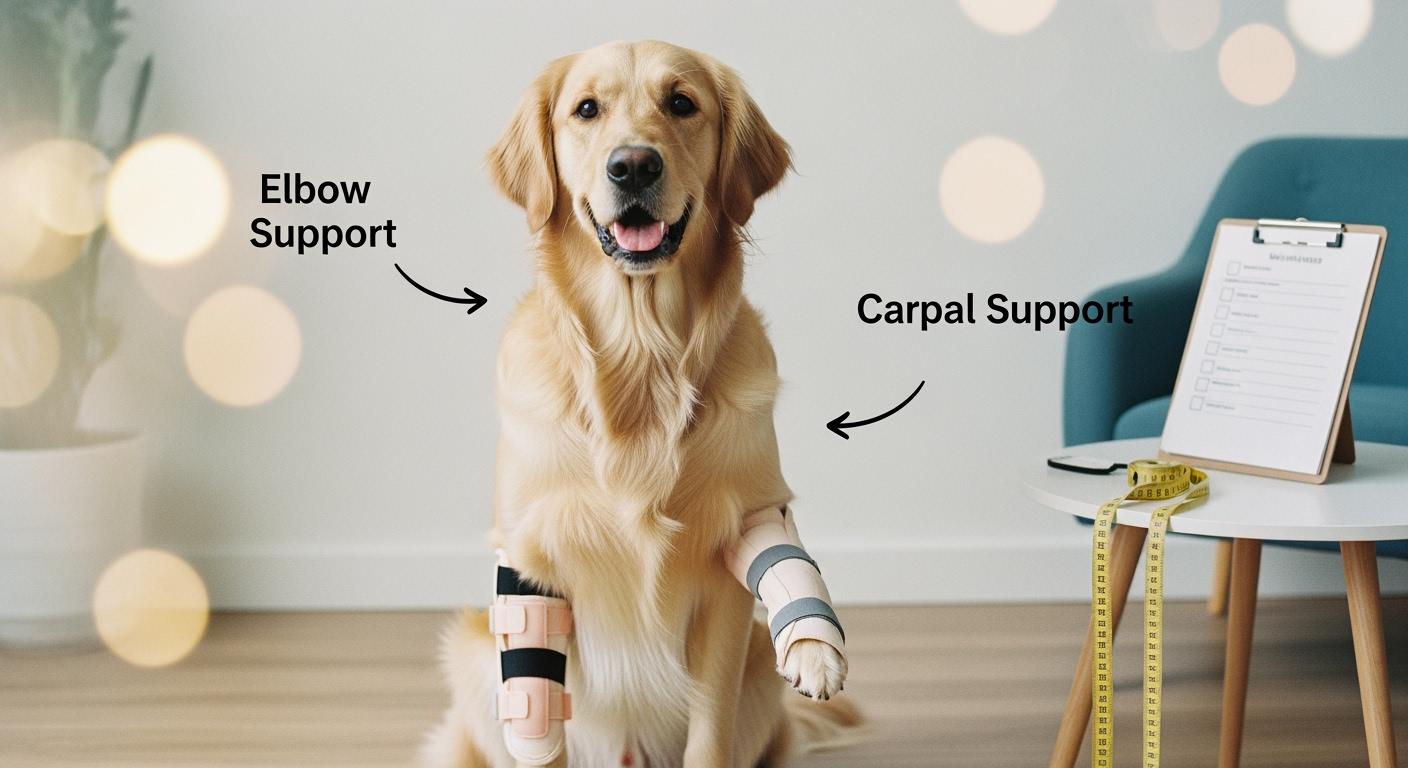
When comparing a dog front leg brace for arthritis elbow vs carpal, the main decision is which joint actually needs support and what movement problem the brace is supposed to improve. This article is for owners, clinics, and rehab-minded buyers who need to compare elbow support with carpal support before choosing a brace category. Read it to understand when elbow bracing usually makes more sense, when carpal support is the better match, and when to review condition-based support pathways before moving into product selection.
Choose elbow support when arthritis signs center higher in the front limb and elbow motion is the main problem.
Choose carpal support when wrist-level weakness, flat paw posture, or carpal instability is more obvious.
Diagnosis, gait pattern, and fit tolerance matter more than generalized “front leg pain” wording.
The better brace is the one that matches the affected joint, not the one that simply sounds more supportive.
Key Takeaways
Choose elbow support when the dog’s front-leg arthritis is centered at the elbow and upper front limb.
Choose carpal support when the wrist is weak, unstable, or flattening into the paw.
Fit, wear tolerance, and movement response decide whether the brace is actually helping.
Veterinary diagnosis should confirm which joint is driving the problem before brace selection.
Dog Front Leg Brace Arthritis: Elbow vs Carpal
The practical difference is simple: elbow braces are for elbow-driven front-leg arthritis patterns, while carpal braces are for wrist-driven instability or pain patterns lower on the limb. The right choice depends on where the dog is unstable, sore, or compensating during movement.
Elbow Arthritis in Dogs
Elbow arthritis usually shows up higher in the front limb and tends to affect how the dog bends, loads, and extends the elbow during walking, standing up, and lying down. In practical brace selection, elbow support becomes more relevant when the pain and stiffness are centered at the elbow rather than farther down toward the wrist.
Common signs of elbow osteoarthritis are:
Limping that seems to start higher in the front leg
Reduced elbow extension or stiffness after activity
Visible soreness or thickening around the elbow
Reluctance to play, lie down, or rise normally
An elbow brace is usually the better fit when the goal is to support the upper front limb, reduce elbow-area strain during movement, and make daily activity more manageable without shifting the problem to the wrong joint.
Carpal Arthritis in Dogs
Carpal arthritis affects the wrist region of the front leg and usually becomes more relevant in brace selection when the dog shows weakness, flattening, or instability lower on the limb. Carpal support is generally the better match when the movement problem is centered around wrist control rather than elbow motion.
Signs of carpal osteoarthritis are:
Wrist-level pain, weakness, or swelling
Flat paw posture or unstable-looking wrist movement
Limping or reduced willingness to bear weight on the front limb
Stiffness after rest with lower-limb compensation
A carpal brace is usually the better fit when the wrist needs more stability during standing and walking, especially if the dog shows weakness, flattening, or reduced control lower in the front limb.
Key Differences in Support Needs
The comparison is not about which brace is generally better. It is about which joint is actually driving the front-leg arthritis pattern and what type of support that joint needs during daily use.
Here is a quick look at symptoms and limits:
Joint Type | Symptoms and Functional Limitations |
|---|---|
Elbow Arthritis | Higher-limb pain, reduced elbow extension, reluctance to rise, elbow-area stiffness |
Carpal Arthritis | Wrist weakness, flat paw tendency, lower-limb instability, stiffness after rest |
When you pick a dog front leg brace arthritis elbow vs carpal, think about these things:
Support area: elbow braces support higher in the front limb; carpal braces support lower at the wrist.
Movement problem: elbow bracing helps when elbow motion is limited; carpal bracing helps when wrist stability is the issue.
Fit priority: the brace must match the affected joint precisely or support may be misapplied.
Wear tolerance: daily compliance matters because even the right brace category fails if the dog cannot tolerate it.
Decision rule: choose the brace by the joint that is functionally failing, not by the broad label “front leg arthritis.”
Choosing between elbow and carpal support is not just about the joint. You should think about how your dog moves, feels, and how the brace fits. The best dog front leg brace arthritis elbow vs carpal will fit your dog’s needs and help your dog move better.
Elbow Braces for Dog Arthritis
When to Use an Elbow Brace
Use an elbow brace when the arthritis pattern is clearly centered at the elbow and the support goal is to reduce upper front-limb strain during standing and walking.
Warning Sign | Description | Action Suggested |
|---|---|---|
Higher-limb limping | Limp appears to start near the elbow | Confirm elbow-focused support need |
Reduced elbow extension | Dog resists bending or straightening normally | Review elbow support options |
Elbow-area pain on motion | Joint-level soreness affects routine movement | Veterinary confirmation recommended |
Reduced activity willingness | Dog avoids play, rising, or front-leg loading | Track response before brace selection |
If these signs cluster around the elbow rather than the wrist, elbow support is usually the more relevant brace direction. For broader educational background after this section, continue through our Guides.
How Elbow Braces Work
Elbow braces give your dog support and help lower pain. The brace goes around the elbow joint and helps the upper front leg. This support lets your dog walk and stand with less pain. Elbow braces stop unwanted movement and protect the joint. You can use a brace during walks or when your dog rests. Your dog may need time to get used to the brace. Check the fit often to keep your dog comfortable.
Tip: Begin with short times wearing the brace and slowly increase as your dog gets used to it.
Pros and Cons of Elbow Support
Elbow braces have many benefits for dogs with arthritis. Studies show elbow braces are safe, affordable, and work well for mild or moderate cases. The table below shows the good and bad points:
Advantages | Disadvantages |
|---|---|
Supports upper front-limb stability during movement | Only useful when elbow is the true support target |
May reduce strain during daily walking and standing | Requires monitoring for fit and wear tolerance |
Can be practical for conservative support routines | Does not replace full veterinary management |
Elbow bracing is most useful when the support target is clearly elbow-specific and the brace can be integrated into a broader arthritis-management plan.
Carpal Braces for Dog Arthritis
When to Use a Carpal Brace
Use a carpal brace when the arthritis pattern is centered at the wrist and the support goal is to improve lower-limb stability during standing and walking.
Clinical Sign |
|---|
Knuckling or walking on the top of the paw |
Lameness or reluctance to bear weight |
Swelling or pain in the front leg wrist |
If wrist weakness, flat paw posture, or lower-limb instability are more obvious than elbow pain, carpal support is usually the stronger match.
How Carpal Braces Work
Carpal braces stop bad movements but let your dog walk. These braces keep the wrist steady and stop it from bending too far. Your dog gets help for weak parts in the joint. Carpal braces also lower pain by stopping moves that hurt and by giving gentle pressure.
Mechanism | Description |
|---|---|
Range control | Helps reduce excessive wrist motion during standing and walking |
Stability support | Adds external structure to a weaker wrist joint |
Load management | May reduce painful movement patterns at the wrist |
Main fit requirement | Must stay aligned at the carpal joint during repeated use |
When you move from diagnosis to product review, compare Products by support level, wrist alignment, and wear practicality.
Pros and Cons of Carpal Support
Carpal braces have many good points for your dog. They make the wrist steady and help lower pain from arthritis. Your dog may walk better and feel more at ease every day. Carpal braces are simple to use and can be worn during walks or rest.
Advantages:
Support for weak or unstable wrists
Pain relief for dogs with arthritis
Better movement and more confidence
Simple to put on and adjust
Considerations:
Your dog may need time to get used to the brace
You should check the fit often to stop rubbing or pain
Carpal braces do not take the place of your vet’s care. Always talk to your veterinarian before trying new support. For more help, visit the dog carpal brace guide and support pages.
Choosing the Right Dog Leg Brace

Identifying the Affected Joint
Start by identifying which joint is actually failing functionally. Elbow and carpal arthritis can both produce front-leg limping, but they do not point to the same brace category. Correct joint identification should happen before sizing, product comparison, or brace ordering.
Record for 7 days before changing brace type: where the limp seems to start, elbow extension tolerance, wrist stability, stair difficulty, weight-bearing quality, skin response under the brace, and whether movement improves or worsens with support.
Fit, Comfort, and Adjustability
Fit quality determines whether either brace category will remain useful. The brace should stay aligned to the intended joint, avoid pressure problems, and allow the dog to move without creating a worse compensation pattern.
Here are the most important factors for fit, comfort, and adjustability:
Accurate joint-specific measurement
Stable alignment at the elbow or wrist
Enough adjustability to maintain fit through swelling or routine changes
Material tolerance for repeated wear
Regular skin and gait checks during use
Fit check rule: if the brace stays wearable but no longer supports the correct joint effectively, it is still a brace failure.
Measuring Your Dog’s Leg
Measure the front leg based on the brace category you are actually considering. Elbow support and carpal support do not use the same measurement logic, so avoid generic leg-measurement routines that were designed for hind-leg or knee braces.
Steps to measure your dog’s leg:
Keep the dog standing naturally on a flat surface.
Identify whether the brace will target the elbow or the carpal joint.
Measure directly above and below the target joint.
Measure the circumference of the joint area if the product requires it.
Record the length of the support zone the brace needs to cover.
Double-check all numbers before comparing with the product sizing guide.
Measurement rule: measure for the target joint, not for the whole leg in general.
Use product-specific sizing guidance only after you have confirmed whether the case is elbow-driven or carpal-driven.
Veterinary Guidance
Veterinary guidance matters because elbow and carpal arthritis can look similar in early observation while needing different support categories. Diagnosis should come before brace type, and brace type should come before product selection.
Workflow tip: diagnose the joint first, then choose the brace category, then compare products.
If the joint direction is still unclear, compare the case first against the broader scenarios in our Solutions overview.
Tips for Successful Use
Introducing the Brace to Your Dog
Brace introduction should be gradual and structured. Start with short sessions, confirm fit and gait response, and extend wear time only if the dog stays comfortable and the brace remains aligned.
Confirm the brace is for the correct joint.
Begin with short supervised wear periods.
Watch gait, skin response, and tolerance immediately.
Increase wear time only if function remains stable or improves.
Monitoring Comfort and Mobility
Monitoring should focus on repeatable signals rather than general impressions. The useful questions are whether weight-bearing improves, whether the target joint looks more stable, and whether the dog is moving with less or more compensation under the brace.
Weight-bearing quality on the affected front leg
Change in limping or stride symmetry
Tolerance during walking and resting
Skin response after wear
Monitoring rule: a brace that stays on but does not improve function should be reassessed.
Common Mistakes to Avoid
The most common mistake is choosing elbow support for a wrist problem or carpal support for an elbow problem. The second most common mistake is assuming that any wearable brace is helping just because the dog tolerates it.
Choosing the wrong joint category
Using the brace without broader arthritis management
Ignoring skin checks and fit drift
Continuing use even when gait worsens
Common error: a front-leg brace that is still wearable is not automatically the correct brace for the actual joint problem.
The key difference between elbow and carpal support is joint location and movement problem. Elbow braces are usually the better fit when arthritis is centered higher in the front limb. Carpal braces are usually the better fit when the wrist is weak, unstable, or flattening during use.
For follow-up after this comparison, continue only to the most relevant internal paths: use Guides for educational background, Solutions for condition-based direction, and Products when the case is ready for brace evaluation.
Data authenticity note: This article is for educational purposes only. It is designed to help readers compare when elbow support is more appropriate than carpal support, and when carpal support is more appropriate than elbow bracing in dogs with front-leg arthritis. It does not replace veterinary diagnosis, imaging, individualized brace fitting, or a full arthritis-management plan.
FAQ
How do I know if my dog needs an elbow or carpal brace?
Watch where the movement problem appears to start. Upper front-limb pain or reduced elbow extension usually points toward elbow support. Wrist weakness, flat paw posture, or lower-limb instability usually point toward carpal support.
Can my dog wear a brace during walks?
Usually yes, if the brace is fitted correctly and the dog’s gait stays stable or improves. Walking with the brace should be monitored, not assumed to be beneficial automatically.
Should I ask my veterinarian before buying a brace?
Yes. Veterinary guidance helps confirm whether the arthritis pattern is elbow-driven or carpal-driven, which is the most important decision before brace selection.
Can a dog with front-leg arthritis need both elbow and carpal support?
Sometimes, yes. Multi-joint arthritis can affect more than one part of the limb, but the first brace decision should still focus on which joint is currently driving function loss most clearly.
When should a brace plan be reassessed?
Reassess when limping worsens, weight-bearing drops, skin irritation develops, or the brace no longer improves movement in a meaningful way.
